
18v vs 20v Max Power Tool Batteries: What Should You Buy?
This post contains affiliate links. As an Amazon Associate, we earn from qualifying purchases.
18V and 20V Max batteries run on the same 18-volt nominal electrical system. The difference is a marketing label, not a power gap. DeWalt’s “20V Max” refers to the initial, unloaded peak voltage of a five-cell lithium-ion pack, while “18V” from brands like Milwaukee or Makita states the nominal voltage that pack holds under load.
That sentence clears up the label confusion in under 50 words, but it leaves a lot unsaid. The real question in the 18v vs 20v max power tool batteries debate isn’t about volts; it’s about the battery platform you’re buying into for the next decade. Labeling conventions don’t change torque, but the ecosystem of tools available for your chosen battery does.
What follows is a breakdown of the cell-level math that proves the voltage equivalence in the 18v vs 20v max power tool batteries, a look at where performance actually differs, and a guide to picking a platform based on your real needs, not marketing numbers.
Key Takeaways
- The voltage labels are a naming convention, not a performance tier. Both 18V and 20V Max systems use five lithium-ion cells in series, resulting in a nominal working voltage of about 18 volts, though specific packs may vary slightly (e.g., 18V or 18.5V).
- Compatibility is mechanical, not electrical. A DeWalt 20V Max battery cannot physically connect to a Milwaukee M18 tool without a third-party adapter, which bypasses factory safety systems.
- Real power differences come from Amp-hours (Ah), cell technology, and motor design. A 5.0Ah high-output pack will outrun a 2.0Ah standard pack on the same tool, regardless of the “18V” or “20V” label.
- Platform depth matters more than the label. The number of tools available within a brand’s battery ecosystem (like Milwaukee M18 or DeWalt 20V Max) is a more important long-term investment than the two-volt naming difference.
- Adapters exist, but with caveats. They allow cross-brand use but may impact tool performance, void warranties, and pose safety risks due to mismatched electronics.
Voltage Math: The Simple Cell Arithmetic Behind the Labels
Strip away the plastic casing, and every modern 18V or 20V Max battery pack reveals the same basic architecture. It starts with a standard lithium-ion cell, which has a nominal voltage of about 3.6 volts. When fully charged and sitting idle, that same cell reaches a maximum voltage of 4.0 to 4.2 volts.
Manufacturers wire these cells in series, adding their voltages together. The standard for this class of tool is five cells.
A five-cell series connection yields 18 volts nominal (5 x 3.6V) and a maximum initial voltage of 20 volts. This isn’t opinion; it’s the basic electrical math confirmed by manufacturer disclosures. DeWalt states in its specifications: “Maximum initial battery voltage (measured without a workload) is 20 volts. Nominal voltage is 18.”
Here’s how that breaks down across major brands:
| Platform | Marketed Voltage | Nominal Voltage | Cells in Series | Convention Used |
|---|---|---|---|---|
| DeWalt 20V Max | 20V | 18V | 5 | Maximum Initial Voltage |
| Milwaukee M18 | 18V | 18V | 5 | Nominal Voltage |
| Makita 18V LXT | 18V | 18V | 5 | Nominal Voltage |
| Ryobi 18V ONE+ | 18V | 18V | 5 | Nominal Voltage |
The moment you pull the trigger on a tool, that “20V Max” reading disappears. The loaded circuit pulls the voltage down into the nominal range (approximately 18V), where it stays for the majority of the discharge cycle. This is why your drill doesn’t feel 11% more powerful just because the battery says 20V.
Where Sources Disagree: The 18V vs. 18.5V Nominal Nuance
While the “18V nominal” consensus is strong, the precise figure can vary slightly depending on the source and cell chemistry. The FACT SHEET highlights one such discrepancy.
This minor difference likely stems from the specific cell chemistry used (20700 cells in the 6.0Ah pack vs. Possibly 18650 or 21700 in others) and the exact point at which “nominal” is defined. For all practical purposes, tool operation, compatibility, and your experience at the workbench, treat them as the same 18V-class system. The half-volt is lost in the noise of motor draw and cable resistance.
The Real Performance Factors: It’s Not About the Two Volts
If the voltage label is a red herring, what does make one drill, saw, or grinder outperform another? The differences are tangible, but they live in the specs behind the label.
Amp-hours (Ah) are about endurance, not strength. This rating tells you the battery’s capacity, how long it can run before needing a recharge. A DeWalt 20V Max 6.0Ah pack has a nameplate capacity of 120 Wh. The larger pack won’t make your circular saw cut faster, but it will let you make more cuts before the battery dies.
Cell format and technology dictate power delivery. Modern packs use different cell types:
- 18650 cells are the traditional standard, found in many standard packs like the Milwaukee M18 CP2.0.
- 20700 or 21700 cells offer more capacity and current in a slightly larger package, used in higher-capacity packs.
- Pouch cells (like in some DeWalt Powerstack packs) or tabless cells (in Milwaukee M18 Forge packs) are advanced designs that reduce internal resistance, allowing for more power and faster charging with less heat.
Where this goes sideways: Choosing a battery based solely on its Ah rating. A 12.0Ah pack is overkill for a drill driver and makes it uncomfortably heavy. Match the capacity to the tool’s typical draw and your need for runtime.
The tool’s motor and electronics are the true power brokers. A brushless motor paired with smart electronics will extract more consistent torque and runtime from any battery compared to a cheaper brushed motor. This is why a premium DeWalt 20V Max XR brushless tool often outperforms a basic brushed tool, even when both are using the same 5.0Ah battery.
The Crucial Distinction: Voltage Label vs. Platform Depth
This is the decision that matters more than any spec sheet number. You’re not just buying a battery; you’re buying a ticket into a brand’s entire cordless ecosystem. The “18V vs 20V Max” question fades into irrelevance next to “Do I want DeWalt’s, Milwaukee’s, or Makita’s family of tools?” when you compare a 18v vs 20v max power tool batteries.
Platform depth refers to the sheer number of tools that share the same battery. Milwaukee’s M18 and DeWalt’s 20V Max platforms each offer a wide range of tools., from drills and impacts to lights, ratchets, and caulking guns, and they even power lawn equipment. Ryobi’s 18V ONE+ system is legendary for its breadth on a budget. This is the real long-term value.
Your first battery-powered drill commits you. Future tool purchases become far more cost-effective if they’re “bare-tool” only, requiring no additional battery or charger. Stepping outside your chosen platform means starting a whole new, expensive collection.
Easy to miss: The battery technology within a platform is evolving faster than the tools. Today’s high-output batteries deliver more power than packs from five years ago. Choosing a platform with a strong track record of backward compatibility, like DeWalt’s 20V Max system, protects your investment.
Can You Use a 20V Max Battery on an 18V Tool? The Adapter Question
The short answer is electrically yes, mechanically no, unless you use an adapter. Since both systems are 18V nominal, there’s no electrical mismatch. The barrier is the physical connection. A DeWalt 20V Max pack slides onto a rail; an old DeWalt 18V stem pack slots up into a handle.
Adapters bridge this physical gap. DeWalt sells an adapter to let 20V Max batteries run older 18V tools. Third-party adapters go further, claiming compatibility across brands like Makita to DeWalt.
Here’s the trade-off: While adapters work, they introduce potential issues. They can impede communication between the battery’s and tool’s onboard electronics, disabling low-voltage protection or temperature monitoring. This can lead to over-discharging the battery (killing its lifespan) or even a safety risk. Tool warranties almost certainly don’t cover damage caused by a non-OEM adapter.
For the occasional, careful use to finish a job, an adapter can be a lifesaver. For daily professional use, it’s a risk. You’re better off investing in the native battery platform for your most-used tools.
The High-Voltage Landscape: Where 20V and 40V Are Truly Different
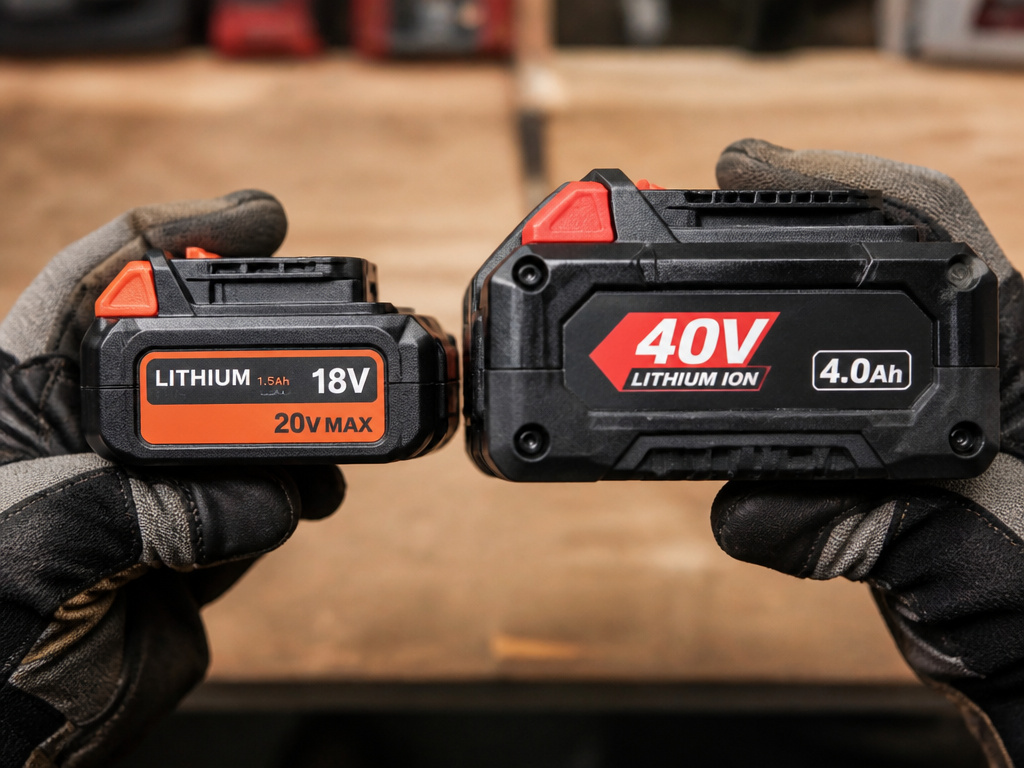
The “18V vs 20V Max” debate exists within a single voltage class. When you step up to a higher class, the differences are real and substantial. This is where the 20V vs 40V comparison becomes meaningful.
Platforms like DeWalt FlexVolt or Makita 40V XGT use a different cell configuration, often ten cells in series instead of five. This genuinely doubles the nominal voltage to 36V or 40V. This higher voltage allows for more powerful motors, enabling tools that rival corded performance, like large-angle grinders, concrete saws, and commercial lawn equipment.
Within a single brand, these systems are often distinct. To access the full 60V potential, you need both a FlexVolt battery and a FlexVolt tool. This layered compatibility adds flexibility but also complexity to your purchasing decisions.
Sizing Up Your Needs: A Quick Decision Guide
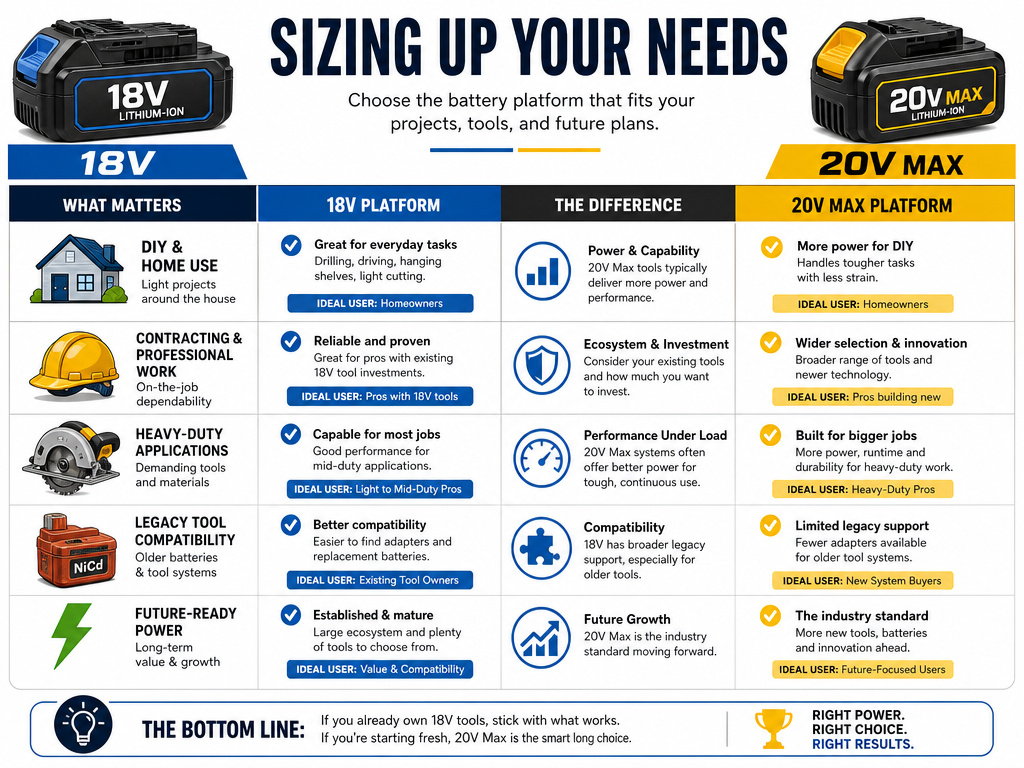
Cut through the noise. Your choice should hinge on your use case, not the voltage label. Use this table to steer your thinking.
| Your Primary Use Case | Recommended Starting Point | Why It Fits |
|---|---|---|
| Home DIY / Occasional Projects | Ryobi 18V ONE+ or a value 18V/20V Max kit | Massive tool variety, excellent value, sufficient power for 95% of home tasks. |
| General Contracting / Frequent Use | Milwaukee M18 Fuel or DeWalt 20V Max XR Brushless Kit | Best balance of pro-grade durability, performance, and expansive tool lineup. |
| Heavy-Duty / High-Demand Tools (Saws, Grinders) | Platform with High-Output batteries (M18 HO, 20V Max XR) | Sustained power delivery is critical; standard batteries will sag and overheat. |
| Legacy Tool Owner (Old 18V NiCd tools) | Brand-specific adapter (e.g., DeWalt DCA1820) | Economical way to modernize old tools with new lithium batteries. |
| Starting from Scratch, Want Maximum Future Power | DeWalt FlexVolt or Makita 40V XGT platform | Commits you to a higher voltage class capable of powering the largest cordless tools. |
You need both, but within the 18V class, the pressure is essentially identical.
Frequently Asked Questions
Are 18V and 20V batteries the same?
Electrically, for power tools, yes. Both labels describe a battery pack with five lithium-ion cells in series, resulting in an 18-volt nominal operating voltage. The “20V Max” label refers to the higher, initial voltage reading when the battery is fully charged and not under load.
Is it okay to use a 20V battery on an 18V tool?
Not directly, due to incompatible physical connections. However, using a manufacturer-approved adapter (like DeWalt’s for its own tools) is generally safe. Third-party adapters that mix brands can work but may bypass safety features and void warranties, so they’re best for temporary or emergency use only.
Is there a big difference between 18V and 20V drills?
Not because of the voltage label. The perceived difference comes from other factors: brushless vs. Brushed motors, the Ah rating of the included battery, and the quality of the tool’s gearing and electronics. A high-quality 18V brushless drill will outperform a basic 20V Max brushed drill.
Why did DeWalt discontinue 18V?
DeWalt phased out its old 18V NiCad (nickel-cadmium) stem-type battery platform to transition to a superior, more powerful lithium-ion system. The new “20V Max” slide-pack platform offered longer runtime, more power, no memory effect, and a lighter weight. They kept the “20V” name for marketing distinction in North America.
Before You Go
The “18V vs 20V Max” question is a solved puzzle. The two-volt gap is a paperwork difference, not a workshop one.
Your real decision is a platform decision. It’s about which battery fits the broadest range of tools you’ll actually need over the next five years. For most people building a home workshop, that means picking an ecosystem, be it the 2Ah vs 5Ah power tool battery options within Ryobi, the raw power of Milwaukee’s M18 Fuel line, or the sheer breadth of DeWalt’s 20V Max system, and sticking with it.
Invest in the platform first, then in the high-output power tool batteries that match your heaviest tasks. And if you’re nursing along old tools with adapters, just know the trade-off: convenience today for potential battery wear tomorrow. Sometimes, the right upgrade is a new tool that speaks your battery’s native language.
