
What Tools Come in a Power Tool Combo Kit: Kit Deep Dive
This post contains affiliate links. As an Amazon Associate, we earn from qualifying purchases.
A power tool combo kit bundles a drill driver with other cordless tools like an impact driver, reciprocating saw, circular saw, work light, and sometimes a multi-tool, all sharing a common battery platform and including at least one charger and two batteries. The exact mix depends on the kit size, brand, and price, but the value lies in the shared battery system, not in getting every tool you’ll ever need.
That shared battery is the real product. The tools are almost secondary. A kit locks you into an ecosystem, so the first tool you buy decides the brand of the twentieth. A common question is what tools come in a power tool combo kit. What follows is a breakdown of the seven tools you’ll find in most kits, the specs that actually matter on the box, and a frank look at what you’re really buying: convenience now versus flexibility later.
Key Takeaways
- The drill driver is the universal anchor, but an impact driver is what separates a basic kit from a useful one, its hammering action drives screws without stripping heads.
- Kit battery ratings are deceptive; a 2.0 Ah battery paired with a drill is light and agile, but a circular saw will drain it quickly.
- Reciprocating saws in kits are often compact, around 11 inches long, designed for pruning and demolition in tight spaces, not for felling trees.
- Charger speed is never advertised. Black & Decker states their chargers take 3-5 hours; a “rapid” charger might cut that to an hour, which changes your workflow entirely.
- What’s not included costs you extra: no kit includes a full set of drill bits, saw blades, sanding pads, or the safety glasses mandated by the ANSI Z87.1 standard printed in the manual.
The 7 Core Tools That Define a Kit
You’ll find these seven tools, in various combinations, across nearly every major brand’s lineup. Their form might change, but their function defines the kit.
A basic 12V or 20V Max cordless combo kit centers on a drill/driver and impact driver for fastening, adds a reciprocating saw and circular saw for cutting, includes an LED worklight for visibility, and may feature an oscillating multi-tool for detail work, all powered by shared lithium-ion batteries and a single charger.
1. Drill/Driver (The Anchor)
Every kit has one. It’s your hole-maker and screw-driver. But look past the chuck. The clutch settings, 20+1 on the Bosch PS31 12V Max, for example, are what prevent you from over-driving screws into drywall. The two speed ranges (0-350 RPM and 0-1,300 RPM on that same drill) let you drill slowly with large bits or drive screws quickly. This is the tool you’ll use first and most often.
Where the kit version disappoints: It’s usually the base model. You get a keyless chuck and a basic clutch, not the all-metal geared chuck or hammer-drill function you’d find on a bare tool you buy separately. For drilling into masonry, you’ll need to buy a hammer drill attachment or a different tool altogether.
2. Impact Driver (The Workhorse)
If the drill is for precision, the impact driver is for persuasion. It uses a rotational hammering action to sink long screws and lag bolts without straining your wrist. Kits that skip this are starter sets for very light duty. A proper kit includes an impact driver. You’ll know it by the hex collet that accepts quick-release bits, not a chuck.
The guttural rattle it makes is the sound of work getting done. It’s the tool you reach for when assembling a deck, building a fence, or mounting anything substantial. Without it, you’re using a drill for jobs it wasn’t designed for, and you’ll burn out the motor or strip screws.
3. Reciprocating Saw (The Destroyer)
This is your pruning and demolition saw. Kit versions like the Bosch PS60 12V Max Pocket Reciprocating Saw are compact, 11 inches long, and lighter than their corded cousins. They’ll cut through PVC, tree limbs, and drywall, but they’re not for precision work. Stroke rates can hit 3,000 per minute, which is fine for quick cuts but can feel brutal on your hands during a long job.
4. Circular Saw (The Cutter)
Including a circular saw marks a kit as meant for real projects. It’s for cross-cutting lumber and sheet goods. Kit saws often have a compact blade and can cut through a 2×4 in a single pass. The catch is battery life. A 2.0 Ah battery provides limited runtime for a circular saw; for building a deck, you need a larger capacity battery, which is often sold separately.
Common mistake: Assuming the included blade is good for anything. It’s usually a generic combination blade. For clean cuts in plywood or hardwoods, you’ll buy a dedicated finishing blade before your first project is done.
5. LED Worklight (The Illuminator)
It seems like a throw-in, but the Bosch GLI12V-300 worklight makes a huge difference in a dim garage or under a sink. The Bosch GLI12V-300 provides 3 hours of runtime per battery amp hour, so a 2.0 Ah battery gives you six hours of light. It’s cordless, magnetic, or has a hook, and it often has a swivel head. You’ll use it more than you think.
6. Oscillating Multi-Tool (The Detailer)
This is the tool for plunge cuts, scraping, and sanding in tight corners. It vibrates a blade back and forth at high speed (8,000–18,000 OPM on tools like the Benchmark 20V Max model). Kits might include one or two basic blades. To use it effectively, you’ll immediately need to buy a set of specialized blades for cutting, scraping, and sanding, another hidden cost.
7. The Battery and Charger (The Beating Heart)
The tools are useless without them. A standard kit includes two batteries and a charger. The battery voltage (12V Max, 20V Max) defines the platform. The capacity, measured in Amp Hours (Ah), defines runtime. A 2.0 Ah battery is light; a 5.0 Ah battery is heavy but lasts longer.
| Battery Spec | What It Means for You | Typical Kit Inclusion |
|---|---|---|
| Voltage (e.g., 12V Max) | Defines the power platform. Higher voltage generally means more power for tougher tools. | Kit-defining. All tools in the kit share this voltage. |
| Capacity (e.g., 2.0 Ah) | Runtime. A 2.0 Ah battery has less energy than a 5.0 Ah battery. | Usually two 2.0 Ah batteries in entry kits; larger Ah batteries are upgrades. |
| Charger Speed | How fast it refuels a drained battery. Rarely advertised. | Often a standard charger (3-5 hour charge time). “Rapid” chargers are a premium feature. |
Chargers have their own specs. The Benchmark 12V Max cordless rotary tool charger, for instance, takes an input of 120 V AC, 60 Hz and outputs 12 V DC, 1.5 A (maximum). A 1.5 amp output is a slow charge. If you have two batteries and one charger, a slow charger means downtime.
Beyond the Core: Specialized Kit Additions
As kits grow in size and price, manufacturers add more specialized tools to justify the cost and lock you deeper into their system.
Jigsaws and Rotary Tools
A jigsaw is for curved cuts in wood and thin metal. Kit jigsaws like the Benchmark 20V Max model have a stroke length of 3/4 inch and can cut 3-3/16 inches into wood. A rotary tool (like a Dremel) is for grinding, carving, and polishing. The Benchmark 12V Max cordless rotary tool spins up to 25,000 RPM and includes collets for different bit sizes (1/8″, 3/32″, 1/16″). These are valuable for detailed work but are not daily drivers for most.
Blowers, Trimmers, and Outdoor Tools
Some kits bridge into lawn care, adding a leaf blower or a string trimmer. These are high-drain tools. The battery that runs your drill for an extended time might run a high-drain tool like a blower for a much shorter period. It’s a clever way for a brand to sell you on a larger, more expensive battery.
Easy to miss: These outdoor tools often have different temperature tolerances. The BLACK+DECKER manual warns not to store or use the tool and battery where temperatures reach 105°F (40°C), like in a shed in summer. An indoor drill battery isn’t rated for that.
Decoding the Specs: What Matters and What’s Hype
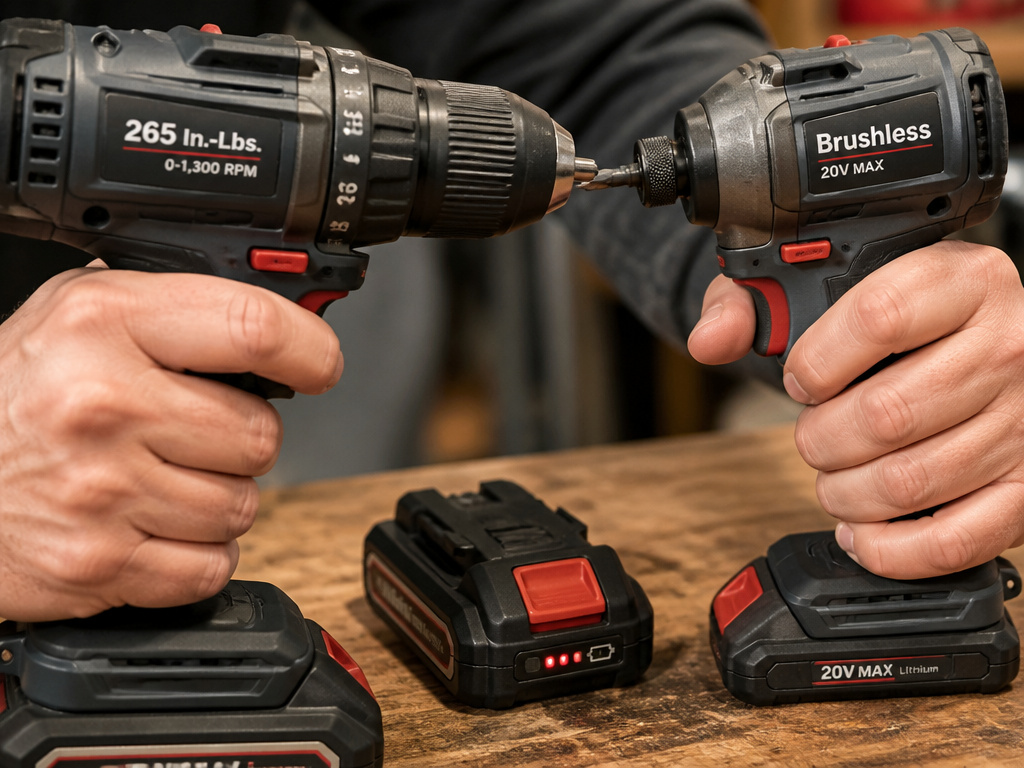
The box is covered in numbers. Only a few affect your work.
Torque (In.-Lbs.): This is twisting force. The Bosch PS31 drill delivers 265 In.-Lbs. Of max torque. That’s enough for most drilling and driving. For an impact driver, you want high torque to drive lag bolts.
Speed (RPM, SPM, OPM): Revolutions (or strokes) per minute. Higher isn’t always better. A drill’s 0-1,300 RPM high-speed setting is for driving; its 0-350 RPM setting is for drilling with control. A saw’s 3,000 SPM is for aggressive cutting.
Brushless vs. Brushed Motor: A brushless motor is more efficient, runs cooler, and lasts longer because it has no physical brushes that wear out. It’s a sign of a better-built tool. A brushed motor is cheaper and will eventually wear out, often signaled by a burning smell and sparking from the vents.
The part nobody mentions: “20V Max” is a marketing term for the initial battery voltage. The nominal voltage, what the tool runs at under load, is 18V. It’s the same platform. “12V Max” tools have a nominal voltage of 10.8V. Don’t get hung up on the “Max.”
What’s NEVER Included (The Hidden Cost)
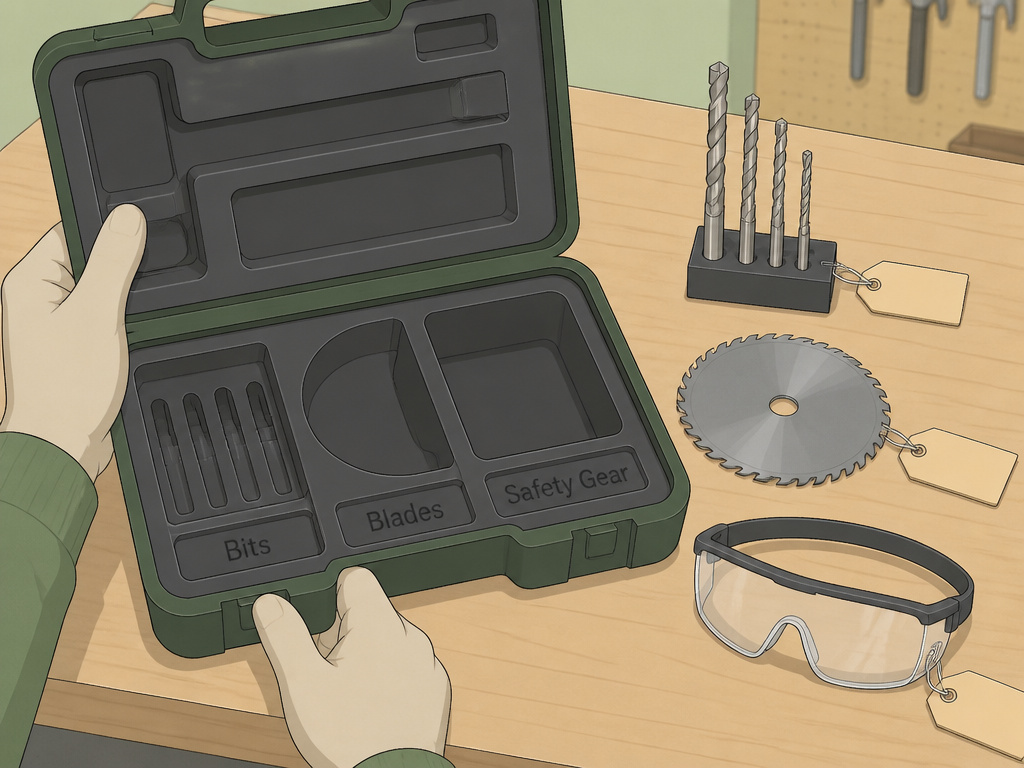
The kit gives you the tool bodies. You supply the consumables and safety gear. This is where the real spending starts.
- Drill Bits & Driver Bits: You get zero. You’ll need a basic set of twist bits for wood/metal and a set of impact-rated driver bits.
- Saw Blades: The reciprocating saw might include one blade. The circular saw might include one generic blade. You’ll need pruning blades, wood-cutting blades, and fine-tooth blades for metal.
- Sanding Pads & Attachments: An oscillating multi-tool may include a sanding pad, but no sandpaper. You buy that separately.
- Safety Gear: This is critical. Manuals like the Benchmark multi-tool manual insist you always wear safety goggles (not glasses) that comply with ANSI safety standard Z87.1. The kit does not provide them. Hearing protection and a dust mask are also your responsibility.
Building a functional workshop from a kit means budgeting extra for these essentials.
Kit Deep Dive: The Bosch 12V Max 3-Tool Example
Let’s look at a real kit, the Bosch GXL12V-310B22. It contains the PS31 Drill/Driver, the PS60 Pocket Reciprocating Saw, and the GLI12V-300 Worklight, plus two 12V Max 2.0 Ah batteries and a charger.
The total weight is low, the drill is about 2 lbs, making it a good kit for overhead work or all-day use. The drill’s 20+1 clutch and two-speed gearbox are professional features. The saw’s compact size is a genuine benefit for plumbing or electrical work under a sink.
Where this kit falls short for a homeowner: No impact driver. For building anything substantial, you’ll want one. That means either buying it as a bare tool later (locking you further into Bosch’s 12V system) or realizing you need a different kit entirely. This is the “kit mentality” trap: you buy a kit for the saw and light, but you really needed a drill and impact driver.
Common mistake: Choosing a kit based on the number of tools alone. A 6-tool kit with brushed motors and one slow charger is often a worse value than a 3-tool kit with brushless motors and a rapid charger.
Building Your Own Kit vs. Buying a Boxed Set
Here’s the trade-off in a nutshell.
| Approach | Pros | Cons | Best For |
|---|---|---|---|
| Buying a Pre-Packaged Combo Kit | Immediate discount vs. Buying tools separately. One warranty start date. Everything matches. | Contains tools you may not need. Often includes lower-tier “kit-only” tool versions. Locks you into one brand’s ecosystem. | First-time buyers, gift-givers, or those who need a baseline set right now and will supplement later. |
| Building Your Own Kit (Buying Bare Tools) | You choose only the exact tools you need, at the performance level you want. You can mix brands. You buy batteries optimized for each tool. | Higher upfront cost per tool. More complex warranty management. Requires research to ensure battery compatibility if staying within a brand. | Experienced users replacing tools, or those with a specific project list who know a circular saw is essential but a multi-tool is not. |
My stance has always leaned toward building your own. You end up with better tools and the right batteries. But I’ve also seen the analysis paralysis that causes. Sometimes, a 5-tool brushless kit is the right catalyst to just start building.
Safety & Maintenance: The Manuals Don’t Lie
The paperwork in the box is not filler. It contains essential rules for keeping the tools, and you, working.
Battery Care is Non-Optional:
- Charge Temperature: BLACK+DECKER specifies the best performance comes from charging between 65°F and 75°F (18°-24°C). Do not charge below +40°F (+4.5°C) or above +105°F (+40.5°C).
- Recharge Promptly: “Recharge discharged batteries as soon as possible after use or battery life may be greatly diminished.” Letting a battery sit dead damages it.
- Storage Charge: For longest life, do not discharge batteries fully. The manual recommends recharging after each use.
Tool Longevity:
- Avoid Abrasive Dust: The Benchmark jigsaw manual warns that extended work on fiberglass, wallboard, or plaster accelerates wear on bearings and motor brushes because the dust is highly abrasive.
- Keep It Clean: “Do not allow brake fluids, gasoline, petroleum-based products, penetrating oils, etc. To come into contact with plastic parts.” They can dissolve or weaken the housing.
- Use an Outdoor-Rated Extension Cord: When working outdoors, use an outdoor-rated cord marked “W-A” or “W”.
These aren’t suggestions. A battery charged in a hot shed will fail sooner. A saw used to cut drywall all day will wear out faster. The manuals tell you this; most people don’t read them.
What is typically included in a 5-tool or 6-tool kit?
While the specific answer to what tools come in a power tool combo kit varies by brand, most larger kits build on a core set. You’ll almost always find a drill/driver and an impact driver. From there, kits add tools for cutting and sawing. A reciprocating saw is common for demolition and pruning, and a compact model like the Bosch PS60 12V Max is just 11 inches long. A circular saw or jigsaw is often included for making straight or curved cuts in wood. The final slot might be a worklight for illuminating your project or an oscillating multi-tool for detail sanding and plunge cuts. These kits come with multiple batteries and a charger to keep you working.
What kit is best for a DIYer versus a contractor?
The right kit depends on how hard you’ll push your tools. For a homeowner tackling occasional repairs and small projects, a compact kit with a drill, impact driver, and maybe a reciprocating saw is a great start. Look for a system with a three-year or five-year limited warranty. A contractor needs tools built for daily use and abuse. They require more power, longer runtime, and durability. Their kit should include a high-torque drill, a robust impact driver, and saws capable of all-day cutting. Battery care is critical for professionals: recharge batteries soon after use and avoid fully discharging them for the longest life. Always use the charger and battery packs specified by the manufacturer for safety.
Frequently Asked Questions
What is the most common tool in a power tool combo kit?
Drill/driver is in every single kit. It’s the foundational cordless tool. The second most common is an impact driver, which is what turns a basic set into a functional one for building.
Is a hammer drill better than a regular drill in a kit?
For most DIY tasks, no. A hammer drill adds a pounding action for drilling into masonry or concrete. If you’re not installing anchors into brick or block regularly, a standard drill/driver is lighter, cheaper, and perfectly adequate. Kit drills are rarely hammer drills unless specifically advertised as such.
How many batteries should a good combo kit have?
At least two. One battery powers a tool while the other charges. For kits with high-drain tools like circular saws, the included 2.0 Ah batteries are insufficient; look for kits that include at least one higher-capacity battery (4.0 Ah or 5.0 Ah) or plan to buy one separately.
Can I add tools from the same brand but a different kit later?
Yes, this is the core promise of a battery platform. You can buy “bare tools” (tool only, no battery) that run on the batteries and charger you already own from your initial kit. This is how you intelligently expand your combo kit over time by adding bare tools.
What’s the difference between brushed and brushless motors in a kit?
Brushed motors have physical carbon brushes that transmit electricity to the motor armature; they wear down over time, reducing power and eventually needing replacement. Brushless motors are electronically controlled, more efficient, run cooler, and last longer. A kit with brushless tools is a sign of a higher-quality, longer-lasting set.
The Bottom Line
A power tool combo kit isn’t a complete workshop. It’s a starter system built around a shared battery. You get a drill, an impact driver, maybe a saw or two, a light, and the crucial batteries and charger.
Look past the power tool combo kit pros and cons of sheer tool count. Judge a kit on the quality of its weakest tool and the suitability of its battery setup for your actual projects. If you only need a drill, buy a drill. If you’re facing a deck rebuild, a kit with a robust drill, impact driver, and circular saw, and a serious battery, makes sense.
The smart move is to see a kit as a down payment. It gets you into an ecosystem. Your future tool purchases, the bare tools you buy one at a time, are where you build the workshop you actually need. Choose that first kit battery platform as carefully as you choose a spouse. You’re going to be with it for a long, long time.
