
How to Prevent Rust on Power Tools: The 3-Layer Defense
This post contains affiliate links. As an Amazon Associate, we earn from qualifying purchases.
To prevent rust on power tools, you must control three things: the humidity around the metal, a physical barrier on the surface, and manufacturer-mandated storage conditions for batteries and motors. Skipping any one invites corrosion, but mastering all three locks it out for good.
That control splits into a dry environment, a coated surface, and a correct storage posture. Humidity is the catalyst; a dehumidifier or silica gel tackles it. The coating is the shield, wax, oil, or a commercial inhibitor like Boeshield T9. Storage is the final lock, dictated by your tool’s manual: batteries at a partial charge, motors blown clean, and metal lightly oiled. This isn’t vague advice. It’s the sequence that works on a Skil chainsaw, a Foredom flex shaft, and a Bosch cordless saw. Understanding how to prevent rust on power tools is key to this process.
What follows breaks down each layer, compares the coatings head-to-head, and gives you a seasonal checklist for the how to prevent rust on power tools question you can run this weekend. You’ll know which method fits your garage, which to skip, and the exact steps manufacturers demand.
Key Takeaways
- Control humidity first with a dehumidifier or silica gel, moisture in the air is the primary reactant in rust formation.
- Apply a physical barrier; for most DIYers, paste wax on surfaces and a light machine oil in crevices offers the best balance of protection and clean-up.
- Follow manufacturer storage specs, especially for batteries (charge levels vary by brand) and carbon brushes (check every 2–6 months), these override generic advice.
- Never spray WD-40 or oil into motor vents or switches; it attracts dust and creates a conductive, gummy paste that can short components.
- Clean tools before coating them; any dirt or sawdust left under wax or oil traps moisture and accelerates corrosion.
The 3-Layer Defense: Dry, Coat, Store Correctly
Rust needs three things: iron, oxygen, and water. You can’t change the first two, so you attack the third. The defense is a stack: pull moisture from the air, seal the metal from the air that remains, and then store the tool according to its specific engineering.
A dry environment is non-negotiable. High humidity provides the electrolyte for the electrochemical reaction of rust. Silica gel packs or a small dehumidifier can lower humidity inside a sealed cabinet, effectively pausing the process.
The first layer in how to prevent rust on power tools is environmental. Sawdust is hygroscopic, it pulls moisture from the air and holds it against your tools. A clean shop is a dry shop. If your tools live in a garage or shed, a GoldenRod type dehumidifier or abundant silica gel desiccant packs are a better investment than any magic spray. This isn’t about making the air comfortable for you; it’s about making it hostile to corrosion.
The second layer is the barrier. This is where most articles stop, but they treat all tools the same. A table saw cast iron top and the intricate gears inside a cordless drill impact driver need different solutions.
Which Protective Coating Actually Works for Power Tools?
You have four realistic options, each with a job. A clean, dry tool is the mandatory starting point for all of them.
| Coating Method | Best For | Application Notes | Risk If Done Wrong |
|---|---|---|---|
| Paste Wax (e.g., Johnson’s) | Large, flat surfaces (saw tables, joiner beds) | Apply thin, buff completely dry. | Un-buffed wax collects sawdust, creating a wet, abrasive paste that scratches the surface. |
| Light Machine Oil (3-In-One) | Gears, bearings, bare metal in enclosed spaces | Wipe on, wipe off excess. Leaves a micro-film. | Over-application runs onto plastics, attracts dust, and can degrade rubber seals over time. |
| Commercial Inhibitor (Boeshield T9) | Complex tools (drill chucks, saw blades) & salt-air environments | Spray on, let dry to a waxy film. Excellent displacement. | Can be expensive over many tools; the aerosol propellant is flammable. |
| VCI (Vapor Corrosion Inhibitor) | Long-term storage in sealed containers (toolboxes, cases) | Emitter tabs or paper placed near tools. Works through air. | Useless in open, drafty spaces; protection fades once the sealed container is opened. |
Paste wax is the default for a reason. It’s cheap, easy, and it makes your tools work better. The wax layer reduces friction, so wood slides smoothly. The trick is the buff. If you can still see a whitish haze, you didn’t buff enough. That residue will grab sawdust and hold moisture against the metal.
Light oil is for the places wax can’t go: inside the chuck of a drill, on the threads of a vise screw, or on the non-coated saw blades that Bosch specifically calls out for protection with a thin layer of acid-free oil. Remember to wipe it off before the next use, or it will stain your workpiece.
Common mistake: Soaking a tool in oil. A thin film displaces water; a thick one runs onto grips and into switch housings, attracting every bit of dust in your shop into a sticky, conductive mess. A rag should come away nearly clean.
Commercial inhibitors like Boeshield T9 are essentially sophisticated waxes in a carrier fluid. They penetrate better than paste wax and are fantastic for salt-air environments or protecting saw blades. They dry to a touch-dry film.
VCI products are your set-and-forget option for the toolbox you won’t open for six months. They emit a corrosion-inhibiting vapor that coats all metal surfaces evenly, perfect for that set of wire brush attachments you only break out once a year.
Power Tool Specifics: It’s Not Just Surface Rust
A hand plane only needs surface protection. Power tools have vents, brushes, and electronics. Here’s what changes.
Corded Tools & Motors: Carbon dust is the enemy. After heavy use, use compressed air to blow out the motor vents. For tools like the Skil SPT55-11 chainsaw, the manual directs you to check and clean carbon brushes every two to six months. Brushes caked in dust arc, overheat, and wear the commutator faster. It’s maintenance that prevents both rust and motor failure.
Cordless Tools & Batteries: This is where manufacturer advice diverges, and you must follow the label on your battery.
- Husqvarna states to charge batteries to 30% to 50% before long-term storage.
- Greenworks, however, advises that for prolonged storage (three months or longer), the battery should be removed and then fully charged before next use.
The takeaway? There’s no universal rule. Check your manual. The Bosch professional manual warns that leaving a battery in a hot car, for example, can push it outside the permitted storage temperature range, accelerating deterioration.
Flexible Shaft Tools (e.g., Foredom): These have a unique need: grease. The Foredom service manual specifies using their MS10006 grease and cleaning the shaft every 50 hours of use, with a deep clean every 200 hours. A dry, dirty shaft doesn’t just rust; it overheats and snaps.
The Step-by-Step Seasonal Storage Routine
This is the “how” for the 95% of tools you won’t touch until next season. It combines all the layers.
- Clean Thoroughly: Remove all dust, pitch, and debris. For grease-heavy tools like chainsaws, Skil advises cleaning thoroughly before storing. Use a dry brush or rag, never hose down a tool. The Makita hedge trimmer manual explicitly warns against washing shear blades in water, as it causes rust.
- Dry Completely: Let the tool sit in a warm, dry area for a few hours. The Makita manual notes a risk of malfunction due to freezing if any moisture is trapped inside before winter storage.
- Apply Protectant: Choose based on the tool:
- Saw Tables/Joiner Beds: Paste wax.
- Saw Blades/Drill Chucks: Light oil or Boeshield T9.
- Gears/Bearings: A drop of light oil.
- Prepare the Battery: Consult your manual. Charge to the specified level (often 30-50%), then remove it from the tool.
- Store Intelligently: Keep the tool in a dry place. Skil directs you to store the saw in its stand indoors, in a dry place, and away from corrosive agents like garden chemicals. Don’t store an oily tool on a finished wood surface.
How to Use WD-40 on Power Tools
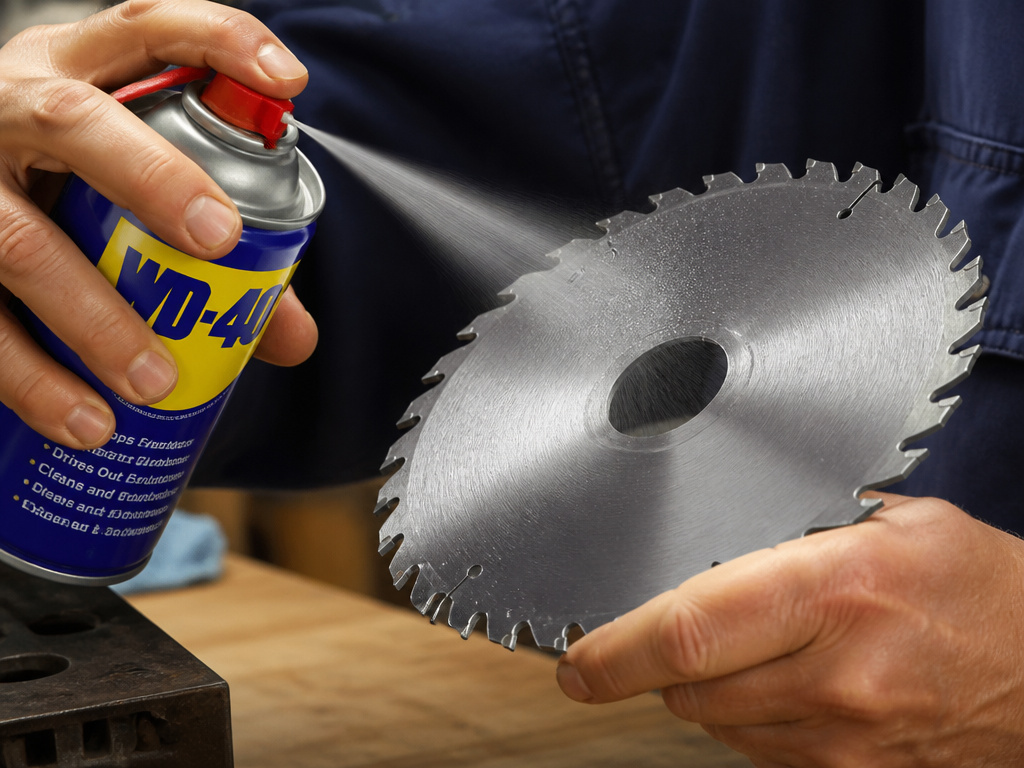
It creates a thin, non-greasy film that pushes moisture off metal surfaces. For application, spray a light coat directly onto clean, dry tool surfaces, especially on bare metal parts like saw blades or drill chucks. Wipe away any excess to avoid attracting dust. Its role is debated because the film is not a long-term, heavy-duty protectant; it can dry out or be wiped away with handling. It’s best suited for short-term protection or as a supplementary step after a thorough cleaning and before a more durable coating is applied for extended storage.
FAQ
Does WD-40 prevent tools from rusting?
WD-40 is a water-displacer and light lubricant, not a long-term protectant. For long-term storage, use a dedicated protectant like wax or a commercial corrosion inhibitor.
What is the best oil to use on tools to prevent rust?
For general use, a light machine oil. For tools that will contact wood, use an acid-free oil (like camellia oil) to avoid staining. For manufacturer-specific applications, like the Foredom flexible shaft, you must use the specified MS10006 grease, substitutes may not hold up to the heat and torque.
Can I use vinegar to remove rust before protecting tools?
You can, but with caution. Household vinegar is a weak acid that dissolves rust. However, on precision tools or plated surfaces, it can cause pitting if left on too long or not neutralized perfectly with a baking soda solution.
What tools are most prone to rust?
Cast iron surfaces (table saw tops, joiner beds), uncoated steel saw blades, and any tool with tight crevices that trap moisture (wrenches, pliers). Cordless tool battery terminals can also corrode if stored in a damp environment.
How often should I reapply protectants?
Reapply protectants as needed when you see the metal losing its sheen or feeling bare to the touch. If you see the metal losing its sheen or feeling bare to the touch, it’s time.
Before You Go
The one rule that reframes everything: rust prevention is a system, not a product. Buying a $20 can of protectant and spraying it over dirty tools in a damp shed is a waste of money. The sequence, clean, dry, coat, store correctly, is what works.
Stick to the manufacturer’s script for batteries and motor care. That’s the system. Everything else is just a variation on those three layers.
And the first step starts the moment you put a tool down. Wipe it off before you walk away. That single habit does more than any annual ritual.
