
How to Lubricate Power Tools: The 3-Step Process
This post contains affiliate links. As an Amazon Associate, we earn from qualifying purchases.
Lubricating a power tool means matching three things: the moving part (gears, bearings, or a chain), the correct OEM-specified lubricant (grease or oil), and a clean, measured application. Missing any one burns out motors, strips gears, or clogs oil pumps within weeks.
The numbers in those OEM manuals aren’t suggestions. A Bosch router bearing needs grease after approximately 300-400 hours of operation or at every second brush change. A Foredom handpiece needs a drop of oil every single hour of continuous use. Knowing how to lubricate power tools correctly is critical. Spray the wrong stuff into the wrong place, and you’re not maintaining the tool, you’re signing its repair bill.
What follows is the breakdown every manual assumes you’ll just know: how to read a grease spec, how much to use, where to never add lubricant, and the one field clean that matters more than the lube you choose when learning how to lubricate power tools.
Key Takeaways
- Use grease for gears and oil for chains. Grease stays put under high load; oil flows to cool and coat. Mixing them up causes rapid wear.
- Match the OEM lubricant exactly. Milwaukee’s Type J Grease (No. 49-08-4220) is not compatible with other greases, mixing them requires removing 90-95% of the old grease first.
- Never lubricate permanently sealed bearings. Tools like the Foredom Series TX handpieces and Greenworks 40V chainsaw motors are sealed for life; adding oil washes out the factory grease.
- For Bosch routers, check carbon brushes every two to six months. If the brushes are worn, the gears need grease at every brush change, and bearings need grease at every second brush change.
- Empty chain oil tanks after use. To prevent seepage and a messy storage box, run a Greenworks chainsaw for one minute after emptying its oil reservoir.
What “Grease” and “Oil” Actually Do Inside Your Tools
Forget “lubricant” as a single idea. Grease and oil solve different mechanical problems. Grease is a thickened oil designed to stay. It fills gear teeth, clings to bearings, and resists being flung off by centrifugal force. That’s why the Milwaukee manual specifies 4 grams for an idler gear and 6 grams for a large spur gear, it’s packing a cavity.
Oil flows. It’s for chains that need constant, thin coating and for cooling friction points too tight for grease to penetrate, like the splined coupling on a Husqvarna pole saw. Oil also carries away heat; grease traps it. Put grease in a chain oiler, and the pump jams. Put light oil in a gearbox, and it flings out, leaving the gears dry in under an hour.
The choice is forced by the mechanism. You don’t get a vote.
Grease: For Gears, Slides, and High-Load Bearings
Grease is your go-to for any enclosed, slow-moving, high-pressure contact. Think worm-drive saw gears, drill chucks, and the elevation gears under a table saw. White lithium grease is a common, general-purpose choice, but OEM-specific grease is essential for gearboxes.
Common mistake: Assuming all “white” greases are compatible. Milwaukee’s manual explicitly warns that its original factory grease may be similar in color to Type J but is not compatible. Installing the new grease over the old without removing 90-95% of it first risks a chemical reaction that breaks down both.
Grease application is about filling, not coating. The manual gives you a weight, use it. Under-greasing causes metal-on-metal wear; over-greasing creates drag and can overheat the assembly.
Oil: For Chains, Bushings, and Light-Duty Bearings
Oil is for high-speed, lower-load applications where it needs to flow into a gap. Chainsaw bars need a continuous flow of oil to reduce friction between the chain and the bar groove.
Where this goes sideways: Using waste oil in a chainsaw. The Husqvarna manual forbids it outright, waste oil contains particles that clog the oil pump and lack the additives to prevent oxidation, which damages the guide bar and chain.
Oil grades matter with temperature. The Husqvarna 55iDEPS manual warns that temperatures below 0°C (32°F) can make some chain oils too thick, stalling the oil pump. Their dielectric chain oil is formulated to flow in the cold.
The 3-Step Process to Lubricate Any Gear-Driven Tool
Opening a gearbox feels like a big step. It’s not. The process for how to lubricate power tools is the same for a router, a drill, or an angle grinder: clean, measure, pack. The risk isn’t in the taking apart; it’s in putting back the wrong lubricant or the wrong amount.
- Disassemble to the Component Level. You need clear access to the gear or bearing you’re servicing. For a Bosch router, this means removing the motor housing. For a cordless drill, it’s the chuck and gear casing. Blow out all old dust and debris with compressed air first. A dirty workspace guarantees contaminating the new grease.
- Remove the Old Lubricant Completely. This is the step every DIY guide glosses over. For Milwaukee tools using Type J Grease, you must remove 90-95% of the existing grease with a clean, dry cloth or plastic scraper. The old grease may look fine, but mixing bases can cause separation and loss of lubrication. Miss this, and your fresh grease is compromised from the start.
- Apply the New Grease to the Specified Weight. Don’t eyeball it. Use a small gram scale. The Milwaukee 54-40-2712R manual calls for 4 g (.14 oz) around the idler gear teeth and 3.8 g (.13 oz) around the helical gear. Pack the grease into the gear teeth and any bore holes.
The whole job takes twenty minutes. The alternative, a seized gearbox, takes a weekend and a $150 service call.
Chain & Bar Oil: More Than Just Slickness
Chain oil isn’t just a lubricant; it’s a coolant and a cleaner. A chain moving at 60 feet per second generates intense friction heat. The oil dissipates that heat and flings sawdust out of the bar groove. Using the wrong oil doesn’t just mean more wear, it means a chain that runs hot, dulls faster, and increases the risk of kickback.
The Greenworks 40V chainsaw ships without bar and chain oil in the box. You must add a dedicated formula like Greenworks Bar and Chain Lubricant, which is designed for their automatic oiler system. Thinner oils will leak out too fast; thicker ones won’t pump.
After each use, empty the oil tank and run the saw for one minute. This clears the oil passages and prevents the seepage that stains your storage case. If you’re storing the saw for more than three months, lightly lubricate the chain itself to prevent rust on the bar sprocket.
For guide bars with a sprocket nose, a weekly shot of grease via the lubrication hole is mandatory. The sprocket bearings are a high-wear point that chain oil doesn’t reach.
Why You Can’t Use “Any Oil” on a Pole Saw
The Husqvarna 55iDEPS uses dielectric chain oil. “Dielectric” means it doesn’t conduct electricity, which is critical because the oil flows near electrical components for the automatic chain brake. A conductive oil could cause a short. This isn’t a marketing term, it’s a safety specification.
The manual also demands dielectric grease on the splined drive shaft coupling every 30 hours of operation. This keeps moisture out and prevents the steel shafts from galling under torque. Skip it, and you’ll hear a pronounced grinding noise within two months of weekly use.
When Not to Lubricate: Permanently Sealed Systems
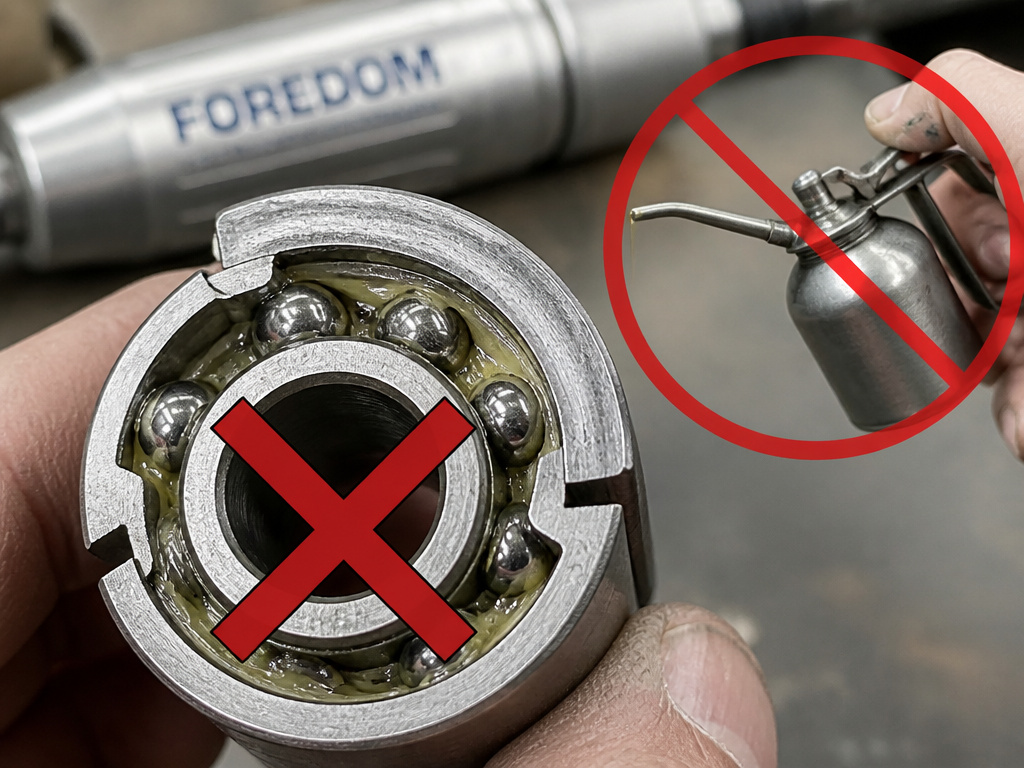
Your instinct to “keep things slick” can actually destroy a tool. Many modern components are lubricated for life at the factory with sealed bearings or special greases that never need replenishing.
The Foredom flexible shaft handpieces (models 8, 18, 20, 25, 25H, 28, 30®, 30H, 35, 43T, 44T, 44HT, and 52) have greased-shielded ball bearings. Their service manual states in bold: do not lubricate. Adding oil will wash out the factory grease, leading to bearing failure. Similarly, the Greenworks 40V chainsaw motor is permanently lubricated, no further maintenance is possible or required.
The rule is simple: if the manual doesn’t list a lubrication step for a component, assume it’s sealed. Don’t go looking for oil holes that aren’t there.
The Flexible Shaft Exception
The Foredom’s flexible inner shaft is the opposite, it needs meticulous greasing. Every 50 hours, wipe it clean and apply a very light coating of white lubricating grease (Foredom MS10006). Every 200 hours, do a full solvent clean and re-grease. The manual specifies the shaft tip must extend 3/4″ (19mm) beyond the sheath. Too little extension, and the handpiece connection wears; too much, and the shaft whips.
| Tool Type | Lubricant | Frequency | Key Warning |
|---|---|---|---|
| Bosch Router Gears | Special Gear Lubricant | Every second brush change | Check carbon brushes every 2-6 months first |
| Milwaukee Gearbox | Type J Grease (49-08-4220) | At service (remove 90-95% old) | Grease quantities are weight-specific (3.8g, 4g) |
| Husqvarna Pole Saw Coupling | Dielectric Grease | After each 30 hours of operation | Must use dielectric oil in chain system |
| Foredom Flexible Shaft | White Lubricating Grease | Every 50 hours of use | Do NOT lubricate permanently sealed handpieces |
| Chainsaw Guide Bar Sprocket | General-Purpose Grease | Weekly | Use grease syringe in lubrication hole |
WD-40, 3-In-One, and the “General Purpose” Trap
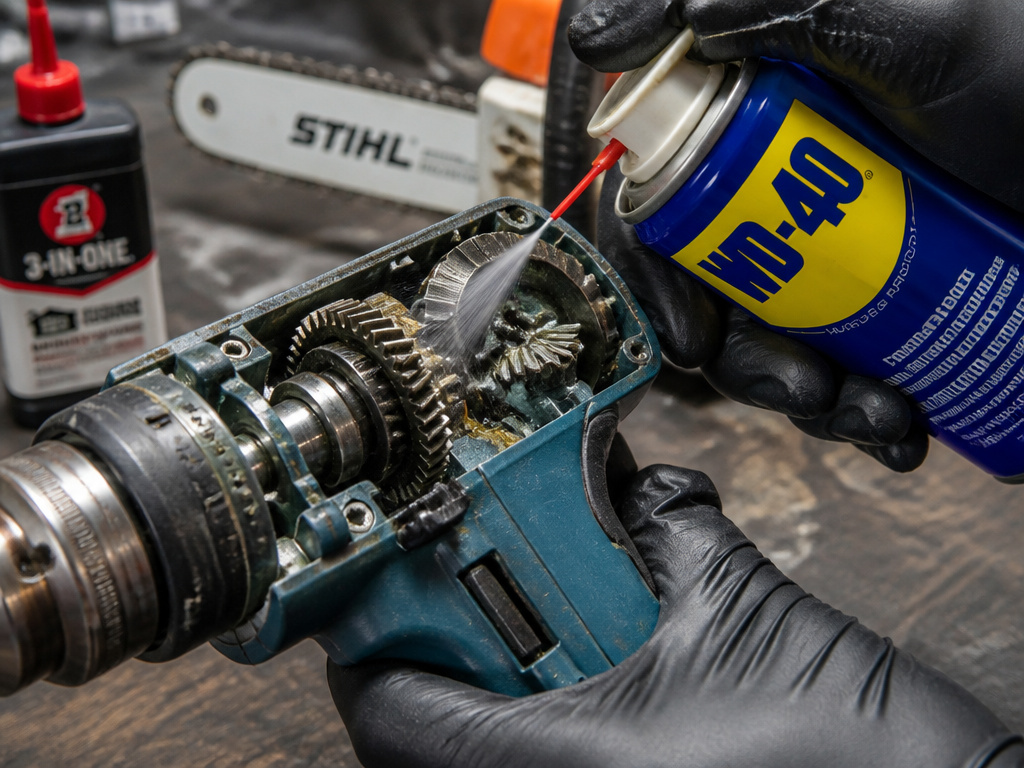
WD-40 is a water displacer and a light cleaner. It’s not a lubricant. In a gearbox, it will thin the existing grease and evaporate, leaving the gears worse off. On a chainsaw chain, it offers no lasting film protection and attracts sawdust.
3-In-One oil is a light machine oil good for hinges, locks, and the occasional drop on a pneumatic tool‘s air inlet. It lacks the film strength for gear teeth or the additives for chain operation.
The part nobody mentions: Spraying either product into an electric motor’s vents or brush slots attracts a paste of dust and carbon that eventually shorts the commutator. You’ll hear a rhythmic ticking sound for a few weeks before the motor seizes.
For rust prevention on tool surfaces, a dedicated dry film lubricant or silicone spray is better. They leave no oily residue that can contaminate wood glue or finishes. For the internals, you need the product the engineer specified.
How Often Should You Lubricate? The Real Intervals
There is no universal schedule. The interval is set by your tool’s manual and how you use it. Here’s how to translate “heavy use” into a calendar.
- By Hour Meter: This is the most accurate. The Bosch router bearing schedule (300-400 hours) is a classic example. If you use your router every weekend for four hours, that’s 200 hours a year. Grease it every 18-24 months.
- By Brush Inspection: The Bosch manual ties gear lubrication to brush checks. When you examine the brushes (every two to six months), check the gears. If they look dry or the grease is contaminated, regrease.
- By Project Cycle: For a pole saw used seasonally, lubricate the drive shaft at the start and end of the season, and after every 30 hours in between.
- By Sound and Feel: A dry gearbox starts with a high-pitched whine under load. A dry chain on a saw smokes and leaves fine, dark dust on the cut. These are last-chance warnings.
The one interval you control completely is cleaning. Blowing out your tools with compressed air after every use does more for longevity than any tube of grease. Dirt is the real abrasive.
Frequently Asked Questions
What type of grease is best for power tools?
For internal gearboxes, you must use the OEM-specified grease. Milwaukee’s Type J, Bosch’s special gear lubricant, and Foredom’s MS10006 are not interchangeable. Using the wrong one voids warranties and causes premature failure.
Can you use 3-in-1 oil to lubricate pneumatic tools?
Yes, but it’s not ideal. 3-in-1 oil is a light machine oil that will work for light-duty pneumatic nailers or brad guns in a pinch.
Can you use WD-40 to clean power tools?
Yes, but only as a cleaner and water displacer. Spray it on a rag and wipe down metal surfaces to remove light rust and moisture. Never spray it directly into motor vents, electrical switches, or gearboxes. After cleaning, always follow up with a lubricant on moving parts, as WD-40 leaves little protective film.
What kind of oil keeps tools from rusting?
For long-term storage, a light coating of a dry film lubricant or silicone spray is best. They displace moisture without leaving a sticky residue that attracts dust. Avoid heavy oils, they collect grime and are messy to remove when you need to use the tool again.
Before You Go
Lubrication isn’t a guessing game. It’s a matching problem: this part gets this grease in this amount. The manuals have the answers; your job is to follow them exactly.
If you take one thing from this, let it be the 90-95% removal rule for Milwaukee grease. That single step separates a service that removes 90-95% of the old grease from a hack job that fails in six months. Everything else, the types, the intervals, the warnings, flows from the specific tool in your hand. Find its manual. Read the lubrication notes. Then go to work.
The smell of sawdust is fine. The smell of a burning motor is not.
