
How to Store Power Tools in a Garage: The 5-Year Rule
This post contains affiliate links. As an Amazon Associate, we earn from qualifying purchases.
Store power tools in a garage by controlling three things: environment, organization, and access. A cool, dry space out of direct sunlight protects electronics and metals. Organized wall systems or secured racks keep tools accessible and prevent tipping. Follow specific manufacturer limits for drawer weight and battery storage, some batteries can sit for five years if conditions are right.
The difference between a tool that works in five years and one that doesn’t is a set of printed numbers most people never read. The manuals have the answers, load limits, clearance heights, temperature ranges, written to keep the tool and the user safe. Your garage doesn’t have to be a hostile environment if you treat it like the workshop it is. The manuals often explain how to store power tools in a garage.
What follows is the spec-sheet approach to the how to store power tools in a garage question. This section explains the manufacturer-mandated limits for racks and drawers, the science behind battery longevity, and the one habit that prevents most garage storage failures before you even lift a tool.
Key Takeaways
- A DEWALT DC385 battery pack can be stored for 5 years or more in cool, dry conditions away from sunlight and extreme temperatures.
- The UL201 standard requires load testing at 4 times the maximum load.
- Secure all freestanding racks to a wall, the DEWALT DXST4500-W holds 4,500 lb total but can tip if not anchored, especially on uneven surfaces.
- Disconnect power and batteries before storage, as per Bosch manuals, to eliminate the risk of accidental startup and reduce electrical fire hazards.
- Snap-on advises loading drawers with no more than 15 lbs at a time, starting from the bottom drawer up. Other manufacturers may have different guidelines.
The 3-Step Pre-Storage Checklist (Before You Put Anything Away)
Disconnect the plug from the power source and/or the battery pack from the power tool before storing power tools. That’s the first line in That’s the first line in the Bosch GKT13-225 plunge saw manual.
Before you start: Remove all batteries and unplug all cords. A tool with energy stored is a tool that can start unexpectedly. Check cutting edges for gummed-up sap or resin, and wipe handles free of oil and grease. Slippery grips cause drops.
Your three steps are clean, inspect, and document.
- Clean with the right agents. Blow off sawdust with compressed air if you must, but follow it with a brush. For grease, use a rag dampened with a mild detergent. That rules out a lot of garage-floor cleaners.
- Inspect for the next job. Inspect for cracked housings, frayed cords, and loose chucks. Then go deeper. Does the blade guard on your circular saw retract smoothly? Is there excessive side-to-side play in your drill’s gearbox? A binding switch or a misaligned part will only get worse sitting idle.
- Document the state. This is the underrated step. Note the date on a piece of masking tape stuck to the tool. Write the last brush replacement, the last bearing grease, or the current issue (“bit wobble in chuck”). When you pull it out in six months, you have a history. You’re not starting from scratch.
The alternative is pulling out a drill next spring to find the battery dead, the chuck rusted shut, and a mystery rattle inside. Which sounds like more work?
Wall Systems vs. Freestanding Racks: Which Holds More?
The math is not subtle. A well-secured wall system holds the weight you bolt into the studs. A freestanding rack holds the weight printed on its manual, but only if you anchor it.
It seemed fine for a week. Then one morning I walked in to find the entire unit leaning forward like a slow-motion tree fall, saved only by a box of rags that had serendipitously been placed in front of it. The drywall anchors had pulled straight through.
The DEWALT DXST4500-W Industrial Rack has a total capacity of 4,500 lb (2,041 kg) when weight is evenly distributed. Each shelf holds 1,500 lb (680 kg). Its manual states: “Serious injury or death can occur from the rack tipping over. To prevent this, the rack must be secured to a wall.”
That’s the technical snippet. The why-layer is torque. A tall, loaded rack has a high center of gravity. Any lateral force, a bump from a ladder, a pet running past, an earthquake tremor, creates a tipping force at the base. Wall straps turn that force into a shear load on the bolts, which they’re designed to handle.
| Storage Type | Best For | Critical Limitation |
|---|---|---|
| Pegboard / Slatwall | Handheld tools, accessories, keeping items visible and accessible. | Load per hook is low (usually 10-25 lbs). Requires solid backing (plywood over studs is best). |
| Heavy-Duty Shelving (Bolted to Wall) | Bench grinders, drill presses, tool cases, bulk supplies. | Must be anchored into wall studs, not just drywall. Spacing between shelves is fixed. |
| Freestanding Industrial Rack (e.g., DEWALT DXST4500-W) | Bulk storage, weight exceeding wall capacity, flexible shelf heights. | Must be secured to a wall. Floor must be level. Dimensions (47″H x 49.5″W x 18″D) need floor space. |
| Mobile Tool Cart | Frequently used tools, jobs that move around the garage. | Low overall capacity. Can become a tripping hazard if left in walkways. |
The decision rule is simple. If your tools are under 50 lbs each and you have solid walls, go vertical with a wall system. It saves floor space. If you’re storing sheet goods, miter saws, or multiple heavy toolboxes, you need the freestanding rack. And you must bolt it to the wall. Different wall materials require different fasteners.
Drawer Discipline: Why 15 Pounds at a Time Matters
Toolbox drawers fail predictably. They sag in the middle, the slides bind, and eventually the drawer won’t close because the frame has twisted. Snap-on’s manual gives the exact sequence to prevent this: load drawers with no more than 15 lbs at a time, starting from the bottom drawer up.
The logic is structural. A tool cabinet is a steel box designed to handle compressive loads (weight pushing down) far better than torsional loads (twisting). Loading from the bottom up ensures the weight is transferred directly down through the cabinet’s corner posts into the casters. Dropping 50 lbs into a top drawer first creates a lever arm, trying to twist the entire cabinet.
Here’s the sensory reality. A properly loaded drawer slides out with a solid, smooth pull, no grinding, no catches. An overloaded drawer feels gritty halfway out, and you’ll hear a faint pop or creak from the slides as they deflect under uneven weight.
- Respect the “Slots ’n dots™” limit. For Snap-on boxes, the maximum load for this style of slide is 10 lbs per linear foot.
- Distribute weight left-to-right. Don’t stack all your heavy sockets on the right side. Spread them out across the drawer’s width.
- Use drawer liners. They’re not just for looks. A non-slip liner keeps tools from sliding around and concentrating impact force on one spot of the slide during opening and closing.
This isn’t about being gentle. It’s about obeying the engineering. The UL201 standard requires load testing at four times the maximum load. The UL201 standard requires load testing at 4 times the maximum load. It’s strong, but it’s not infinitely strong. Consistent overloading is what beats it.
The Garage Environment: Fighting Rust, Cold, and Fire
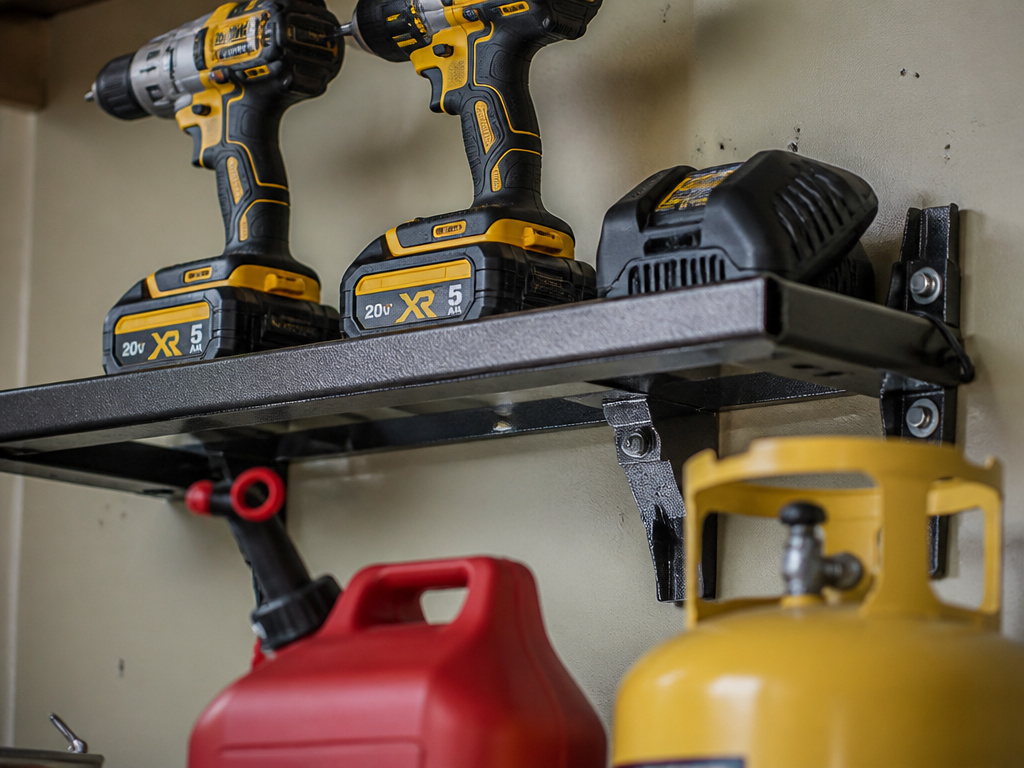
A garage is a terrible place for precision machinery. Temperature swings cause condensation inside metal housings. Humidity rusts bare steel. And for some, it’s a shared space with lawnmowers, gasoline, and propane tanks.
Where this goes sideways: Storing a toolbox in a recessed area or below floor level. The Snap-on manual explicitly warns against this because flammable vapors are heavier than air, they pool in low spots. An electrical component in the toolbox could arc and ignite them.
The first defense is elevation. Keep electrical tools and battery chargers at least 460 mm (18 inches) off the floor. That’s Snap-on’s rule for preventing vapor accumulation. The second defense is separation. Create a dedicated zone for power tools, away from fuel cans and paint thinners.
For rust, control what you can.
- Use a dehumidifier. Use a dehumidifier to control moisture in the storage area.
- Apply a protectant. A light coat of a technical-grade corrosion inhibitor like CRC 3-36 on bare metal surfaces (saw blades, drill chucks) forms a dry film.
- Store accessories properly. Bosch advises keeping saw blades and drill bits in a dry and temperate environment to avoid corrosion. Avoid freezing for certain accessories, some plastics become brittle.
Your garage doesn’t need to be climate-controlled. It needs to be managed. Pick the driest, most stable corner for your tool storage, and defend that space from moisture and contaminants.
Battery Longevity: The 5-Year Promise and the Monthly Habit
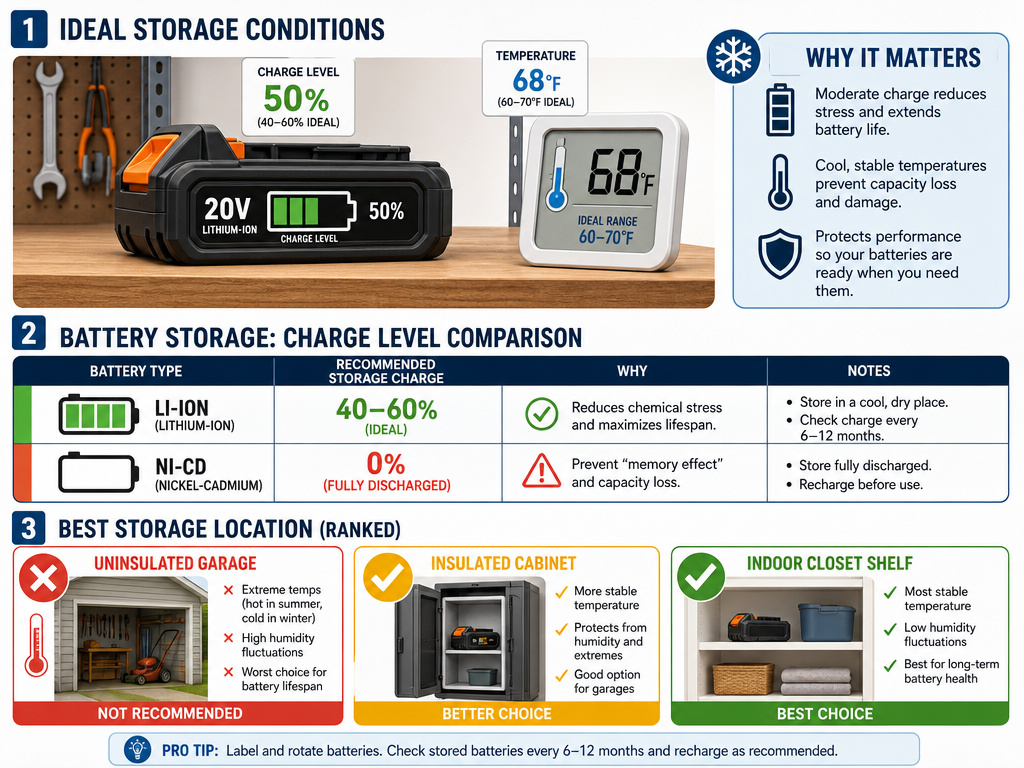
The most expensive part of your cordless ecosystem is the battery. Treat it like the sensitive electrochemical device it is, not a brick. The DEWALT DC385 manual states its battery pack can be stored for 5 years or more under proper conditions: cool, dry, and away from direct sunlight or excess heat/cold.
That’s a sourced-number magnet. Five years is a manufacturer’s verified claim, not a guess. For longevity, follow the manufacturer’s storage guidelines for battery state of charge.
You’re not charging them fully; you’re waking up the management circuit and letting it balance the cells. A battery left completely alone for a year might not wake up at all.
| Battery State | Ideal Storage Charge | Storage Temperature | What Happens If You Ignore It |
|---|---|---|---|
| Lithium-ion (Li-ion) | 40-60% | 50°F – 77°F (10°C – 25°C) | Capacity loss, swelling, failure to hold charge. |
| Nickel-Cadmium (Ni-Cd) | Fully Discharged | Same as above | Memory effect is exaggerated, rapid self-discharge. |
| Storage Location | Recommendation | Rationale | |
| Garage Shelf | Only if temperature-controlled. | Winter freezes and summer heat accelerates chemical decay. | |
| Insulated Cabinet | Better. | Buffers against daily temperature swings. | |
| Inside the House | Best. | Stable temperature and humidity. |
If your garage isn’t insulated, bring your batteries inside for the winter. Storing batteries in low temperatures isn’t just about immediate failure; it’s about the cumulative damage from repeated freeze-thaw cycles that crack internal seals.
Moving and Securing Your Storage: Don’t Pull, Push
A loaded tool cabinet is a tipped-over tool cabinet waiting for the right mistake. The manuals are unanimous on procedure: close and lock all drawers, disconnect all power cords, and apply the caster brakes before you even think about moving it.
The Snap-on manual has a specific, counterintuitive warning: “Do not open any drawer with swivel caster positioned inward.” When a caster is turned inward, the cabinet’s center of gravity shifts outside its wheelbase. Opening a drawer increases the tipping force, and the whole unit can tip toward you. Always lock casters parallel to the front of the cabinet before accessing drawers.
When transporting a unit out of the shop, empty all contents prior to moving. This isn’t a suggestion.
Pulling a unit makes you the counterweight, and if it hits a bump, it can roll right over your feet. Pushing allows you to step back and get out of the way. This gives you control over the steering.
How to use bins and containers for tool organization
Clear plastic bins let you see contents and group small parts or accessories. Store these bins on shelving, but ensure the rack is secured to a wall to prevent tipping. Keep accessories in a dry and temperate environment to avoid corrosion. Before placing items into bins, disconnect tools from power and check them for issues like breakage or binding. Always store these containers out of the reach of children. For tool storage units with electrical components, avoid placing bins in recessed areas below floor level where flammable vapors can accumulate.
Separating tools by size and how often you use them
Organize your heaviest, least-used tools on lower shelves or in bottom drawers, loading weight from the bottom up. Place frequently used items at waist level for easy access. Keep small, everyday items like drill bits or drivers in the upper sections of your storage. Electrical components in any storage unit should be located well above floor level. For safety, always disconnect the plug and battery before putting any tool away, and check cutting tools to ensure they are sharp and clean. This system keeps your workspace efficient and safe.
Frequently Asked Questions
Is it okay to store power tools in an unheated garage?
Yes, but with major caveats for batteries and moisture. The tools themselves, if properly cleaned and protected with a corrosion inhibitor, can handle the cold. However, lithium-ion batteries suffer permanent capacity loss when stored in freezing temperatures. This is why a stable environment, even a cool one, is better than one that swings from freezing to thawing daily.
What is the best way to hang power tools in my garage?
The best way uses the wall’s structure. Then, mount heavy-duty pegboard hooks, slatwall brackets, or French cleats to the plywood. This distributes the load across multiple studs.
How do I prevent my tool rack from tipping over?
You secure it to a wall with the correct fasteners for your wall material. The DEWALT storage rack must be secured to a wall to prevent tipping over. Different wall materials require different types of fasteners for securing a DEWALT storage rack. The manual’s warning is explicit because a 4,500-lb capacity rack loaded with even a fraction of that weight has immense tipping force.
Can I store power tools in their original cases?
You can, but be vigilant about moisture. Plastic cases can trap humidity against the tool, creating a perfect environment for rust. For long-term storage in a garage, an open shelf or a ventilated cabinet is often a drier option than a sealed case.
Before You Go
One rule reframes everything: your garage floor is a condensation engine. Concrete is porous and cold. Warm, moist air hits it and leaves water behind. That’s why the first 18 inches above the slab are the most corrosive zone in your garage.
Raise your storage off the floor. Get your toolboxes, shelves, and cabinets up on feet or a platform. If you can’t, make a seasonal ritual of pulling everything out, checking for moisture, and reapplying protectant. The goal isn’t a perfect climate. It’s a managed one. You control what you can, elevation, separation, and the information in the manuals you probably threw away. Find those PDFs online. The numbers there are the only ones that matter.
