
10 Best Pneumatic Framing Nailers in 2026
This post contains affiliate links. As an Amazon Associate, we earn from qualifying purchases.
Our best overall pneumatic framing nailer is the Metabo HPT NR83A5 for its reliable power, user-selectable trigger, and lasting durability. For high-volume sheathing, choose the Best High Capacity Bostitch N80CB-1 coil nailer. For tight spaces and reduced fatigue, the Best Lightweight Paslode F325R is a top contender.
The right tool balances power, weight, magazine type, and nail capacity for your specific tasks. This guide is based on reviewing manufacturer specifications, expert opinions, and patterns in user feedback across many professional sources. We’ll help you understand what makes a great framing nailer for your projects.
Top 10 Pneumatic Framing Nailers in the Market
Certain content that appears on this site comes from Amazon. This content is provided "as is" and is subject to change or removal at any time.
The Best Pneumatic Framing Nailers, Reviewed
Metabo HPT NR83A5 Framing Nailer

What We Like
- Selectable trigger for safety and speed
- Hardened claw tip for grip and durability
- Rear-loading, two-piece magazine for easy reloads
- Reversible rafter hook for user preference
Trade-offs
- Maximum 3 1/4-inch nail length limits some framing tasks
- At 8.8 pounds, it is heavier than some coil nailers
- Requires a separate air compressor to operate
Metabo HPT’s framing nailer uses a cylinder valve drive mechanism for quick response and powerful driving. The tool was rated the Pro Preferred Nailer for nine consecutive years by Builder and Developer Magazine. A selectable trigger lets users choose between contact actuation for speed or sequential mode for safety, a feature reviewers noted can help prevent accidental double-firing. Its two-piece magazine is designed for durability and easy replacement on the jobsite, and a reversible rafter hook adds to the convenience.
This nailer drives nails up to 3 1/4 inches long. That maximum is shorter than some other framing nailers, which can handle 3 1/2-inch nails. For most standard framing tasks, its proven durability and balanced design provide a reliable, easy-to-use tool.
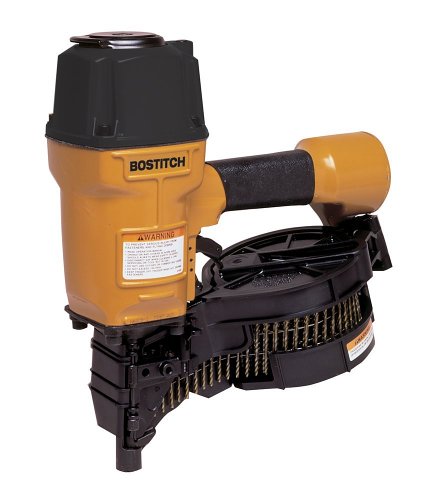
Bostitch N80CB-1 Coil Framing Nailer
What We Like
- 300-nail coil magazine minimizes reloading
- Aggressive toe-nailing teeth grip lumber securely
- Heavy-duty, quick-open canister survives jobsite drops
- Aluminum housing balances durability and weight
Trade-offs
- Weighs 8.0 pounds.
- Contact-trip trigger only.
The Bostitch N80CB-1 holds a full 300-nail coil, a spec that means you can sink nails all morning without stopping to reload. That high capacity is built for production framing, sheathing, and decking where speed is measured in coils, not strips. It’s the right pick for the crew tackling large-scale projects where downtime is the real enemy. The aluminum housing and fortified canister are designed to take the inevitable jobsite knocks.
You trade some maneuverability for that capacity. That makes it less suited for intricate work or overhead nailing where a lighter, more compact gun would be easier to handle. Choose this for the raw efficiency of its magazine when the scale of the work justifies the heft.
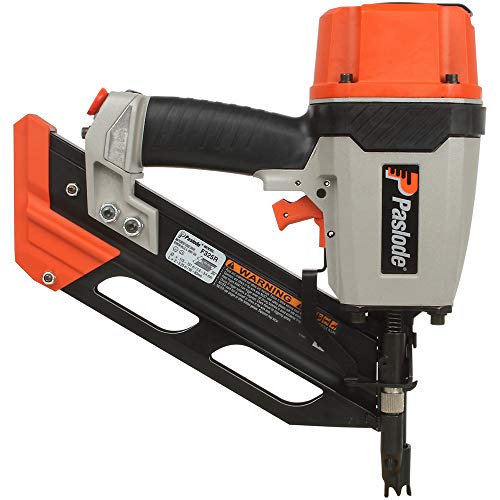
Paslode F325R Framing Nailer
What We Like
- Lightest weight reduces user fatigue
- Compact size fits between 16" studs
- Quick two-step reloading mechanism
- Fewer jams with specified Paslode nails
Trade-offs
- Requires specific 30° Paslode-brand nails
- Shorter nail capacity than a coil nailer
- Maximum nail length is 3-1/4 inches
Paslode markets this as the lightest framing nailer ever at 5.9 pounds, which means less arm fatigue during overhead work or in confined areas. Its compact size lets it fit between standard 16-inch on-center studs, a key advantage for remodelers moving interior walls. The design prioritizes control for tasks like sheathing and blocking, where the reduced weight helps maintain precision over many hours.
The trade-off for that compact, lightweight frame is a stick-style magazine, which holds fewer nails than the high-capacity coil models like the Metabo HPT NV90AGS. You also commit to using Paslode’s 30-degree nails to achieve the stated reliability. For heavy production framing where you’re constantly sinking 3-1/2 inch nails, the Paslode 501000 PowerMaster or a dedicated coil nailer would be a more suitable workhorse.
Metabo HPT NV90AGS Coil Framing Nailer

What We Like
- Lightweight at 7.7 lbs for all-day use
- Tool-less depth dial for flush fastening
- Open nose design for easy jam clearing
- Selectable trigger for sequential or contact nailing
Trade-offs
- Maximum nail length is a half-inch shorter than some 3-1/2-in models
- Uses 15° coil nails, not as common as 21° or plastic strip
A 15° coil nailer holding up to 3-1/2-inch fasteners gives you high capacity and a favorable driving angle for tight spots. At just 7.7 pounds, it’s built for a full day of overhead work without wearing out your arm. The tool-less depth adjustment and selectable trigger let you switch from precise trim work to rapid sheathing with a flip. That balance of power, control, and endurance is exactly why it’s been a jobsite staple for over a decade. This is the nailer you grab when the project list is long and your tolerance for jams or misfires is zero.
The trade-off is the 3-1/2-inch maximum. If you regularly need to sink longer nails for certain framing connectors, you’ll hit its limit. For that specific task, a model like the NuMax SFR2190 offers the full 3-1/2-inch capacity. It’s a refined tool that prioritizes reliability and ergonomics over raw length.
NuMax SFR2190 Framing Nailer

What We Like
- Anti-dry-fire mechanism protects internals
- No-mar safety tip prevents surface damage
- Comfort grip handle reduces user fatigue
- One-piece hardened steel drive blade for durability
Trade-offs
- At 8.6 pounds, it's heavier than the 4.2-pound Paslode F325R
- Limited to 21-degree plastic-collated nails, not coil or wire-weld
The NuMax SFR2190 is built around a dual-mode trigger, letting you switch between precise single-shot placement and faster bump firing as the job demands. A tool-free depth adjustment wheel allows quick changes to nail depth for different materials. An anti-dry-fire mechanism protects internal parts by preventing the tool from firing when empty, a design that helps extend its service life.
This nailer’s weight and format are its main compromises. At over eight pounds, it demands more arm strength over a long day compared to lighter options like the Paslode F325R. You also use 21-degree plastic-collated nails, which is a common and accessible system. That format doesn’t offer the high capacity of a coil nailer for marathon sessions, though. It’s a tool built for common framing tasks, not for squeezing into the tightest corners or firing thousands of nails without a reload.
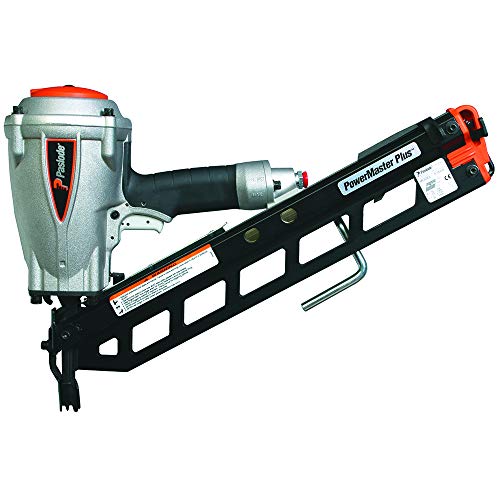
Paslode 501000 PowerMaster Framing Nailer
What We Like
- Low-recoil design for less arm fatigue
- Compact size fits between 16" on-center studs
- Powerful drive for hardest woods and LVL
- Soft grip handle provides comfort
Trade-offs
- Weighs 8.4 pounds, which is heavier than the 4.2-pound Paslode F325R
The Paslode 501000 PowerMaster Framing Nailer has a low-recoil design that places its center of gravity close to the trigger, providing great balance and less arm fatigue during use. This heavy-duty tool drives nails into the hardest woods, including LVL, and works with fewer jams or misfires. Its compact size fits between 16-inch on-center studs, joists, and rafters, while a soft grip handle adds comfort.
You get smooth operation in exchange for some added weight and length. It’s not the lightest or shortest framer in the guide, so overhead work on rafters might become tiring faster than with a lighter option like the Paslode F325R. For general wall framing and decking, however, its comfortable grip and reduced kickback translate directly to more consistent nail placement and less wear on your wrist and elbow.
Product photos
Senco FramePro 701XP Framing Nailer

What We Like
- Tool-free depth of drive adjustment
- Aggressive claw-like safety for toenailing
- In-line magazine improves line of sight
- Rear two-step loading for quick reloads
Trade-offs
- Weighs 8.0 pounds, a handful for all-day overhead work
- Limited to 30-degree paper collated nails only
The aggressive claw-like safety tip is the key feature here. It bites into the wood, giving you a rock-solid pivot point for driving nails at extreme angles. That makes this nailer a specialist for framers and deck builders who regularly need to toenail joists or secure blocking in tight corners. The in-line magazine and clear line of sight further help you place those awkward shots accurately, which is why it stands out for precision work over raw speed.
You do pay for that focus. At eight pounds, it’s on the heavier side of the category, and the sequential-only trigger prioritizes control over blistering pace. If your job involves more sheathing or high-volume framing runs, a tool with a different design might be a better fit. But for the specific, frustrating task of driving a 3-1/2-inch nail into a tight corner without it deflecting, the Senco’s design is purpose-built.
Freeman G2CN90 Coil Framing Nailer

What We Like
- Transparent magazine for quick nail checks.
- Tool-free depth adjustment for flush driving.
- Durable magnesium body and steel drive blade.
- Dual-mode trigger for precision or speed.
Trade-offs
- Length of 14.1 inches limits tight-space maneuvering.
- Requires specific 15-degree wire collated nails.
A transparent magazine lets you see your nail supply at a glance, which is a serious time-saver when you’re up on a ladder or deep into a production run. This Freeman nailer suits the contractor or serious DIYer who values minimizing downtime and appreciates the high-capacity of a coil gun. Its optimized air flow is engineered for solid driving power while being mindful of your compressor’s load, and the magnesium construction means it can handle the inevitable drops and bumps of a job site.
At 7.5 pounds, the Freeman G2CN90 is lighter than many coil framing nailers, which helps reduce arm strain during long projects. Its 14.1-inch length, however, is greater than some other models, so it may be less convenient in confined spaces than a more compact tool. The coil magazine design provides high nail capacity for extended work on large-scale jobs like deck building or roof decking without frequent reloading.
Product photos
CRAFTSMAN CMP21PL Framing Nailer

What We Like
- Tool-free depth-of-drive adjustment
- Selectable trigger with lockout
- Reversible rafter hook
- Drives nails into engineered lumber
Trade-offs
- At 8.2 lb, it's heavier than the 4.2 lb Paslode F325R
- Weighs 8.2 pounds for extended overhead use.
The ability to drive a full 3-1/2-inch nail into engineered lumber means it can handle the toughest framing jobs on a modern site. This nailer is built for the budget-conscious builder or serious DIYer who needs reliable, no-frills power. Its selectable trigger and tool-free depth adjustment give you the control needed for precise work, from sheathing to toenailing, without complicating the tool.
This framing nailer drives nails up to 3-1/2 inches long into engineered lumber, providing the reach needed for substantial framing tasks. Its 8.2-pound weight is noticeable during extended overhead work, a trade-off for its durable build. As a straightforward workhorse, the tool puts its cost into core function rather than premium features.
Product photos
Bostitch LPF28WW Framing Nailer

What We Like
- Low-profile design for tight spaces
- Tool-free depth of drive adjustment
- Adjustable rafter hook
- Last nail retention magnet
Trade-offs
- The 28-degree angle requires specific, less common nails.
A 5.3-inch height is the key number here. That low-profile design lets you slip the tool between rafters and joists where a taller nailer simply won’t fit. If your work involves a lot of overhead framing or confined retrofit jobs, this design choice directly solves a common physical obstacle. It suits the carpenter who needs to drive nails in established, cramped structures without constantly fighting for clearance.
Its slim height comes with a 22.5-inch length, which makes it less maneuverable in all directions compared to a shorter coil nailer like the Bostitch N80CB-1. You gain access in one critical dimension but sacrifice a bit in another. For open-wall framing on a new build, a more balanced tool might be faster. For the specific problem of tight vertical clearance, however, this Bostitch has a clear and purposeful advantage.
Product photos
How We Evaluated Pneumatic Framing Nailers
This list is based on research, comparing manufacturer specifications and studying trusted expert round-ups. We identified consistent patterns in owner feedback, focusing on criteria that matter on a real job site. Key factors include driving power for dense lumber, tool weight and balance for all-day use, magazine capacity to minimize reloading, and essential features like depth adjustment and safety triggers.
We prioritize tools with strong reputations for durability and minimal jamming. Our research-based approach means we don’t conduct hands-on tool tests, but we rely on detailed reports from professionals who do.
What To Look For In Pneumatic Framing Nailers
Choosing the right tool means matching its strengths to your common tasks. A production framer needs something different than a remodeler working in cramped attics.
Look for a balance of power, manageable weight, and an appropriate magazine. Consider nail length capacity and collation angle for your projects. Tool-free depth adjustment and a selectable trigger are key quality-of-life features.
Power and Drive Consistency
A nailer must sink nails flush into the hardest woods, including wet pressure-treated lumber and engineered LVL beams, without hesitation. A consistent, powerful drive cycle is non-negotiable for structural integrity and professional speed. Look for models praised for their reliable performance across varied materials, as noted in many reviews of air framing nailers. Systems with a sturdy valve and piston design tend to maintain power over years of use.
Weight, Balance, and Ergonomics
A framing nailer is an all-day tool, so its feel in your hand is critical. Weight varies between models, with some designed to be lightweight and others built for heavy-duty work. A well-balanced tool reduces wrist and arm fatigue, especially during overhead work. Features like a comfortable grip, a reversible rafter hook, and a low-recoil design all contribute to less user strain. Balance is as important as raw weight, as noted in framing nailer buying guides.
Magazine Type and Nail Capacity
Your magazine choice directly impacts workflow. Stick (or strip) magazines, often holding around 50-70 nails, offer a lighter, more compact tool ideal for precise work and tight spaces. Coil magazines hold up to 300 nails, drastically cutting reload stops, a major advantage for high-volume sheathing or decking. Your choice here also locks you into a nail collation angle (like 21°, 30°, or 15°), affecting tool profile and nail availability. Understanding the trade-offs in coil vs stick magazine types is essential.
Key Features and Compatibility
Beyond the core specs, practical features separate good tools from great ones. A tool-free depth-of-drive dial is mandatory for adapting to different wood densities. A selectable trigger (bump fire vs. Sequential) adds versatility and safety. Also, remember a pneumatic nailer is only half the system; you’ll need a capable air compressor for framing with sufficient CFM to run it. Finally, always check the maximum nail length, as some cap at 3 1/4 inches while others handle 3 1/2-inch nails.
- Confirm the nail collation type (paper, plastic, wire) and angle required.
- Check for a clear jam-clearing mechanism, preferably a tool-less open nose.
- Ensure the tool includes a rafter hook or has a spot to add one.
- Verify the required air pressure (PSI) and air consumption (CFM) to match your compressor.
Always pair your nailer with a compressor that meets or exceeds its CFM requirements for consistent, powerful drives.
Pneumatic Framing Nailers Compared
For a quick view of how these framing nailers compare on key specs, see the table below.
| Product | Weight | Nail Length Range | Trigger Modes |
|---|---|---|---|
| Metabo HPT NR83A5 Framing Nailer | 8.8 pounds | N/A | Selectable contact/sequential |
| Bostitch N80CB-1 Coil Framing Nailer | 8.0 pounds | 1-1/2 to 3-1/4 inches | Contact-trip |
| Paslode F325R Framing Nailer | 4.2 Pounds | 2" to 3-1/4" | N/A |
| Metabo HPT NV90AGS Coil Framing Nailer | 7.7 pounds | 1-3/4-in to 3-1/2-in | Sequential or contact |
| NuMax SFR2190 Framing Nailer | 8.6 pounds | 2" to 3-1/2" | Dual mode trigger |
| Paslode 501000 PowerMaster Framing Nailer | 8.4 Pounds | N/A | N/A |
| Senco FramePro 701XP Framing Nailer | 8.0 pounds | 2 inch to 3 1/2 inch | Sequential |
| Freeman G2CN90 Coil Framing Nailer | 7.5 pounds | 1-3/4", 3-1/2" | Sequential & bump |
| CRAFTSMAN CMP21PL Framing Nailer | 8.2 pounds | Up to 3-1/2-inch | Sequential or contact |
| Bostitch LPF28WW Framing Nailer | 8.0 pounds | N/A | Selectable single/multi-drive |
Frequently Asked Questions
Who makes the best pneumatic framing nailer?
While “best” depends on your specific needs, brands like Metabo HPT, Bostitch, and Paslode consistently earn high marks from professionals for durability and power. Our research into professional framing nailers shows that the top tools combine reliable drive mechanisms, thoughtful ergonomics, and jobsite-tough construction. The best brand for you is the one whose tool features align with your most common framing tasks.
What should I look for in a framing nailer?
Prioritize power for driving nails into hardwoods, a comfortable weight for all-day use, and a magazine type that suits your work volume. Essential features include tool-free depth adjustment and a good safety trigger. Also, consider the required nail length and collation angle, as this affects both the tool’s physical profile and the cost/availability of fasteners.
What is the difference between a stick and coil framing nailer?
Stick nailers use a straight magazine holding 50-70 nails; they are generally lighter and more compact, better for tight spaces. Coil nailers use a round magazine holding up to 300 nails, ideal for high-volume work like sheathing where minimizing reloads boosts productivity. Your choice will also determine the nail angle you use, which is a key factor covered in guides about framing nailer angles.
Can I use any nails with my pneumatic framing nailer?
No. You must use nails specified for your exact nailer model, including the correct length, shank type, collation material (paper, plastic, wire), and angle (e.g., 21-degree or 30-degree). Using incorrect nails is a primary cause of jams and can damage the tool’s internal mechanism.
Do I need a special air compressor for a framing nailer?
Yes. Framing nailers require a compressor that can deliver sufficient air volume (measured in CFM) at the required pressure (PSI). A small “pancake” compressor often cannot keep up, leading to weak drives. You need a larger portable compressor, and our resource on the best air compressor can help you select one.
The Bottom Line
The Metabo HPT NR83A5 is our best overall framing nailer, a durable and powerful choice for professionals and serious builders tackling standard framing day in and day out. For large-scale production work, the Bostitch N80CB-1 coil nailer wins for its high capacity, while budget-minded users should look at the NuMax SFR2190. For those working in attics or crawlspaces, the Bostitch LPF28WW is built for tight vertical clearance. Ultimately, matching the tool’s weight, magazine type, and nail capacity to your most frequent tasks is the most important decision you’ll make.
