
10 Best Miter Saws For Beginners in 2026
This post contains affiliate links. As an Amazon Associate, we earn from qualifying purchases.
For beginners, the Metabo HPT 10-Inch Compound Miter Saw is the best overall pick for its lightweight design and straightforward operation. Those needing to cut metal or plastic should look at the Best Multi-Material Saw, while the Best Space-Saving Design is ideal for tight workshops.
Choosing your first miter saw means balancing power with simplicity. A tool that’s too complex or heavy can be intimidating, while one that’s too limited may not handle your projects. Our research focuses on saws that are easy to handle, set up, and use safely.
We evaluated specifications, expert insights, and patterns in owner feedback to find the models that offer the best start for new users.
Top 10 Miter Saws For Beginners in the Market
Certain content that appears on this site comes from Amazon. This content is provided "as is" and is subject to change or removal at any time.
The Best Miter Saws For Beginners, Reviewed
Metabo HPT 10-Inch Compound Miter Saw
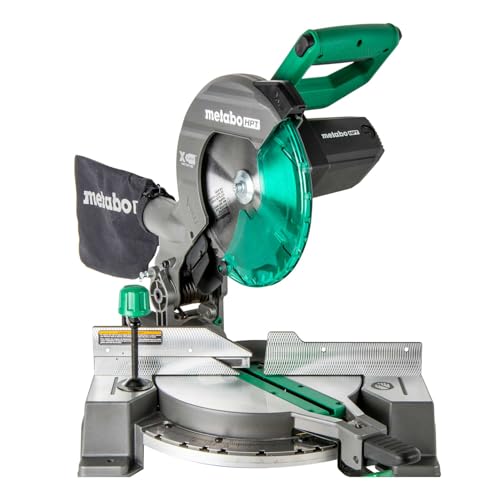
What We Like
- Lightweight, portable 24.2 lb design
- Powerful 15-Amp motor for effortless cuts
- Large table for better material support
- Includes vice clamping system for safety
Trade-offs
- Single-bevel design limits compound cuts to one direction
- No sliding mechanism, limiting crosscut capacity
A 15-Amp motor spinning at 5,000 RPM gives you the power to slice through framing lumber and trim without bogging down, which is exactly the reliable performance a beginner needs to build confidence. Its real genius is in the balance. At just over 24 pounds, it’s easy to carry to a jobsite or lift onto a bench, yet the large table and vice clamp provide a solid, secure feel for accurate miter and bevel cuts. This saw removes the intimidation factor without cutting corners on core performance, making it a trustworthy first stationery saw.
Weighing only 24 pounds, this Metabo HPT saw is easy to carry from a workshop to a job site. Its single-bevel design means you must flip wider material to make matching compound cuts on the opposite side, which can add steps to complex crown molding. While a sliding model like the Bosch 10-Inch Dual-Bevel Glide offers different features, this tool’s lighter build and simpler controls prioritize straightforward handling. For foundational DIY tasks like building a deck frame or installing baseboards, it delivers the required power and precision.
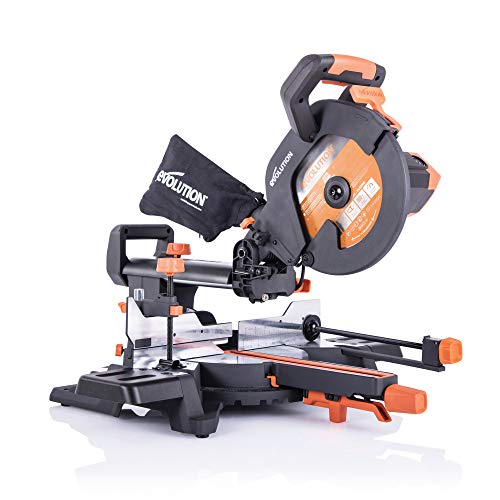
Evolution Power Tools 10-Inch Sliding Miter Saw
What We Like
- Cuts wood, metal, plastic with one blade
- Includes quick-release clamps and dust bag
- Three-year warranty for reliability
- Virtually no sparks when cutting mild steel
Trade-offs
- At 41.8 lb, it's heavier than the 24.2 lb Metabo HPT
- Slide rails increase its footprint on the workbench
Its ability to cut wood, plastic, and mild steel with one included blade defines this saw’s multi-material purpose. This allows a single tool to handle tasks that often require separate saws for wood and metal. The package includes dual quick-release clamps for securing workpieces and a dust bag for basic chip collection.
That multi-material capability results in a 41.8-pound weight. This weight requires planning for a permanent bench or a sturdy mobile stand. The Metabo HPT 10-inch model, for example, is listed at 24.2 pounds for users prioritizing lighter weight.
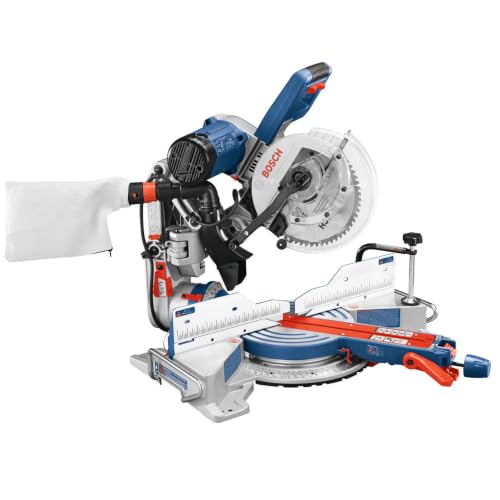
Bosch 10-Inch Dual-Bevel Glide Miter Saw
What We Like
- Articulated arms reduce front-to-back footprint significantly.
- Axial-Glide System for durable, precise sliding motion.
- Wide 12-inch horizontal cut capacity for a compact saw.
- Front-facing bevel controls for quick, easy adjustments.
Trade-offs
- At 64 pounds, it is substantially heavier than most beginner models.
- The unique glide mechanism adds complexity compared to a basic chop saw.
A 12.6-inch front-to-back footprint is the key spec here, letting this saw fit on a crowded bench where a traditional slider simply wouldn’t. Its articulated Axial-Glide System delivers full sliding capacity without the rear rails, a perfect solution for a beginner with a cramped garage or workshop. The upfront bevel lock and powerful 15-amp motor make it capable and straightforward to set up for common trim and framing tasks. This design prioritizes stationary utility over portability.
Weighing 64 pounds, this saw is substantially heavier than many competitors, like the 24.2-pound Metabo HPT, so it’s better suited for a stationary workshop than frequent job-site transport. Its articulated hinge arms reduce the front-to-back footprint by up to 10 inches compared to slide saws with similar capacity, which means it can fit into a more compact, space-efficient workstation. The design delivers professional-grade cutting capacity without requiring a professional-grade amount of floor space.
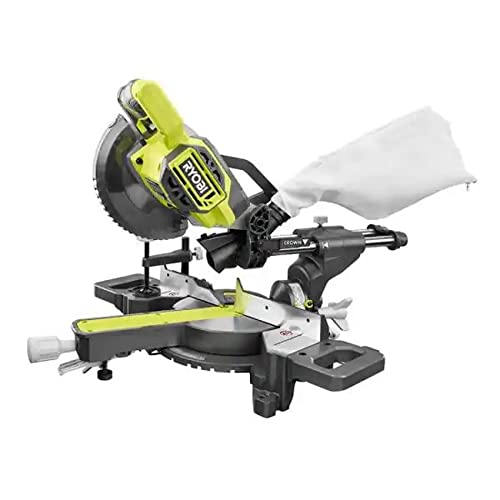
Ryobi ONE+ 18V Cordless Sliding Miter Saw
What We Like
- Cordless design for unmatched portability
- Best-in-class 2×10 cross-cut capacity
- Integrates with 260+ Ryobi ONE+ tools
- Up to 800 cuts per battery charge
Trade-offs
- 7-1/4 inch blade limits depth of cut
- Single-bevel design constrains complex angles
Its best-in-class 2×10 cross-cut capacity on a cordless platform lets you handle wide boards and framing lumber without needing an outlet, ideal for deck or fence projects away from power. The included battery and compatibility with over 260 tools in the Ryobi ONE+ ecosystem lower the initial investment. Research on a Ryobi corded model notes simple controls and setup for beginners, along with an LED cutline indicator that makes lining up compound bevels more intuitive.
That cordless convenience and capacity come with a 7-1/4 inch blade, which cannot match the depth of cut from a larger corded 10-inch saw like the Metabo HPT. You will need more passes on thicker stock, positioning this as a tool for mobility and common DIY tasks rather than milling hardwoods all day. Expert round-ups describe it as a smaller, cheaper, and less capable battery-powered alternative, though its good dust collection suits indoor use.
Bosch PROFACTOR 18V Cordless Slide Miter Saw
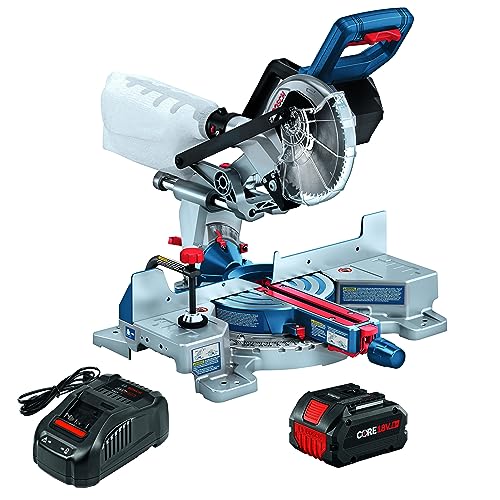
What We Like
- Lightweight 26-pound design with carry handle
- Biturbo brushless motor for cordless power
- Sliding bars for an 8-1/4 inch crosscut
- Single-bevel cutting up to 45 degrees
Trade-offs
- Battery and charger sold separately
- 7-1/4 inch blade limits depth of cut
- Single-bevel design requires flipping wide boards
At just 26 pounds, this saw is easy to lift onto a bench or carry across a yard, making it a truly mobile solution. For a beginner who values portability for deck work or trim jobs, the Bosch PROFACTOR is a serious contender. Its brushless motor is designed to make the most of Bosch’s high-power batteries, providing the runtime needed for a full day of intermittent cuts. The sliding action gives you an 8-1/4 inch crosscut, which is enough to handle most common dimensional lumber.
The major caveat is that it’s sold as a tool only, so you’ll need to factor in the cost of a battery and charger if you’re not already invested in the Bosch 18V platform. The 7-1/4 inch blade is smaller than the 10-inch blades on most stationary saws, so it can’t make as deep a cut in thick material. Compared to a corded workhorse like the Metabo HPT 10-Inch Compound Miter Saw, you’re trading unlimited runtime and a larger blade for ultimate cord-free convenience and easy transport.
DEKOPRO 10-Inch Compound Miter Saw
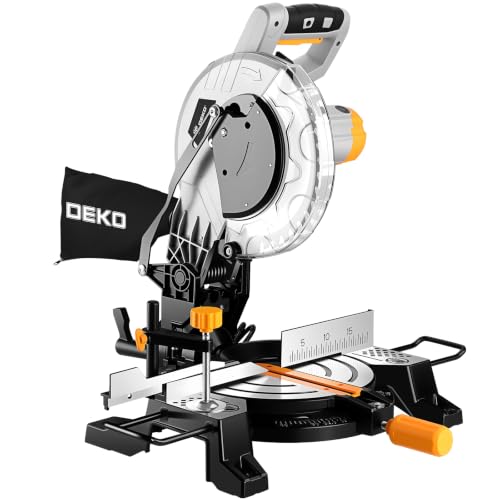
What We Like
- Lightweight 20.5-lb design for easy portability
- Transparent blade guard for clear cut line view
- Includes material clamp for improved workpiece stability
- Head locks down for compact storage
Trade-offs
- Single-bevel design limits compound cuts to one direction
- Non-sliding mechanism restricts maximum cut width
At just 20.5 pounds, this saw is easy to haul from your workshop to a jobsite and stow away when you’re done. The 13-amp motor and 5,000 RPM spin a 10-inch blade that handles common trim and framing lumber with authority. It’s a straightforward, single-bevel compound saw that delivers the essential miter and bevel adjustments a beginner needs to tackle crown molding or deck building without overwhelming complexity. This is the tool for someone who needs reliable, basic cutting power without the heft or cost of a more permanent workshop fixture.
The fixed blade design limits crosscut width to the 10-inch diameter, so wider boards require flipping. Unlike the sliding Evolution Power Tools model, it cannot cut broad panels. The included clamp and large work table are designed to hold material securely for stability during operation.
Product photos
SEESII 8-1/4-Inch Compound Miter Saw
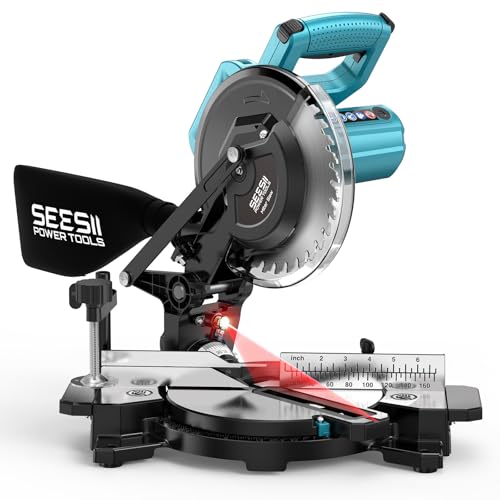
What We Like
- Integrated laser guide for precise cutlines
- Compact 20.9-inch length for portability
- Tilt protection and dual-switch safety system
- Complete kit with clamps and dust collection
Trade-offs
- Smaller 8-1/4-inch blade limits cut depth on thick stock
- Single-bevel design requires flipping workpiece for mirrored cuts
A clear laser line projected onto your workpiece eliminates the guesswork for a beginner, turning a nerve-wracking first cut into a confident one. This SEESII saw is built for the new DIYer who values safety and simplicity above raw cutting capacity. The dual safety switches require two-handed operation, a thoughtful feature that encourages good habits from the start. Its compact footprint fits easily on a workbench, and the included clamps and dust bag mean you can start a project right out of the box without hunting for extras.
The trade-off for that beginner-friendly package is in the cut. For framing 2x4s or cutting wide decking, you’ll hit the fence. If your projects demand cutting wider dimensional lumber, a model like the Metabo HPT with its larger 10-inch blade would be a more capable, though less portable, first step. This SEESII excels at introductory trim work and small crafts, not heavy renovation.
Product photos
Hoteche 7-1/4-Inch Compound Miter Saw
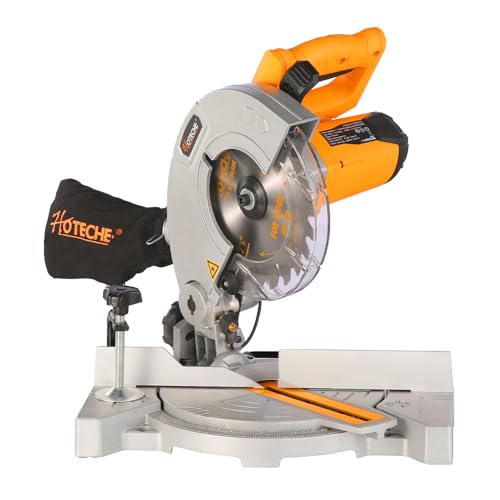
What We Like
- Built-in laser guide for precise alignment
- Lightweight aluminum base with rubber feet
- Complete kit includes essential accessories
Trade-offs
- Single-bevel design restricts compound cuts to one side
For a beginner tackling trim, picture frames, or basic 2×4 projects, that’s a sweet spot. The integrated laser guide is the star here, taking the guesswork out of lining up cuts, which is exactly the kind of confidence boost a new user needs. Add in the complete accessory kit and plug-and-play 120V operation, and you have a saw designed to get you from box to first cut with minimal fuss.
Its compact, beginner-friendly design does limit material capacity. For heavier framing or cutting 4×4 posts, you’ll need to look at a 10-inch model like the Metabo HPT. However, if your workshop is a garage corner or a driveway, and your projects are trim and DIY builds, the Hoteche’s laser-guided precision in a manageable package is a compelling starting point.
Product photos
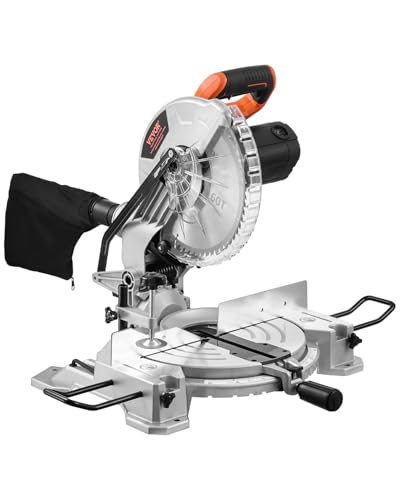
VEVOR 10-Inch Compound Miter Saw
What We Like
- Clear LED guide for precise cuts
- Lightweight aluminum base for transport
- Powerful 15-amp motor for hardwoods
- Dual-button activation for safety
Trade-offs
- Left-only bevel limits flexibility for right-side cuts
- 24.2 lb weight is average, not the lightest in class
- No sliding mechanism limits cut width capacity
An advanced LED guide system projects a clear cutting line onto your workpiece, which eliminates guesswork for precise angle alignment. Its 15-amp motor and 5000 RPM blade deliver 2800W of straight-cutting power, enough to handle hardwood and thick boards for home renovation tasks. A lightweight cast aluminum base provides easier transport than traditional cast iron while maintaining strength for continuous operation. Safety features like a dual-button activation system help prevent accidental startups during use.
The single-bevel design only tilts to the left. This can feel awkward for certain compound cuts or if you’re working in a tight corner. For strictly straight and miter cuts on narrower stock, it’s a capable and user-friendly choice. If your projects demand cutting wider boards, you’d need to look at a sliding model like the Evolution Power Tools 10-Inch Sliding Miter Saw, which adds that capability at a significant increase in weight and complexity.
Product photos
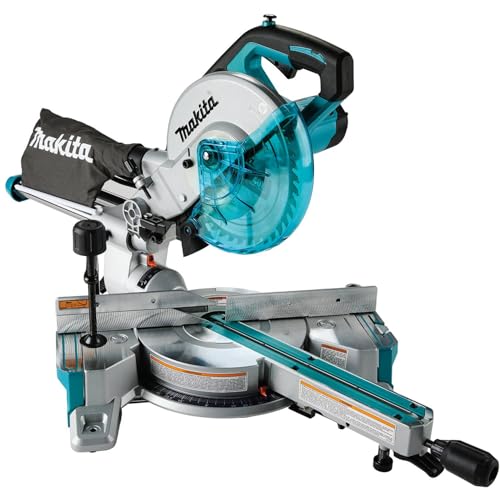
Makita 8-1/2-Inch Slide Compound Miter Saw
What We Like
- Compact and lightweight for easy job-site portability
- Linear ball bearing system for dead-on accurate cuts
- Built-in LED light illuminates the line of cut
- Soft start feature for smooth, controlled startups
Trade-offs
- 8-1/2 inch blade limits stock thickness versus 10-inch models
- Right bevel only adjusts 2 degrees, limiting some compound cuts
A sliding miter saw that weighs 30.9 pounds can cut material up to 12 inches wide at 90 degrees, which makes it easier to carry to a job site than many heavier saws. Its linear ball bearing slide is engineered for accurate cuts, and the built-in LED light illuminates the line of cut for better visibility. The soft start feature provides a smooth start-up when the trigger is pressed.
Its compact size comes with an 8-1/2 inch blade, which can’t match the vertical cut depth of a standard 10-inch saw like the Metabo HPT. You’ll be making two passes on some thicker material that a larger saw would handle in one. For a beginner focused on lighter-duty projects and portability, that’s a reasonable compromise. If your primary work involves thick dimensional lumber, you’ll want to look at a model with a larger blade diameter.
Product photos
How We Evaluated Miter Saws For Beginners
Our evaluation was based on manufacturer specifications, expert round-ups, and consistent patterns in owner feedback. We did not physically test these tools. Instead, we focused on criteria that matter most for a first-time user: ease of use, portability, safety features, and value. We prioritized saws with clear visual guides, simple controls, and a manageable weight for carrying to a workbench. We also looked for designs that support material securely and offer enough power for common DIY lumber.
A research-based approach has limits. We cannot verify the real-world feel of a cut or the long-term durability of a motor from a spec sheet. For hands-on learning, our guide on basic miter saw techniques covers essential operation.
What To Look For In Miter Saws For Beginners
Your first miter saw should feel like a helpful partner, not a complex machine. Focus on models that simplify setup and make accurate cuts intuitive.
Key criteria are blade size for your projects, a design you can easily move, safety features like blade guards and clamps, and whether a corded or cordless model fits your workspace.
Blade Size and Type
Blade diameter directly determines what you can cut. A 10-inch blade is a versatile starting point, handling common 2x4s and trim. Smaller 7-1/4 or 8-1/2-inch blades are lighter and more portable but limit the depth of cut on thicker stock. The blade’s tooth count also matters; a blade with around 40 teeth is a good all-purpose choice for both rough framing and smoother cuts on pine. Beginners should look for a saw that comes with a decent general-purpose blade to start.
Portability and Workspace
Consider where you will use the saw. A lightweight model is much easier to carry from a garage to a driveway. For a permanent installation on a bench, a heavier saw can offer more stability and cutting capacity. Cordless models provide portability but require an investment in a battery system. If your workspace is limited, look for a saw with a compact design or a rail system that does not need rear clearance, which allows it to be placed against a wall.
Ease of Use and Safety
Features that reduce guesswork are crucial for beginners. A clear blade guard lets you see your cut line. Built-in laser or LED guides project a line onto your workpiece, showing exactly where the blade will land. A material clamp is essential for holding your wood securely, making cuts safer and more accurate. Positive miter stops at common angles like 22.5 and 45 degrees make repeat cuts simple.
- Check for a clear, unobstructed view of the blade and workpiece.
- Look for a vice or clamp included in the kit.
- Ensure the power switch requires deliberate two-handed operation or has a safety lock.
- Prefer models with easy-to-read bevel and miter scales.
- Verify the saw has a mechanism to lock the head down for compact storage.
The best beginner saw is the one you’ll feel confident using for your most common projects.
Miter Saws For Beginners Compared
The following table compares key specifications for all ten miter saws we researched, helping you see trade-offs in weight, power, and capacity at a glance.
| Product | Motor / Power | Blade Size | Weight |
|---|---|---|---|
| Metabo HPT 10-Inch Compound Miter Saw | 15 Amp | 10-Inch | 24.2 lb |
| Evolution Power Tools 10-Inch Sliding Miter Saw | N/A | 10-inch | 41.8 pounds |
| Bosch 10-Inch Dual-Bevel Glide Miter Saw | 15 Amp | 10 In. | 64.0 pounds |
| Ryobi ONE+ 18V Cordless Sliding Miter Saw | 18V Cordless | 7-1/4 inches | 30.2 pounds |
| Bosch PROFACTOR 18V Cordless Slide Miter Saw | 18V cordless | 7-1/4 inch | 26.0 pounds |
| DEKOPRO 10-Inch Compound Miter Saw | 13-Amp | 10-Inch | 20.5 lbs |
| SEESII 8-1/4-Inch Compound Miter Saw | 4900 RPM | 8-1/4 inches | N/A |
| Hoteche 7-1/4-Inch Compound Miter Saw | 7.5A, 5000 RPM | 7-1/4 inches | N/A |
| VEVOR 10-Inch Compound Miter Saw | 15 Amp | 10-Inch | 24.2 Pounds |
| Makita 8-1/2-Inch Slide Compound Miter Saw | 10.5 AMP, 5,000 RPM | 8-1/2 inches | 30.9 Pounds |
Frequently Asked Questions
What is the best miter saw for beginners?
The best miter saw for a beginner balances simplicity, portability, and enough power for common tasks. Our top pick, the Metabo HPT 10-Inch Compound Miter Saw, exemplifies this with its 24.2-pound weight, straightforward single-bevel operation, and included clamping system, making it a dependable and easy-to-handle choice for standard wood cuts.
Is a 10 or 12 inch miter saw better for a beginner?
A 10-inch miter saw is generally better for a beginner. It is lighter, more affordable, and its capacity is sufficient for most DIY projects like building furniture, decks, and trim work. A 12-inch saw is heavier, more expensive, and its greater power and capacity are often overkill for a first-time user’s needs.
What is the best mitre saw for DIY?
The best miter saw for DIY depends on your projects. For general woodworking, our Best Overall Metabo HPT is excellent. If you work in various locations without easy power access, consider a cordless model like the Best Lightweight Cordless Bosch PROFACTOR. For those cutting multiple materials, the Best Multi-Material Saw from Evolution Power Tools handles wood, metal, and plastic.
Is rigid or Dewalt miter saw better?
This comparison is less relevant for beginners, as both brands offer professional-grade tools that can be more complex and costly than a starter needs. For a first saw, focus on models designed with the novice in mind, prioritizing clear guides, safety features, and a manageable size rather than brand name alone.
Should a beginner get a sliding miter saw?
A sliding miter saw increases cutting capacity for wider boards, which is valuable if your projects involve large dimensional lumber. However, sliding mechanisms add weight, cost, and a slight learning curve. Beginners doing mostly trim, 2x4s, or smaller projects may find a standard compound miter saw, like our Best Overall, to be perfectly adequate and easier to manage.
The Bottom Line
The Metabo HPT 10-Inch Compound Miter Saw is the best overall beginner saw for its winning combination of light weight, solid power, and user-friendly features like its large table and clamping system. It’s the right tool to learn on for most standard woodworking tasks.
If your budget is tight, the DEKOPRO 10-Inch Compound Miter Saw offers capable performance at an affordable price. For those tackling varied materials or needing cordless freedom, the award picks for Best Multi-Material and Best Lightweight Cordless provide specialized solutions. Ultimately, choosing a saw that matches your most common project size and that you can move comfortably will lead to more confidence and better results.
