
Can a Cordless Ratchet Break Loose Bolts? Key Takeaways
This post contains affiliate links. As an Amazon Associate, we earn from qualifying purchases.
A cordless ratchet can break loose bolts, but you must use it as a manual wrench first. The motors in tools like the Makita DWR180 (47.5 N•m max) or Ingersoll Rand R3130 (54 ft-lbs max) aren’t built for high breakaway torque. Official manuals from Snap-on and Makita instruct you to apply manual force to break the fastener free before pulling the trigger, while Ingersoll Rand advises using it manually after an automatic shut-off occurs. Trying to power through a stuck bolt stalls the motor, risks gear damage, and can void the warranty.
That “manual first” rule isn’t a suggestion, it’s printed in the safety section to protect a specific, expensive part inside the head. The motor provides speed for spinning, not brute force for breaking. People often ask, can a cordless ratchet break loose bolts?
What follows is the exact sequence those manuals specify, the numbers that define what “stuck” really means when you compare a can a cordless ratchet break loose bolts, and what happens inside the tool when you ignore the warning. By the end, you’ll know precisely when to grab the ratchet and when to reach for the breaker bar.
Key Takeaways
- Manually break the bolt first. Snap-on and Makita state this rule to prevent motor stall and gear damage, while Ingersoll Rand advises using the tool manually after an automatic shut-off.
- Respect the maximum manual torque limit (e.g., 54 ft-lbs for Ingersoll Rand). Exceeding it voids the warranty.
- A cordless ratchet is for speed in confined spaces, not for breakaway force. Its motor delivers under 75 N•m; a rusty suspension bolt can require significantly more torque to break free.
- Use impact-rated sockets. Standard chrome sockets can shatter under the sudden shock of breaking a bolt loose manually.
- If the motor stalls and shuts off, that’s the automatic safety feature. Release the trigger, use it manually to break free, then power on.
The Correct, Manufacturer-Approved Sequence
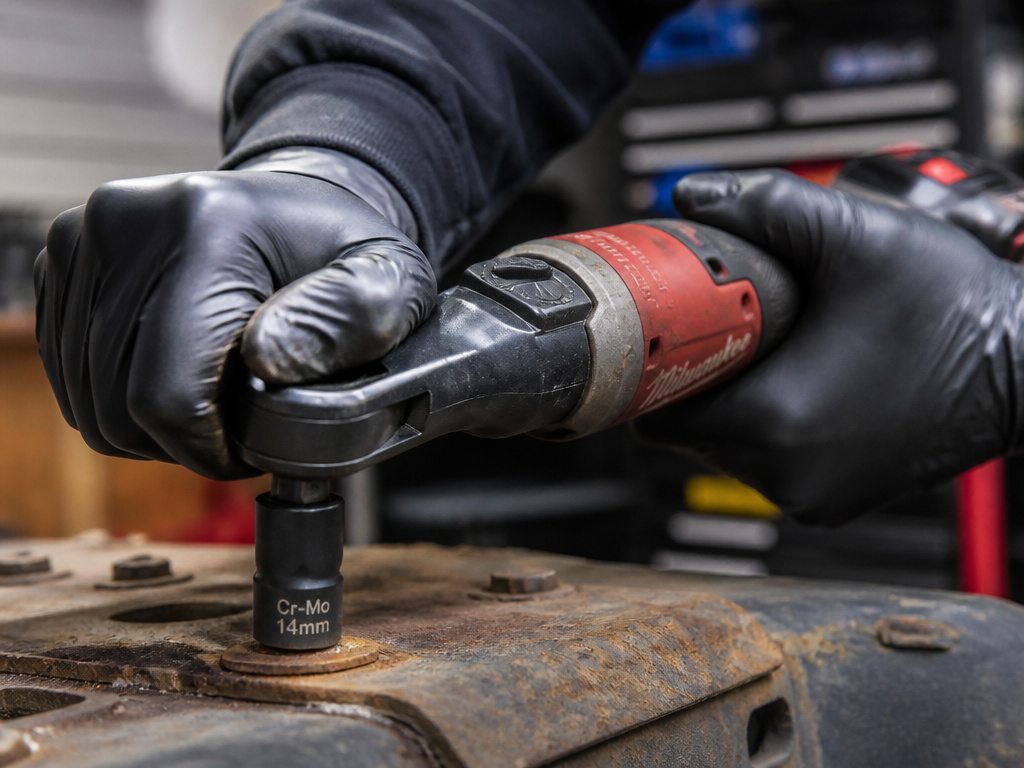
The manuals aren’t vague. Here is the direct, step-by-step translation from the Snap-on, Makita, and Ingersoll Rand guides.
First, set the direction selector to loosen. Attach an impact socket. Now, do not touch the trigger.
Apply steady, two-handed pressure on the tool’s head or handle to break the fastener’s initial grip. You’re using the tool as a pure hand ratchet. Listen and feel for the initial crack of the thread breaking free. That’s the signal.
Snap-on CTR862 manual: “If a fastener has been tightened beyond the powered limits of tool, torque can be applied manually to break the fastener free prior to pulling the trigger.”
Once the bolt moves, release your manual force, pull the trigger, and let the motor spin it out. This sequence aligns with Snap-on and Makita’s instructions, while Ingersoll Rand’s method involves using the tool manually after an automatic shut-off. The alternative is a stalled motor, a frustrated user, and a tool that gets jerked around. That jerking is what breaks teeth off the internal pawl.
What “Stuck” Really Means: The Torque Numbers
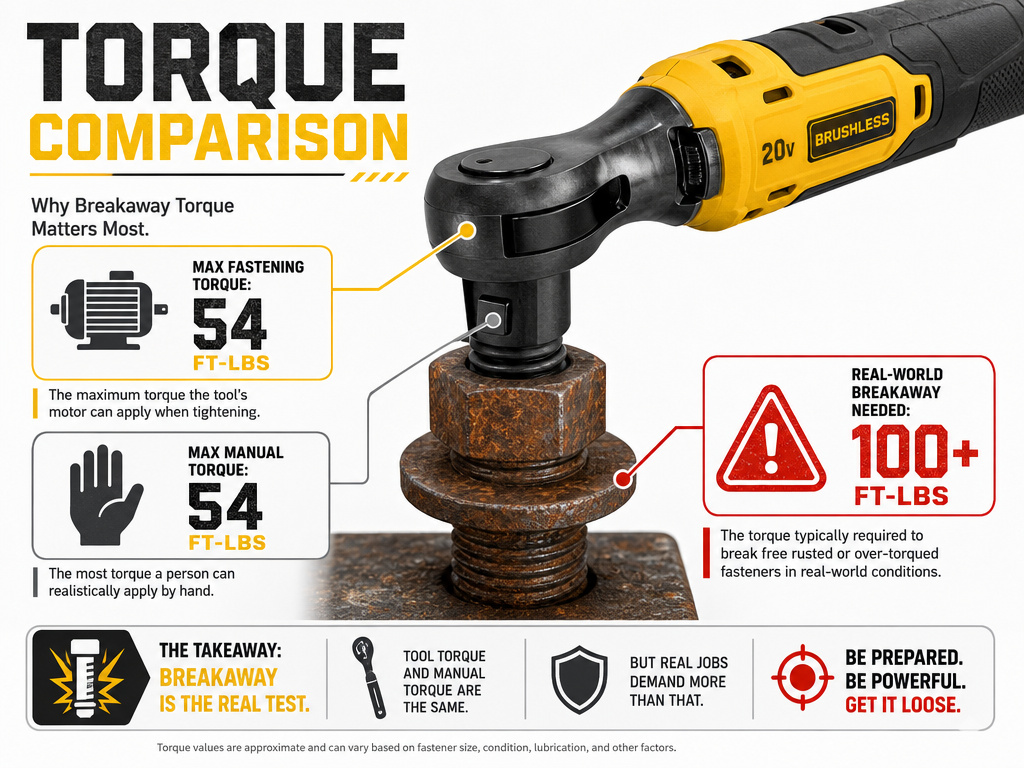
A cordless ratchet feels powerful when it zips a bolt in. That sensation betrays its actual limits. You need the numbers.
| Tool Model | Drive Size | Max Fastening Torque (Motor) | Max Manual Torque (Per Manual) | Real-World Breakaway Needed |
|---|---|---|---|---|
| Makita DWR180 | 3/8″ | 47.5 N•m (35 ft-lbs) | Not specified | M5-M12 bolts |
| Ingersoll Rand R3130 | 3/8″ | 54 ft-lbs (73 N•m) | 54 ft-lbs (73 N•m) | 10-45 ft-lbs recommended range |
| Ingersoll Rand R3150 | 1/2″ | 54 ft-lbs (73 N•m) | 54 ft-lbs (73 N•m) | 10-45 ft-lbs recommended range |
The “Max Fastening Torque” is what the motor can apply while running. The “Max Manual Torque” is the critical one, it’s the ceiling for when you’re using the tool as a hand wrench. Ingersoll Rand states that exceeding this manual limit “may cause damage to the product and will void the warranty.”
Now, a rusted suspension bolt can require far more torque to break loose than a cordless ratchet can provide. A cordless ratchet’s 54 ft-lbs limit isn’t even half of that. This gap is why the manual-first rule exists. The tool’s job is to spin the bolt out quickly after it is broken free, not to apply the initial breakaway force.
Where the Gears Are, and What Breaks
When you pull the trigger on a stuck bolt, the motor spins until it can’t. It then stalls. Modern tools like the Ingersoll Rand have an automatic shut-off that cuts power to the motor at this point to prevent burnout.
Ingersoll Rand manual: “The automatic shut-off feature shuts off power to the motor when the motor is stalled… After automatic shut-off occurs, the tool can continue to be used as a manually-operated ratchet.”
But the stall shock is still transmitted through the gears. Inside the ratchet head, a hardened steel pawl clicks over gear teeth. A sudden, high-torque shock from a stalled motor or from you putting a cheater pipe on the handle can chip or shear the corner off a tooth. The tool might still work, but it will start to slip under load, feeling gritty and unreliable.
That’s the physical consequence the manuals are guarding against. It’s not about preserving the battery. It’s about keeping the pawl and gear ring, the heart of the ratcheting function, intact.
Cordless Ratchet vs. Ratcheting Wrench: The Breaking Loose Test
This confusion is common. Both tools ratchet. Their breaking-loose abilities are not the same, which directly addresses can a cordless ratchet break loose bolts.
A dedicated ratcheting wrench is a solid bar of steel. Its pivot point is directly over the fastener, and you can put a pipe over the end to apply more force. All the force goes into turning the bolt. The ratchet mechanism is built as a single, stout component to handle this.
A cordless ratchet is a motor attached to a ratchet head. The head is often smaller to fit into tight spots, and the handle houses electronics. The pivot point is higher, and the internal gears are designed for the motor’s continuous output, not for a massive, one-time shock load from a breaker bar.
For breaking loose, the ratcheting wrench wins every time. It’s the right tool for that job. The cordless ratchet is the right tool for what comes next: quickly removing that now-loosened bolt from a cramped valve cover.
When to Use It, When to Grab Something Else
The cordless ratchet has a specific job description. Here is the decision tree.
Reach for the cordless ratchet when:
- You’re working in a confined space (engine bay, under dash, inside furniture).
- The fastener is tight but not seized or corroded.
- You have many fasteners to run in or out. The speed payoff is huge.
Immediately grab an impact wrench or breaker bar when:
- You see visible rust or corrosion on the fastener.
- It’s a high-torque fastener (lug nut, caliper bracket, suspension component).
- The fastener is aluminum and prone to galling.
- Your first attempt with steady manual pressure on the ratchet doesn’t budge it.
If you catch that scent, you’ve already asked the tool to do a job it wasn’t built for. Stop.
The One Safety Rule Everyone Skips
Wear ear protection. It sounds trivial for a tool that isn’t an impact gun.
A cordless ratchet like the Makita DWR180 has a no-load speed of up to 800 RPM. In a quiet garage or under a car, that high-pitched whine is concentrated right near your ear. Prolonged use in confined spaces can lead to hearing damage. That’s cumulative hearing damage.
The Makita manual lists “Wear ear protectors” as a specific safety warning for this tool. It’s not a generic suggestion. It’s there because in confined spaces, the sound reflects back at you. Use foam plugs or muffs. Your future self will notice.
Battery size recommendations (compact vs. XC for access)
Battery size is a trade-off between runtime and tool head clearance. A compact battery pack keeps the overall profile slim, which is critical for squeezing the ratchet head into tight spots like around engine brackets or between suspension components. This lower weight also reduces hand fatigue during overhead work. A larger, extended capacity battery will last longer between charges for big jobs but adds bulk at the tool’s base, which can interfere in confined spaces. Choose the smallest battery that gives you enough runtime for your typical task to maximize access.
Comparison to air ratchets (kicking, noise, hose)
A cordless ratchet eliminates the air hose, which is a major advantage over pneumatic tools. No hose means no tangling, no trip hazard, and no need to drag a compressor line into tight engine bays. Cordless models also operate much quieter. However, they lack the sudden ‘kick’ or impact pulse that some air ratchets use to initially break a fastener. Instead, a cordless ratchet applies steady rotary force. If a bolt is stuck beyond the tool’s motor power, the tool may simply stall. Manufacturers state that after an automatic shut-off from stalling, you can then use the tool as a manual ratchet to break the bolt free, provided you do not exceed its manual torque limit.
Specific applications (brake jobs, valve covers, spark plugs)
It saves time and wrist action. For spark plugs, use caution. The tool is excellent for spinning out the long plug once it’s initially broken loose by hand, but you should never use power to seat the new plug, as overtightening is a serious risk. Always refer to a torque wrench for final tightening. In any application, if you encounter hidden wiring, hold the tool only by its insulated gripping surfaces to prevent shock.
Frequently Asked Questions
Can you use a cordless ratchet to break bolts loose?
Yes, but only by using it as a manual hand wrench first. Apply steady pressure to crack the bolt free before you pull the trigger to engage the motor. This is the official procedure from Snap-on, Makita, and Ingersoll Rand.
What is the strongest cordless ratchet?
Based on available manufacturer specs, the Ingersoll Rand R3130 and R3150 list a maximum torque of 54 ft-lbs (73 N•m). However, “strongest” is misleading. No cordless ratchet is designed for high breakaway torque; they are designed for speed and access. For breaking bolts loose, a tool’s maximum manual torque rating is more important than its motor’s fastening torque.
Can you use impact sockets on a cordless ratchet?
Yes, you must. Always use impact-rated sockets. The shock of breaking a bolt loose manually, or the sudden stop from a motor stall, can create enough instantaneous force to fracture a standard chrome socket. Impact sockets are forged and tempered to absorb this shock.
Is a cordless ratchet better than an impact wrench for tight spaces?
For pure access, yes. A cordless ratchet head is slimmer and shorter than an impact wrench, letting you fit into places an impact can’t. For breaking loose bolts, no. An impact wrench delivers sudden, rotational hammer blows specifically designed to shock fasteners loose, that’s its core function.
Why did my cordless ratchet stop spinning but the light is on?
The motor has stalled and the automatic shut-off has engaged. This is a normal safety feature. Release the trigger completely, then use the tool as a manual wrench to break the fastener free. Once it’s moving, you can pull the trigger again to resume powered operation.
Before You Go
The rule is simple, but it requires discipline: hands before power. Your cordless ratchet is a spectacular time-saver for the run-down, not the break-loose. Its value is in the spin, not the crack.
If a bolt doesn’t move with steady, two-handed pressure on the ratchet, that’s the tool telling you the job has escalated. Listen to it. Put the ratchet down and get a breaker bar or impact wrench. You’ll save thirty minutes of struggle and a very expensive repair bill for a stripped ratchet head.
For the majority of automotive and assembly work, spark plugs, valve covers, intake manifolds, furniture, and trim, following the manual-first sequence turns the cordless ratchet from a frustrating gadget into the most reached-for tool in your kit. That’s where it earns its keep.
