
10 Best Compound Saws in 2026
This post contains affiliate links. As an Amazon Associate, we earn from qualifying purchases.
Our best overall pick is the DEWALT DWS780 for its precise XPS LED shadow line and powerful motor. For those seeking premium performance at a lower price, the DEWALT DWS779 offers excellent value, while the BOSCH CM10GD wins for compact, wall-flush operation. Choosing a compound miter saw means balancing cutting capacity, precision, and the space you have available.
The wrong saw can leave you struggling with inaccurate cuts or a machine that consumes your entire workbench. We researched specifications, expert round-ups, and patterns in owner feedback to bring you these ten distinct picks, each suited to a different priority.
Top 10 Compound Miter Saws in the Market
Certain content that appears on this site comes from Amazon. This content is provided "as is" and is subject to change or removal at any time.
The Best Compound Miter Saws, Reviewed
DEWALT DWS780 12-Inch Double Bevel Miter Saw

What We Like
- XPS LED shadow line for precise cut alignment
- Powerful 15 amp motor for heavy-duty applications
- Integrated cutline system requires no adjustment
- Comes perfectly calibrated out of the box
Trade-offs
- Weighs 54.7 pounds, making transport a two-person job
A 15 amp, 3800 rpm motor delivers the guts for continuous cutting in framing or trim, and the real magic is the XPS light. That shadow line eliminates guesswork, letting you line up cuts perfectly every time without fiddling with lasers. This saw is built for the contractor or serious DIYer who needs dead-on accuracy and reliability day in and day out. It handles heavy workloads without complaint, and the dust collection actually works, keeping your workspace cleaner.
The trade-off for that capability is heft and footprint. At nearly 55 pounds and standing four feet tall, this isn’t a saw you’ll casually toss in your truck. It demands a permanent spot on a sturdy stand. If shop space is tight, the Bosch CM10GD with its compact arm design saves a lot of room while still offering dual-bevel cuts. But for a primary station saw where precision and power are non-negotiable, the DWS780’s performance is hard to beat.
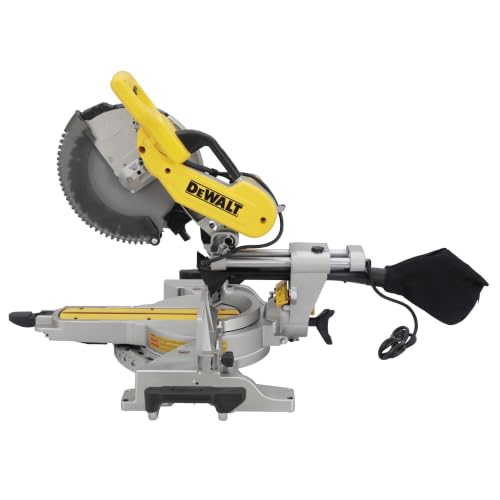
DEWALT DWS779 12-Inch Sliding Compound Miter Saw
What We Like
- Powerful 15 Amp motor for demanding cuts
- Tall sliding fences support large crown molding
- Adjustable miter detent plate with 10 positive stops
- Dust collection captures over 75% of debris
Trade-offs
- Heavy at 67.7 lb, making it cumbersome to move frequently
- Dust bag system works but isn't a full shop-vac solution
A 15 Amp motor and the capacity to crosscut a 2×14 board mean this saw handles the framing and trim work found in most serious DIY and professional projects without complaint. This is the saw for the builder who needs reliable, repeatable cuts on a budget, not every conceivable bell and whistle.
The main trade-off is a lack of refinement compared to DeWalt’s own models. You forgo features like the XPS shadow light system found on the DWS780, which reviewers report helps with alignment. That means using a traditional blade-mounted laser or marking lines yourself, a step back in convenience for intricate trim work. For the money, however, you’re getting a proven design with an adjustable stainless-steel miter detent plate for accurate stops. It’s a pragmatic choice that puts capability before flash, leaving room in your budget for a better blade or a sturdy stand.
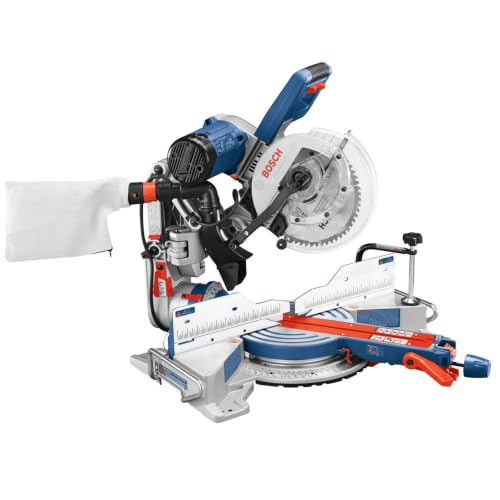
BOSCH CM10GD 10-Inch Dual-Bevel Glide Miter Saw
What We Like
- Axial-Glide System for durable, precise sliding action.
- Compact footprint saves up to 10" of rear clearance.
- Front-mounted bevel lock and selector for easy adjustments.
- Tall sliding fences increase crown molding capacity.
Trade-offs
- At 64 pounds, it's heavy for frequent job-site relocation.
- 12-inch horizontal cut is narrower than many 12-inch sliders.
Its articulated hinge arms pull the saw’s action forward, reducing the front-to-back footprint by up to ten inches compared to slide saws with similar capacities. This space-saving design means it can be placed closer to a wall in a workshop. The powerful 15 Amp motor delivers 4,800 RPM for professional cutting, while upfront bevel controls and a wide 47-degree range simplify complex angle setups.
The Axial-Glide system offers more durable precision than side rail systems and eliminates rails that can clog. Its wide capacities include a 12-inch horizontal cut and a 6-inch crown cut nested against the fence. Reviewers mention its compact design with forward fixed rails and large, easy-to-set scales.
Makita LS1219L 12-Inch Dual-Bevel Sliding Miter Saw

What We Like
- Unique sliding system allows flush wall placement
- Increased vertical capacity for tall moldings
- Dual dust ports for better dust extraction
- In-front bevel lock for convenient adjustments
Trade-offs
- At 81.6 lb, it is a heavy, stationary workshop tool
- Large 36-inch width demands a dedicated, spacious bench
The Makita LS1219L’s 2-steel rail sliding system is its defining feature, pulling the saw’s mechanism forward on a single glide instead of needing rear clearance. This lets you park it permanently against a wall in a tight shop, a major space-saving advantage for detailed trim work. The design also delivers a solid 15-inch crosscut and a notable 6-3/4 inches of vertical capacity, so you can handle wide boards and tall crown molding nested vertically without a second thought. It’s the logical pick for the finish carpenter or serious DIYer who needs maximum cutting capacity in a minimum floor footprint.
That capability comes with real heft. At over 80 pounds, this is not a saw you’ll casually move from the garage to the job site. Its substantial size and weight demand a sturdy, permanent stand or workbench. If portability is your primary concern, a model like the 54.7-pound DEWALT DWS780 is a more mobile option, though it lacks the wall-flush sliding action. The Makita trades easy transport for exceptional stability and space-efficient operation right where you need it most.
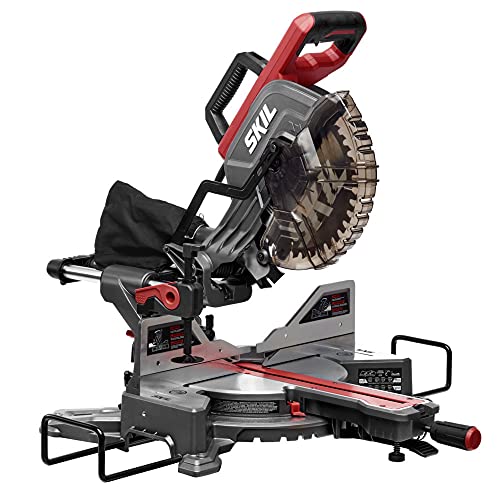
SKIL MS6305-00 10-Inch Dual Bevel Sliding Miter Saw
What We Like
- LED shadow line for accurate blade alignment
- Powerful 15-amp motor for quick cuts
- Cuts wide 2×12 boards at 90 degrees
- Dual-bevel design with positive stops
Trade-offs
- At 39.4 lb, it's heavier than some basic compound saws
- Lacks the compact footprint of a glide-arm saw
A 2×12 cutting capacity means you can handle most common dimensional lumber for decks and framing without flipping the board. The 15-amp motor provides plenty of power for repetitive crosscuts, and the dual-bevel feature adds versatility for crown molding.
You do trade some portability for that capability, as its 39.4-pound weight is noticeable when moving it from the truck to the job site. The sliding rail design also requires more depth on your workbench compared to a space-saving option like the Bosch CM10GD. However, for the woodworker who needs a reliable, full-featured sliding saw without the premium price tag, the SKIL MS6305-00 covers the fundamentals exceptionally well.
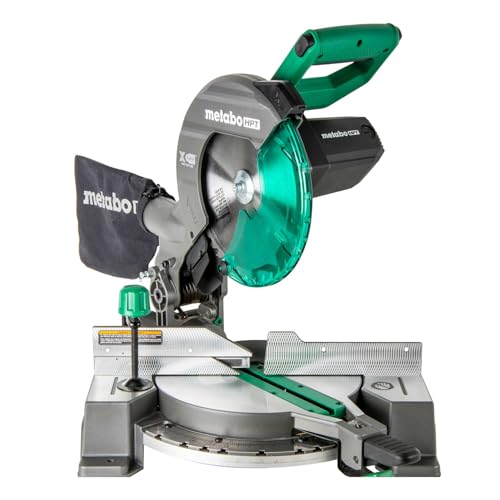
Metabo HPT C10FCG2 10-Inch Compound Miter Saw
What We Like
- Lightweight 24.2 lb design for easy transport
- Powerful 15-amp, 5,000 RPM motor for clean cuts
- Improved miter scale and controls for accuracy
- Includes a vice clamping system for secure work
Trade-offs
- Single-bevel design limits compound cuts to one direction
- No sliding mechanism, limiting crosscut capacity versus sliders
At just over 24 pounds, this saw is remarkably portable for anyone who needs to move their tool constantly. Its 15-amp motor spins a 10-inch blade at 5,000 RPM, delivering plenty of power for trim and framing lumber. The compact footprint also makes it easy to stash in a vehicle or a crowded workshop. Finish carpenters hopping between job sites or DIYers working in a garage that doubles as a parking space will find it a logical choice. An improved miter scale and clamping system provide the precision needed for clean joints, even without a permanent bench.
This miter saw weighs just over 24 pounds, making it one of the lightest in its class and easy to carry between job sites. Its compact, non-sliding design trades the extended cutting width of a sliding saw for greater portability and a smaller footprint in a truck or workshop. The tool is a single-bevel model, meaning it can only tilt in one direction for beveled cuts, which can require flipping the workpiece for certain complex joints.
Product photos
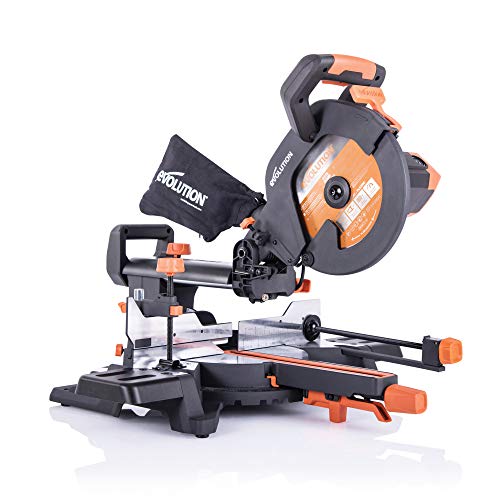
Evolution R255SMS+ 10-Inch Sliding Miter Saw
What We Like
- Cuts steel, wood, plastic with one blade
- Includes quick-release clamps and dust bag
- Three-year warranty for reliability
- Integrated carry handles for easier transport
Trade-offs
- Sliding rails add depth compared to compact saws
A single TCT blade that slices through wood, plastic, and even mild steel makes this a true workshop multitasker. For the contractor or serious DIYer dealing with mixed materials, think framing with nails, metal studs, or composite trim, it eliminates the constant blade changes that kill momentum. The included clamps and dust bag are thoughtful touches that mean it’s ready to work right out of the box, and the three-year warranty signals built-for-business confidence.
A key consideration is its 50-degree to 50-degree miter range, which is sufficient for common trim but may not accommodate the most extreme compound angles some woodworkers require. The sliding rails add depth compared to compact saws, so it demands a solid stand and more space behind the bench. While a dedicated wood blade on a standard miter saw can yield a smoother finish in wood alone, the Evolution’s multi-material capability keeps it ready for a mixed project list.
Product photos
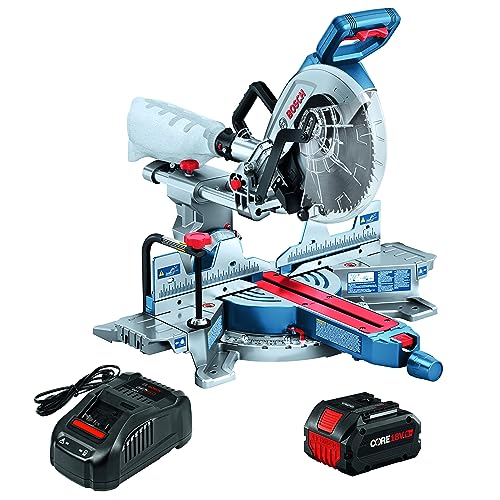
BOSCH GCM18V-10SDN14 Cordless Slide Miter Saw
What We Like
- Large crosscut capacity for a cordless model
- Dual-bevel design for compound cuts to either side
- Tall fence supports taller material accurately
- Lightweight for a 10-inch sliding miter saw
Trade-offs
- Sold as a tool-only kit; battery and charger are separate purchases
- 40.2 lb weight, while portable, still requires consideration for transport
With a crosscut capacity of 11-1/2 inches, this cordless saw can handle wide crown molding or a 2×12 board without needing an outlet. Its dual-bevel design and tall fence support taller material for accurate cuts on complex trim work. The brushless motor and drive-train are engineered to take full advantage of the additional power from Bosch’s CORE18V high-power batteries.
The tool weighs 40.1 pounds and has a carry handle, which makes it manageable to transport for a mobile jobsite solution. A major consideration is that the battery and charger are sold separately, so it’s a dedicated tool for users already invested in the Bosch 18V platform. For shop-based work with constant power, a corded model like the 64-pound BOSCH CM10GD presents an alternative without runtime concerns.
Product photos
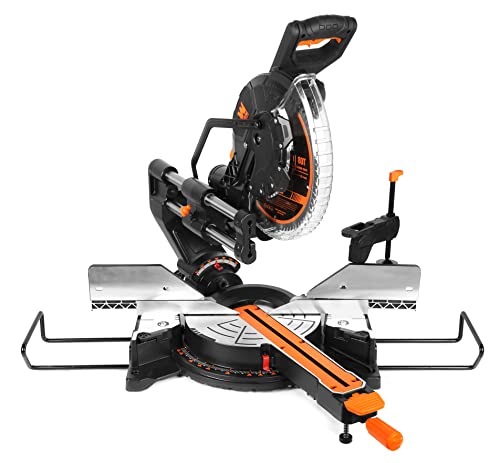
WEN MM1215 12-Inch Dual Bevel Sliding Miter Saw
What We Like
- Dual-rail slide minimizes footprint against a wall
- LED cutline guide illuminates the cut for accuracy
- Includes 80-tooth carbide blade and extension arms
- Dual-bevel and 9 miter stops provide versatile angles
Trade-offs
- At 53.5 lb, it's a substantial lift for frequent transport
- Dust collection is a basic port and bag system
A 15-amp motor driving a 12-inch blade through 13.25-inch wide boards brings serious job-site capacity to a modest budget. It suits the DIYer or contractor who needs to handle large trim, decking, or framing lumber but can’t justify a pro-tier investment. With dual-bevel action and a sliding rail, you can tackle complex crown molding or wide planks without constantly flipping the workpiece. This full-featured workhorse puts big cuts within reach.
The WEN MM1215 crosscuts boards up to 13.25 inches wide, a capacity that handles wide trim and decking. Its dual-rail slide system allows for compact operation flush against a wall, which minimizes the saw’s footprint on a workbench. The tool includes an 80-tooth carbide-tipped blade and two quick-lock table extension support arms, so it arrives ready for tasks without needing immediate accessory purchases.
Product photos
Makita XSL06PT Cordless Sliding Miter Saw

What We Like
- Cordless operation with two-battery power
- Automatic speed change for optimal cuts
- Substantial cuts per charge on dimensional lumber
Trade-offs
- Weighs 80.5 pounds, making it cumbersome to move
The Makita XSL06PT runs on two 18V LXT batteries, which provides cordless operation for job sites or workshops without an outlet. Makita’s x2 technology can deliver up to 334 cuts in a 2×4 SPF lumber per charge using two 5.0Ah batteries, allowing for extended cutting sessions. This cordless design suits framers or deck builders who need to work away from power sources but still require substantial cutting capacity.
That cordless capability comes with a physical trade-off. At 80.5 pounds, this saw is a beast to lift onto a stand. It’s a tool you’ll likely set up on a dedicated stand and leave there, which adds stability for a contractor’s multi-day station or a serious DIYer’s workshop corner. However, the weight is a genuine consideration for anyone who needs to frequently move their saw between sites.
Product photos
How We Evaluated Compound Miter Saws
Our selection is based on research into manufacturer specifications, documentation, and expert tool round-ups. We also looked at consistent patterns in owner feedback. The focus was on criteria critical for this category: cutting capacity for both crosscut width and vertical crown molding height, precision features like cutline guides and detent plates, and the physical footprint of the saw’s sliding mechanism.
A saw’s weight and motor power are also key factors, determining its portability and ability to handle dense hardwoods. This evaluation is based on product specifications and common user considerations.
What To Look For In Compound Miter Saws
The right miter saw fits your projects and your workspace. Your choice hinges on the material sizes you cut, the precision you need, and how much bench or floor space you can dedicate.
Prioritize crosscut capacity for wide boards, a dual-bevel feature for complex trim work, and a compact sliding system if your shop is tight against a wall.
Blade Size & Cutting Capacity
Blade diameter, typically 10 or 12 inches, dictates the maximum thickness of a vertical cut. More important for width is whether the saw slides. A basic compound miter saw pivots and tilts but has a fixed crosscut width, often around 6 inches. A sliding compound miter saw adds a sliding carriage, extending the cutting width to 12 inches or more for handling wide boards and dimensional lumber. For cutting tall crown molding nested against the fence, also check the vertical clearance between the blade and the fence.
Bevel Capability & Precision Features
A single-bevel saw only tilts in one direction (usually to the left), which can force awkward workpiece flips for matching compound angles. A dual bevel miter saw tilts both left and right, saving time and improving accuracy on complex trim. For precision, look for a reliable cutline indicator, either a laser or an LED shadow system like DeWalt’s XPS, and a miter detent plate with positive stops at common angles like 22.5 and 45 degrees. These features are crucial for consistent, accurate results.
Footprint & Portability
The sliding mechanism dramatically affects a saw’s depth. Traditional rear-rails can need over 40 inches of clearance behind the saw. Compact sliding systems like axial-glide or articulating-arm designs save up to a foot of depth, allowing flush wall placement, a major advantage in small shops. Weight is the final factor; a 50+ pound saw is a stationary shop tool, while models under 30 pounds are viable for job-site mobility. Consider if you’ll move the saw often or if it will live on a dedicated bench.
- Check the saw’s depth with the slide fully extended if rear clearance is limited.
- Verify the dust port size and whether it includes a bag, as collection efficiency varies.
- Ensure the fence is tall and sturdy enough to support your material securely.
The best saw is the one that handles your most common project sizes without dominating your workspace.
Compound Miter Saws Compared
The following table compares key specifications across our picks to highlight their differences at a glance.
| Product | Motor Power | Weight | Bevel Range |
|---|---|---|---|
| DEWALT DWS780 12-Inch Double Bevel Miter Saw | 1100 watt, 15 amp | 54.7 pounds | Double Bevel |
| DEWALT DWS779 12-Inch Sliding Compound Miter Saw | 15 Amp, 3800 RPM | 67.7 pounds | 49° right and left |
| BOSCH CM10GD 10-Inch Dual-Bevel Glide Miter Saw | 15 Amp, 4,800 RPM | 64.0 pounds | 47° left/right |
| Makita LS1219L 12-Inch Dual-Bevel Sliding Miter Saw | N/A | 81.6 pounds | Dual-Bevel |
| SKIL MS6305-00 10-Inch Dual Bevel Sliding Miter Saw | 15 Amp, 4,800 RPM | 39.4 pounds | 48° & 45° left, 0°, 45° right |
| Metabo HPT C10FCG2 10-Inch Compound Miter Saw | 15 Amp | 24.2 lb | 0-45° left |
| Evolution R255SMS+ 10-Inch Sliding Miter Saw | N/A | 41.8 pounds | 0° – 45° |
| BOSCH GCM18V-10SDN14 Cordless Slide Miter Saw | Biturbo Brushless | 40.2 lbs | Dual-bevel |
| WEN MM1215 12-Inch Dual Bevel Sliding Miter Saw | 15-amp | 53.5 pounds | 45 degrees either direction |
| Makita XSL06PT Cordless Sliding Miter Saw | N/A | 80.5 pounds | Dual-Bevel |
Frequently Asked Questions
What is the best brand of compound miter saw?
No single brand is best for every user. Brands like DeWalt, Bosch, and Makita consistently rank high for their build quality, powerful motors, and innovative features like compact glide systems or precise cutline guides. Your choice should be based on the specific model’s capacity, features, and how they match your primary use case, whether that’s a stationary shop or mobile job site.
What is the best value compound mitre saw?
Value means getting professional-grade capacity and features without a premium price. The DEWALT DWS779 is our value pick because it delivers a powerful 15-amp motor and tall sliding fences for large molding. It also has an effective dust collection system. This model matches the performance of more expensive saws while forgoing some premium convenience features like an integrated LED cutline system.
What are the 10 best miter saws?
Our list of the ten best compound miter saws includes top models for different needs. It covers the best overall (DEWALT DWS780) and the best value (DEWALT DWS779). The list also features the most compact design (BOSCH CM10GD), the best wall-flush saw (Makita LS1219L), top budget options, and specialized picks for cordless operation or cutting multiple materials.
Should I get a 10-inch or 12-inch miter saw?
A 10-inch saw is often lighter, more affordable, and sufficient for most trim and common lumber. A 12-inch blade provides greater vertical cut depth for thicker material. For maximum crosscut width, however, the sliding mechanism matters more than blade size; a 10-inch slider can often cut wider than a non-sliding 12-inch saw. Consider a 12-inch compound miter saw if you regularly work with thick stock or want the largest possible capacity.
What’s the difference between a chop saw and a miter saw?
A chop saw, or abrasive cut-off saw, is designed primarily for cutting metal using a abrasive wheel and typically only makes straight 90-degree cuts. A compound miter saw uses a toothed blade for wood and can make angled miter and bevel cuts. Our guide focuses on compound miter saws for woodworking and construction; for dedicated metal cutting, you would look for specific chop saws.
The Bottom Line
For the woodworker or contractor who needs a precise, powerful saw that’s ready for serious shop work, the DEWALT DWS780 stands out with its factory calibration and excellent XPS cutline system. If your budget is tighter but you still need professional sliding capacity, choose the DEWALT DWS779. For a workshop where every inch counts, the space-saving BOSCH CM10GD is the clear winner.
Before deciding, honestly assess the widest and tallest material you need to cut. This will tell you if you need a basic compound saw, a sliding model, or a compact glide design. Matching the saw’s capacity to your actual projects is the most important step in choosing the right tool.
