
10 Best Circular Saw Blades For Plywood in 2026
This post contains affiliate links. As an Amazon Associate, we earn from qualifying purchases.
Our best overall pick for cutting plywood is the CMT ORANGE TOOLS P07060 Circular Saw Blade, thanks to its super-thin kerf and 10-degree shear angle for clean, waste-reducing cuts. For a premium finish on veneers, the Freud Thin Kerf Ultimate Plywood Blade excels, while the WORKPRO Fine Finish Circular Saw Blade is our favorite budget-friendly option.
Choosing the wrong blade can leave you with chipped veneers and frustrating tear-out. A blade designed specifically for plywood makes all the difference in achieving a smooth, ready-to-glue edge. We researched specifications, expert round-ups, and owner feedback to identify the ten blades that deliver the best results for this tricky material.
Top 10 Circular Saw Blades For Plywood in the Market
Certain content that appears on this site comes from Amazon. This content is provided "as is" and is subject to change or removal at any time.
The Best Circular Saw Blades For Plywood, Reviewed
CMT ORANGE TOOLS P07060 Circular Saw Blade

What We Like
- Super-thin kerf reduces material waste.
- 10-degree ATB shear angle for smooth cuts.
- Orange Shield coating reduces pitch and corrosion.
- Excellent finish on plywood and melamine.
Trade-offs
- 7-1/4 inch diameter limits cutting depth on thick stock.
- Specialized for crosscuts and finish work, not for ripping.
With 60 teeth and a 10-degree ATB shear grind, this blade is designed for crosscuts on materials like plywood and melamine, producing a smooth finish on both sides. Its super-thin kerf reduces cutting force and material waste, which can make a portable saw easier to control. This makes it a practical choice for visible cuts in cabinetry or furniture where a clean edge is required.
Built for precision, the thin plate and kerf are optimized for crosscutting sheet goods and lumber, not for heavy ripping tasks. Compared to a 10-inch blade like the Freud Ultimate Plywood, it is a lighter-duty option suited for portable circular saws. It aims to deliver a fine finish in a hand-held tool, fitting for panel breakdown and finish work.
Product photos
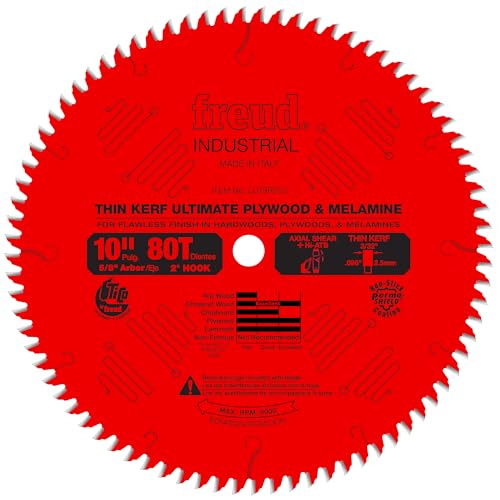
Freud Thin Kerf Ultimate Plywood Blade
What We Like
- Hi-ATB geometry for superior shearing and tear-out reduction
- Laser-cut anti-vibration slots for a crisp, splinter-free finish
- Premium TiCo carbide blend for maximum edge retention
- Perma-Shield coating reduces friction and heat buildup
Trade-offs
- At 1.7 pounds, it is heavier than many 7-1/4 inch blades
- Requires a 10-inch saw, limiting compatibility with smaller tools
- Designed for finish cuts, not for fast ripping or framing work
An 80-tooth Hi-ATB design shears through plywood veneers and melamine, leaving an edge clean enough for finish carpentry right off the saw. This blade is built for cabinetmakers and serious woodworkers who need a flawless, chip-free surface on expensive sheet goods without additional sanding. The premium TiCo carbide and anti-vibration slots ensure that polished result holds up over time.
Designed for ultra-smooth, chip-free edges in veneered plywood and melamine, the Freud LU79R010 blade is built for finish carpentry and cabinetmaking. Its high-density TiCo crosscutting blend aims to maximize cutting performance and edge retention in tough woods. The Hi-ATB tooth geometry provides a shearing action intended to reduce tear-out on delicate materials, while laser-cut anti-vibration slots are meant to reduce movement for a splinter-free finish.
Product photos
Diablo Finish Saw Blade

What We Like
- Super thin kerf for fast, clean cuts with minimal waste
- Perma-SHIELD coating resists heat, gumming, and corrosion
- TiCo carbide teeth deliver smooth crosscuts in plywood
- Hardened steel body enhances longevity and edge retention
Trade-offs
- 7-1/4 inch diameter limits depth of cut versus a 10-inch blade
- Primarily designed for wood, not ideal for abrasive materials like OSB
A super thin laser-cut kerf is the star here, slicing through plywood with impressive speed and leaving behind very little sawdust. That means less work for your saw and less wasted material, which is a major plus for big sheet goods projects. This 40-tooth Diablo is a fantastic all-rounder for the contractor or serious DIYer who needs one blade to handle everything from framing lumber to plywood. It delivers clean enough cuts to minimize sanding, and the Perma-SHIELD coating really does fight off the pitch and gunk that builds up when cutting manufactured sheets.
The Diablo Finish Saw Blade is a versatile 7-1/4-inch option designed for both rip and crosscuts in wood and plywood. Its 40-tooth ATB design and super thin kerf provide fast, clean cuts with minimal material loss, making it efficient for general construction and shop tasks. While research mentions praise Diablo blades for cutting straighter and cleaner than competitors, this model is positioned as a reliable workhorse for a wide range of cuts rather than a specialist for the finest finishes.
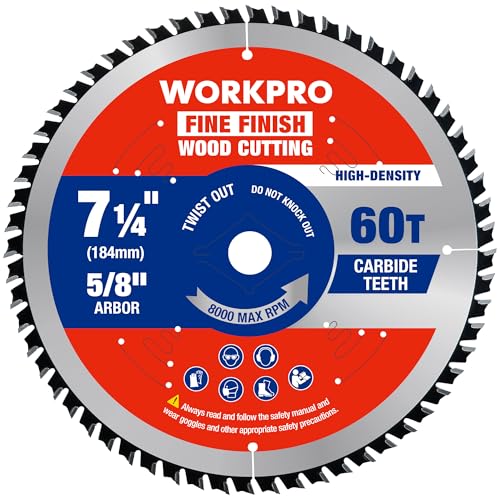
WORKPRO Fine Finish Circular Saw Blade
What We Like
- Thin kerf design for faster, cleaner cuts with less effort.
- ATB tooth geometry reduces splintering for precise cuts.
- Carbide-tipped teeth provide long-lasting sharpness and wear resistance.
- Fits most common 7-1/4 inch circular saws for wide compatibility.
Trade-offs
- Thin kerf can deflect more in dense hardwoods than a full-kerf blade.
A 7-1/4 inch blade with 60 teeth and a thin kerf is designed for smooth, clean cuts in wood with reduced cutting resistance. The WORKPRO Fine Finish Circular Saw Blade uses an alternating top bevel tooth geometry for this purpose, which the manufacturer states helps reduce splintering. Its listed applications include plywood, hardwood, softwood, and trim.
The trade-off is in specialization. While it handles plywood well, it lacks the ultra-high tooth count or dedicated shear angles of a purpose-built plywood blade. A tool like the Freud Thin Kerf Ultimate Plywood Blade is engineered to virtually eliminate tear-out on fragile veneers. For breaking down sheets for cabinets or building a shed, the WORKPRO is a capable and sensible performer. When your project demands absolute, splinter-free perfection in expensive hardwood plywood, you’ll want to step up to a more focused tool.
Product photos
Freud Ultimate Plywood & Melamine Blade

What We Like
- 80-tooth HiATB design for splinter-free cuts
- Laser-cut anti-vibration slots reduce chatter
- Perma-Shield coating reduces drag and corrosion
- Premium TiCo carbide for long edge life
Trade-offs
- At 2.0 pounds, it is heavier than many 7-1/4 inch blades
- 5/8-inch arbor limits compatibility with some smaller saws
An 80-tooth HiATB grind is the key here, slicing through plywood veneers with a scissors-like action to prevent tear-out on both faces. This blade is built for the craftsman who demands a flawless, ready-to-finish edge straight off the saw. The laser-cut anti-vibration slots are a critical detail, stabilizing the cut so the blade tracks perfectly without wandering, which is essential for tight joinery and clean dados in sheet goods.
The trade-off for that clean cut is in the power required. For a job-site circular saw, a Freud plywood blade offers a similar tooth count in a design that places less demand on the motor. Still, if your saw has the guts, this 10-inch blade delivers a finish that often needs no further sanding.
Product photos
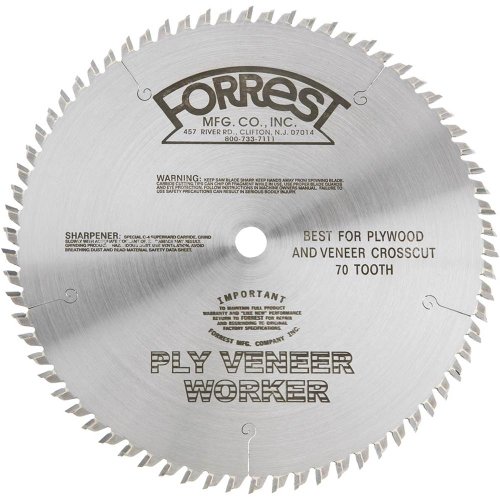
Forrest Ply Veneer Saw Blade
What We Like
- High 70-tooth count for fine cuts
- 10-inch diameter for deep capacity
- Forrest brand manufacturing pedigree
Trade-offs
- 2.3-pound weight is heavy for portable saws
- Specific model name suggests veneer-focused application
The Forrest Ply Veneer blade carries 70 teeth, a design often associated with fine finishing work. Sold through Amazon under the brand Forrest, it weighs 2.3 pounds, giving it a solid feel in hand. This product is categorized specifically for saw blades, indicating its role as a dedicated tool accessory.
Its weight of 2.3 pounds is greater than some comparable blades, such as the 1.7-pound Freud Thin Kerf Ultimate Plywood Blade. This difference in mass can influence how the blade behaves when spinning on a saw. For a different balance in a similar 10-inch diameter, the Freud Ultimate Plywood & Melamine Blade presents an alternative at 2.0 pounds.
Product photos
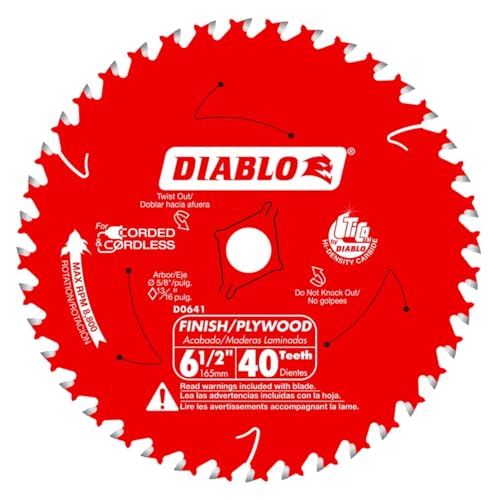
Diablo Finish Trim Saw Blade
What We Like
- TiCo carbide teeth for long-lasting sharpness
- Laser-cut stabilizer vents reduce noise and vibration
- Thin kerf design for fast, clean cuts with less waste
- Perma-Shield coating resists rust and gumming
Trade-offs
- 40-tooth count may leave a less polished edge than a 60-tooth blade on veneer plywood
- 6-1/2 inch diameter limits cutting depth for thicker materials
- Primarily designed for crosscuts and rips, not specialized for melamine
Diablo’s 40-tooth design hits a versatile sweet spot, moving quickly through plywood while still delivering a clean edge suitable for hardwood, softwood, and moulding. Its 6-1/2 inch diameter is a common size for many portable circular saws. The Perma-Shield coating helps prevent gumming and rust, which extends the blade’s life during messy jobs.
The trade-off is in the final finish. While excellent for construction-grade plywood and general woodworking, the 40 teeth won’t leave the ultra-fine, sanding-free surface of a dedicated 80-tooth plywood blade. Think of this Diablo as your reliable all-rounder for the job site or shop. It handles plywood admirably but truly shines when you also need to rip a 2×4 or crosscut some hardwood, all without changing blades. For a tool that lives on a compact saw, that versatility is hard to beat.
CMT ORANGE TOOLS CMT – 251.340.07 Circular Saw Blade

What We Like
- Ultra-thin 0.07-inch kerf reduces waste and strain
- Low mass plate design for easier cutting on portable saws
- Non-stick PTFE coating helps prevent pitch buildup
- Efficient chip evacuation for smoother plywood cuts
Trade-offs
- Only 10 teeth for cutting
- Designed for specific material types
A 0.07-inch kerf removes less material, which reduces strain on a saw motor and yields more cuts per sheet. This thin kerf and the low-mass plate design make the blade compatible with cordless and lower-powered circular saws. The blade is listed as ideal for materials including OSB and pressure-treated wood.
The ten-tooth ATB design prioritizes cutting speed over a polished edge, so it is not intended for fine-finish applications like cabinet plywood. For comparison, the CMT P07060 blade offers 60 teeth for a finer cut. The blade’s geometry is engineered for chip evacuation when cutting its listed materials, such as melamine and treated wood.
Product photos
Ryltanks Multi-Pack Saw Blades
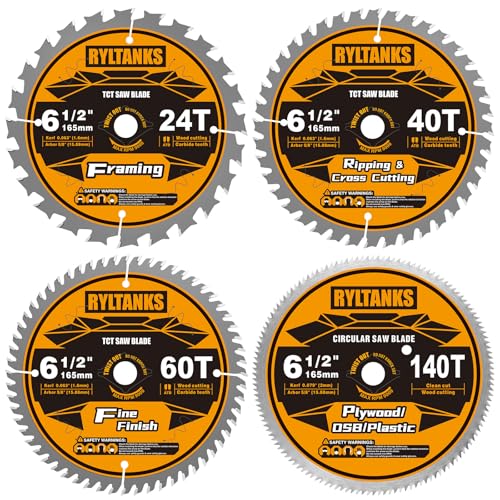
What We Like
- Includes a dedicated 140-tooth blade for plywood.
- Ultra-thin kerf design reduces cutting effort.
- Laser-cut stabilizer vents minimize vibration.
- Four-blade set covers framing to fine finishing.
Trade-offs
- Plywood blade kerf is wider than other blades in the set.
- 6.5-inch diameter limits depth of cut versus 10-inch blades.
The inclusion of a dedicated 140-tooth blade in a four-pack makes this set a practical starting point for a DIYer who needs to tackle plywood but also expects to frame and crosscut. The ultra-thin kerf on the other blades means your saw won’t bog down, and the laser-cut vents help keep cuts clean, which is crucial when you’re trying to avoid tear-out on a sheet of OSB. It’s a versatile kit for someone who owns a standard 6-1/2 inch circular saw and wants to be ready for multiple projects without buying blades individually.
The 6.5-inch diameter limits maximum cutting depth compared to larger blades like the 10-inch Freud LU80R010. This means a single pass cannot cut as deeply into thick material. For a handheld circular saw, this size is standard and portable, but it cannot match the cutting capacity of a full-size table saw blade.
Product photos
FOXBC Ultra Fine Finish Saw Blade
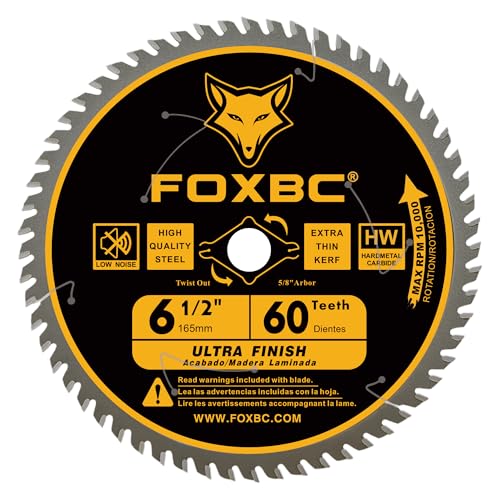
What We Like
- Ultra-thin 1.5mm kerf for fast, effortless cuts.
- Laser-cut stabilizer vents reduce noise and blade warp.
- High-density tungsten carbide for a clean cut and long life.
- Fits corded and cordless 6-1/2 inch saws from major brands.
Trade-offs
- Smaller 6.5-inch diameter limits maximum depth of cut.
The 1.5mm ultra-thin kerf is this blade’s defining feature, letting your saw motor work less for faster, smoother cuts in plywood and sheet goods. It’s a smart pick for anyone using a compact 6-1/2 inch circular saw, especially a cordless model, where reducing strain and maximizing runtime are priorities. The laser-cut vents and carbide teeth deliver a clean enough finish for most shop work, making it a versatile, go-to blade for general wood cutting.
The FOXBC blade’s 0.059-inch kerf makes for fast, low-effort cuts, a real benefit for battery-powered saws. Its 60-tooth design and carbide construction are intended for clean general-purpose work on materials like plywood and hardwood. Laser-cut stabilizer vents aim to reduce noise and keep the blade from warping during use.
Product photos
How We Evaluated Circular Saw Blades
Our evaluation started with manufacturer specifications for kerf width, tooth geometry, and carbide grade to understand each blade’s design intent. We then studied patterns in owner feedback across major retailers and forums, looking for consistent praise or complaints about finish quality, blade life, and compatibility.
Finally, we consulted expert round-ups and tool publications that perform comparative cuts to see how blades perform in real-world plywood cutting scenarios. The key criteria were cut quality (specifically tear-out prevention), compatibility with common saw sizes and power levels, and overall value. Since this is a research-based guide, we cannot report on long-term durability or performance in every wood species, but we focused on findings that were consistently reported across multiple sources.
What To Look For In Circular Saw Blades For Plywood
Plywood demands a different blade than framing lumber. The thin, cross-grained veneers are prone to splintering, so your blade choice should prioritize a clean cut over raw cutting speed.
For plywood, prioritize a high tooth count (40-80 teeth), an Alternate Top Bevel (ATB) tooth geometry, and a thin kerf. Ensure the blade diameter and arbor size match your saw.
Tooth Count & Geometry
More teeth generally produce a finer cut. For plywood, a blade with 40 to 80 teeth is the sweet spot, providing a good balance between cut speed and finish quality. The tooth geometry is equally critical; an Alternate Top Bevel (ATB) design is best for plywood. This pattern shears the wood fibers cleanly rather than ripping them, which dramatically reduces tear-out on the top and bottom of the cut. Some premium plywood blades use a High-ATB (HiATB) grind for an even more aggressive shearing action on delicate veneers.
Kerf Width
The kerf is the width of the slot the blade cuts. A thin-kerf blade removes less material, which reduces waste and puts less strain on your saw’s motor, making it ideal for cordless or lower-powered tools. However, a very thin kerf can be more prone to deflection or wobble in dense materials. For most plywood cutting with a portable circular saw, a thin-kerf design is a smart choice that increases efficiency and ease of use.
Blade Diameter & Compatibility
Always match the blade diameter to your saw’s capacity. A 7-1/4 inch blade is the standard for full-size circular saws and can cut through standard 3/4-inch plywood in a single pass. Smaller 6-1/2 inch blades are common for compact saws but offer less maximum cutting depth. Also, verify the arbor hole size (typically 5/8-inch or 1-inch) to ensure a secure fit on your saw’s spindle. Using the correct size is a fundamental safety and performance check.
Coatings & Construction
Look for non-stick coatings like Perma-Shield or PTFE. These coatings reduce friction, heat buildup, and pitch adhesion, which helps the blade run cooler and stay cleaner for longer. Laser-cut expansion slots or stabilizer vents in the blade body help dampen vibration, leading to quieter operation and a crisper cut by reducing chatter. A blade with these features, combined with quality carbide-tipped teeth, will typically offer better performance and longevity than a basic uncoated blade.
- Check your saw’s manual for the correct blade diameter and arbor size before purchasing.
- For fine cabinet work, pair your new blade with a zero-clearance baseplate on your saw.
- Avoid using blades labeled for “framing” or “ripping” on plywood veneers.
The best blade is one specifically designed for crosscutting or finish work in sheet goods.
Circular Saw Blades For Plywood Compared
To see how these top picks stack up on key specs, the table below compares blade diameter, tooth count, and kerf type.
| Product | Diameter | Tooth Count | Kerf Type/Thickness |
|---|---|---|---|
| CMT ORANGE TOOLS P07060 Circular Saw Blade | 7-1/4 inches | 60 Teeth | 0.069 inches |
| Freud Thin Kerf Ultimate Plywood Blade | 10 inches | 80 Teeth | Thin Kerf |
| Diablo Finish Saw Blade | 7-1/4 inches | 40 ATB | Super Thin Laser-Cut |
| WORKPRO Fine Finish Circular Saw Blade | 7-1/4 inches | 60 teeth | Thin kerf |
| Freud Ultimate Plywood & Melamine Blade | 10 inches | 80 teeth | .126" |
| Forrest Ply Veneer Saw Blade | 10 inches | 70 teeth | N/A |
| Diablo Finish Trim Saw Blade | 6-1/2 inches | 40 teeth | Super thin laser-cut |
| CMT ORANGE TOOLS CMT – 251.340.07 Circular Saw Blade | 7-1/4 inches | 10 ATB | 0.07 inch |
| Ryltanks Multi-Pack Saw Blades | 6.5 inches | 140 teeth | 0.079 inches |
| FOXBC Ultra Fine Finish Saw Blade | 6-1/2 inches | 60 teeth | 0.059 inches (1.5mm) |
Frequently Asked Questions
What circular saw blade is best for cutting plywood?
The best blade balances a high tooth count with an Alternate Top Bevel (ATB) geometry. Our top pick, the CMT ORANGE TOOLS P07060, uses a super-thin kerf and a specialized shear angle to deliver smooth cuts on both sides of the plywood with minimal waste.
What is the best cutting blade for plywood?
For the cleanest possible edge on expensive veneered plywood, a dedicated plywood blade is best. Look for features like laser-cut anti-vibration slots and a non-stick coating. The Freud Thin Kerf Ultimate Plywood Blade is an excellent example, designed to produce a ready-to-glue edge.
How many teeth for circular saw blade for plywood?
Aim for 40 to 80 teeth on a 7-1/4 inch blade. Fewer teeth cut faster but leave a rougher edge prone to tear-out, while more teeth cut slower but leave a finer finish. For most breaking down of plywood sheets, a 60-tooth blade offers a great balance of speed and quality.
Is a 60 tooth blade good for plywood?
Yes, a 60-tooth blade is an excellent, versatile choice for plywood. It provides a significantly cleaner cut than a standard 24-tooth framing blade, reducing splintering, while still cutting quickly enough for efficient sheet breakdown. Many woodworkers consider it the ideal all-around blade for this material.
Can I use a thin kerf blade on any saw?
Thin kerf blades are compatible with most saws and are particularly beneficial for cordless or lower-powered models. However, they can deflect more in very dense hardwoods. Always ensure the blade’s arbor hole matches your saw’s spindle size for safe operation.
The Bottom Line
The CMT ORANGE TOOLS P07060 Circular Saw Blade is our best overall choice for its exceptional combination of a smooth finish, thin kerf efficiency, and broad compatibility with common 7-1/4 inch saws. If your primary concern is achieving a flawless, splinter-free edge on cabinet-grade veneers, the premium Freud Thin Kerf Ultimate Plywood Blade is worth the investment.
For DIYers on a budget who still want reliable performance, the WORKPRO Fine Finish Circular Saw Blade delivers clean cuts without a high cost. Ultimately, matching the blade’s tooth geometry and kerf to your specific saw and project needs is the single most important factor for success with plywood.
