
8 Best Boat Polishers in 2026
This post contains affiliate links. As an Amazon Associate, we earn from qualifying purchases.
We chose the ENEACRO 1700W Rotary Buffer Polisher as the best overall for its powerful yet lightweight design and boat-ready kit. Other top picks include the Maxshine M21 Pro for dual-action efficiency and the VEVOR 650W for a safe, budget-friendly start. Choosing the wrong polisher for your boat’s size and its level of oxidation can lead to frustration, wasted effort, or even damage to your gel coat.
This guide uses specifications and user feedback to help you select the appropriate tool for tasks ranging from heavy paint correction to routine waxing.
Top 8 Boat Polishers in the Market
Certain content that appears on this site comes from Amazon. This content is provided "as is" and is subject to change or removal at any time.
The Best Boat Polishers, Reviewed
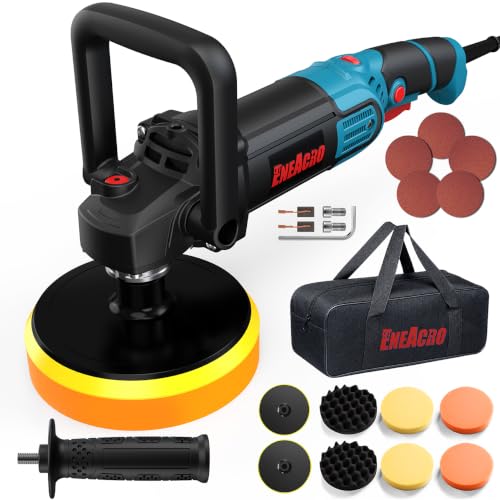
ENEACRO 1700W Rotary Buffer Polisher
What We Like
- Lightweight 5.5 lb design reduces user fatigue
- Comprehensive kit includes boat-specific wool disc and pads
- Safety lock button for consistent speed during long sessions
Trade-offs
- Rotary action requires more skill than a dual-action polisher
- No soft start feature mentioned in specifications
Driven by a 1700W pure copper motor, this rotary polisher is built for heavy-duty tasks like restoring faded marine gelcoats. Its high-temperature resistant wiring allows for steady, prolonged professional use, which means you can tackle large surfaces without the motor overheating. With a speed range from 1300 to 3500 RPM, it adapts from low-speed waxing to high-speed paint correction.
As a pure rotary buffer, it requires more technique than a dual-action polisher to avoid burning paint. For experienced users, features like the two interchangeable handles and a safety switch lock provide multi-angle control and reduce hand fatigue during long sessions. The kit includes a wool disc and sandpapers, components suited for removing deep swirls, scratches, and oxidation.
Product photos
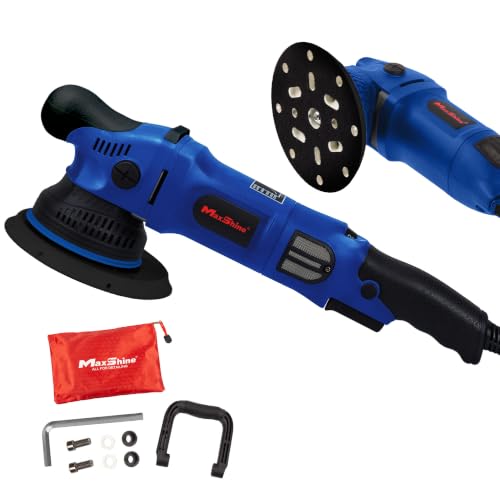
Maxshine M21 Pro Dual Action Polisher
What We Like
- High-torque 1000W motor for heavy correction
- 21mm long throw maximizes coverage and efficiency
- Six-speed dial for precise control across stages
- Ergonomic, balanced design minimizes user fatigue
Trade-offs
- No weight or specific dimension data provided
- Tool-only package; pads and compounds are separate
A 21mm long throw orbital is the key spec here, dramatically increasing the effective work area of the pad with each pass. This means you’ll cover the expansive, flat surfaces of a boat hull or an RV side much faster than with a standard throw polisher. The 1000W motor provides the consistent torque needed to keep that larger pad moving under load, making it a strong candidate for someone tackling significant oxidation or swirl removal on large vehicles. Its balanced, low-vibration design is a critical feature for maintaining control during those long sessions.
With its 21mm long throw design, the Maxshine M21 Pro covers more area per pass, which can significantly reduce the time needed to polish a large vehicle or boat. The 1000W motor provides consistent power for tasks like heavy paint correction and swirl removal. This combination makes it a tool focused on professional detailing performance for expansive surfaces.
LDHTHOPI 1600W Rotary Buffer Polisher

What We Like
- High-power 1600W motor for tough oxidation removal
- Three grip configurations for control and comfort
- Includes seven specialized pads for different tasks
- Variable speed dial for precise material matching
Trade-offs
- Requires a 5-minute cooldown after every 15 minutes of use
- Rotary action demands more user skill than a dual-action polisher
A 1600W motor provides the power for removing oxidation and deep scratches from surfaces like car paint or boat hulls. This rotary polisher offers three grip methods for user comfort: direct use, a D-handle, or a side handle, which helps maintain control during extended work. Its seven included pads serve different purposes, such as wool pads for deep scratches and black pads for oxidation, while red and yellow pads are for polishing and enhancing shine.
The trade-off is that it’s a pure rotary polisher, which demands more technique to avoid burning the gel coat compared to a forgiving dual-action model like the Maxshine M21 Pro. You also need to manage its workload; the mandated 15-minute run time with a cooldown break means it’s better suited for paced, section-by-section work rather than rushing a big job. For a user comfortable with rotary tools who needs one adaptable machine for both cars and boats, its power and grip flexibility make it a compelling mid-range option.
Product photos
WorkBless 1600W Rotary Buffer Polisher

What We Like
- Rugged 1600W motor for prolonged, stable operation.
- Seven speed settings for fine wax to heavy correction.
- Three interchangeable handle modes for user preference.
- Multi-purpose pad kit covers polishing to sanding tasks.
Trade-offs
- Pure rotary action requires more skill to avoid paint damage.
- Lacks the safer dual-action motion of models like the Maxshine M21 Pro.
A 1600W pure copper motor provides reliable, consistent power for a wide range of delicate or difficult polishing tasks. The three ergonomic handle options, side, U-shaped, or handle-free, are designed for comfort and control, letting you adapt the grip to your preference. This makes the polisher suitable for various applications from fine waxing to removing stubborn grime.
The trade-off is that it’s a pure rotary machine, which spins in a fixed circle. This design makes it highly effective for removing deep scratches and heavy oxidation, but it demands a steady hand and proper technique to avoid burning through paint or leaving holograms. Users less confident with that learning curve might prefer a dual-action polisher, which offers a safer and more forgiving orbit. The WorkBless excels as a versatile, high-torque workhorse, provided you respect its power.
Product photos
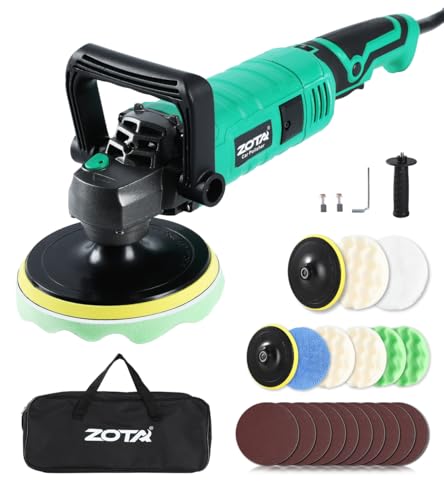
ZOTA 1600W Rotary Buffer Polisher
What We Like
- 13.1-foot cord aids large surface work
- Three handle designs improve grip comfort
- Seven speeds handle delicate to aggressive tasks
- 1600W motor provides strong polishing torque
Trade-offs
- Heavy rotary action risks burn-through for novices
- Requires a separate M14-threaded backing plate for some pads
With a 13.1-foot power cord, this polisher allows you to move around a car or boat without frequently changing outlets. Its 1600W motor provides power for tasks like removing oxidation, and the seven speed settings let you match the RPM to the job.
The kit includes soft wool pads, durable sponge pads, and hard sandpaper pads for different tasks, and the manufacturer states it can also be used on furniture, floors, and marble. It offers three ergonomic handle styles, including detachable D-handle and side handle options, and a safety switch lock to hold a selected speed.
Product photos
GEVEELIFE 1600W Rotary Buffer Polisher

What We Like
- Built-in constant-power control board for extended use.
- Lightweight 4.5 lb design reduces user fatigue.
- Includes multiple pad types for various materials.
- Safety switch lock maintains set speed.
Trade-offs
- Compatible only with M14 caliber discs, not 5/8-11.
- A rotary polisher requires more skill to avoid paint burn-through.
Its 1600W motor includes a constant-power control board, which means the polisher can work for extended hours without overheating. This sustained output is key for large projects like removing oxidation from a boat hull, where the tool must maintain performance under load. The design focuses on delivering reliable power through long polishing sessions.
The 4.5-pound weight is combined with a detachable D-handle and side handle to accommodate different hand sizes and gripping habits. A safety switch lock allows the user to keep a set speed without holding the button, which can reduce fatigue during use. The included kit features sponge pads, wool pads, and sandpapers selected for polishing without damaging paint.
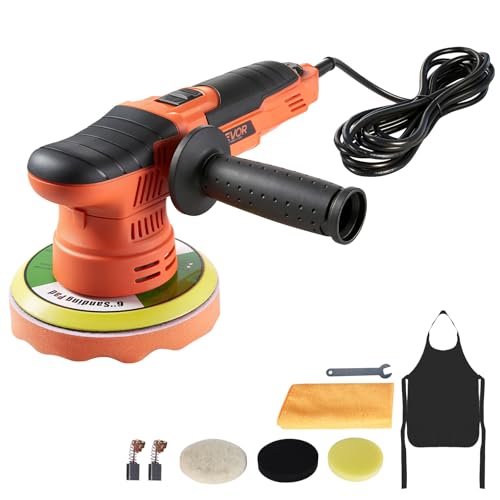
VEVOR 650W Dual Action Polisher
What We Like
- Lightweight body and ergonomic grip for comfort
- Soft-start function for smoother operation
- Includes four versatile hook-and-loop pads
Trade-offs
- Kit includes only one wool pad for heavy correction
- One wool pad included for heavy correction tasks
A 650W dual-action motor and a 5.4-pound frame make this polisher a logical first step into machine polishing for a boat owner. The six-speed control gives you the range to tackle everything from applying wax at the low end to removing light oxidation up at 6800 RPM. It’s built for the newcomer who values control and safety over raw cutting power, as the random orbital motion significantly reduces the risk of burning through gel coat. You get a complete kit with foam and wool pads right out of the box, so you can start working without hunting for accessories.
The trade-off for that user-friendly design is outright aggression. That 650W motor simply can’t match the brute force of a rotary polisher like the ENEACRO 1700W when dealing with severe hull oxidation or deep scratches. It’s a tool for maintenance and light correction, not for major restoration projects. For polishing a well-kept fiberglass hull or applying a final sealant, however, its lightweight build and variable speeds offer precise, fatigue-free control that heavier rotary tools can’t match.
Product photos
AOBEN 1600W Rotary Buffer Polisher

What We Like
- Safety lock switch for speed setting
- Detachable side handle for control and reduced fatigue
- Wide 1000-3500 RPM speed range
- Comprehensive kit with pads and sandpaper
Trade-offs
- Rotary action requires more skill than a dual-action polisher
A 1600W pure copper motor gives this polisher the grunt to cut through oxidation and old wax on large boat hulls without bogging down. The real standout, however, is its thoughtful ergonomics. The detachable side handle and safety lock switch are features you appreciate after an hour of work, letting you maintain a secure grip and a consistent speed to avoid burning the gelcoat. This makes it a solid choice for a dedicated boat owner or a detailer who values control and safety during long polishing sessions.
Being a rotary polisher, it demands respect and technique. The direct spin can generate significant heat, so it’s less forgiving than a dual-action model for a novice learning on their prized finish. This is a tool built for efficient material removal and high-gloss results in experienced hands. It trades a gentle learning curve for raw cutting power on tough marine-grade surfaces.
Product photos
How We Evaluated Boat Polishers
Our research examined manufacturer specifications and expert recommendations for marine detailing, along with patterns in owner feedback. We prioritized motor power for cutting through oxidation and the type of polishing action for safety and results. We also considered practical design features like weight and included accessories, which affect a long day working on a hull. A research-led evaluation cannot replicate the feel of a tool in your hands or predict every outcome on a specific, complex boat surface. However, it does identify the models consistently noted for performance and reliability.
What To Look For In Boat Polishers
Boat polishing is a specialized task requiring the right balance of power, control, and safety. The best tool for you depends heavily on your boat’s condition and your own experience level.
Focus on motor power for cutting oxidation, the safety of dual-action vs. The power of rotary motion, and ergonomic features like weight and grip to reduce fatigue during large, curved surfaces.
Polisher Type: Dual-Action vs. Rotary
This is the most critical choice. Dual-action (DA) polishers, like our Best Long-Throw DA pick, use a combined orbiting and spinning motion that significantly reduces the risk of burning through gel coat. They are safer for beginners and ideal for applying wax or removing light oxidation.
Rotary polishers, like our Best Overall, spin on a single axis, generating more heat and cutting power for severe oxidation but requiring more skill to avoid damage. For a full breakdown of the trade-offs, see our guide on the key differences between dual-action and rotary polishers.
Power and Performance
Motor wattage indicates potential cutting power. For heavy gel coat oxidation, a polisher with 1600W or more, common in our rotary picks, provides the necessary torque. For maintenance waxing or light correction, a lower-wattage DA model around 650W is often sufficient and easier to handle. Consider the speed range; a wide range (e.g., 1000-3500 RPM) allows you to match the speed to the task, from slow wax application to fast compounding. The right boat buffer blends adequate power with the control you need.
Design and Usability
Boat hulls are large, often curved, and worked on for extended periods. A lighter tool, like our 4.5 lb and 5.5 lb picks, drastically reduces arm fatigue. Look for features like multiple handle positions or a detachable side handle for better control on vertical surfaces.
A long power cord, such as the 13.1-foot cord on our Best Extended Cord pick, is a major convenience, reducing the need for extension cords and outlets while working. While corded models dominate for sustained power, you can explore modern cordless options for ultimate portability in some detailing scenarios.
- Check the included backing plate thread size (commonly 5/8″-11 or M14) to ensure compatibility with aftermarket pads.
- Verify the kit includes pads suitable for your tasks, like a wool pad for heavy cutting or foam pads for polishing.
- Look for a safety lock switch to maintain your chosen speed without holding the trigger.
Match the tool’s aggression to your boat’s needs: a DA for safety and maintenance, a rotary for heavy correction.
Boat Polishers Compared
The table below compares key specifications across our eight picks to help you see the differences at a glance.
| Product | Motor Power | Speed Range | Type |
|---|---|---|---|
| ENEACRO 1700W Rotary Buffer Polisher | 1700W | 1300-3500 RPM | Rotary |
| Maxshine M21 Pro Dual Action Polisher | 1000W | 2200-5000 OPM | Dual Action |
| LDHTHOPI 1600W Rotary Buffer Polisher | 1600W | 1000-3500 RPM | Rotary |
| WorkBless 1600W Rotary Buffer Polisher | 1600W | 1300-3500 RPM | Rotary |
| ZOTA 1600W Rotary Buffer Polisher | 1600W | 1000-3500 RPM | Rotary |
| GEVEELIFE 1600W Rotary Buffer Polisher | 1600W | 1000-3500 RPM | Rotary |
| VEVOR 650W Dual Action Polisher | 650W | 2000-6800 RPM | Dual Action |
| AOBEN 1600W Rotary Buffer Polisher | 1600W | 1000-3500 RPM | Rotary |
Frequently Asked Questions
What is the best polisher for a boat?
The best polisher depends on your boat’s condition and your skill. For severe oxidation, a powerful rotary polisher like the ENEACRO 1700W is most effective. For routine waxing and light correction, a safer dual-action polisher like the VEVOR 650W is a better choice for most owners.
What is the difference between a buffer and a polisher?
The terms are often used interchangeably today. Technically, a “buffer” might refer to an older, lower-speed tool for applying wax, while a “polisher” implies a higher-speed tool for paint correction. In modern usage, both describe power tools used for cleaning, polishing, and protecting surfaces.
Are Harbor Freight buffers any good?
They can be a budget-friendly entry point for occasional use. However, for the demanding task of boat oxidation removal which requires sustained power and durability, investing in a tool from a brand specializing in detailing polishers often yields better long-term results and reliability.
What are the best products for boat detailing?
Start with a marine-specific one-step cleaner/wax for oxidized gel coat, as it combines cutting, polishing, and protection. Follow with a dedicated marine sealant or wax for durable protection. Always use pads designed for gel coat, which is harder than automotive paint.
Can I use a car polisher on my boat?
Yes, the same tools are used. The critical difference is the product and pads. Boat gel coat is thicker and harder than automotive clear coat, requiring more aggressive compounds and often wool pads for initial correction. Always use marine-formulated products.
The Bottom Line
For boat owners facing significant oxidation or performing paint correction on larger surfaces, the ENEACRO 1700W Rotary Buffer Polisher is the best overall choice, offering a powerful yet manageable tool with a thoughtful kit. If you’re new to machine polishing or primarily do maintenance waxing, start with the safer, budget-friendly VEVOR 650W Dual Action Polisher. Ultimately, honestly matching the tool’s power and action type to your skill level and your boat’s needs is the single most important factor for a successful, damage-free detail.
