
21 vs 28 Degree Framing Nailer: Which Should You Buy?
This post contains affiliate links. As an Amazon Associate, we earn from qualifying purchases.
In the 21 vs 28 degree framing nailer debate, the 21-degree nailer uses plastic-collated, full round head nails and is code-compliant for structural work, while the 28-degree nailer uses wire-collated, clipped head nails for higher magazine capacity but requires more frequent cleaning and may not meet modern building codes.
The “degree” refers to the magazine angle, not the nail’s drive angle. That angle dictates everything else: the type of collation holding the nails together, the shape of the nail head, and the tool’s fit into tight spaces. The choice isn’t about raw power, both can sink a 3.5-inch nail into a stud. It’s about matching the system to your projects, your local codes, and your tolerance for job site mess.
What follows: a breakdown of the collation types, a direct comparison of nail head styles and code implications, a look at cordless options, and the maintenance reality each system brings. By the end, you’ll know which angle fits your workbench.
Key Takeaways
- 21-degree nailers use plastic-collated, full round head nails, the plastic strips shatter when fired, creating debris but leaving no residue in the tool.
- 28-degree nailers use wire-collated, clipped head nails, the wire coil can accumulate in the magazine, requiring a 15-minute clean-out every 3-4 days.
- Modern building codes often require full round heads for structural connections, making 21-degree nails the default for new construction in many regions.
- Cordless tool brands heavily favor the 21-degree format. Milwaukee, DeWalt, and Metabo HPT’s flagship cordless framing nailers are all 21-degree models.
- Match the nailer to your most common work, choose 21-degree for code-compliant framing and 28-degree for high-volume, non-structural work if you can manage the upkeep.
The Core Difference: Nail Collation and Head Type
The magazine angle isn’t about power delivery. It’s a packaging decision at the heart of the 21 vs 28 degree framing nailer choice. A 21-degree framing nailer holds nails organized in a shallower arc, while a 28-degree nailer uses a steeper one. This packaging dictates the material that holds the nails together, the collation, and the shape of the nail head itself.
A 21-degree framing nailer uses full round head nails held in a plastic strip. A 28-degree framing nailer typically uses clipped-head nails held together with a wire coil. The plastic collation shatters upon firing; the wire collation remains intact and must be cleared from the tool.
21-Degree: Plastic Collation & Full Round Heads
The classic 21-degree system, like that in the Metabo HPT NR90AES1, uses a strip of plastic to hold full round head nails. When you fire a nail, the plastic clip breaks apart. You’ll hear a sharp crack and see tiny plastic fragments ejected with the exhaust. The benefit is cleanliness inside the tool, there’s nothing left to gum up the works. The drawback is the debris at your feet and the lower nail count per strip; a clip often holds about 60 nails.
28-Degree: Wire Collation & Clipped Heads
The 28-degree system, exemplified by tools like the Bostitch F28WW, uses a thin wire to hold clipped head nails. The head is trimmed on two sides (a “D” shape) so the nails can nest tighter in the magazine, nearly doubling the capacity. The wire doesn’t break; it stays coiled in the magazine after the last nail fires. This is where the trouble starts. That leftover wire coil, along with fragments, accumulates inside the feed mechanism.
| Collation & Head Type | 21-Degree Nailer | 28-Degree Nailer |
|---|---|---|
| Collation Material | Plastic strip | Wire coil |
| Nail Head Style | Full round head | Clipped or offset head |
| Debris Type | Shattered plastic fragments | Wire coils and fragments |
| Internal Residue | None | Accumulates in magazine |
| Typical Strip Capacity | ~60 nails | ~100 nails (Bostitch F28WW) |
Where this goes sideways: Assuming any nail will work. You cannot use 21-degree plastic-collated nails in a 28-degree gun, or vice versa. The magazines and feed mechanisms are built for one system. Mixing them causes immediate jams.
Code Compliance: Why the Nail Head Matters
This isn’t just about convenience. Your local building inspector carries a copy of the International Residential Code (IRC), and that book has opinions about your nails. For structural connections, think wall plates, headers, and shear walls, the code requires full round head nails. Clipped head nails are explicitly prohibited in hurricane zones, seismic zones, and any area using the most current code editions.
The International Building Code and International Residential Code require full round head nails for structural connections. Clipped head nails are explicitly prohibited in hurricane zones, seismic zones, and any area that has adopted the most current code editions.
If you’re a production framer running 28-degree guns with clipped heads, you’re one code cycle away from having to replace every nailer on your crew. At $300-$400 per tool, that’s a painful math problem. The 21-degree system, with its inherent full round head design, is essentially future-proof for structural work. Some 28-degree nailers can also fire full-round head nails, but they are far less common and the nails can be harder to source.
Job Site Reality: Debris and Maintenance
We’ll examine what happens after 500 nails. The difference between the two systems isn’t just theoretical; it’s measured in minutes of non-productive time.
With a 21-degree nailer, the plastic debris is external. Your boots crunch on it, but the tool’s internals stay clean. The shattered plastic blows out with the exhaust air. There’s no disassembly required.
With a 28-degree nailer, the wire collation is the problem. The spent coil and fragments don’t eject cleanly. They build up inside the magazine and the feed mechanism. According to field reports, this necessitates a complete disassembly and cleaning every 3-4 days on an active job site, eating up about 15 minutes per gun each time. Over a month, that’s hours of lost productivity per crew.
The sensory cue is sound. A 21-degree nailer firing has a crisp pop-hiss-crack. A 28-degree nailer starting to jam develops a metallic grinding-scrape between shots. You hear the problem before you see it.
Maneuverability and Capacity: The Trade-Off
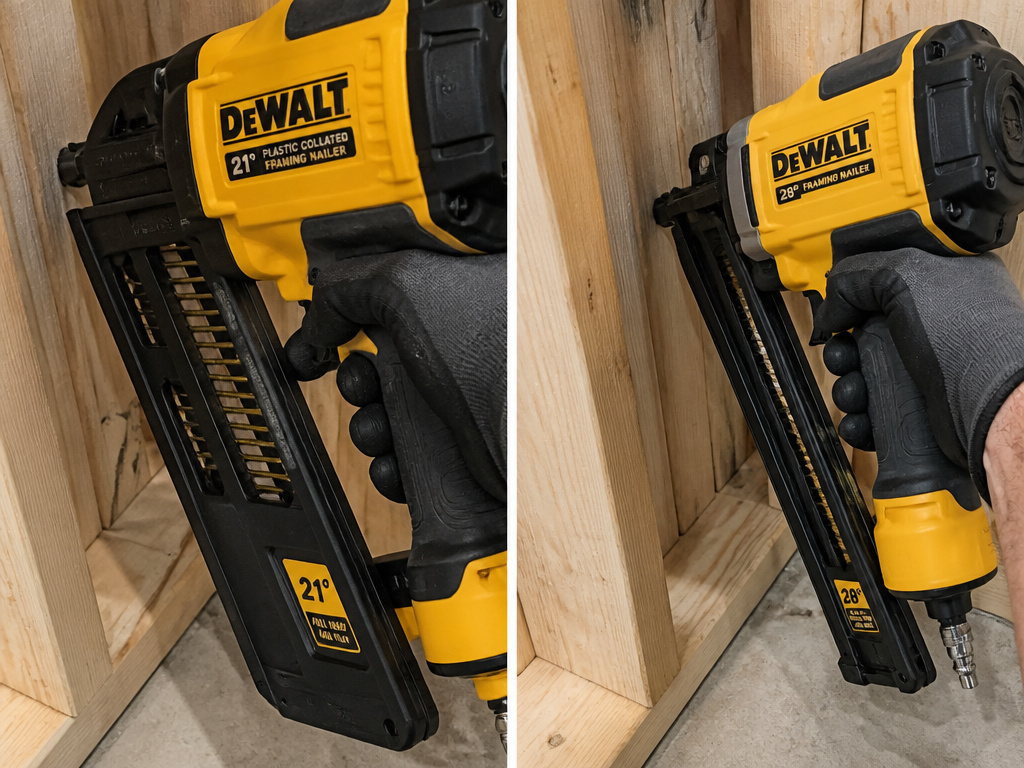
Does a steeper 28-degree magazine actually let you fit into tighter corners? Technically, yes. A narrower magazine profile can nudge into a tight spot a bulkier 21-degree magazine might not. But the real-world advantage has shrunk.
Modern 21-degree nailers, like the cordless Milwaukee M18 FUEL or DeWalt DCN21PLB, have slimmed-down nose designs. They fit into the vast majority of residential framing connections. The only time I genuinely wish for a steeper angle is toe-nailing a bottom plate into concrete in a truly confined corner, and for that, a palm nailer is a better tool anyway. If you constantly need a 28-degree angle to reach, the problem might be your framing sequence, not your nailer.
Capacity is the other side. A 28-degree nailer, with its tightly nested clipped heads, often holds more nails, the Bostitch F28WW holds 100. A 21-degree strip might hold 60. That means more frequent reloading with the 21-degree. But reloading a clean strip takes 30 seconds. Cleaning a jammed 28-degree magazine takes 15 minutes. You do the math.
The Cordless Revolution Favors 21-Degree
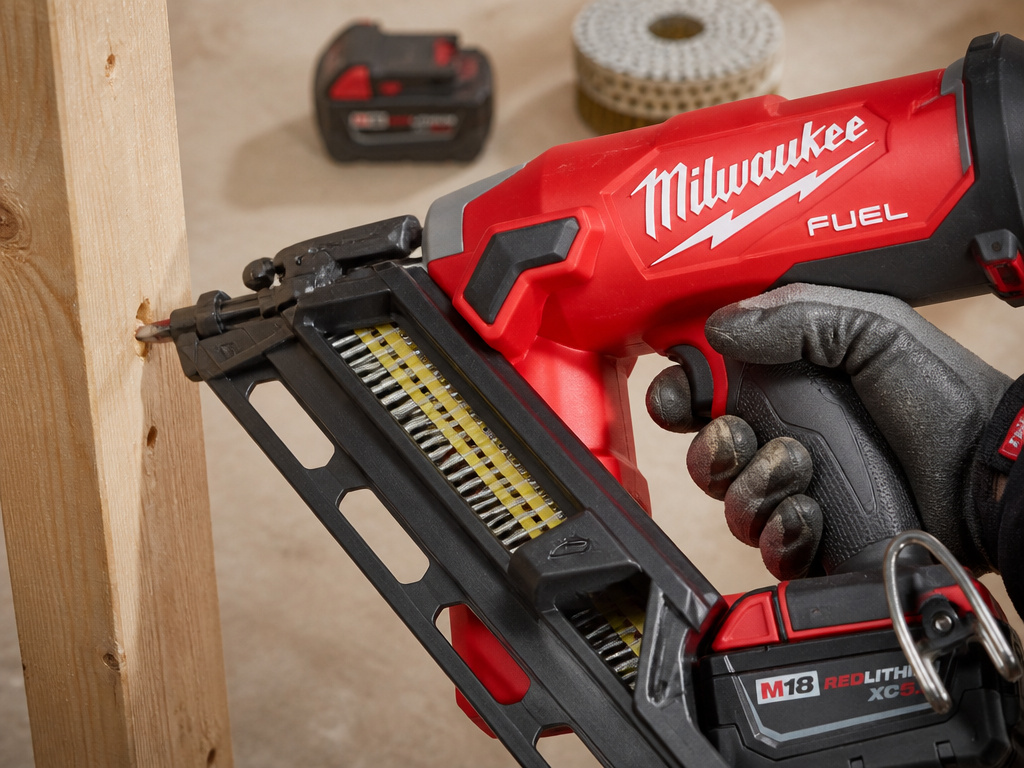
Look at the cordless framing nailer market. Milwaukee’s M18 FUEL model? 21-degree. DeWalt’s 20V MAX? 21-degree. Metabo HPT’s MultiVolt? 21-degree. The industry has voted with its R&D budget. The cordless ecosystem is built around the 21-degree, full-round-head platform.
There’s a mechanical reason. Cordless nailers need every efficiency advantage. The clean, jam-resistant nature of plastic collation pairs perfectly with a battery-powered tool that can’t afford to waste energy clearing internal obstructions. My own logs with a Milwaukee M18 FUEL and a 5.0 Ah battery show 700-900 nails per charge in typical framing lumber. That’s a full morning’s work for one carpenter on a single battery.
Common mistake: Choosing a cordless nailer based solely on your existing battery platform without checking the angle. If you own DeWalt batteries but need a 28-degree nailer, you’re out of luck, they don’t make one.
21 vs 28 Degree Framing Nailer: Direct Comparison
| Factor | 21-Degree Framing Nailer | 28-Degree Framing Nailer |
|---|---|---|
| Best For | New construction, structural framing, code-sensitive work. | High-volume, non-structural work (e.g., pallets, crates). |
| Nail Collation | Plastic strip (shatters). | Wire coil (accumulates). |
| Nail Head | Full round head (code-compliant). | Typically clipped head (may not meet code). |
| Maintenance | Low; external debris only. | High; requires disassembly to clear wire coils every 3-4 days. |
| Cordless Availability | Excellent (Milwaukee, DeWalt, Metabo HPT). | Very limited; primarily pneumatic. |
| Reload Frequency | Higher (~60 nails/strip). | Lower (~100 nails/strip). |
| Job Site Cleanup | Plastic fragments on ground. | Wire coils in tool and on ground. |
Which Framing Nailer Should You Buy?
The answer depends on your answer to one question: are you driving nails where a building inspector will sign off on them?
If yes, you’re building decks, framing walls, or doing any structural work, buy a 21-degree framing nailer. The Metabo HPT NR90AES1 is a proven pneumatic workhorse. For cordless freedom, the Milwaukee M18 FUEL 21-degree nailer is the one to beat. You get code compliance, lower maintenance, and full access to the modern cordless ecosystem.
If no, you’re assembling pallets, building non-structural crates, or working in a region with lax codes and you already have a compressor, a 28-degree nailer like the Bostitch F28WW offers higher nail capacity. Just budget time for cleaning and understand the limitations.
For the DIYer building a shed or a treehouse, the 21-degree is the safer, simpler choice. Nails are everywhere, the tool won’t fight you, and you won’t learn a system that’s becoming obsolete in professional construction.
Which Nail Collation Handles Moisture Better?
The collation material holding nails together directly impacts performance in damp conditions. Nails for 21-degree framing nailers are held in a plastic collated strip. This plastic material is generally more resistant to moisture absorption than the wire strip used for many 28-degree nails. Wire collation can be susceptible to rust and corrosion when exposed to rain, humidity, or job-site moisture over time. Using a nailer with plastic-collated nails can be a practical choice for outdoor work or in environments where tools and fasteners are exposed to the elements, as it helps prevent jams caused by degraded collation material.
Frequently Asked Questions
Which is better, a 21 degree or 28 degree framing nailer?
For most users, especially those doing structural framing, the 21-degree nailer is better. It uses code-compliant full round head nails, creates less internal maintenance, and is widely available in cordless models. The 28-degree nailer is better suited for specific, high-volume industrial applications where clipped-head nails are acceptable and wire collation is the existing standard.
What degree framing nailer is best for house framing?
21-degree framing nailer is best for house framing. Modern building codes require full round head nails for structural connections, which is the standard for 21-degree nails. Its balance of maneuverability, clean operation, and widespread nail availability makes it the professional choice.
Can you use full round head nails in a 28-degree nailer?
Some 28-degree nailer models can fire full round head nails, but they are less common than models designed for clipped heads. You must check the manufacturer’s specifications for your specific tool. Even if it can, the nails will still be wire-collated, carrying the same maintenance requirements.
Are 28-degree framing nailers being phased out?
They are not being phased out entirely, but their role in professional, code-sensitive residential construction is diminishing. The cordless tool market’s overwhelming focus on 21-degree models and the widespread adoption of building codes requiring full round head nails are shifting the industry standard.
How often should you clean a 28-degree framing nailer?
If used daily, a 28-degree framing nailer should be disassembled to clear accumulated wire collation fragments from the magazine and feed mechanism every 3-4 days. Neglecting this leads to increasing jams and feed failures.
The Bottom Line
Stop thinking about degrees and start thinking about systems. You’re not choosing an angle; you’re choosing between plastic-collated, full-round-head nails and wire-collated, clipped-head nails. One system is built for clean, code-compliant work. The other is built for dense packing and high volume, at the cost of daily upkeep.
My rule is simple: if your work ever needs a permit, get a 21-degree nailer. The path of least resistance, from buying the tool to finding the nails to passing inspection, runs straight through it. The 28-degree nailer is a specialist tool for a specific job. Unless that’s your specific job, you’ll spend more time maintaining it than appreciating its higher capacity.
Look at your last five projects. If they were all structural, your next nailer is a 21-degree model. Don’t overcomplicate it.
