
10 Best Air Compressors For Sprinkler Blowout in 2026
This post contains affiliate links. As an Amazon Associate, we earn from qualifying purchases.
For clearing irrigation lines before winter, the VEVOR 15 Gallon Oil-Free Air Compressor is the best overall for its balanced oil-free design and solid airflow. The California Air Tools 20020 is our Best Ultra-Quiet Pick, while the Makita MAC2400 is a durable choice for jobsite use.
Choosing the wrong compressor risks leaving water in pipes or damaging your sprinkler system with excessive pressure. You need sufficient continuous airflow (CFM) and a tank that can keep up, not just high maximum PSI. This guide is based on research into specifications, manufacturer data, and patterns in owner feedback to help you find a compressor that safely and effectively handles your specific system.
Top 10 Air Compressors For Sprinkler Blowout in the Market
Certain content that appears on this site comes from Amazon. This content is provided "as is" and is subject to change or removal at any time.
The Best Air Compressors For Sprinkler Blowout, Reviewed
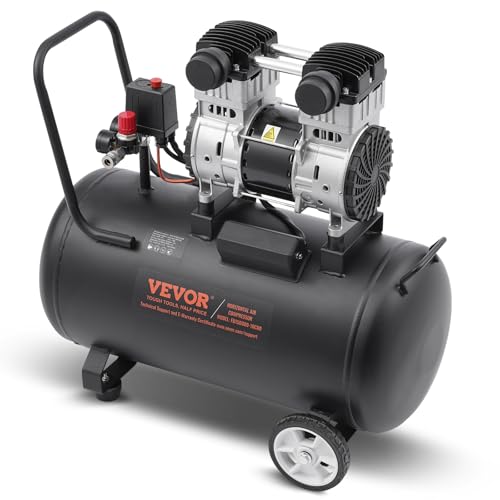
VEVOR 15 Gallon Oil-Free Air Compressor
What We Like
- Oil-free motor for low maintenance
- 78 dB operation is relatively quiet
- Automatic thermal and pressure protection
- Rust-resistant three-layer steel construction
Trade-offs
- At 81.6 lb, it's heavy for one-person portability
- 5.3 CFM is modest for continuous high-demand tools
- 15-gallon tank refills more often than larger units
A 5.3 CFM air delivery at 90 PSI, paired with a 15-gallon steel tank, provides enough sustained airflow for tools like impact wrenches and spray guns. This oil-free design eliminates the need for routine maintenance, so you can use it for auto repair or inflation and then store it without preparation. Built-in thermal protection and a 78 dB noise rating mean it can run in a garage without excessive disturbance.
Portability requires consideration, as the unit weighs 81.6 pounds. While its dimensions allow it to fit in many workspaces, you’ll likely want a permanent spot or a wheeled base for moving it. Compared to a larger model like the 27-gallon DEWALT vertical compressor, it offers a more compact footprint, trading some air reserve for a smaller overall size.
Product photos
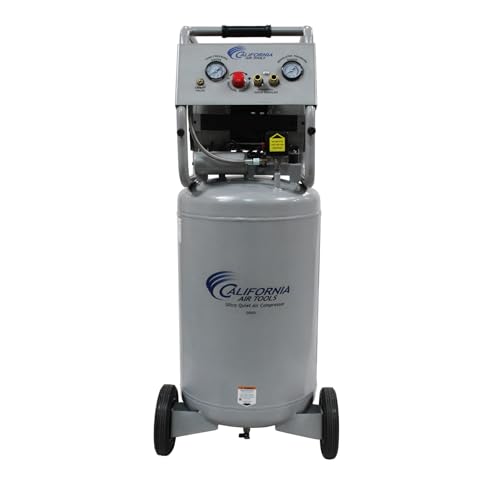
California Air Tools 20020 20-Gallon Air Compressor
What We Like
- Ultra-quiet 70 dB operation for noise-sensitive areas
- Oil-free pump requires minimal maintenance
- Wheeled design for easy 134-pound unit portability
- Low amp draw runs on standard 110V outlets
Trade-offs
- 5.3 CFM at 90 PSI output is moderate for large systems
Operating at a 70 dB noise level, this compressor is quiet enough for indoor workshops or garages without disturbing a household. Its oil-free pump requires no routine oil changes, reducing long-term maintenance. The 2.0 HP motor draws only 14 amps, so it can run on a standard 110V outlet found in most homes.
Compared to other 120V models like the FORTRESS 27 Gallon, this compressor has a smaller 20-gallon air tank. The FORTRESS model also stores air at a higher maximum pressure. Research notes the California Air Tools pump output closely matches the FORTRESS, but the larger tank of the FORTRESS provides a greater air reserve.
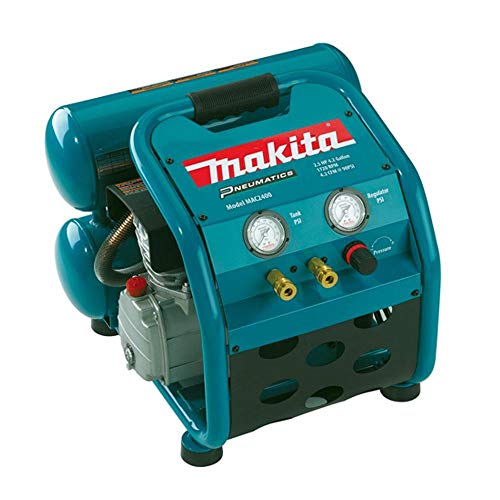
Makita MAC2400 Big Bore Air Compressor
What We Like
- Cast iron Big Bore pump for faster recovery
- Roll-cage protects against jobsite damage
- Low AMP draw reduces breaker trips
- Oil lubrication extends pump life
Trade-offs
- Oil-lubricated pump requires maintenance, unlike oil-free models
- 4.2 CFM is modest for large-volume tasks
The Makita MAC2400 is built around a cast iron Big Bore pump, a design that delivers 4.2 CFM at 90 PSI with cooler operation and less wear over time. That makes it a compressor for the long haul, suited for contractors who need a unit that can handle daily use in rough conditions without flinching. Its roll-cage construction and low AMP draw motor are direct answers to common jobsite problems like physical damage and tripped circuits.
The trade-off is the required maintenance of an oil-lubricated system. This won’t appeal to users wanting a simpler, oil-free setup. Its air delivery is sufficient for consistent sprinkler blowout work. If your primary need is moving a massive volume of air quickly, the VEVOR 15-Gallon model’s higher 5.3 CFM output would be a more relevant comparison point for sheer speed.
ECOMAX Pancake Air Compressor

What We Like
- Light 27.6-pound weight for easy transport
- Two quick couplers for simultaneous tool use
- Oil-free motor for low-maintenance operation
- Rubber feet and handle provide stable base
Trade-offs
- 2.6 CFM airflow limits continuous tool use
- 6-gallon tank requires frequent refills for high-demand tasks
A 6-gallon tank and 150 PSI max pressure make this a solid entry point for light-duty pneumatic work. The oil-free motor means you can store it without worrying about maintenance, and its 27.6-pound frame is genuinely easy to haul around a garage or job site. This compressor suits a DIYer who needs intermittent air for tasks like blowing out sprinkler lines, inflating tires, or running a single nailer, where its compact size and simple operation are real assets.
The trade-off comes with its 2.6 CFM airflow, which can struggle to keep up with tools that demand a continuous air supply. For longer blowout sessions or running multiple tools, you’ll face more frequent pauses waiting for the tank to refill. Compared to the heavier, higher-capacity VEVOR 15-gallon model, the ECOMAX sacrifices sustained power for its budget-friendly portability. It’s a capable unit for its class, but know its limits before committing.
DEWALT 27-Gallon Vertical Air Compressor

What We Like
- High 27-gallon tank capacity for sustained work
- Oil-free pump for zero maintenance
- Quiet 78 dBA operation for neighborhood use
- Low-voltage start for reliable garage power
Trade-offs
- At 136 pounds, it's not easily carried by one person
- 54.5-inch height requires careful storage planning
A 27-gallon tank gives you the reserve air to methodically clear sprinkler zones without waiting for the compressor to catch up. This DEWALT model suits a homeowner with a multi-zone system who also wants a reliable, all-purpose garage compressor. Its 5.1 SCFM output at 90 PSI handles typical residential lines, and the oil-free design means you can store it after the blowout without worrying about maintenance until next season.
Weighing 136 pounds, this compressor is built to be wheeled to a job site and left in place. Research suggests a DEWALT 25-gallon model is a top pick for sprinkler winterization at a typical home. The 27-gallon tank here provides more reserve air for longer tool runs between motor cycles, which can justify its larger workshop footprint.
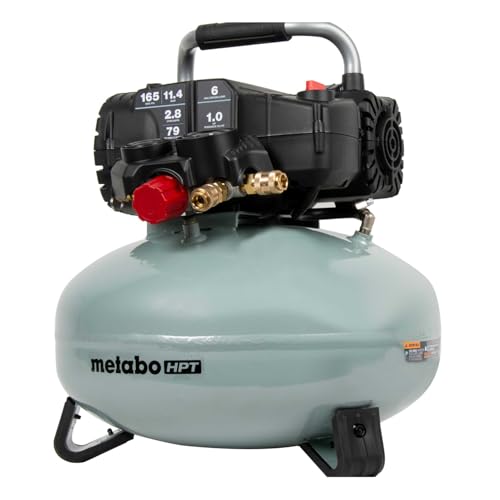
Metabo HPT 6-Gallon Pancake Air Compressor
What We Like
- Fast 46-second tank recovery time.
- Lightweight 38.5-lb pancake design.
- Oil-free motor for minimal maintenance.
- 73 dB quiet operation.
Trade-offs
- 6-gallon tank limits continuous air supply.
- 2.8 CFM at 90 PSI is lower than some larger models.
A 46-second tank recovery time means you can resume work quickly after a short pause. This portable air compressor delivers a maximum of 165 PSI, which supports multiple nail guns for various applications according to its description. Its oil-free high-efficiency motor ensures reliable startups even in cold weather, minimizing maintenance needs. At 73 dB, the operational noise level is quieter than many other brands, and the compact design with a steel tool cage provides protection during transport.
The trade-off for that quick recovery is the 6-gallon air tank. You’ll be waiting for the compressor to catch up if you’re clearing multiple large zones in one session, as the 2.8 CFM airflow can’t sustain a high-demand tool indefinitely. For a sprawling system, a unit like the VEVOR 15-Gallon with its 5.3 CFM would provide more continuous air, though it sacrifices the pancake’s portability. This Metabo HPT sits in a useful middle ground, faster than most small compressors but still constrained by its tank size.
Product photos
DEWALT 200 PSI Quiet Trim Compressor
What We Like
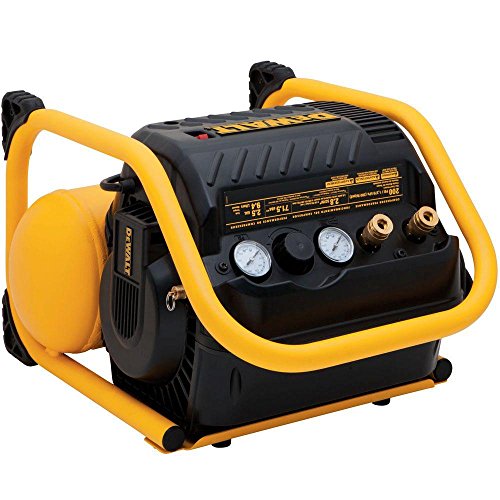
- Quiet 71.5 dBA operation per ISO3744
- Compact, lightweight design for easy storage
- Low 12 amp draw reduces breaker tripping
- Dual quick couplers for two tools
Trade-offs
- 2.5-gallon tank requires frequent pump cycles for sustained use
- 36 lb weight is heavier than smaller pancake compressors
A 71.5 dBA noise level makes this compressor one you can run without disturbing the whole neighborhood. Its thin 12.5-inch profile and 36-pound weight let you tuck it into a corner of the garage or truck bed. For a homeowner focused on finish work like trim and small pneumatic tasks, the oil-free pump and dual couplers offer real convenience. This unit is built for portability and low-impact operation, not for heavy, continuous air demand.
That 3.0 SCFM airflow and 2.5-gallon tank are the trade-offs. For sprinkler blowout, this compressor is only suitable for very small, single-zone systems. You’ll be waiting for the tank to refill often. Research indicates most homeowners need a unit like the DEWALT 25-gallon compressor with over 6 SCFM for reliable zone-by-zone winterization. This model excels as a dedicated, quiet shop companion, not as a primary irrigation tool.
CRAFTSMAN 10-Gallon Wheeled Air Compressor

What We Like
- Wheeled design for easy transport
- 4.0 CFM at 90 PSI provides solid air volume
- Dual quick couplers for running two tools
- Oil-free motor reduces maintenance needs
Trade-offs
- 10-gallon tank requires frequent recovery cycles for high-demand tasks
- 4.0 CFM is lower than some 15-20 gallon models in the guide
With a 10-gallon tank on wheels, this compressor offers a portable air supply that moves easily to the job. Its 4.0 CFM at 90 PSI delivers 30% more airflow than a basic model, which the brand says allows multiple large body nailers to run at once. The dual quick couplers support running two finish nailers or two brad nailers simultaneously, keeping a small crew productive. It fits a space under a workbench, providing more capacity than a pancake compressor without the footprint of a large stationary unit.
Compared to a 15-gallon model, the smaller tank may require more frequent refills during extended tool use. The compressor reduces energy consumption by 20% versus a basic unit, according to the manufacturer, offering consistent performance for various pneumatic tools. Its folded handle and wheeled design make it easier to transport than a bulky vertical compressor for professional-grade nailing across multiple applications.
Product photos
Makita MAC700 Big Bore Air Compressor

What We Like
- Cast iron big bore pump for maximum performance
- Lower noise from 1,720 RPM pump operation
- Low amp draw reduces breaker trip risk
- Oil lubrication for cooler running and less wear
Trade-offs
- At 61 pounds, it's heavier than oil-free portables like the ECOMAX
- Requires oil maintenance, unlike most other compressors in this guide
- Smaller tank than stationary models like the DEWALT 27-Gallon
The cast iron, oil-lubricated big bore pump is the core of this compressor, built for sustained duty cycles without the overheating that can kill a cheaper motor. That low 1,720 RPM speed and oil bath mean it runs cooler and quieter, which translates directly to longevity during extended tasks. This is the pick for someone who views the compressor as a decades-long workshop investment, not just a seasonal tool. The low amp draw reduces incidences of tripped breakers and voltage drop that can cause premature motor failure.
You must be ready for a commitment. At 61 pounds, it’s a substantial lift, and it requires the periodic oil check that oil-free models eliminate. For extended runtime, its tank size is adequate, but you’ll get more continuous air from a larger stationary unit like the California Air Tools 20020. This Makita sacrifices some portability and maintenance-free convenience for a design focused on enduring, reliable performance where other compressors might wear out.
Product photos
California Air Tools 5020W 5-Gallon Compressor
What We Like
- Ultra-quiet 70 dB operation
- Strong 5.3 CFM output for its size
- Oil-free pump for low maintenance
- Easy to move with large wheels
Trade-offs
- 5-gallon tank requires frequent pump cycles for long blowouts
- 82-pound weight is substantial for a compact unit
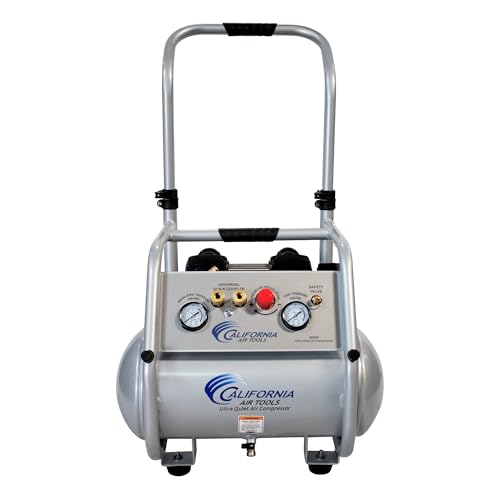
This compressor delivers a 5.3 CFM flow at 90 PSI from a 5-gallon steel tank, providing enough air for tasks like running pneumatic tools or inflating tires. Its 70 dB noise level, similar to a normal conversation, means it can be used in noise-sensitive areas without significant disturbance. An oil-free dual piston pump requires no lubrication, reducing long-term maintenance while providing cleaner air output.
You’ll need to consider the small air tank. This design means you’ll be relying on the pump’s continuous output more than a stored air reserve, which can slow down the job on larger zones. For pure flow in a quiet package, it’s a standout. If you have a very large property, stepping up to a model like the California Air Tools 20020 with its 20-gallon tank will give you more sustained air between pump cycles.
Product photos
How We Evaluated Air Compressors For Sprinkler Blowout
Our evaluation started with manufacturer specifications and technical documentation to establish a baseline for performance, including CFM, tank size, and duty cycle. We then examined professional recommendations for sprinkler blowout compressors and patterns in owner feedback. This helped us understand real-world reliability and suitability for winterizing irrigation systems. The key criteria were continuous airflow (CFM), which is more critical than maximum PSI for moving water; tank capacity, which determines how long you can blow before waiting for a refill; and portability, which matters for moving around a property.
This guide helps identify models that match the demands of winterizing sprinkler systems, but it does not involve physical testing of every model under actual winterizing conditions. While individual claims about longevity or performance in extreme cold cannot be verified, the focus is on designs proven for this seasonal task.
What To Look For In Air Compressors For Sprinkler Blowout
Choosing the right compressor for winterizing your sprinklers is about matching air volume to your system’s size, not just buying the most powerful machine. Using too little air leaves water in the pipes, while too much pressure can crack fittings. The goal is a steady, controlled flow.
Focus on continuous airflow (CFM) over maximum PSI. A tank of at least 10-15 gallons helps sustain airflow. For most home systems, aim for 4-6 CFM at 90 PSI, but larger zones may need 10+ CFM. Always use a pressure regulator to keep output below 50-80 PSI at the sprinkler connection.
Continuous Airflow (CFM)
Cubic Feet per Minute (CFM) is the most important spec for a sprinkler blowout. It measures the volume of air the compressor can deliver continuously. Your sprinkler zone’s water flow rate determines the CFM you need; a common rule is to divide the zone’s gallons per minute (GPM) by 7.5.
For example, a 30 GPM zone needs about 4 CFM. Smaller residential zones often work with 4-6 CFM, while larger systems or commercial work require 20-50 CFM. A compressor’s CFM at 90 PSI is the key rating to check, not its maximum PSI.
Tank Capacity
The air tank stores compressed air, allowing you to deliver a burst of airflow before the pump must cycle on to refill it. A larger tank means longer blowing time between recovery cycles, which is crucial for clearing an entire zone without constant stops. For sprinkler blowouts, a 10-gallon tank is a practical minimum for small systems, while 15-30 gallon tanks are better for medium to large residential zones.
Remember, the tank supports the pump’s CFM output; it does not replace it. You cannot use a tiny tank with a high-CFM pump for sustained work.
Portability and Power Source
You need to move the compressor around your property to access different sprinkler zone connections. Wheeled designs, like those on the California Air Tools 20020 or CRAFTSMAN 10-Gallon, are essential for heavier units. Consider weight and whether handles are included. Power source is also key: standard 110V/120V electric models are convenient for homeowners, while gas-powered compressors offer cordless operation for large properties or professional use but require ventilation and fuel.
Noise Level and Maintenance
Operating a loud compressor in a residential neighborhood can be disruptive. Noise is measured in decibels (dB), and models with lower decibel ratings are significantly quieter. For maintenance, oil-free pumps require less upkeep but may have a shorter lifespan. Oil-lubricated pumps need regular oil changes but often run cooler and last longer under heavy use.
- Use a regulator: Always install a pressure regulator at the compressor outlet to control PSI going into your sprinkler lines.
- Check connections: Ensure you have the correct hose fittings to connect from your compressor’s coupler to the sprinkler system’s blowout port.
- Drain the tank: After use, release all air and open the tank drain valve to remove moisture and prevent internal rust.
- Mind the duty cycle: Know how long your compressor can run continuously before it needs to cool down to avoid overheating.
- Start low: Begin blowing out a zone at a low pressure (around 30 PSI) and gradually increase only as needed to clear water.
The safest approach is to prioritize sufficient CFM and use a regulator to keep working pressure well below your pipe’s maximum rating.
Air Compressors For Sprinkler Blowout Compared
The table below compares key specifications for all ten compressors to help you see the differences in tank size, airflow, and noise at a glance.
| Product | Tank Capacity | Air Delivery @ 90 PSI | Motor/Pump Type |
|---|---|---|---|
| VEVOR 15 Gallon Oil-Free Air Compressor | 15 gallons | 5.3 CFM | Oil-Free |
| California Air Tools 20020 20-Gallon Air Compressor | 20 gallons | 5.30 CFM | Oil-Free |
| Makita MAC2400 Big Bore Air Compressor | N/A | 4.2 CFM at 90 PSI | Oil-lubricated cast iron |
| ECOMAX Pancake Air Compressor | 6 gallon | 2.6 CFM @ 90 PSI | Oil-free |
| DEWALT 27-Gallon Vertical Air Compressor | 27 gallons | 5.1 SCFM | Oil-free |
| Metabo HPT 6-Gallon Pancake Air Compressor | 6 Gallon | 2.8 CFM | Oil-Free |
| DEWALT 200 PSI Quiet Trim Compressor | 2.5 gallon | 3.0 SCFM | oil free |
| CRAFTSMAN 10-Gallon Wheeled Air Compressor | 10 gallons | 4.0 CFM | Oil-free |
| Makita MAC700 Big Bore Air Compressor | N/A | N/A | Oil-lubricated cast iron |
| California Air Tools 5020W 5-Gallon Compressor | 5 gallons | 5.3 CFM | Oil-Free |
Frequently Asked Questions
What is the best air compressor for blowing out sprinklers?
The best compressor depends on your system size. For most homeowners with standard residential zones, the VEVOR 15 Gallon Oil-Free Air Compressor offers a good balance of airflow and tank capacity. For larger properties or more frequent use, a high-CFM model like the DEWALT 27-Gallon Vertical Air Compressor provides more sustained air volume.
How many CFM do I need for a sprinkler blowout?
A common calculation is to divide your sprinkler zone’s gallons per minute (GPM) rating by 7.5. For example, a 30 GPM zone needs about 4 CFM. Most small to medium home systems can be cleared with 4 to 6 CFM at 90 PSI, while large commercial systems may require 20 to 50 CFM for efficient, steady blowing.
What is the best PSI for a sprinkler system blowout?
You should always use a pressure regulator to keep the air pressure entering your sprinkler lines between 50 and 80 PSI. Polyethylene pipe is fragile and can crack above 50 PSI, while rigid PVC can typically handle up to 80 PSI. Never use the compressor’s maximum tank pressure, which can be 150 PSI or higher.
Can I use a small 6-gallon pancake compressor?
You can, but it requires patience. A small compressor like the ECOMAX Pancake has limited CFM and tank air, so you will need to make multiple short passes, allowing the tank to refill completely between each. This method works for very small systems but is inefficient for larger zones.
Do I need an oil-free compressor for this job?
Not necessarily, but oil-free models are popular for low maintenance. They are simpler for occasional seasonal use. Oil-lubricated compressors, like the Makita MAC2400, often have longer service lives and run cooler but require periodic oil changes. For a once-a-year blowout, an oil-free pump is usually sufficient.
The Bottom Line
The VEVOR 15 Gallon Oil-Free Air Compressor is the best overall pick for homeowners who need a reliable, mid-sized unit for annual sprinkler winterization and other garage tasks. It provides adequate CFM and tank capacity for most residential systems without the maintenance of an oil-lubed pump.
If your budget is tight, the ECOMAX Pancake Air Compressor can handle small zones with careful, patient use. For the quietest operation in a shared space, the California Air Tools 20020 20-Gallon Air Compressor is the clear choice. Regardless of your pick, remember that sufficient continuous airflow (CFM) is far more important than a compressor’s maximum PSI rating for a safe and effective sprinkler blowout.
