
Rotary Screw vs Piston Air Compressor: Which Is Worth It?
This post contains affiliate links. As an Amazon Associate, we earn from qualifying purchases.
A rotary screw compressor runs on two interlocking rotors for smooth, continuous airflow at a 100% duty cycle, while a piston compressor uses a reciprocating piston in a cylinder for intermittent, pulsating air. For a shop running tools more than half the day, the rotary screw’s energy savings and lower lifetime costs win. For light, occasional use, a piston compressor’s lower upfront price makes sense.
That’s the mechanical split. The financial split is starker. Over ten years, electricity is your biggest bill, often several times the compressor’s purchase price. A key consideration in this is the rotary screw vs piston air compressor efficiency difference. A rotary screw compressor uses less power per cubic foot of air, which is why a Pilot Air ALTA-TEC model can cut energy costs by up to 20% annually and pay for itself in two years for larger installations.
The rest of this guide walks you through the five numbers that decide the rotary screw vs piston air compressor choice: duty cycle, decibels, dollars per kilowatt, part replacement costs, and how honestly you’ll handle maintenance. We’ll also cover where the standard advice flips, like why a mobile mechanic should never buy a piston compressor.
Key Takeaways
- The 100% duty cycle of a rotary screw compressor means it can run continuously without overheating, while a piston compressor needs rest after reaching its 60-75% limit.
- Energy is the largest lifetime cost. A rotary screw compressor uses 6.5-7.5 kW per 100 CFM, while a piston compressor uses 8.5-10.5 kW for the same air, creating a significant power bill gap.
- A failed piston pump for a 10 HP unit costs over $3,200 to replace, while a drop-in rotary screw airend replacement runs about $1,500 plus installation.
- Rotary screw compressors operate at 68-75 dB(A), a conversation-friendly hum. Piston compressors hit 80-90 dB(A), a volume that demands hearing protection for anyone nearby.
- Manufacturers recommend draining the piston compressor tank daily to prevent rust, but anecdotal field reports suggest draining happens closer to once a month, if that. This neglect is the leading cause of tank corrosion and a major safety risk.
The Core Difference: Continuous vs. Intermittent Duty
This is about stamina, not power. A piston compressor works like a sprinter, powerful in bursts but built for rest. A rotary screw compressor is the marathon runner, engineered for a steady, unbroken pace.
A piston, or reciprocating, compressor pulls air into a cylinder and a piston slams forward to compress it. This happens in a rapid, hammering cycle. All that reciprocating motion generates intense heat. The machine has to shut off or idle to cool down, which is why its duty cycle, the percentage of time it can safely run, typically caps at 60-75%.
A rotary screw compressor uses two helical rotors that mesh together. As they turn, air is trapped in the cavities between them and smoothly compressed as the space gets smaller. This rotary motion generates far less heat and allows for 100% continuous operation.
Now, what does “100% duty cycle” actually mean on a Tuesday afternoon? It means if you’re running a die grinder or a sandblaster for a four-hour job, the compressor doesn’t dictate your break schedule. A piston compressor pushing past its limit will overheat. You’ll hear it first, the motor strains, the sound gets angrier. Then it will either shut down on a thermal overload or, worse, keep running while the oil breaks down and internal parts start to weld themselves together.
I learned this the hard way running a small body shop years ago. We had a 5 HP piston compressor feeding a sandblasting cabinet. The first full-car job we quoted, the compressor ran for about 45 minutes before it just stopped. No air. The thermal overload had tripped. We waited 20 minutes for it to cool, restarted, and got another 30 minutes of work. That job took three days instead of one. We upgraded to a rotary screw unit the next week. The difference wasn’t just speed; it was the removal of a constant, low-grade anxiety about whether the air would hold.
Where this goes sideways: Buying a piston compressor because its peak CFM rating matches your need, without checking its duty cycle. If your longest continuous tool draw is 30 minutes and the compressor’s duty cycle is 60%, it can only run for 36 minutes in every hour before it needs a 24-minute cooldown. You’ll spend more time waiting than working.
Matching Duty Cycle to Your Actual Use
Your compressor choice lives or dies by one question: what’s the longest you’ll need to run a tool without stopping? Not on average, but at peak demand.
| Your Air Use Pattern | Best Compressor Type | The Reason |
|---|---|---|
| Short bursts (nail guns, inflation, impact wrenches) | Piston | The tank stores air for the burst; the compressor cycles on briefly to refill it. Perfect for its design. |
| Intermittent but long sessions (sanding, grinding for 15-30 mins) | Large Piston or Small Screw | You’re flirting with the piston’s duty limit. A larger tank helps, but a small screw removes the risk. |
| Steady, continuous demand (blast cabinet, CNC, multiple tools) | Rotary Screw | The only machine built for this. A piston will overheat and fail prematurely. |
For mobile mechanics, the choice is even clearer. A 2025 VMAC industry survey found about 75% of respondents prefer rotary screw air compressors over reciprocating compressors for mobile applications. When you’re on the side of the road with an impact wrench, you can’t wait for a compressor to cool down. The continuous duty of a rotary screw compressor designed for vehicles is essential for professional uptime.
Noise, Power, and Air Quality: The Shop Environment Trio
Walk into a shop with a piston compressor running. It’s loud, a rhythmic thump-thump-thump that vibrates through the floor. Now walk into a shop with a running rotary screw compressor. It’s a steady, lower-pitched hum, like a large refrigerator. That difference, measured in decibels, impacts everything from worker fatigue to where you can even place the machine.
The numbers from the spec sheets are clear. A rotary screw compressor package runs at approximately 68-75 dB(A). A piston compressor hits 80-90 dB(A). That’s not a linear scale; a 10 dB increase represents a doubling of perceived loudness. A 90 dB piston compressor is significantly more than twice as loud as a 75 dB screw model. At 85 dB, OSHA requires a hearing conservation program. At 90 dB, they mandate hearing protection. Your piston compressor might legally require everyone in the shop to wear ear muffs.
Common mistake: Putting a loud piston compressor in a corner and thinking distance will solve the noise. Low-frequency sound carries and reflects. That 90 dB reading at the source can still be 80 dB on the other side of the shop, which is still in the range of causing hearing damage over time.
When you compare a rotary screw vs piston air compressor, the power difference is just as concrete, and it hits your wallet every month. Efficiency is measured in specific power: how many kilowatts it takes to produce 100 cubic feet of air per minute (CFM). A rotary screw compressor uses about 6.5-7.5 kW per 100 CFM. A piston compressor needs 8.5-10.5 kW for the same output. Run that for 8 hours a day, 5 days a week, and the annual energy bill divergence is massive.
Air quality is the third leg. Piston compressors run hot. Hot air holds more moisture, which then condenses inside your tank and lines, leading to rust and water spraying out of your tools. You must pair them with an aftercooler, dryer, and filter system. Rotary screw compressors run cooler and often have integrated aftercoolers. The air coming out is drier and cleaner from the start, though you still need downstream filtration for sensitive work like painting.
TL;DR: A rotary screw compressor gives you a quieter shop, a lower power bill, and cleaner air with less auxiliary equipment. You pay more upfront for all three.
The 10-Year Cost Breakdown: Sticker Price vs. Reality
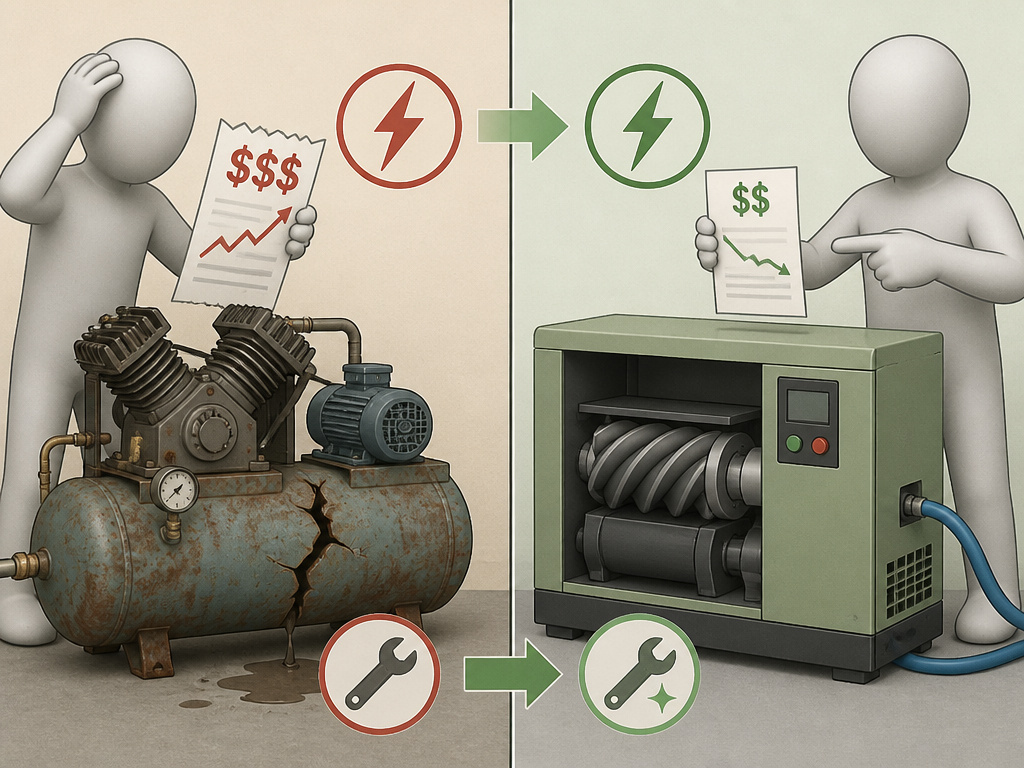
Be honest. The price tag pulls you toward the piston compressor. It’s often half the cost or less for a similar CFM rating. That’s the trap. The purchase price is the smallest number in a ten-year equation.
The biggest cost by far is electricity. Over a decade, you’ll spend several times the compressor’s purchase price on power. As we just covered, the rotary screw uses less energy per CFM. Pilot Air notes that a rotary screw compressor can reduce energy costs by up to 20% annually compared to a reciprocating system. For larger installations, a Pilot Air ALTA-TEC rotary screw air compressor can pay for itself in 24 months.
When things break, and they will, the repair bill tells another story. According to parts cost data, a complete 10 HP two-stage piston pump assembly runs roughly $3,200 and up. A complete drop-in rotary screw airend replacement costs around $1,500 plus installation. The screw’s core wear part is not only cheaper, but its rotary design also means it typically lasts longer before needing replacement.
Maintenance is where the manual and reality violently disagree. Manufacturers recommend draining the piston compressor tank daily to prevent rust, but anecdotal field reports suggest draining happens closer to once a month, if that. Almost nobody drains daily. This neglect leads to the single most common and dangerous failure: a rusted-out air tank. A patched or welded pressure vessel is a serious safety hazard, not a repair.
| Cost Category (10-Year View) | Piston Compressor | Rotary Screw Compressor |
|---|---|---|
| Initial Purchase Price | Lower | Higher |
| Energy Costs | Higher (8.5-10.5 kW/100CFM) | Lower (6.5-7.5 kW/100CFM) |
| Core Part Replacement | ~$3,200+ (pump, sooner) | ~$1,500 (airend, later) |
| Maintenance Discipline | High (daily drain, frequent oil) | Lower (auto drain, longer intervals) |
| Risk of Unsafe Tank Failure | Higher | Lower (often no tank, or drier air) |
The rotary screw isn’t maintenance-free. It has oil and filters that need changing on schedule. But the intervals are longer, and many models have automatic tank drains, removing the most commonly skipped task from human hands.
Oil, Air Purity, and Specialized Applications
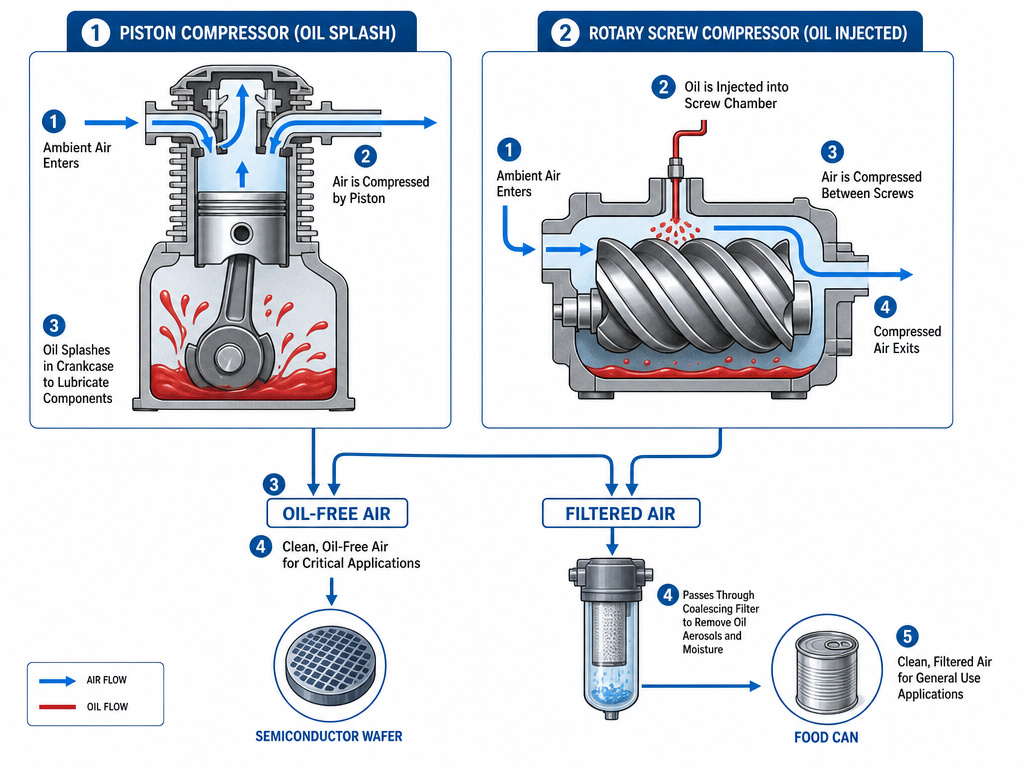
For most wood and metal shops, general compressed air is fine. But step into food processing, pharmaceuticals, or high-end automotive painting, and air purity is a specification, not a preference.
This is where the “oil-free” claim gets muddy. There are two paths: oil-free compressors (which use alternative materials like Teflon for lubrication) and oil-injected compressors with extensive filtration.
With oil-injected screw compressors, you cannot have compressed air 100% free from oil when it comes out of the compressor. Filters can remove the vast majority, but some minute amount is always carried over.
That’s the hard line from Atlas Copco, a major manufacturer. For applications where any oil aerosol is catastrophic, like semiconductor manufacturing or certain pharmaceutical processes, you need a true oil-free compressor. These are more expensive and have their own maintenance schedule.
For many other “clean” applications, the installed base tells a different story. In food and beverage, oil-injected rotary screw compressors are common. The key is pairing them with filtration that meets the required ISO 8573-1 purity class for the application. It’s a matter of risk management and cost. A true oil-free compressor is the safest, most expensive option. A well-filtered oil-injected system is a more common, cost-effective solution that meets many standards.
This is a critical distinction when you’re reading about different compressor types and their lubrication systems. “Oil-free” can refer to the pump technology or the delivered air quality. Know which one you’re actually buying.
Rotary Screw vs Piston: The Final Decision Guide
Enough theory. Here’s how to choose, step by step.
- Calculate Your True CFM Need. List every air tool you might run. Find its CFM requirement at your operating PSI (check the tool manual). Don’t use “average” CFM, find the tool with the highest continuous demand (like a die grinder or sander). That’s your target CFM. Tank size is irrelevant for continuous use.
- Estimate Your Duty Cycle. How many minutes per hour will you be drawing that peak CFM? If it’s over 40 minutes in a 60-minute period, you’ve exceeded a typical piston compressor’s capability. A rotary screw is your only option.
- Consider Your Environment. Is the compressor in a shared space? Will the noise bother people? If the answer is yes, the 68-75 dB of a screw compressor is a major quality-of-life upgrade over the 80-90 dB of a piston.
- Run the 5-Year Math. Sticker price + (estimated yearly energy cost x 5) + (estimated maintenance/repair cost). Online calculators can help with energy costs based on your local kWh rate. This simple exercise makes the rotary screw’s value clear for most professional shops.
- Plan for the Worst. If the pump fails, can you afford a $3,200+ replacement on a piston compressor, or a ~$1,500 airend on a screw? Factor potential downtime into your business cost.
For the home hobbyist using a nail gun and inflating tires, a piston compressor is a great buy. For the small business owner running a sandblaster for an hour at a time, the math flips. The higher upfront cost of a rotary screw compressor is an investment in uninterrupted productivity and lower operating costs.
Space requirements for air compressors
Rotary screw compressors are often more compact for their output compared to piston models. Their integrated design packages the motor, airend, and cooling system efficiently. For a given air delivery, a screw compressor typically has a smaller footprint than a piston unit with a comparable tank. This makes screw compressors a strong choice for shops where floor space is limited. Piston compressors, with their separate motor and pump mounted on a larger air receiver tank, generally require more floor area. Consider the total area needed for the compressor itself plus necessary service clearance when planning your installation.
Air compressor vibration
Rotary screw compressors operate with significantly less vibration than piston compressors. The screw mechanism provides smooth, continuous compression with no reciprocating parts, leading to a stable operation. This low vibration allows for direct installation on most floors without special foundations and reduces wear on the unit and surrounding structures. Piston compressors, with their back-and-forth pumping action, generate inherent shaking and vibration. This often necessitates a more solid mounting surface or isolation pads to prevent noise transmission and potential damage from the constant movement.
Frequently Asked Questions
Are rotary screw air compressors better?
For continuous, heavy-use applications, yes. They are better on energy efficiency, noise, maintenance, and long-term cost. For light, intermittent use (less than 50% duty cycle), a piston compressor is more cost-effective because the higher efficiency doesn’t have enough run time to offset the much higher purchase price.
Which is better for a home garage, a screw or piston compressor?
Piston compressor is almost always the better choice for a home garage. The duty cycles and CFM requirements of typical DIY projects (impact wrenches, nailers, inflation) fit a piston compressor’s design perfectly. The noise is less of an issue in a detached garage, and the lower initial cost is a significant advantage for occasional use.
What is the main disadvantage of a rotary screw compressor?
The main disadvantage is the significantly higher initial purchase price. They are also more complex machines, so when they do need service, it often requires a more specialized technician compared to a piston compressor. For the right user, these cons are outweighed by the long-term savings and reliability.
Can you use a piston compressor for painting?
You can, but you must invest in serious air preparation. Piston compressors produce pulsating, hot, oily, and wet air, all enemies of a paint job. To use one for painting, you need a large tank to dampen pulses, a high-quality aftercooler, a refrigerant dryer, and coalescing filters rated for oil removal. It’s often cheaper and more reliable to use a compressor better suited to the task.
How long do rotary screw compressors last?
With proper maintenance, a rotary screw compressor can last 15-20 years or more in industrial service. Their continuous-duty design means they aren’t undergoing the thermal stress cycles that wear out piston compressors. The core airend is designed for tens of thousands of hours of operation before a rebuild is needed.
Before You Go
The choice between a rotary screw and a piston air compressor is about matching a machine’s inherent design to the job you’re actually going to give it, not about good versus bad.
If your air use is sporadic and light, buy the piston. Appreciate its simplicity, maintain it diligently (yes, drain the tank), and it will serve you well. But if compressed air is part of your livelihood, if your tools run for more than a few minutes at a time, or if downtime costs you money, the rotary screw compressor is the only rational choice. Its higher price is a down payment on lower bills, fewer headaches, and a machine that works as hard as you do.
Start by timing your longest, most air-intensive task. If that number is over 30 minutes, you’re already in screw compressor territory. The rest is just math.
