
4 Best 4×4 Cnc Routers in 2026
This post contains affiliate links. As an Amazon Associate, we earn from qualifying purchases.
Our best overall 4×4 CNC router is the Genmitsu PROVerXL 4×4 for its combination of a true full-sheet work area, industrial-grade construction, and the option to add a dual Z-axis for production work. The Axiom Precision AR16-Elite is our pick for best industrial performance, while the SainSmart Genmitsu PROVerXL 4×4 offers the best value.
A 4×4 router opens up projects from furniture parts to full signage, but it also demands serious shop space and often a higher budget. This guide is built from a deep-dive into manufacturer specifications and owner feedback patterns. We’ve distilled it down to four clear choices so you can invest confidently in a machine that fits your floor space and ambitions.
Top 4 4×4 CNC Routers in the Market
Certain content that appears on this site comes from Amazon. This content is provided "as is" and is subject to change or removal at any time.
The Best 4×4 CNC Routers, Reviewed
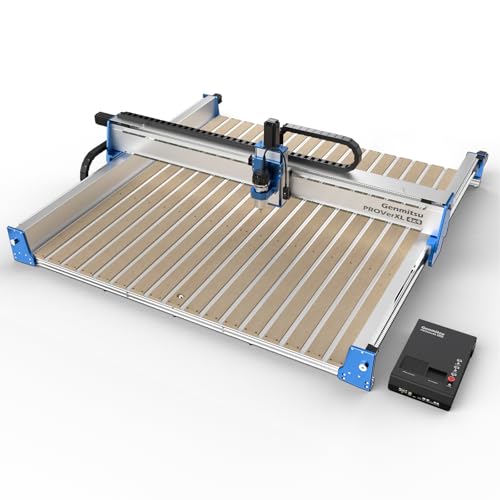
Genmitsu PROVerXL 4×4 CNC Router
What We Like
- Large 4'x4' work area for full-sheet processing
- Industrial-grade ball screws and dual rails for stability
- Wi-Fi app for convenient remote machine control
- Optional dual Z-axis and spindle support for mass production
Trade-offs
- Spindles and add-on Z-axis are sold separately
- At 51.2 inches square, it requires significant shop floor space
A 4’x4′ work area is large enough for handling standard plywood sheets through indexing, making it a practical choice for cabinet shops or batch production. Industrial 20mm diameter ball screws and dual linear rails on the X-axis deliver the rigidity required for precise, repeatable cuts in wood and light metals. Managing the machine via Wi-Fi from your phone adds convenience for a workflow designed for serious production.
You are buying a capable frame and control system, but remember that spindles are sold separately. This modular approach keeps the initial investment reasonable and lets you tailor the powerhead to your exact material needs, though it adds to total setup time and cost.
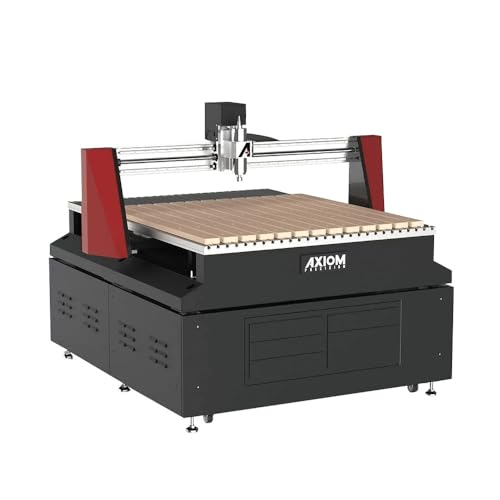
Axiom Precision AR16-Elite CNC Router
What We Like
- Servo-driven motors for speed and precision
- Onboard liquid cooling for spindle longevity
- Heavy 1347-pound frame ensures stability
Trade-offs
- Requires 230V single-phase power and a 15A circuit
- At 1347 lb, it demands a permanent, reinforced shop floor
- Its 72-inch square footprint needs significant dedicated space
A servo-driven system with prismatic guides and ball screws on every axis delivers the repeatable accuracy and speed needed for production shop work. It’s the foundation for a serious fabrication cell, not a hobbyist’s weekend project.
The trade-off for that industrial performance is a substantial physical and electrical footprint. You’ll need to plan for a dedicated, reinforced space and the appropriate power hookup. Compared to more compact kits like the Genmitsu PROVerXL, the AR16-Elite is a turn-key industrial asset. It’s for the workshop where downtime is the real enemy, and the machine’s weight and construction are its first line of defense.
Product photos
SainSmart Genmitsu PROVerXL 4×4 CNC

What We Like
- Closed-loop motors prevent lost steps for reliable cuts.
- Dual linear rails on X-axis enhance rigidity.
- Open design allows machining of 4×8 sheets via indexing.
- Wi-Fi module enables convenient phone control.
Trade-offs
- Spindle and optional dual Z-axis are sold separately.
- At 51.2 inches square, it demands significant shop floor space.
A 4×4 foot work area with an open front and back lets you handle full 4×8 sheet goods through indexing, which is a serious capability for a machine in this class. That open design, paired with ball screws and closed-loop stepper motors, delivers the repeatable accuracy needed for batch production without breaking the bank. This setup is a smart match for a small shop owner or a dedicated hobbyist who needs to process large panels but doesn’t have the room or budget for a dedicated 8-foot machine.
The spindle and optional dual Z-axis are sold separately, which lowers the starting cost but means your total investment depends on what accessories you add. The machine’s open design and compatibility with various spindles let you configure it for specific tasks, from metal carving with a dedicated spindle to woodworking with a trimming router.
VXB 8' x 4' CNC Router Kit

What We Like
- Generous 8' x 4' work area for sheet goods
- Complete linear motion kit for a custom build
Trade-offs
- 75-pound kit requires sourcing your own frame and spindle
- No electronics, motors, or software included
Its 96 by 48 inch work area is the main event, letting you machine full sheets of plywood or composite panels without pre-cutting. This kit is for the builder who needs a true large-format machine and wants to select their own spindle and electronics. You get a foundation of linear guides and ball screws, which must be mounted to a proper frame you build. It’s a project that demands workshop space and mechanical savvy, but it delivers a professional-scale canvas.
The trade-off is that you’re buying a component set, not a machine. You’ll need to fabricate a gantry and table, then add motors, drivers, and a controller. Compared to a ready-to-run option like the Axiom Precision AR16-Elite, the VXB kit is a blank slate. It provides the linear motion components for a custom build, but requires significant time and additional investment to become operational. This path makes sense if you enjoy the build process as much as the routing.
How We Evaluated 4×4 CNC Routers
Our selection is research-based. It focuses on manufacturer documentation, detailed expert round-ups, and consistent patterns in owner feedback across forums and reviews. We prioritized criteria that matter most for a large-format machine. This includes the actual work area and ability to handle full sheets, the mechanical components that determine precision and longevity like ball screws and linear rails, and the power requirements that dictate shop readiness.
We also considered the completeness of the kit and the availability of key upgrades like spindles. The main limitation of this approach is that we cannot verify cutting speed or accuracy claims, so we rely on corroborated owner reports and detailed specification sheets.
What To Look For In 4×4 CNC Routers
Choosing a 4×4 machine means committing to a significant shop footprint. Your decision hinges on balancing the work envelope you need with the mechanical quality you can afford, all while ensuring your shop’s infrastructure can support it. Understanding the core components and their trade-offs is the key to a smart purchase.
Look for a true 4’x4′ work area, industrial-grade ball screws and linear rails for precision, and confirm your shop’s power and floor strength can handle the machine’s weight and electrical needs.
Work Area & Footprint
The advertised size can be misleading. A “4×4” machine needs a cutting area of at least 48 by 48 inches to process a full sheet of plywood without pre-cutting. However, the machine’s total footprint is often several inches larger in each direction to accommodate the frame and rails.
Our top picks range from approximately fifty-one inches to a full seventy-two inches square. Also consider if the design allows for ’tiling’ or indexing, where you can move a larger sheet through the work area to cut an eight-foot length in two passes. This feature, mentioned in several CNC router reviews, effectively doubles the usable project size without needing a physically larger machine.
Mechanical Components & Precision
The drive and guidance systems are the heart of a CNC’s precision and repeatability. Ball screws are superior to lead screws for accuracy and reduced backlash, making them a hallmark of better machines. Dual linear rails on critical axes, especially the long X-axis, provide the rigidity needed for clean cuts in hard materials at high speeds.
Motor type matters too; closed-loop steppers or servo motors prevent lost steps, ensuring a complex carving finishes exactly as programmed. These industrial-grade components are what separate a reliable production tool from a frustrating hobby kit, and they are a focus in any serious CNC router buying guide.
Power, Weight & Shop Requirements
Large-format routers are heavy, powerful tools. Machine weight, often exceeding 1,300 pounds for industrial models, indicates stability but requires a reinforced concrete floor, not just a wooden shop subfloor. Electrically, many premium machines require a 230V single-phase circuit, which may need to be installed by an electrician.
The spindle itself is another critical and often separate purchase; liquid-cooled spindles run quieter and last longer under continuous use than air-cooled routers. Before buying, audit your shop space, floor strength, and electrical panel. For those new to the technology, starting with a smaller machine is a common path, which is why we have a dedicated resource on CNC routers for beginners.
Kit Completeness & Upgradability
The term “CNC router kit” covers a wide spectrum. A complete kit includes the frame, motors, electronics, controller, and sometimes basic software. Many value-oriented kits, however, require you to source the spindle and its power supply separately.
At the far end are barebones linear motion kits for building a custom frame, which demand significant mechanical skill. Consider your willingness to assemble and your budget for necessary add-ons. A machine that supports future upgrades, like adding a second Z-axis for multiple tools, protects your investment as your needs grow.
Learning how to use a CNC router effectively also depends heavily on having a complete, well-documented system to start with.
- Confirm every major component is included: frame, motors, drivers, controller, spindle (or specify which are not).
- Check the software compatibility; some kits are locked to proprietary software, while others work with standard G-code senders.
- Verify the warranty length and the availability of technical support for assembly and troubleshooting.
The most expensive part of a CNC project can be the accessories you didn’t budget for.
4×4 CNC Routers Compared
To see how these four 4×4 routers stack up on key specifications, the table below provides a direct comparison of their work areas, drive systems, and power needs.
| Product | Work Area | Drive System | Control |
|---|---|---|---|
| Genmitsu PROVerXL 4×4 CNC Router | 1300mm x 1300mm (4' x 4') | 20mm ball screws | Wi-Fi app control |
| Axiom Precision AR16-Elite CNC Router | 48" x 48" | ball screws | Industrial 4-axis CNC controller |
| SainSmart Genmitsu PROVerXL 4×4 CNC | 51.18'' x 51.18'' x 4.72'' | 20mm diameter ball screws | Wi-Fi module |
| VXB 8' x 4' CNC Router Kit | 96" x 48" x 10" | Ball Screws | N/A |
Frequently Asked Questions
Which 4×4 CNC router is the best?
For most shops ready to scale up, the best overall 4×4 CNC router is the Genmitsu PROVerXL 4×4. It offers a true full-sheet work area, industrial-grade ball screws and dual linear rails for precision, and a modular design that supports adding a second Z-axis for production work. Its balance of capacity, quality, and configurability makes it a versatile centerpiece for a serious workshop.
What is the best brand of CNC router?
There isn’t a single “best” brand, as different manufacturers excel in different niches. For industrial-grade performance and heavy-duty construction, brands like Axiom Precision are highly regarded. For hobbyists and makers seeking value and a large community for support, brands like SainSmart Genmitsu are popular. The best brand for you depends on your specific needs for precision, material types, budget, and the level of technical support you require.
What should I know before buying a 4×4 CNC router?
Before buying, you must assess your shop’s physical and electrical capacity. These machines are large, often requiring a dedicated floor space of 6×6 feet or more, and they can weigh over half a ton, needing a solid concrete floor. Many require a 230V electrical circuit. You should also budget beyond the base machine for essential items like a capable spindle, dust collection, clamps, and a computer to run the control software.
Can a 4×4 CNC router cut an 8-foot sheet?
Yes, many 4×4 CNC routers can cut an 8-foot sheet through a process called indexing or tiling. You secure a 4×8 sheet of material, cut one 4×4 section, then shift the material to cut the remaining section. This requires a machine design with an open frame or removable end stops. It’s a crucial feature for cabinetry or long sign projects and is common among the machines we evaluated.
Is a 4×4 CNC router good for a home workshop?
A 4×4 CNC router can be used in a home workshop, but it is a major commitment. It requires significant, permanent floor space, often specialized power, and effective dust collection. For many home woodworkers, a smaller 2×2 or 3×2 machine is a more practical starting point to learn the craft. If your projects consistently involve full sheets of plywood or large panels, then a 4×4 is the right tool, but be prepared for its footprint. Our guide to hobby CNC routers explores more compact options.
The Bottom Line
The Genmitsu PROVerXL 4×4 is our best overall pick because it delivers the full-sheet capacity and industrial-grade construction that serious workshops need, all while offering a path to expand with a dual Z-axis for batch production. It’s the right choice if you have the space and are ready to move beyond smaller projects.
If your budget is tighter but you still want a capable large-format machine, the best value pick is the SainSmart Genmitsu PROVerXL 4×4. For shops with reinforced floors and 230V power seeking uncompromising performance, the Axiom Precision AR16-Elite stands alone. Ultimately, the single most important factor is ensuring your shop’s floor space and infrastructure can handle the machine you choose, measuring twice applies to your workshop footprint, not just your stock.
