
10 Best Car Buffer Machines in 2026
This post contains affiliate links. As an Amazon Associate, we earn from qualifying purchases.
Our best overall car buffer is the Chemical Guys TORQX Random Orbital Polisher Kit for its complete package and controlled, safe polishing action. For focused paint correction, consider the Griot’s Garage G9, and the BATOCA S3 is our top cordless pick for its convenience. Choosing the wrong buffer can leave swirl marks or fail to correct paint, wasting your effort. We researched specifications, manufacturer data, and patterns in expert and owner feedback to compile this list of ten top performers.
Top 10 Car Buffer Machines in the Market
Certain content that appears on this site comes from Amazon. This content is provided "as is" and is subject to change or removal at any time.
The Best Car Buffer Machines, Reviewed
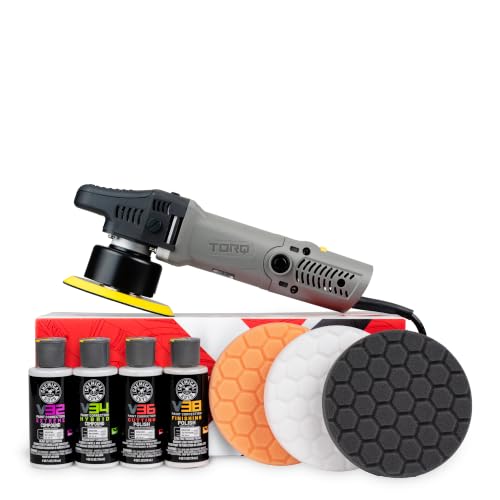
Chemical Guys TORQX Random Orbital Polisher Kit
What We Like
- Complete 9-piece kit includes pads and polishes
- 8mm orbital throw for safe, controlled polishing
- 700W motor provides smooth, versatile performance
- Ergonomic design for comfortable extended use
Trade-offs
- At 8.6 lb, it's heavier than the 5.2 lb Griot's G9
- 20.5-inch height requires more storage space
A 700W motor with an 8mm random orbital throw provides the controlled power to remove light scratches and oxidation safely on paint and clear coat. This complete nine-piece kit includes the polisher, pads, and compounds, so you can start working immediately without buying extra products. Chemical Guys notes it is favored by detailers and DIYers, offering a solution that is easy for beginners yet powerful for professionals.
The unit weighs 8.6 pounds, which can require more arm stamina over a full car compared to other models like the 5.2-pound Griot’s Garage G9. The kit’s all-in-one design bundles the essential pads and polishes for compounding, polishing, and finishing, which is a major time-saver. Its ergonomic design and balanced weight are intended to make it comfortable for extended use.
Griot's Garage G9 Random Orbital Polisher

What We Like
- 6 variable speed settings for different applications
- Ergonomic double-shot rubber grip for comfort
- Convertible to a 5-inch pad system for flexibility
Trade-offs
- Corded design limits mobility compared to cordless models
- Requires an optional plate for 5-inch pad conversion
A 1000-watt motor and 9mm orbit throw give this polisher the guts to tackle serious swirls and oxidation without bogging down. The constant speed control maintains smooth operation under pressure, making it a solid choice for someone ready to move beyond basic waxing into true paint correction. It’s built for the detailer who values power and precision over portability, offering the control needed for multi-stage polishing jobs.
The trade-off for that power is being tethered to an outlet. While the 10-foot cord provides good reach, you can’t wander far from a power source, unlike cordless options like the BATOCA S3. Its convertible design adds versatility, but remember you’ll need to buy the separate 5-inch backing plate to run smaller pads for tighter areas. This is a dedicated, hard-wired workhorse best suited for garage use.
Porter-Cable 7424XP Orbital Polisher

What We Like
- Swirl-free random orbit polishing action
- Electronic variable-speed dial for control
- Compact 5.8-pound design is easy to handle
- Proprietary counterbalance reduces vibration
Trade-offs
- AC-only power limits cordless mobility
- Sanding and polishing require the specific 5-inch counterweight
The Porter-Cable 7424XP delivers a true random orbital, swirl-free action, which is the foundation for safe paint correction. Its variable speed dial lets you dial in the right pace for compounding or waxing. At 5.8 pounds and with a compact body, it’s a tool you can manage with one hand for applying wax or use two-handed for hours of polishing without excessive fatigue. This makes it a solid, predictable choice for detailers who prioritize a flawless finish over raw speed.
That predictability comes with a trade-off in raw power. The 4.5-amp motor is less aggressive than some direct-drive units, so tackling severe defects on a large vehicle will take more time and patience. Research suggests a full correction on a mid-sized car can be a multi-hour project. If you need more cutting power for heavy work, a tool like the Griot’s Garage G9 with its 1000-watt motor would be a stronger alternative, though it may sacrifice some of the 7424XP’s beginner-friendly finesse.
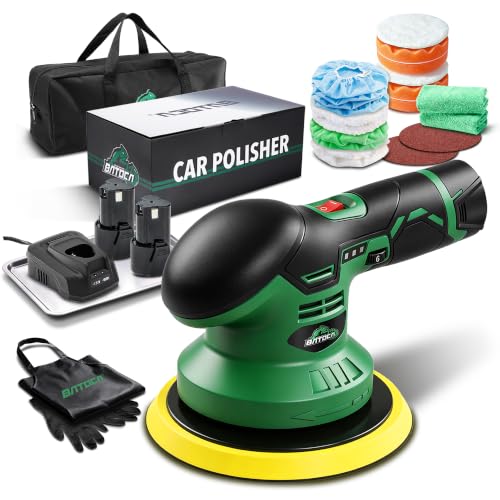
BATOCA S3 Cordless Car Polisher
What We Like
- Two-battery system with fast charger for continuous use
- Clear power alert function with three-color LED lights
- Six-speed adjustment for compound, polish, and wax
Trade-offs
- Battery runtime is finite, unsuitable for marathon detailing sessions
- Compact size may be less stable on large, flat panels than heavier tools
The BATOCA S3 cordless polisher weighs 2.4 pounds, allowing easy overhead and vertical panel work without causing arm fatigue. Its 5mm random orbit helps create a uniform finish and is friendly for beginners on painted surfaces. You get two batteries and a charger, so one battery can charge while the other is in use. The tool has a speed range from 2500 to 5000 RPM, suitable for applying waxes, sealants, and glazes.
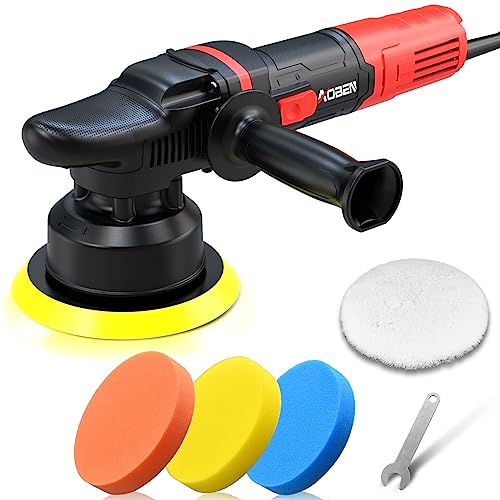
AOBEN Dual Action Car Polisher Kit
What We Like
- Six variable speeds for different detailing tasks
- Ergonomic, multi-position handle reduces fatigue
- Includes four specialized pads for polishing and waxing
- Dual-action orbital motion prevents swirl marks
Trade-offs
- Stops under pressure at low speeds 1-3
- Corded 120V operation limits range of movement
A 700-watt motor and six speeds from 1000 to 4500 rpm give you a wide operational range, letting you dial in the right power for everything from gentle wax application to cutting through oxidation. This makes the AOBEN kit a solid pick for the detailer who wants one machine to handle their entire paint correction and protection workflow. The included assortment of foam and wool pads means you can start working right out of the box without needing an immediate trip to the store.
The main compromise is its behavior under load; applying too much pressure at the lowest three speeds will cause the machine to stall, requiring a restart at a higher setting. This demands a lighter touch for finishing work. Compared to a dedicated tool like the lighter-weight Griot’s Garage G9, the AOBEN asks for a bit more finesse from the operator but packages greater versatility for the price. It’s a capable workhorse that covers a lot of ground in a single kit.
Griot's Garage G8 Orbital Polisher

What We Like
- Small frame design for tight contours.
- Double-shot rubber dampening for comfort.
- 45% stronger gearset for durability.
- Quick access brush side ports for maintenance.
Trade-offs
- Exclusively uses small 2" and 3" backing plates.
- 700-watt motor is less powerful than full-size models.
Designed for agility and precision, the Griot’s Garage G8 Orbital Polisher handles small areas and tight contours with its compact frame and included 2-inch backing plate. Its 700-watt motor and 8mm orbit provide focused power for removing scratches and swirls, while the contoured grip and rest pads offer stability during detailed work.
The G8’s specialized design for small areas means it is not intended for polishing large, flat panels like entire hoods or doors. For covering broad surfaces efficiently, a larger model with a more powerful motor would be more suitable.
Product photos
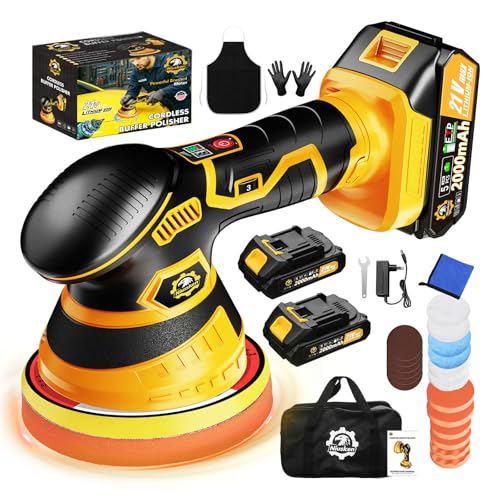
Niusken Cordless Car Buffer Polisher Kit
What We Like
- Cordless design with two 21V batteries
- LED screen shows real-time speed and battery level
- Lightweight 3.3 lb body with ergonomic grip
- Comprehensive kit with pads for multiple surfaces
Trade-offs
- Overheats and shuts off after 20 minutes of high-speed use
- Battery system is proprietary, not compatible with DeWalt
- Requires full charge before first use for optimal performance
Two 21V batteries and a cordless design mean you can tackle a full sedan or SUV detail without hunting for an outlet, a major advantage for mobile work. The clear LED screen is the standout, giving you instant feedback on speed and remaining power so you can adjust your technique on the fly. This makes the Niusken a logical pick for detailers who value clean workspaces and data-driven control, especially beginners who benefit from the visual cues and the extensive pad selection for learning different techniques.
Continuous high-speed polishing may trigger an automatic shut-off after about 20 minutes, which protects the motor but requires a brief pause before restarting. This design prioritizes component safety over non-stop operation, making it suitable for shorter detailing sessions rather than prolonged, intensive use. The cordless convenience comes with a proprietary battery system, so it cannot share power packs with common professional brands like DeWalt.
Product photos
SEESII Cordless Car Polisher Kit
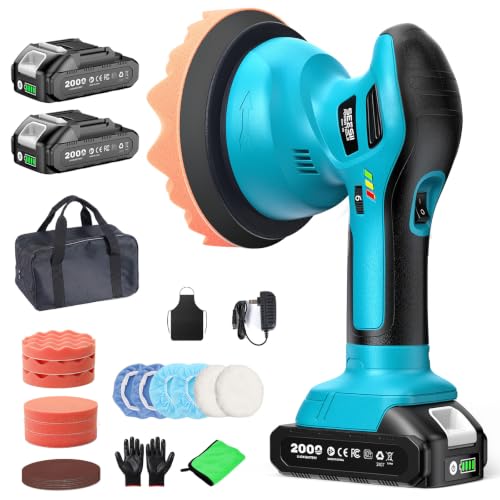
What We Like
- Dual batteries for extended cordless runtime
- Lightweight cordless design reduces fatigue
- Complete kit with pads and accessories
- Six-speed adjustment for various tasks
Trade-offs
- 300W motor is less powerful than many corded rivals
- 8mm orbit is less aggressive for heavy correction
- Runtime is limited to hood, trunk, and two doors per charge cycle
Two batteries in the box mean you can polish the main panels of a car without stopping to recharge, which is the core advantage of this kit. For a DIYer tackling a single vehicle in a garage without a convenient outlet, that cordless freedom is a major practical win. The 3-pound weight and ergonomic handle make it easy to manage for beginners, and the included array of pads lets you start on paint, boats, or furniture right away.
The trade-off for that cordless convenience is raw power. Its motor can handle light polishing and waxing, but it won’t tackle severe defects as quickly as a high-wattage corded model. Think of this tool as a detailer’s maintenance tool, not a body shop’s correction machine. If your project stays within its battery life and your paint needs are moderate, it eliminates cord hassles cleanly.
Product photos
ZOTA 1600W Buffer Polisher Kit
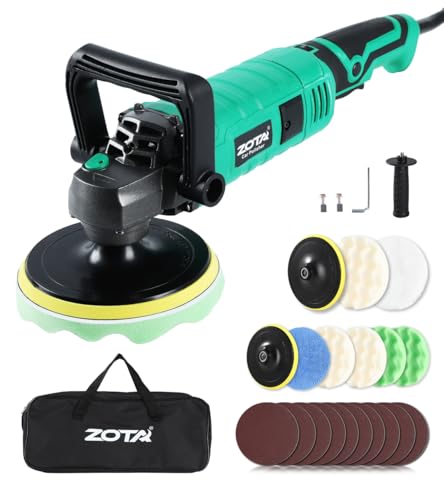
What We Like
- High-torque 1600W motor for demanding correction
- Long 13.1 ft cord reduces outlet hunting
- Three handle positions improve long-session comfort
- Seven-speed range suits sanding to final polishing
Trade-offs
- Heavy-duty motor and design increase overall weight
- 7-inch pad size requires more care on tight curves
With a 1600W pure copper motor, this polisher delivers the power needed to remove oxidation and deep scratches on large surfaces without stalling. Its seven speed settings, ranging from 1000 to 3500 RPM, provide control for tasks from delicate sanding to aggressive polishing. An upgraded 13.1-foot power cord allows you to work around a full-size vehicle without frequently moving your power source, which streamlines large projects.
The design includes three ergonomic handle options and a detachable D-handle to reduce fatigue during long sessions, accommodating different hand sizes and grip preferences. A safety switch lock can hold a selected speed, which helps maintain consistent operation without continuous finger pressure. This polisher kit includes wool, sponge, and sandpaper pads for tasks ranging from gentle polishing to heavy grime removal on surfaces like cars, boats, or furniture.
Product photos
SPTA Dual Action Random Orbital Polisher
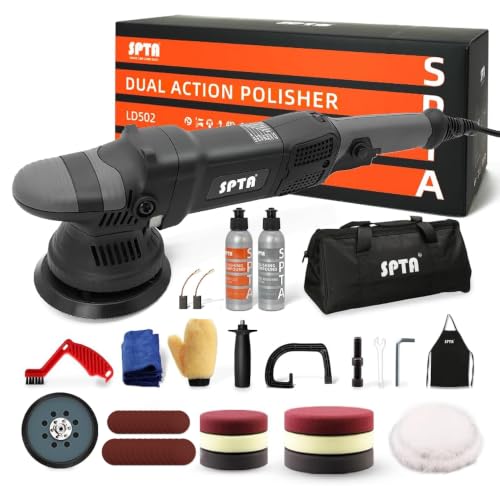
What We Like
- Includes a comprehensive kit with pads and compounds.
- Offers six adjustable speeds for different tasks.
- Features constant power electronics for stable operation.
- Provides two ergonomic handle options for comfort.
Trade-offs
- Lacks specified weight, which complicates fatigue assessment for overhead work.
- Kit includes many consumable items that will eventually need replacement.
A 750-watt motor paired with a six-speed dial gives you the range to tackle everything from gentle waxing to serious defect removal. The constant power electronics keep the tool from bogging down under load, which is crucial for maintaining a consistent finish across a large panel. This polisher suits the detailer who wants a single box solution, as it arrives ready to work with a full array of pads, compounds, and even sanding discs. You won’t need to hunt down separate accessories before your first project.
The trade-off is in raw muscle. It makes up for this with its exceptional out-of-the-box completeness. For a newcomer or an enthusiast who values convenience, having every pad and compound included from the start eliminates guesswork and multiple orders, letting you focus on technique rather than parts gathering.
Product photos
How We Evaluated Car Buffer Machines
Our evaluation began by compiling specifications and manufacturer documentation for dozens of popular models. We then analyzed professional round-ups and synthesized recurring patterns in owner feedback to understand real-world performance and common trade-offs. Key criteria included the machine’s power and motion type, its ergonomics and ease of use, and the completeness of any included kits. Since this is a research-based guide, we cannot comment on the precise feel or balance of a tool in hand, which is a key factor for long detailing sessions.
What To Look For In Car Buffer Machines
The right machine makes paint correction safe and effective, while the wrong one can damage your car’s finish. Understanding a few key specifications will help you match a tool to your projects and skill level.
Focus on power source (corded vs. Cordless), the orbital throw for safe polishing, motor wattage for correction ability, and overall kit completeness to get started right away.
Power Source and Runtime
Corded buffers provide unlimited runtime and consistent power. This makes them ideal for marathon detailing sessions or heavy paint correction on large vehicles. Cordless models offer excellent mobility and a clutter-free workspace, but they have finite battery life. Research shows some can run for over three hours on a charge, while others are best for a single car’s hood and doors. For beginners, a guide to using a car buffer can help you plan your workflow around either power type.
Polishing Action and Power
A dual-action, or random orbital, polishing motion is safest for beginners as it drastically reduces the risk of burning through paint. The size of the orbital “throw,” measured in millimeters, influences its correction speed and smoothness. Motor wattage is another key indicator; a 700W motor is versatile for most DIY tasks, while a heavy-duty 1600W unit is built for large, flat surfaces like truck panels. For a deeper comparison of tool types, our resource on dual-action vs. Rotary polishers explains the trade-offs.
Ergonomics and Kits
A comfortable grip and manageable weight are crucial, as polishing sessions can last hours. Look for models with rubberized handles and multiple grip positions. Many car buffer kits include pads, backing plates, and sometimes compounds, offering significant value for first-time users. Before you buy, consider these practical checks:
- Verify the backing plate size is compatible with the pads you plan to use.
- Check the cord length if using a corded model; a longer cord reduces outlet hunting.
- Assess the handle configuration to ensure it will be comfortable for overhead and vertical panel work.
- For cordless models, confirm battery compatibility with other tools you own or check if spares are affordable.
- Read the warranty terms, as they can range from 30 days to several years.
A complete starter kit often provides better immediate value than a bare tool for a first-time user.
Car Buffer Machines Compared
The comparison table below highlights the key specifications and strengths of our top picks at a glance.
| Product | Motor Power | Speed Range | Orbit Throw |
|---|---|---|---|
| Chemical Guys TORQX Random Orbital Polisher Kit | 800W Motor | N/A | 8mm |
| Griot's Garage G9 Random Orbital Polisher | 1000 watts | 2000-6400 OPM | 9mm |
| Porter-Cable 7424XP Orbital Polisher | 4.5 Amp | 2,500-6,800 OPM | Random |
| BATOCA S3 Cordless Car Polisher | N/A | 2500-5000 RPM | 5mm random orbit |
| AOBEN Dual Action Car Polisher Kit | 700W | 1000-4500 rpm | N/A |
| Griot's Garage G8 Orbital Polisher | 700-watt | N/A | 8mm |
| Niusken Cordless Car Buffer Polisher Kit | 21V cordless | 2800-5800 RPM | 8mm dual action |
| SEESII Cordless Car Polisher Kit | 300W | 2500-6000 RPM | 8mm random orbit |
| ZOTA 1600W Buffer Polisher Kit | 1600W pure copper | 1000-3500 RPM | N/A |
| SPTA Dual Action Random Orbital Polisher | 750W motor | 2,000-5,200 RPM | N/A |
Frequently Asked Questions
What is the best car buffing machine?
The best machine depends on your needs. For most DIYers and first-time users, a dual-action random orbital polisher is the safest and most versatile choice. Our best overall, the Chemical Guys TORQX, fits this role because it comes with a complete kit for immediate use.
What is the difference between a car buffer and a polisher?
The terms are often used interchangeably, but technically a “buffer” might refer to a tool for applying waxes and sealants, while a “polisher” is used for correcting paint. In practice, modern dual-action machines perform both functions. The critical distinction is between the safe, random orbital motion of a car buffer polisher and the more aggressive, single-direction spin of a rotary polisher.
What is the best car polisher for a beginner?
Beginners should prioritize a dual-action polisher with a complete kit to avoid sourcing separate components. Models like our best overall Chemical Guys TORQX or the Porter-Cable 7424XP are designed to be good for beginners, offering controlled, swirl-free action that minimizes the risk of damaging your paint.
Are cordless car buffers any good?
Yes, modern cordless car buffers are very capable for light to medium polishing and waxing, offering excellent convenience. Their runtime is finite, so they are best suited for polishing a single vehicle or for users who value a tangle-free workspace over marathon correction sessions.
What should I look for in a buffer for paint correction?
For serious paint correction, look for a dual-action polisher with multiple speed settings and sufficient motor power (700W or more). A model with a longer orbital throw can correct defects faster. The Griot’s Garage G9 is our dedicated pick for this task, offering the control and power needed for thorough swirl removal.
The Bottom Line
For most DIYers tackling paint correction for the first time, the Chemical Guys TORQX Random Orbital Polisher Kit is the best overall choice. It provides a safe, effective tool and everything you need to start polishing in one box. If your budget is tighter or you prioritize cordless convenience, look to our dedicated award picks like the BATOCA S3 or the Porter-Cable 7424XP.
Ultimately, choosing a dual-action random orbital polisher is the single most important factor for a safe, successful detailing experience, protecting your vehicle’s finish while you restore its shine.
