
10 Best Wood Lathes in 2026
This post contains affiliate links. As an Amazon Associate, we earn from qualifying purchases.
The best wood lathe for most turners is the Jet JWL-1221VS Variable-Speed Woodworking Lathe, which wins for its smooth variable speed and innovative belt system that makes changes quick and easy. For larger projects, the Jet JWL-1440VSK offers impressive capacity, while the Shop Fox W1836 is a top pick for compact workshops.
Choosing the wrong lathe can leave you frustrated with limited project size, excessive vibration, or a machine that’s awkward to use. We researched specifications, expert evaluations, and owner feedback to build this guide, helping you match a lathe’s true capabilities to your shop space and turning ambitions.
Top 10 Wood Lathes in the Market
Certain content that appears on this site comes from Amazon. This content is provided "as is" and is subject to change or removal at any time.
The Best Wood Lathes, Reviewed
Jet JWL-1221VS Variable-Speed Woodworking Lathe

What We Like
- Innovative ratchet-style belt tension system for quick speed changes.
- Large digital readout and recessed power switch for clear, safe control.
- Smooth forward-to-reverse transition for sanding and thread cutting.
- Integrated spindle lock simplifies accessory changes.
Trade-offs
- At 121 pounds, it's a substantial lift for a benchtop machine.
- 21-inch bed length limits spindle work compared to floor models.
A 12-inch swing over the bed gives you the capacity to turn most bowls and platters a hobbyist would tackle. Its 1 HP motor and three speed ranges provide the muscle and control to handle them smoothly. This lathe suits the serious turner who has outgrown a mini-lathe but doesn’t have the space or need for a full-size floor model. Its thoughtful design means you spend less time fiddling and more time turning. Features like the 24 indexing positions allow for precise fluting, and the Acme thread in the tailstock gives you a solid lock-up.
The real compromise is in length; the 21-inch between-centers capacity is fine for typical spindles but will feel restrictive if you’re regularly making table legs. For those longer projects, you’d need to look at a dedicated floor model like the Shop Fox W1852. For the vast middle ground of turning projects, however, the JET JWL-1221VS delivers a premium, no-nonsense package that balances capability with a relatively compact footprint.
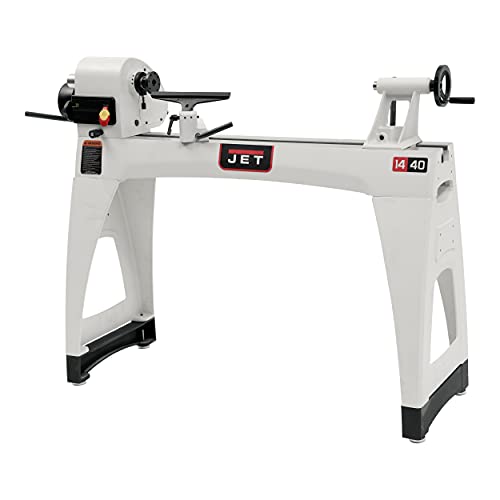
Jet JWL-1440VSK Variable Speed Woodworking Lathe
What We Like
- Wide 400-3000 RPM variable speed range
- Heavy 352 lb cast iron base minimizes vibration
- Acme thread tailstock for stable holds
Trade-offs
- 88-inch length requires significant shop space
- 352 lb weight makes relocation a two-person job
- Large footprint limits use on standard workbenches
With its 14-inch swing and 40-inch between-centers capacity, this lathe handles substantial bowl blanks and long table legs that smaller benchtop models cannot manage. It suits the turner ready to graduate from smaller projects, offering the rigidity and workspace of a floor model that includes an open stand. The variable speed dial, stretching from 400 RPM for out-of-balance pieces up to 3000 for fine finishing, gives direct control for every cut without stopping to change belts.
That capability comes with a real footprint. At 88 inches long and 352 pounds, this lathe demands a dedicated, permanent station. Compared to the compact Jet JWL-1221VS, you gain significant length and more than double the mass, which translates directly into superior stability when turning larger, heavier stock. You trade portability for a solid, vibration-free foundation.
Shop Fox W1836 Bench Top Wood Lathe

What We Like
- Electronic variable speed with digital readout
- Compact 38.5-inch bed length
- Two broad spindle speed ranges
Trade-offs
- 12-inch swing limits bowl diameter versus 14-inch models
- 85 lb weight demands a sturdy, permanent benchtop
- 3/4 HP motor is less powerful than 1 HP options like the Jet JWL-1221VS
With a 12-inch swing over a 38.5-inch bed, this lathe fits compact workspaces while still accommodating spindles, pens, and modest bowls. The electronic variable-speed control and digital RPM readout allow for precise adjustments, which is useful for beginners learning how different woods react. Its 85-pound weight and 3/4 HP motor help keep it steady for common turning tasks, making it a suitable option for a woodworker with dedicated bench space.
The trade-off for that compact footprint is clear when you look at capacity. The 12-inch swing dictates your maximum project width, so if larger bowls or platters are the goal, a model like the Jet JWL-1440VSK with a 14-inch swing becomes the next step up. The Shop Fox W1836 excels within its designed scope, delivering professional features in a package that doesn’t demand a standalone stand. For a first serious lathe or a secondary machine for smaller projects, its specification sheet checks the right boxes for control and stability.
WEN 34035 Variable Speed Benchtop Wood Lathe

What We Like
- Generous 14-inch swing capacity for a benchtop model
- Wide variable speed range from 250 to 3550 RPM
- Includes essential accessories like faceplate and centers
- Standard MT2 tapers ensure accessory compatibility
Trade-offs
- A 20-inch maximum length limits longer spindle projects
- Bench space required is nearly 38 inches long
With a 14-inch swing, this lathe handles bowls and platters that exceed the capacity of many benchtop models. Its variable speed adjusts from 250 to 3550 rotations per minute, a range suitable for various turning tasks. The design suits a woodworker who needs a machine for larger projects but must keep it on a bench.
The maximum workpiece length is 20 inches, which defines the limit for spindle projects like table legs. A 6 Amp motor provides the power for its operations. For longer spindle work, the Jet JWL-1440VSK offers 40 inches between centers but requires a dedicated stand and much more floor space.
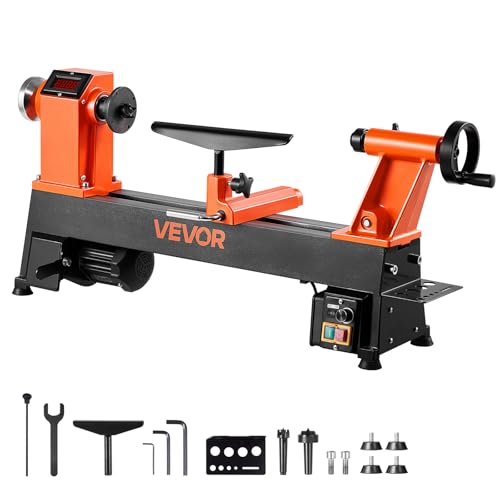
VEVOR 1 HP Benchtop Wood Lathe
What We Like
- Full 1 HP motor for solid cutting power
- Wide 150-3800 RPM variable speed range
- Brushless motor for smooth, low-noise operation
- Comes with a ready-to-use accessory kit
Trade-offs
- 18-inch bed limits spindle length for some projects
- Cast iron construction adds weight for a benchtop model
A 1 HP brushless motor paired with a full 12-inch swing makes this a serious starting point for new turners. The power is there to handle bowls and spindles without bogging down. Its wide variable speed range also means you can go from roughing out to fine finishing without stopping to change belts. This lathe is built for the beginner who wants to grow into the craft. It offers the core performance needed to tackle a wide variety of projects right from the first day, all without the fuss of changing carbon brushes.
A 12 x 18 inch work area defines this lathe’s practical scope, so it’s suited for turning bowls, pens, and small carvings rather than long spindles. The accessible 1 HP power and variable speed handle these smaller projects with ease, making it a focused tool for beginners and hobbyists. For those needing to turn longer items, other models in the category offer greater distance between centers.
Product photos
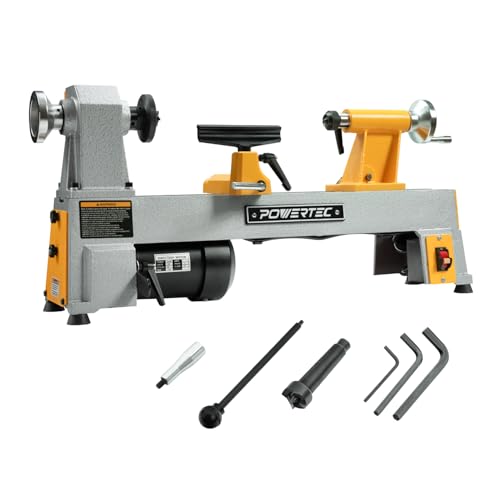
POWERTEC LT1018 Benchtop Mini Wood Lathe
What We Like
- Solid cast iron build for reduced vibration
- Five preset speeds for various materials and tasks
- Includes MT2 live and spur centers for accessory compatibility
- Rubber feet for vibration dampening on benchtops
Trade-offs
- Manual belt changes required for speed adjustment
A 10-inch swing and 18-inch capacity define this lathe’s purpose. It’s built for the turner who needs a solid, compact machine for pens, small bowls, and detailed spindle work on a stable benchtop. The cast iron construction and rubber feet work together to dampen vibration, which is critical for clean cuts on small-scale projects. The five preset speeds, while changed manually, give you the right RPM for everything from roughing out a hard maple pen blank to fine finishing cuts.
Changing speeds requires stopping the machine and manually shifting the drive belt across stepped pulleys. This differs from variable-speed models like the Jet JWL-1221VS, which allow speed changes without stopping. For a dedicated small-shop setup focused on repeatable, smaller tasks, the LT1018’s simple and durable design provides a reliable foundation.
Product photos
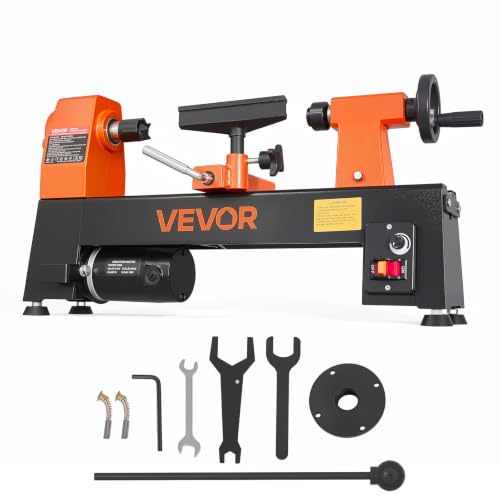
VEVOR 1/3 HP Mini Benchtop Wood Lathe
What We Like
- Complete kit includes tool rest and wrenches
- Wide variable speed range for different tasks
- Built-in overcurrent protection for safety
- Compact metal frame reduces vibration
Trade-offs
- 13-inch bed limits work to small projects
- 37-lb weight offers less mass for damping vibration
An 8-inch swing and 13-inch bed make this lathe a perfect first machine for turning pens, small bowls, and spindles. The 150 to 3200 RPM variable speed control, paired with a 1/3 HP motor, provides enough flexibility for both roughing and finishing softwoods and hardwoods. It arrives ready to use with a tool rest and wrenches, so a beginner can learn the fundamentals without hunting for accessories. The compact, 37-pound metal frame is easy to move but designed to minimize shake, which is crucial for clean cuts when you’re just starting out.
The trade-off for that compact size and low cost is a limited capacity. You won’t be turning table legs or large platters on this machine. For projects that demand more horsepower or a longer bed, like the 18-inch capacity on the VEVOR 1 HP model, you’ll quickly outgrow this lathe. It’s a focused tool that excels at its intended purpose: introducing you to woodturning with a straightforward, capable machine that won’t overwhelm a workshop bench or a first-time budget.
Product photos
Grizzly Industrial G0842 Wood Lathe

What We Like
- Includes a dedicated copy attachment
- 14-inch swing handles medium bowls
- 37-inch capacity for table legs
- 110V motor runs on household current
Trade-offs
- At 170 lb, it requires a sturdy, permanent stand
- 3/4 HP motor is less powerful than some 1 HP models
The inclusion of a copy attachment is the defining feature of this lathe, making it a unique tool for anyone needing to reproduce spindles or turn consistent parts. Its 14-inch swing and 37-inch between-centers capacity provide solid versatility for a home shop, handling everything from bowls to table legs. The 3/4 HP, 110V motor keeps setup simple, plugging into any standard outlet, which suits the woodworker who wants to add duplication to their skill set without complex wiring.
Including a copy attachment lets you duplicate spindles, but mounting it sets the working length between centers at 32 inches. Weighing 170 pounds, the lathe requires a solid, dedicated stand for stable operation. This Grizzly model fits a niche for turners who prioritize replication over the higher horsepower or greater mass found in some full-sized cabinet lathes.
Shop Fox W1852 Wood Lathe

What We Like
- 22-inch swing handles very large bowl blanks
- 3 HP motor provides ample torque for heavy cuts
- Lever-action CAM locks enable quick tool adjustments
- Forward/reverse spindle control aids in sanding
Trade-offs
- 496-pound weight requires a permanent, sturdy installation
- 220V power supply needs dedicated workshop wiring
- 81-inch length demands significant floor space
A 22-inch swing over the bed is the defining feature, allowing you to turn platters and bowls that exceed the capacity of many lathes. This is paired with a 3 HP motor, which provides the power needed for such large workpieces. Variable speed from 100 to 3200 RPM and lever-action CAM locks on the tailstock, headstock, and tool rest help manage the workflow when handling substantial stock.
That capability comes with real physical demands. For most spindle work or smaller bowls, a lathe like the Jet JWL-1440VSK offers a more manageable 14-inch swing in a lighter package. The W1852 makes no compromises for size or power, so only consider it if your projects consistently require its massive swing.
Product photos
Proxxon 37020 DB 250 Lathe
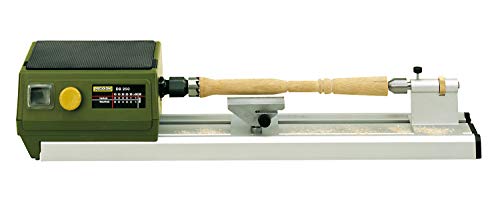
What We Like
- Compact 21.6-inch bed for minimal bench space.
- 10mm through-bore spindle enables serial small-part production.
- Sturdy aluminum profile bed provides a stable foundation.
- 360-degree adjustable tool rest offers versatile positioning.
Trade-offs
- The 10mm spindle bore requires collets for most workholding.
- Limited to the included faceplate for larger diameter attachments.
With a through-going spindle bore of just 10mm, this lathe is engineered for serial production of small parts, a design that necessitates using collets to hold the workpiece. Its compact 21.6-inch aluminum bed provides a stable but minimal footprint, making it a permanent fixture for a dedicated corner of a bench. The quiet motor and included faceplate for bigger workpieces support focused, repetitive work at a very small scale.
The machine’s core capability is also its main constraint, offering precision for minute components while its physical size defines its limits. Its stable tool rest adjusts in height and rotates fully, providing flexibility within that small workspace. This places it in a distinct category compared to typical benchtop lathes like the 38.5-inch long Shop Fox W1836, which occupies a larger volume.
Product photos
How We Evaluated Wood Lathes
Our evaluation started with manufacturer specifications and documentation to understand each machine’s core capabilities like swing, motor power, and speed range. We then consulted expert round-ups and technical reviews to assess real-world performance factors such as vibration dampening, ease of speed changes, and accessory compatibility. Finally, we analyzed patterns in owner feedback to gauge long-term reliability and common user experiences, from setup to daily use.
The most critical criteria were swing capacity and bed length, which dictate your maximum project size. We also prioritized motor horsepower, which determines cutting power for dense woods and large blanks. Features that affect workflow, like variable speed controls and the type of tailstock lock, were important because they directly impact safety and precision. A key limit of our research-based method is that we cannot personally verify the subtle feel of a lathe’s operation or the exact level of vibration dampening on different stands, which are best judged in person.
What To Look For In Wood Lathes
A wood lathe turns a block of wood so you can shape it with hand tools. The right choice balances power for your projects with a footprint that fits your shop.
Key specs are swing (max diameter), distance between centers (max length), and motor horsepower. Benchtop models save space, while floor-standing lathes offer more mass for stability and capacity for large bowls and spindles.
Swing and Bed Length
Swing capacity, measured as the maximum diameter over the bed, is your primary limit for bowl and platter size. A 12-inch swing is common for compact lathes, while 14-inch or larger models handle more ambitious projects. The distance between centers, or bed length, determines how long a spindle you can turn, crucial for table legs and chair rungs. Many midi and benchtop lathes offer bed extensions, but a longer bed floor model is better for consistent, long-term spindle work.
Motor and Speed Control
Motor power, measured in horsepower (HP), dictates how easily the lathe maintains speed under the load of a cutting tool. A 3/4 HP motor handles most spindle work and smaller bowls, while 1 HP or more is better for large, out-of-balance bowl blanks. Look for a wide, variable speed range, something like 250 to 3200 RPM, to safely handle different project diameters and materials. Electronic variable speed with a digital readout is a significant convenience over manual belt changes.
Construction and Features
A lathe’s weight and build material, typically cast iron or heavy steel, directly affect its stability and ability to dampen vibration. Features like a spindle lock, lever-action locks on the tailstock and banjo, and a forward/reverse switch improve safety and workflow. The tailstock should have a solid lock and ample quill travel for drilling operations, and the tool rest should be easy to position and secure.
- Check the spindle thread and Morse taper size (commonly 1″x8 TPI and MT2) to ensure compatibility with common chucks and accessories.
- Consider the required power supply; some high-power models need a dedicated 220V circuit.
- Evaluate the stand or base; a dedicated, heavy stand is often necessary to realize a lathe’s full stability potential.
A good rule of thumb is to choose a lathe with a slightly larger swing and more power than you think you need, as your projects will likely grow.
Wood Lathes Compared
The following table compares the key specifications of all ten lathes side-by-side, helping you quickly see differences in capacity, power, and size.
| Product | Swing over bed | Distance between centers | Motor power | Speed range |
|---|---|---|---|---|
| Jet JWL-1221VS Variable-Speed Woodworking Lathe | 12 inches | 21 inches | 1 HP | 60-900/110-1,800/220-3,600 RPM |
| Jet JWL-1440VSK Variable Speed Woodworking Lathe | 14 inches | 40 inches | 1 HP | 400 – 3000 RPM |
| Shop Fox W1836 Bench Top Wood Lathe | 12 inches | N/A | 3/4 HP | 500-1800 & 1000-3800 RPM |
| WEN 34035 Variable Speed Benchtop Wood Lathe | 14 inches | 20 inches | 6 Amp | 250 to 3550 RPM |
| VEVOR 1 HP Benchtop Wood Lathe | 12 inches | 18 inches | 1 HP | 150 to 3800 RPM |
| POWERTEC LT1018 Benchtop Mini Wood Lathe | 10 inches | 18 inches | 1/2 HP | 5 preset speeds |
| VEVOR 1/3 HP Mini Benchtop Wood Lathe | 8 inches | 13 inches | 1/3 HP | 150-3200 RPM |
| Grizzly Industrial G0842 Wood Lathe | 14 inches | 37 inches | 3/4 HP | N/A |
| Shop Fox W1852 Wood Lathe | 22 inches | 42 inches | 3 HP | 100-3200 RPM |
| Proxxon 37020 DB 250 Lathe | N/A | N/A | N/A | N/A |
Frequently Asked Questions
What is the best lathe for a home shop?
For a versatile home shop, a mid-sized benchtop or midi lathe like our Best Overall pick, the Jet JWL-1221VS, is an excellent choice. It offers a good balance of swing capacity, variable speed control, and power for a wide range of projects without requiring a permanent, large floor footprint. Many woodworking lathes in this category are designed specifically for dedicated hobbyists.
What is the best lathe for a beginner?
Beginners should look for a lathe that is straightforward to set up and use, with good included accessories. The VEVOR 1 HP Benchtop model, a suitable option for beginners, provides ample power and a wide speed range in a ready-to-run package. There are also simpler options among dedicated beginner wood lathes and mini wood lathes for smaller projects.
What size wood lathe do I need?
The size you need depends entirely on the projects you plan to tackle. For pens, knobs, and small spindles, a mini lathe with a 10-inch swing is sufficient. For bowls and typical furniture components, look for a swing of 12 to 14 inches and a bed length of at least 20 inches between centers. For large bowls and long table legs, a floor model with an 18-inch or greater swing and a long bed is necessary.
What are the best wood lathe tools?
A basic set of wood lathe tools should include a roughing gouge, a spindle gouge, a bowl gouge, a skew chisel, and a parting tool. Quality high-speed steel (HSS) tools are a good start, holding an edge longer than carbon steel. Understanding the types of lathe tools and their specific uses is fundamental to good results.
Can I turn bowls on a benchtop lathe?
Yes, many benchtop lathes are excellent for bowl turning. The key specification is swing capacity over the bed, which dictates your maximum blank diameter. Models like our Best High-Capacity Benchtop pick, the WEN 34035, offer a 14-inch swing specifically for this purpose. For dedicated large bowl work, however, a heavy floor-standing lathe for bowl turning provides superior stability.
The Bottom Line
For turners ready to advance beyond the basics, the Jet JWL-1221VS is the best overall wood lathe. Its combination of smooth variable speed, a clever belt system, and solid benchtop capacity makes it a versatile centerpiece for a serious hobbyist’s shop. If your budget is tight or your space is extremely limited, look to the VEVOR 1/3 HP Mini Lathe for small projects. If large bowls are your goal, the Shop Fox W1852 offers unmatched swing capacity.
Ultimately, the most important factor is matching the lathe’s swing and length to the projects you genuinely want to build. Investing in a stable, appropriately powerful machine from the start will make learning how to use a wood lathe more rewarding and your results more professional.
