
10 Best Pneumatic Nailers in 2026
This post contains affiliate links. As an Amazon Associate, we earn from qualifying purchases.
For a powerful, reliable all-around pneumatic nailer, the Metabo HPT NR90AES1 is our best overall pick for its lightweight balance and professional features. For finishing work, the lightweight Metabo HPT NT50AE2 shines, and the DEWALT DWFP12231 kit offers great starter value. Choosing the right nailer depends entirely on your project type, from framing walls to laying floors. We compiled this guide by researching specifications, manufacturer data, and owner feedback to help you match the tool to your task.
Top 10 Pneumatic Nailers in the Market
Certain content that appears on this site comes from Amazon. This content is provided "as is" and is subject to change or removal at any time.
The Best Pneumatic Nailers, Reviewed
Metabo HPT NR90AES1 Framing Nailer

What We Like
- Lightweight and well-balanced for less fatigue
- Fast switch between nailing modes
- Tool-less depth adjustment for flush drives
- Professional 5-year tool warranty
Trade-offs
- Larger footprint than a finish nailer for tight spaces
- Requires a 21-degree plastic collated nail supply
- Heavier than the 5.5 lb roofing nailer for overhead work
At only 7.5 pounds, this framing nailer reduces user fatigue during long tasks like wall sheathing and roof decking. Selective actuation allows quick changes between sequential and contact nailing by flipping a switch, adapting the tool for precise framing or rapid-fire work. Builder and Developer Magazine rated it the Pro Preferred Nailer for seven consecutive years, a distinction based on professional use.
The trade-off for its capable 3-1/2-inch nail capacity is a tool built for power, not finesse; it won’t fit where a compact brad nailer like the Metabo HPT NT50AE2 would. For dedicated roofing work, a specialized coil nailer like the AeroPro CN45N is lighter and angled for shingles. But for general framing and sheathing, this nailer’s balance of weight, power, and essential features makes it the most versatile and user-friendly option in its class.
Metabo HPT NT50AE2 Brad Nailer

What We Like
- Extremely lightweight at 2.2 pounds
- Selective actuation switch for firing modes
- Tool-less depth adjustment dial
- No-mar tip protects workpiece
Trade-offs
- Nail length limited to 2 inches
- Requires a separate air compressor
The Metabo HPT NT50AE2 Brad Nailer weighs 2.2 pounds for easy use all day long. Its selective actuation switch allows selection of bump fire or sequential fire modes, enhancing control. A tool-less depth adjustment dial and a no-mar tip help achieve a professional finish.
This nailer is strictly for 18-gauge brads up to two inches. For heavier tasks like framing, you’d need a different tool, such as the Metabo HPT NR90AES1. While the DEWALT DWFP12231 brad nailer kit is a bit heavier, this model’s lighter weight gives it an edge in pure maneuverability, which helps when working in tight spaces.
DEWALT DWFP12231 Brad Nailer Kit

What We Like
- Lightweight at 2.6 pounds for easy all-day handling
- Tool-free depth and jam adjustments save time
- Rear exhaust keeps debris off your workpiece
- Complete kit includes a protective carrying case
Trade-offs
- Limited to 18-gauge brad nails, not for heavy trim
- 2-inch maximum nail length restricts some molding work
- Pneumatic operation requires a separate air compressor
This DeWalt kit includes a carrying case and an owner’s manual, so you can start a job without hunting for extra gear. The nailer itself weighs 2.6 pounds, which helps reduce fatigue during long sessions of finish work. Its tool-free depth adjustment has detents, allowing quick changes to sink nail heads flush or below the surface. A tool-free jam release and rear exhaust are also part of the design.
The DWFP12231 is a pneumatic tool that drives 18-gauge brad nails from 5/8-inch to 2-inch in length. It is not designed to drive staples like the WEN 61722K 2-in-1 tool, nor does it handle the longer fasteners of a framing nailer like the BOSTITCH F21PL. This focus on a specific nail type results in a dedicated tool for tasks where a smaller-gauge fastener is appropriate.
BOSTITCH BTFP12233 Smart Point Brad Nailer

What We Like
- Smart Point nose allows precise placement without depressing tip
- Tool-free jam release for quick clearing
- Oil-free operation prevents stains on finished work
- Integrated belt hook with pencil sharpener is a clever touch
Trade-offs
- At 5.2 lb, it's heavier than some dedicated 18-gauge nailers
- Requires a separate air compressor to operate
The Smart Point nose is the standout feature, letting you place the tip exactly where the nail will go before you even pull the trigger. This transforms detail work like trim, crown molding, and small furniture projects. You spend less time fussing with alignment and more time driving fasteners cleanly. For a DIYer or a pro focused on finish carpentry, that control is invaluable. The selectable trigger and dial depth control give you further command over the work, making this a thoughtful tool for precision-driven tasks.
The Bostitch BTFP12233 weighs 5.2 pounds, giving it a solid feel during operation. For comparison, the Metabo HPT NT50AE2 brad nailer is listed at 2.2 pounds. This trade-off means the Bostitch may be less tiring for users who prioritize a stable tool over minimal weight during extended bench work.
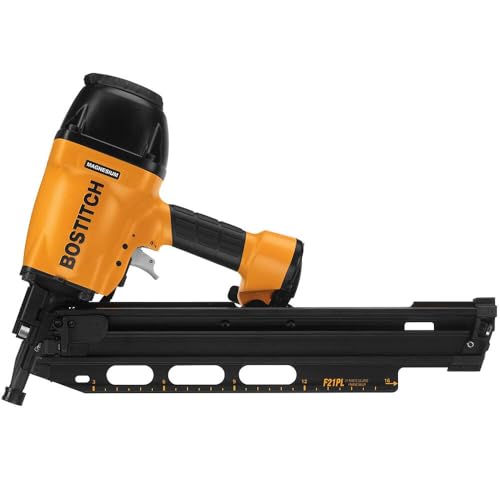
BOSTITCH F21PL Framing Nailer
What We Like
- Converts for framing or metal connector work
- Push-button depth guide for consistent nail sets
- Includes an adjustable rafter hook
- Magnesium body is durable yet light
Trade-offs
- At 8.2 lb, it's heavier than the 7.5 lb Metabo HPT framing nailer
- Length of 21.2 inches demands more swing space
Including two quick-change nosepieces lets a single tool handle both framing and metal connector applications, so you can switch tasks without a separate nailer. Its magnesium body contributes to a durable yet manageable 8.2-pound weight for extended use, and the adjustable rafter hook provides a handy spot to hang it within reach. This design suits users whose work involves both standard framing and specialized metal connector fasteners.
That versatility does add some bulk. The F21PL is over half a pound heavier and significantly longer than the more compact Metabo HPT NR90AES1. If your work is strictly standard framing, that sleeker rival might be easier to maneuver in tight spaces. But if your project list includes joist hangers, framing anchors, or other metal connectors, the included conversion nose on the Bostitch eliminates an entire tool from your purchase list and your tool belt.
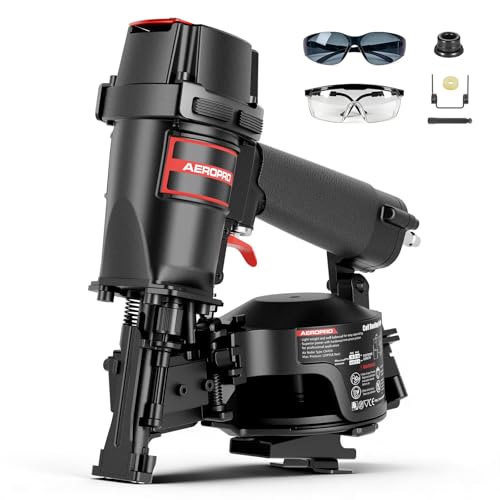
AeroPro CN45N Roofing Nailer
What We Like
- Lightweight, balanced build for all-day use
- High-capacity magazine reduces reload frequency
- Advanced drive system minimizes recoil and kickback
- Rugged all-metal body for harsh job-site conditions
Trade-offs
- Designed solely for 15° coil nails, lacking versatility for other fasteners
- Requires a separate air compressor to operate
A 120-nail capacity means you can cover a lot of shingles before stopping to reload, a major boost for productivity on large roofs. This nailer is built for professional roofing crews who need a durable, high-output tool. Its 5.5-pound balanced design and reduced-recoil system are engineered to combat fatigue and improve accuracy over long shifts, while the all-metal construction shrugs off the weather. The included spare parts and three-year warranty signal a tool meant for serious, continuous use.
This nailer is built specifically for roofing, driving up to three nails per second into asphalt shingles and similar materials. Unlike multi-purpose tools such as the WEN 61722K brad nailer and stapler, it focuses on a single, demanding task. At 5.5 pounds, it is lighter than a framing nailer like the 8.2-pound BOSTITCH F21PL, a design choice meant to reduce fatigue during long days installing shingles.
Product photos
WEN 61722K 2-in-1 Brad Nailer and Stapler

What We Like
- Dual functionality from a single tool body
- Quick-release jam-clearing nose latch
- Depth adjustment wheel for flush sinking
- Rotating exhaust port keeps debris away
Trade-offs
- At 5.4 lb, it's heavier than dedicated brad nailers like the 2.2 lb Metabo HPT NT50AE2
The WEN 61722K combines an 18-gauge brad nailer and a 1/4-inch crown stapler in one tool, which lets you handle both trim and light assembly without a separate gun. Its quick-release magazine holds up to 100 fasteners, so you can switch between brads and staples with a simple reload. A depth adjustment wheel and jam-clearing nose latch are included for control and maintenance, while the hard-shell case organizes everything for transport.
This dual-purpose tool is heavier and bulkier than a dedicated brad nailer. At over five pounds, it can cause fatigue during overhead work or long sessions. A user who only drives brads would find a lighter, purpose-built option like the DEWALT DWFP12231 easier to maneuver. However, if your projects regularly need both fasteners, the convenience of this combo tool can outweigh the extra weight in your belt.
Product photos
DEWALT DWFP2350K Pin Nailer

What We Like
- Tool-free depth adjustment for precise flush or recessed fastening
- Tool-free jam release clears jams quickly without extra tools
- Oil-free operation prevents stains on finished workpieces
- Reversible belt hook for convenient hands-free carrying
Trade-offs
- Exclusively for 23-gauge pin nails, limiting its fastener versatility
- Headless pin nails offer minimal holding power for structural work
DEWALT’s pin nailer drives 23-gauge headless pins up to 2 inches long, leaving the smallest holes possible for delicate trim and securing fragile veneers. Its tool-free depth adjustment lets you sink pins flush or recessed with a simple twist, which is useful for different wood densities. The oil-free operation reduces the risk of oil stains on a finished work surface, and a reversible belt hook allows for hands-free carrying on the jobsite.
The main trade-off is its singular focus. Those tiny pins provide almost no holding strength on their own; you’re relying on glue joints for permanence. It’s a pure finesse tool. For general trim work where you need more holding power, an 18-gauge brad nailer like the DEWALT DWFP12231 is a more versatile choice. The DWFP2350K is purpose-built, so keep your framing nailer handy for anything structural and use this one to make the final details disappear.
Product photos
Makita AF601 Finish Nailer

What We Like
- Built-in air duster clears debris instantly
- Tool-less depth adjustment for precise control
- Nail lock-out prevents dry-fires
- Efficient motor design for strong performance
Trade-offs
- At 3.8 lb, heavier than some 18-gauge nailers
- No included carrying case or basic nails
The built-in air duster is the standout feature here, letting you blow away sawdust right before you drive a nail without ever putting the tool down. That makes the AF601 a serious contender for finish carpenters and trim installers who value a clean, professional result. Its tool-less depth adjustment and nail lock-out mechanism are thoughtful touches for precise, protected work. This is a nailer for the detail-oriented user who hates breaking their workflow to hunt for a separate blower.
At 3.8 pounds, the Makita AF601 is heavier than many pneumatic finish nailers, like the 2.2-pound Metabo HPT brad nailer, so it requires more arm strength during extended overhead use. Its weight is a trade-off for the integrated features, including a built-in air duster to clear debris. For tasks where a clean surface is critical, the tool provides that function, but the overall heft may influence choice for all-day projects.
Product photos
3PLUS HFSNSP Flooring Nailer/Stapler

What We Like
- 2-in-1 design for staples and L-cleats
- Includes mallet and interchangeable flooring plates
- Removable long reach handle for user positioning
- Works on both hardwood and engineered flooring
Trade-offs
- Requires a separate air compressor to operate
- Fastener length maxes out at 2 inches
The 2-in-1 design that handles both 15-1/2 gauge staples and 16 gauge L-cleats gives you the right fastener for different flooring materials, from solid hardwood to engineered planks. This makes it a dedicated specialist for the job. The included interchangeable plates and mallet mean you can set it up for the specific flooring thickness you’re working with right out of the box, which is a thoughtful touch for a focused tool.
Weighing 7.2 pounds, this pneumatic nailer/stapler has the heft needed to drive flooring fasteners into a subfloor, not for delicate trim. That weight is more than double a typical 18-gauge brad nailer like the 2.6-pound DEWALT DWFP12231, signaling its dedicated purpose. It’s a tool built to be positioned and struck with the included mallet, so it excels on a flooring job site.
Product photos
How We Evaluated Pneumatic Nailers
Our evaluation was research-based, focusing on tool specifications, manufacturer engineering documents, and patterns in professional reviews and owner feedback. Key criteria included the tool’s weight and balance for user fatigue, the versatility of its firing modes and depth adjustment, and the specific nail type it’s designed to drive. We also considered special features like no-mar tips for finish work or high-capacity magazines for roofing.
Our research prioritized how each nailer fits its intended role, whether that’s a framing nailer’s power and magazine size or a finish nailer’s precision and anti-marring protection. We compared tool-free adjustments, warranty terms, and the overall build quality reported by users. This method allows us to highlight tools that are purpose-built for specific jobs.
It’s important to note that a research-led approach has limits. We can’t verify long-term durability claims or measure exact recoil and handling feel. Our recommendations are based on the reported performance and specifications that matter most for getting the job done right.
What To Look For In Pneumatic Nailers
Pneumatic nailers are specialized tools. Your choice should be dictated by the primary material and project you plan to tackle most often. Understanding a few key specifications will ensure you buy a tool that feels good in your hands and drives fasteners correctly every time.
The three most important factors are the nail gauge and type, the tool’s weight and balance, and the availability of tool-free adjustments. Match the nailer to your fastener first, then prioritize ergonomics for comfort.
Nail Gauge & Collation
This is the most critical decision. Nail gauge refers to thickness, with lower numbers being thicker. Framing nailers use 21-degree plastic-collated nails for structural strength.
Finish nailers typically use 15 or 16-gauge nails for trim, while 18-gauge brad nailers and 23-gauge pin nailers are for delicate moldings. Roofing nailers require specific 15-degree coil nails. Using the wrong nail type will cause jams and tool damage, so ensure your chosen nailer’s specifications match the fasteners you need to use.
For more on tools suited for cabinetry and delicate work, our guide to the best nailers for woodworking dives deeper.
Weight & Ergonomics
A tool’s weight directly impacts fatigue, especially during overhead or all-day use. A framing nailer around 7.5 pounds is considered lightweight for its class, while a brad nailer under 3 pounds is ideal for detailed trim work. Balance is equally important; a well-balanced nailer feels less cumbersome and improves control. Consider the hose connection point and overall grip design, as these affect maneuverability in tight spaces.
Adjustments & Features
Look for tool-free depth adjustment, which lets you quickly set nails flush without marring the material. A tool-free jam release is invaluable for clearing misfires quickly on the job. Other useful features include a selective actuation switch (sequential or bump fire), a no-mar tip for finish work, and a high-capacity magazine for tasks like roofing where reloading slows you down. For those deciding between power sources, our analysis of cordless vs pneumatic nail guns covers the pros and cons of each system.
- Check the required air compressor specs (PSI and CFM) to ensure compatibility.
- Consider a kit if you need a carrying case and basic accessories.
- For finish work, an oil-free operation prevents staining wood.
- A swivel air connector improves hose management.
- Verify the warranty length and what it covers.
Always match the nailer to the fastener first; a tool built for the wrong nail type is useless.
Pneumatic Nailers Compared
The following table compares our top picks side-by-side to highlight their key specs and intended uses at a glance.
| Product | Nail Gauge & Length | Weight | Depth Adjustment |
|---|---|---|---|
| Metabo HPT NR90AES1 Framing Nailer | 2-in to 3-1/2-in | 7.5 pounds | Tool-less |
| Metabo HPT NT50AE2 Brad Nailer | 18-gauge, 5/8" to 2" | 2.2 pounds | Tool-less dial |
| DEWALT DWFP12231 Brad Nailer Kit | 18GA, 5/8" to 2" | 2.6 Pounds | Tool-free with detents |
| BOSTITCH BTFP12233 Smart Point Brad Nailer | 18 GA, 5/8-inch to 2-1/8-inch | 5.2 pounds | Dial-A-Depth adjustment |
| BOSTITCH F21PL Framing Nailer | 1-1/2" to 3-1/2" | 8.2 pounds | N/A |
| AeroPro CN45N Roofing Nailer | 3/4'' to 1-3/4'' 15° roofing nails | 5.5 pounds | N/A |
| WEN 61722K 2-in-1 Brad Nailer and Stapler | Brads: 5/8" to 2" | 5.4 pounds | N/A |
| DEWALT DWFP2350K Pin Nailer | 23 gauge, 5/8-inch to 2-inch | 0.5 Pounds | Tool-free |
| Makita AF601 Finish Nailer | 16 gauge, 2-1/2" | 3.8 pounds | Tool-less |
| 3PLUS HFSNSP Flooring Nailer/Stapler | 15-1/2 & 16 gauge, 1-1/2" to 2" | 7.2 pounds | N/A |
Frequently Asked Questions
What is the best brand of pneumatic nailers?
There isn’t a single “best” brand, as different manufacturers excel in different categories. Brands like Metabo HPT and BOSTITCH are highly regarded for durable, professional-grade framing and finish nailers. DEWALT is known for reliable kits and ergonomic designs. The best brand for you depends on your specific need, whether it’s a lightweight finish nailer or a versatile framing tool.
Which compressed air nail gun is the best?
The best pneumatic nail gun is the one designed for your specific project. For general structural framing, a 21-degree framing nailer like the Metabo HPT NR90AES1 offers a great balance of power and weight. For detailed trim and molding, a lightweight 18-gauge brad nailer is superior. You must first define the task, then select the nailer built to drive the correct fastener type and length.
Which framing nailer is better, Milwaukee or Metabo?
This comparison depends on the specific models and your priorities. Our research focuses on pneumatic tools, and within that category, the Metabo HPT NR90AES1 framing nailer is noted for its lightweight, well-balanced design and professional warranty. Milwaukee is a leader in cordless framing nailers. For a pneumatic tool, Metabo HPT’s offering is a top contender for professionals seeking to reduce arm fatigue.
What is the best nail gun for home use?
For general home use and DIY projects, a brad nailer is often the most versatile choice. It can handle trim, small crafts, and light assembly. The DEWALT DWFP12231 kit is an excellent option for home use because it’s lightweight, includes a case, and is straightforward to operate. If you need to do framing, a dedicated framing nailer is necessary, but for most common household tasks, a brad nailer suffices.
What is the difference between a finish nailer and a brad nailer?
The main difference is the nail gauge and holding power. A finish nailer typically uses thicker 15 or 16-gauge nails with a head, providing stronger holding power for baseboards and crown molding. A brad nailer uses thinner 18-gauge headless brads, leaving a smaller hole that’s ideal for delicate trim and where splitting is a concern. You can explore dedicated reviews of pneumatic finish nailers and pneumatic brad nailers for more detailed comparisons.
The Bottom Line
For professional framers and serious DIYers building decks, walls, or floors, the Metabo HPT NR90AES1 Framing Nailer is the best overall choice due to its lightweight design and professional-grade features. If you’re on a tight budget and need a tool for trim, the DEWALT DWFP12231 kit delivers reliable performance, while roofers should look directly at the purpose-built AeroPro CN45N.
Ultimately, the single most important factor is matching the nailer to the fastener. Buying a tool designed for the wrong nail size or type will lead to frustration and poor results, so let your project plans guide your purchase.
