
10 Best Electric Concrete Saws in 2026
This post contains affiliate links. As an Amazon Associate, we earn from qualifying purchases.
Our top pick for a dedicated electric concrete saw is the Husqvarna FS 600 E Concrete Floor Saw, due to its efficient gas-assisted lift and integrated water system. For deep cuts, consider the Evolution R14DCT, and for cordless freedom, the Makita XEC01PT1 stands out. Choosing the right electric model involves balancing cutting depth, dust control, and your power source. We researched specifications, manufacturer data, and owner feedback to identify the key models for different professional and serious DIY tasks.
Top 10 Electric Concrete Saws in the Market
Certain content that appears on this site comes from Amazon. This content is provided "as is" and is subject to change or removal at any time.
The Best Electric Concrete Saws, Reviewed
Husqvarna FS 600 E Concrete Floor Saw

What We Like
- Gas-assisted lift reduces operator fatigue
- Ambidextrous blade mounting improves access
- Integrated water tank simplifies setup
- Phase error detection protects the motor
Trade-offs
- No battery option, needs a power outlet
- Heavier than handheld models like the Husqvarna K4000
Left and right hand blade mounting enables cutting into corners and closer to obstructions, a feature that proves its worth when working near walls. This design eliminates the need to reposition the entire machine in tight spaces. The patented gas-assisted raise/lower system reduces the force required to lift the blade, which helps manage operator fatigue during extended use.
Its dimensions of 40 inches in length, width, and height indicate a substantial walk-behind unit. The large integrated water tank supports wet cutting, and a quick connection for the hose requires no tools for disassembly. It is also prepared for fleet management connectivity, allowing for remote monitoring of machine status.
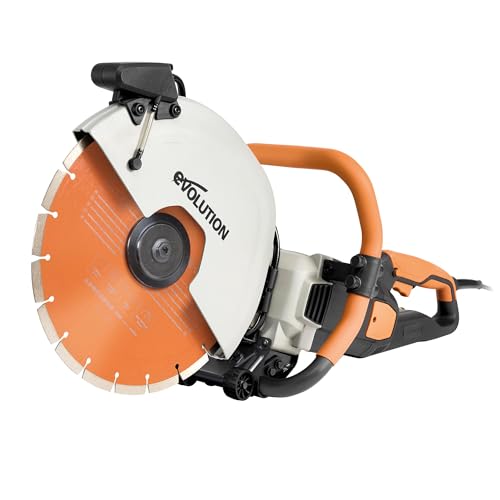
Evolution R14DCT Electric Concrete Saw
What We Like
- Deep 5-1/8-inch cutting capacity
- Auto dust suppression for OSHA compliance
- Heavy-duty steel and aluminum construction
- Includes premium diamond blade
Trade-offs
- Requires a dedicated 20A outlet
- Heavier than many handheld cutters at 30.6 lb
- No cordless option for remote sites
Its 5-1/8-inch cut depth matches capabilities often found in gas saws, allowing it to handle thick concrete, brick, and stone. The auto on/off dust suppression system minimizes airborne particles, which is critical for meeting safety standards on indoor or outdoor job sites. Built with a steel skid plate, cast aluminum casing, and dust-sealed switches, this Evolution model is designed for durability in tough conditions. For users needing deep cuts without fuel maintenance, the high-torque 20A motor provides gas-like performance from an electric power source.
The trade-off is that you’re tethered to power, and not just any outlet. It needs a 20-amp circuit, which limits mobility compared to a cordless option like the Makita XEC01PT1. It’s also a dedicated deep-cutter; for simple scoring or shallow slab work, a smaller saw would be more maneuverable. But if your work regularly demands cuts deeper than five inches in concrete or stone, and you have the required power available, this Evolution is a purpose-built solution that avoids the noise, fumes, and upkeep of a gas saw.
Product photos
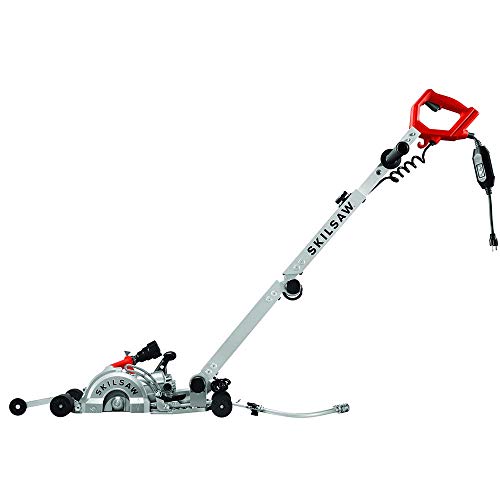
SKIL SPT79A-10 Walk Behind Concrete Saw
What We Like
- Worm drive for power and durability
- Folding handle for transport and storage
- Wet/dry dust control for OSHA compliance
- Die-cast aluminum housings resist corrosion
Trade-offs
- A 31.7 lb walk-behind saw requires dedicated transport space.
- The 7-inch blade limits cut depth versus larger floor saws.
- Corded operation restricts range compared to cordless models.
This is the only worm drive walk-behind concrete saw available, which Skil states delivers a complete system with worm drive power and durability. Its adjustable, folding handle extends to an optimal height and folds to aid transport and storage. The integrated wet/dry dust management system controls dust for cleaner cuts, longer tool life, and OSHA compliance, while die-cast aluminum housings and rust-resistant components resist corrosion.
The trade-off for that worm-drive solidity is a tool designed for a specific role. It’s not a handheld cutter for quick, overhead cuts like the Husqvarna K4000, nor is it a massive floor saw for deep, long-distance slab work. You’re committing to a dedicated, mid-sized saw. For extensive, deep cuts in flatwork, a larger dedicated floor saw would be the more appropriate tool. For many concrete cutting and removal tasks, however, this Skilsaw provides a sturdy, manageable centerpiece.
Makita XEC01PT1 Cordless Power Cutter

What We Like
- Zero emissions allow use in indoor environments
- Brushless motor runs cooler for longer life
- Integrated water system for OSHA compliance
- Immediate start-up with no pull cord
Trade-offs
- 28.5 lb weight is heavier than the 23.9 lb Husqvarna K4000
- Requires managing two 5.0 Ah batteries for runtime
Its zero-emission, 36V cordless design cuts concrete indoors or in confined spaces without fumes, eliminating the hassles of gas. Lower weight and reduced maintenance come from the brushless motor powered by two 18V LXT batteries, which also allow for immediate start-up. An integrated water delivery system with an adjustment knob continuously feeds water for OSHA Table 1 compliance in concrete cutting applications.
The tool weighs 28.5 pounds, which is heavier than some dedicated power cutters like the 23.9-pound Husqvarna K4000. Its operation depends on Makita’s 18V LXT battery ecosystem. Active Feedback-sensing Technology turns the motor off if the wheel rotation is suddenly forced to stop.
Product photos
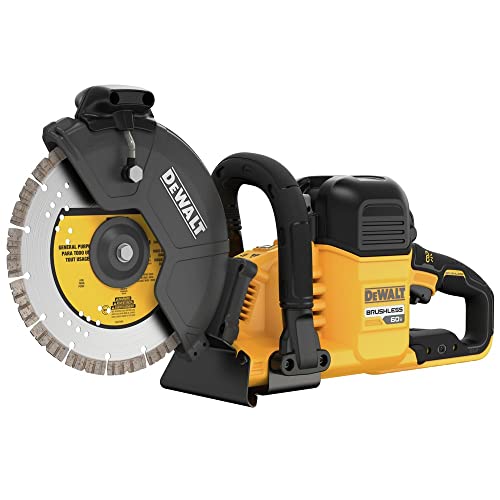
DEWALT 60V Cordless Cut Off Saw Kit
What We Like
- 60V cordless system for outlet-free use
- 26.4-pound weight for easier transport
- 9-inch blade size for controlled cuts
Trade-offs
- 9-inch blade limits cut depth versus 14-inch models.
A 60V cordless system delivers serious cutting power without a cord, making it a standout for contractors who need to move quickly between jobs or tackle cuts where outlet access is a problem. This saw suits the pro who values complete jobsite freedom and has already invested in a cordless platform. Its 9-inch blade and 26-pound frame make it a tool you can carry to the cut, not just roll up to it.
The 9-inch blade provides less cutting depth than models with larger blades, such as a 14-inch electric saw. This tool is suited for tasks like cutting pipe or curbing, not for deep slab work like a dedicated concrete floor saw.
Product photos
Husqvarna K4000 Power Cutter

What We Like
- Integrated constant-flow water valve for dust control
- Ergonomic rear handle with protected cord inlet
- Pop-up carbon brushes for longer service intervals
- Easy-access design simplifies maintenance tasks
Trade-offs
- 5-inch depth is shallower than some dedicated floor saws
- Corded design limits mobility compared to battery models
A 5-inch maximum cutting depth allows it to handle deeper materials than many compact saws. Its design prioritizes easy maintenance, with a one-piece inspection lid and Torx screws that simplify access for service. The constant-flow water valve controls volume to bind dust without excess water, and the ergonomic rear handle positions the power cord underneath for comfortable handling.
As a corded tool, it requires access to a power source and water supply. Compared to larger walk-behind models, the K4000 is more compact at 29 inches long and weighs 23.9 pounds. Its features, including pop-up carbon brushes for longer service intervals, are focused on reliability for extended use.
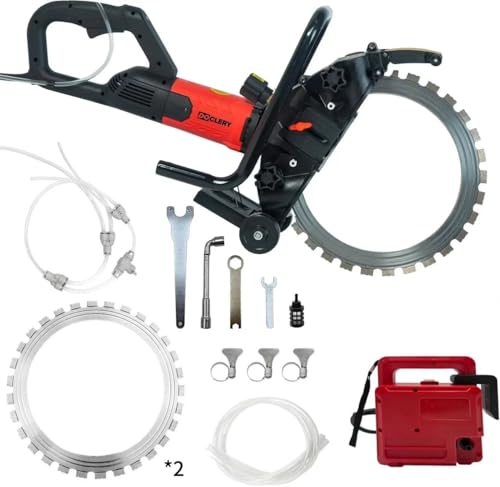
DOCLERY Electric Concrete Ring Saw
What We Like
- 13.8-inch cutting depth for thick materials
- Built-in water pump suppresses silica dust
- Includes two specialized saw blades
- Ergonomic handle minimizes vibration transfer
Trade-offs
- Corded 110V operation limits range versus cordless models.
A 13.8-inch cutting depth lets you slice through thick foundations and walls in a single pass, a capability that defines this tool’s purpose. It’s built for the professional who regularly faces reinforced concrete or deep asphalt and needs a clean, dust-suppressed cut every time. The dual blades and integrated water system mean you can step onto the site and start working efficiently, with the ergonomics to handle longer jobs without excessive fatigue.
Its substantial footprint and corded nature anchor it to larger, stationary demolition tasks. For plunge cuts into vertical surfaces or deep slabs, this DOCLERY model is a focused solution. If your work primarily involves shallow cuts on flat ground, a walk-behind model like the SKIL SPT79A-10 might be a more maneuverable choice, but it won’t match this ring saw’s vertical penetration.
Product photos
HIGOSPRO 3000W Electric Concrete Saw

What We Like
- Anti-vibration handle reduces fatigue
- Complete kit includes blade and accessories
- 110V electric motor eliminates gas hassles
- Cuts concrete, asphalt, and stone
Trade-offs
- 4.8-inch depth limits thicker slab work
- 33-pound weight requires solid handling
- Corded operation restricts remote job sites
A 40% reduction in vibration through its rubber-grip handle makes this 3000W saw a standout for anyone facing hours of cutting. That feature, combined with its ready-to-use kit, positions it perfectly for the contractor or serious DIYer who needs to minimize arm fatigue on medium-duty tasks like slab work, masonry repairs, or asphalt patches. The electric 110V motor delivers consistent power without the maintenance fuss of gas, suiting it for sites with ready power access.
With a 4.8-inch maximum cut depth, this saw can handle many concrete and masonry tasks, though the Evolution R14DCT offers a deeper 5-1/8-inch capacity for thicker materials. Its electric motor and anti-vibration handle are built for controlled, low-maintenance operation rather than the most extreme demolition work. This design prioritizes user comfort and consistent performance, which suits a range of professional and DIY projects.
Product photos
factildfulzhan jianxsz-998643 Electric Concrete Saw
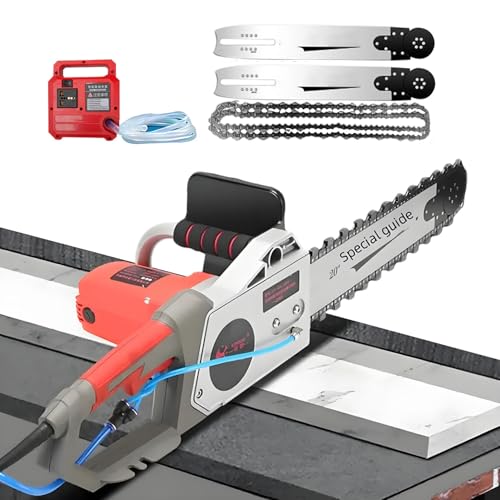
What We Like
- Automatic water feed system for dustless cutting
- Ergonomic handle and lightweight structure for angled work
- Wide material compatibility from concrete to tile
- Complete kit with long power cord and water hose
Trade-offs
- Corded design limits mobility on large, remote job sites
- At 23.6 inches long, it's less compact than handheld cutters
- Requires managing both a power cord and a water hose simultaneously
An 18.9-inch maximum cutting depth and integrated water pump make this saw a dedicated solution for creating deep, clean channels in walls for plumbing and electrical work. The pure copper motor delivers the consistent 6500W needed to power through reinforced concrete and brick without bogging down. Its ergonomic handle and shock-absorbing grip are designed for contractors and remodeling crews who need to manage dust and operate the tool for extended periods, and it arrives with a full accessory kit.
You are managing a specialized, corded setup. This means handling a power cord and a water hose, which anchors you to an outlet and a water source. For chasing a single wall in a renovation, that’s a minor hassle. But for cutting door openings across a sprawling slab or working far from utilities, a cordless option like the Makita XEC01PT1 offers more freedom. This model excels where deep, wet, precise channel cutting is the primary task, not general-purpose demolition.
Product photos
Makita 4101RH Masonry Saw

What We Like
- Exceptionally lightweight and compact design.
- Integrated GFCI plug for enhanced worksite safety.
- Complete water feed system with tubing and regulator.
Trade-offs
- Maximum cut depth is limited to 1-5/8 inches.
At just 6.6 pounds, this saw is built for maneuverability and overhead work where heftier tools would be a burden. The compact size and integrated GFCI plug make it a logical choice for contractors and serious DIYers. They need a dedicated, portable saw for precise masonry and concrete work like cutting block, pavers, or thin slabs. It’s the definition of a specialized tool that excels within its intended scope.
The trade-off for that portability is capacity. You’re limited to a 1-5/8-inch cut, which rules out cutting through a standard 4-inch concrete slab in one pass. For deeper cuts or large-scale slab work, you’d need to step up to a larger walk-behind model. This Makita is for the detailed cuts and tight spaces where a bigger saw simply can’t fit or would be too cumbersome to handle all day.
How We Evaluated Electric Concrete Saws
Our research focused on manufacturer specifications and documented performance to compare critical factors like cutting depth, power source, and integrated dust suppression. We prioritized features that impact daily job site use, such as ergonomic design for reducing operator fatigue and the type of motor drive for consistent power. The availability of water systems for OSHA-compliant silica dust control was also a key consideration. This research-based approach identifies capable tools, but cannot replicate the long-term durability insights gained from years of hands-on field use.
What To Look For In Electric Concrete Saws
Electric concrete saws trade fuel for a power cord or battery, offering cleaner, quieter operation ideal for indoor or sensitive sites. The right choice depends on your specific cutting tasks and site logistics.
Key factors are cutting depth for your materials, power source flexibility (corded or cordless), and effective dust control for safety and compliance. Ergonomics and serviceability also affect long-term satisfaction on demanding jobs.
Cutting Depth & Blade Size
The blade diameter directly determines your maximum cut depth, which is crucial for planning projects. Standard handheld cut-off saws, like the Husqvarna K4000, typically offer depths around 5 inches, suitable for slabs and block. For deeper work on foundations or thick walls, you need a saw like the Evolution R14DCT with over 5 inches of capacity or a specialized tool like a ring saw for plunge cuts.
Always match the blade size to your material thickness, and remember that a larger blade often requires a more powerful motor and a heavier saw.
Power Source: Corded vs. Cordless
Corded electric saws provide unlimited runtime and consistent power, making them excellent for repetitive cutting in a fixed area, but they restrict mobility and require a dedicated outlet, sometimes a 20A circuit. Cordless models, like the Makita XEC01PT1 or DEWALT 60V, offer complete freedom from outlets and are perfect for indoor work or sites without easy power, though you must manage battery life and weight. When choosing, consider if your work is stationary or mobile, and whether you have reliable access to power for recharging or if you need the zero-emissions benefit of a battery.
Dust Control & Ergonomics
Controlling silica dust is a major jobsite safety requirement. Integrated water systems, like the constant-flow valve on the Husqvarna K4000, are essential for wet cutting and OSHA compliance on most concrete work. For operator comfort during long tasks, look for features like anti-vibration handles, as seen on the HIGOSPRO model, and designs that reduce fatigue, such as the gas-assisted lift on the Husqvarna FS 600 E. A well-balanced saw with thoughtful handle placement makes a significant difference in control and reducing strain.
- Check for a built-in water pump or easy hose connection.
- Look for ergonomic rear handles and protected cord inlets.
- Consider the overall weight and if assisted transport features are included.
- Verify that the design allows for easy access to parts like carbon brushes for maintenance.
A good dust control system isn’t just a feature, it’s a necessary investment in jobsite safety and regulatory compliance.
Electric Concrete Saws Compared
The following table compares our top picks across their most important specifications to help you see the differences at a glance.
| Product | Blade Size | Weight | Motor Power/Type |
|---|---|---|---|
| Husqvarna FS 600 E Concrete Floor Saw | N/A | N/A | N/A |
| Evolution R14DCT Electric Concrete Saw | 14-inch diamond | 30.6 pounds | 20A high-torque |
| SKIL SPT79A-10 Walk Behind Concrete Saw | 7 inches | 31.7 pounds | N/A |
| Makita XEC01PT1 Cordless Power Cutter | 9 inches | 28.5 pounds | BL Brushless Motor |
| DEWALT 60V Cordless Cut Off Saw Kit | 9 in. | 26.4 lb | 60V |
| Husqvarna K4000 Power Cutter | 14 inches | 23.9 pounds | N/A |
| DOCLERY Electric Concrete Ring Saw | 16 inch | N/A | 8980W |
| HIGOSPRO 3000W Electric Concrete Saw | 14 inch | 33.0 pounds | 3000W |
| factildfulzhan jianxsz-998643 Electric Concrete Saw | N/A | N/A | 5800W/6500W |
| Makita 4101RH Masonry Saw | N/A | 6.6 pounds | 7.9 AMP |
Frequently Asked Questions
What is the best electric concrete saw?
The best overall electric concrete saw for professional slab work is the Husqvarna FS 600 E, thanks to features that reduce operator fatigue and simplify wet cutting setup. The “best” saw truly depends on your specific need, such as deep cutting, cordless operation, or specialized tasks like wall chasing.
Which concrete saw is better, Husqvarna or Stihl?
Both Husqvarna and Stihl are highly respected brands in professional power cutting equipment.
What saw is best for cutting concrete?
For cutting standard-depth concrete slabs, a dedicated electric floor saw or a powerful handheld cut-off saw is ideal. If you need to make deep plunge cuts into thick walls or foundations, a specialized tool like an electric ring saw is the best choice. It can cut well past the radius of a standard blade.
Are electric concrete saws any good?
Yes, electric concrete saws are excellent tools for many applications. They offer immediate start-up, consistent power, zero emissions for indoor use, and are generally quieter and lighter than comparable gas models. Their limitation is being tethered to a power source or battery, which affects mobility on large, remote job sites.
What should I look for in a concrete saw blade?
The blade is as critical as the saw itself. You need a diamond blade rated for the material you’re cutting (concrete, asphalt, reinforced concrete). The blade’s segment design, continuous rim for clean cuts or segmented for faster, aggressive cutting, should match your priority of finish versus speed.
The Bottom Line
For professional contractors tackling daily slab work, the Husqvarna FS 600 E Concrete Floor Saw is the best overall choice, combining power with operator-friendly features like a gas-assisted lift. Budget-conscious users or those with specialized needs should look to our award winners, like the Evolution R14DCT for deep cutting or the Makita 4101RH for compact, detailed masonry work. Ultimately, matching the saw’s cutting depth and dust control system to your most common tasks is the single most important factor in choosing the right tool.
