
10 Best Mini Miter Saws in 2026
This post contains affiliate links. As an Amazon Associate, we earn from qualifying purchases.
For a precise saw that fits in tight spaces, the SKIL 7-1/4-Inch Single Bevel Miter Saw is a top choice. The Makita 18V X2 Cordless Dual Slide Miter Saw is the best cordless model, and the Ryobi 18-Volt ONE+ Cordless Miter Saw is the best ultra-lightweight option. These compact miter saws balance cutting capacity with a smaller footprint, making them suitable for mobile work and space-limited workshops. Their smaller blades and lighter frames offer different advantages compared to full-size models.
This guide is for anyone who needs accurate crosscuts but lacks the space for a large saw or does not want to move a heavy one. For tasks like installing trim, building furniture, or weekend projects, a compact saw can provide good results from a more manageable tool. This list was compiled using specifications, manufacturer data, and patterns in expert reviews and owner feedback.
Top 10 Mini Miter Saws in the Market
Certain content that appears on this site comes from Amazon. This content is provided "as is" and is subject to change or removal at any time.
The Best Mini Miter Saws, Reviewed
SKIL 7-1/4-Inch Single Bevel Miter Saw

What We Like
- Compact rail system minimizes wall footprint
- LED shadow line for precise cuts
- Lightweight for easy transport
- Quick miter lock for fast angle changes
Trade-offs
- Weighs 31 pounds, heavier than its 'under 25 lbs' claim
- Stand sold separately
- Single-bevel design limits compound cuts
A maximum crosscut capacity up to 2×10 at 0 degrees means this saw can handle most common dimensional lumber and shelving projects. Its fixed compact rail system minimizes the benchtop-to-wall footprint, letting you tuck the saw flush against a wall in a cramped garage. The LED shadow line delivers precise cuts with greater accuracy than lasers for work on baseboards, casing, and crown moulding.
The trade-off for that solid cutting capacity and space-saving design is a bit of heft, with the tool weighing under 25 lbs for transport, though it’s not the lightest in the class. As a single-bevel saw, it’s suited for straight crown moulding and baseboards, but for complex multi-angle crown work, a dual-bevel model would be needed. Research mentions that a similar SKIL model offers cutting power and precision equal to those of saws twice its price.
Makita 18V X2 Cordless Dual Slide Miter Saw

What We Like
- 4-steel rail sliding system for rigid, accurate cuts
- Large cutting capacity for dimensional lumber
- Direct-drive brushless motor with smooth soft-start
Trade-offs
- Tool only: requires two separate 18V Makita batteries and charger
- At 28.2 lbs with batteries, it's heavier than some compact cordless models
This cordless miter saw can cut a 2×12 at 90 degrees, matching the capacity of many corded tools. That large crosscut ability in a portable package suits contractors or serious DIYers moving between job sites without power outlets. Its dual 18V battery system and four-steel-rail sliding mechanism provide the stability needed for precise cuts in trim or framing lumber. Research shows it led a test group with 554 cuts using two 5.0 Ah battery packs.
The main trade-off is the initial cost, as the tool requires a separate purchase of two 18V batteries and a charger. For pure cordless power and portability, it stands out against options like the lighter Ryobi ONE+. If workshop use is primary, a corded model like Makita’s own LS0815F can cut up to 60 degrees to the right, which is more than this model’s left capacity of 57 degrees.
Bosch GCM18V-07SN Profactor Cordless Miter Saw

What We Like
- Lightweight at 26 lbs for easy carrying
- Integrated carry handle for portability
- Tall fence supports taller material accurately
- Smooth sliding bars for precise operation
Trade-offs
- Tool only: requires separate Bosch Core18V battery purchase
- No stand included for mobile setup
Cordless operation allows this saw to be set up anywhere on a jobsite without an outlet or extension cords, which is a major advantage for contractors moving between rooms or floors. Weighing 26 pounds with a dedicated carry handle, it’s built to be picked up and moved easily. It delivers an 8-1/4-inch crosscut capacity for most trim and framing tasks, and the precisely centered sliding bars are designed for smooth, consistent cuts.
The initial investment requires planning, as this is a bare tool needing a separate Bosch Core18V battery and charger. This adds to the upfront cost for those not already using that battery platform. Among cordless options, the 26-pound Bosch is lighter than the 28.8-pound Makita XSL02Z, offering a different weight profile for transport.
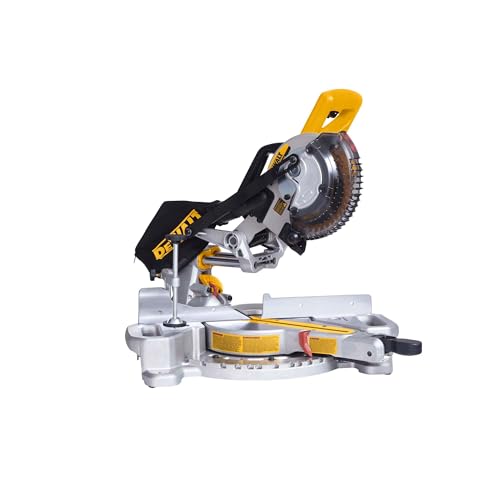
DeWalt 20V MAX Cordless Miter Saw
What We Like
- Integrated cut line system for adjustment-free accuracy
- Adjustable stainless steel miter detent plate with 11 stops
- Cam lock miter handle for quick, precise angle setting
- Oversized bevel scale for easy, accurate adjustments
Trade-offs
- Tool only: requires separate purchase of battery and charger
- No extension wings, offering less workpiece support than some models
Cordless operation sets the DeWalt miter saw apart for trim work on the go or in spaces where an outlet isn’t available. Its adjustable stainless steel miter detent plate has 11 positive stops to lock into common angles, and a lever-style miter lock secures the setting. An integrated cut line system provides adjustment-free indication, aiming to reduce setup time and improve cutting accuracy.
That focus on accuracy does come with a couple of practical trade-offs. The lack of extension wings, unlike models from Bosch or Makita, means you’re on your own for supporting longer workpieces. And while its 30-pound weight is manageable, it’s not the lightest in the category, so if extreme portability is your main goal, the significantly lighter Ryobi ONE+ model might demand a look. You’re also buying into the DeWalt battery ecosystem here, as it ships as a bare tool.
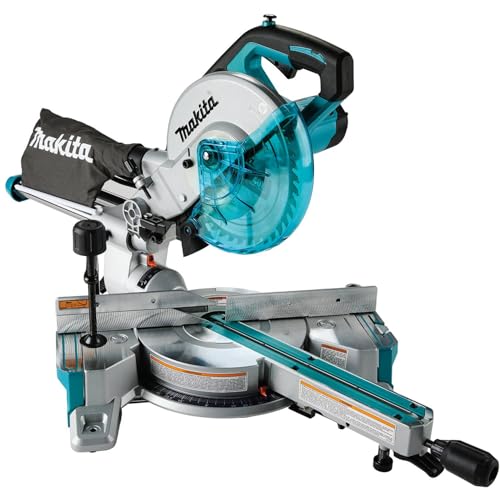
Makita LS0816F Slide Compound Miter Saw
What We Like
- Wide 47° left and right miter range
- Linear ball bearings for dead-on accuracy
- Built-in LED illuminates cut line
- Soft start for smooth operation
Trade-offs
- 8-1/2" blade limits depth of cut vs. 10" models
- Right bevel adjusts only 0°-2°
With miter stops from 0 to 47 degrees in both directions, this saw handles complex crown molding cuts without flipping the board, a key advantage for trim work. Its compact 30.9-pound weight makes it easy to carry to different job sites. The linear ball bearing slide system is engineered to deliver accurate cuts, and the soft-start motor provides smooth operation when you switch it on.
You do trade some cutting depth for that compact size and wide miter sweep. Its 8-1/2-inch blade means you’re limited to an 8-1/2-inch crosscut at 45 degrees, which is fine for most trim but rules out some larger dimensional lumber. If your projects demand maximum crosscut capacity above all else, a 10-inch or 12-inch sliding miter saw would be a better fit.
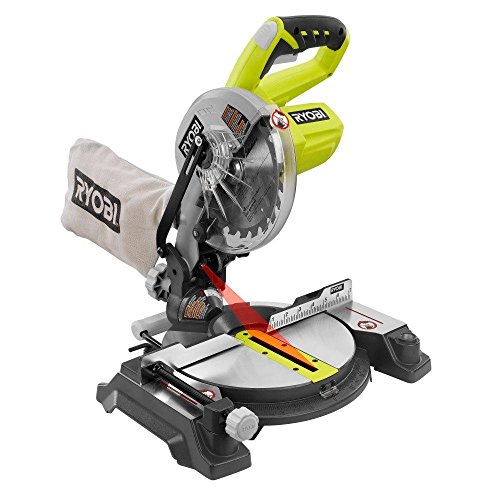
Ryobi 18-Volt ONE+ Cordless Miter Saw
What We Like
- Ultra-lightweight for easy portability and carrying
- Cordless operation provides worksite flexibility
- Weighs 17.4 pounds for easy transport
Trade-offs
- Tool only: requires a separate Ryobi ONE+ battery and charger
- 7-1/4 inch blade limits crosscut capacity compared to 10-inch saws
Weighing only 17.4 pounds, the Ryobi P551 is among the lightest miter saws available, so hauling it between jobs or up to a rooftop is far less strain than with heavier models. It’s a natural addition for anyone already invested in the ONE+ battery platform who needs cordless convenience for trim or DIY tasks. The tool-only listing means you’ll need to supply your own battery and charger separately.
Its featherweight design does limit raw cutting capacity. While it offers good power for a cordless tool, research indicates it has inherent limits. A user needing to frequently cut wider dimensional lumber would find a heavier corded model like the SKIL MS6306-00 with its 10-amp motor more capable, though far less portable.
Product photos
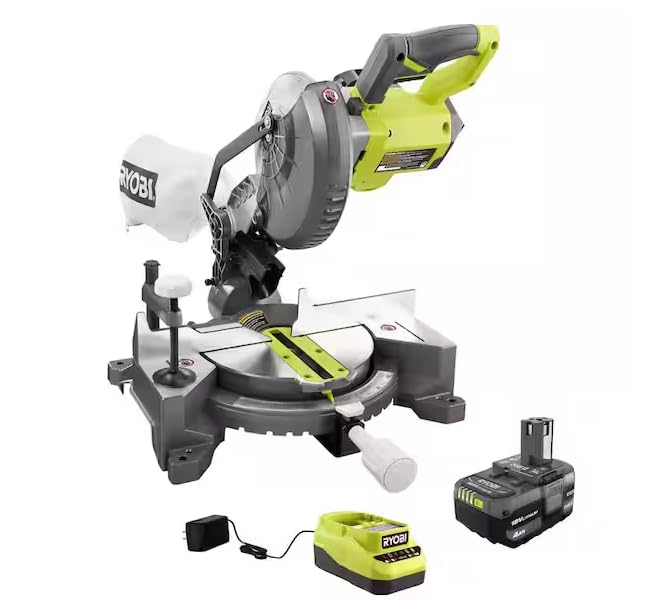
Ryobi 18V ONE+ Compound Miter Saw Kit
What We Like
- One of the lightest miter saws available at 25 lb
- Top handle makes it exceptionally easy to carry
- Good dust collection for indoor use
Trade-offs
- 7-1/4 in. blade limits crosscut capacity
- Less capable than larger, corded sliding models
Weighing just 25 pounds, this is one of the lightest miter saws on the market, and its top handle makes it exceptionally easy to carry. That combination makes it a fantastic choice for anyone who needs to move around a job site, work in a tight space, or haul tools in and out of a truck bed frequently. The cordless design is perfect for quick trim jobs, decks, or projects where an outlet is just out of reach.
That portability comes with a limit on raw cutting capacity. The 7-1/4-inch blade cannot match the crosscut width of a larger 10-inch saw, so it is not suited for large crown molding or wide boards. A corded model like the 31-pound SKIL saw provides more continuous power for bigger stationary tasks. However, if your priority is a saw you can easily grab and go without an extension cord, this Ryobi delivers that convenience in a well-balanced package.
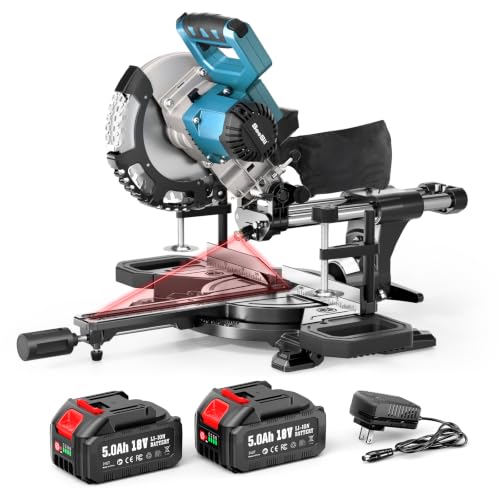
SEESII 8-Inch Cordless Sliding Miter Saw
What We Like
- Dual high-capacity batteries for long runtime
- Sliding rail for 4×12-inch crosscut capacity
- Laser guide and LED light for precision
- Brushless motor maximizes battery efficiency
Trade-offs
- At 25 lbs, it's heavier than most cordless mini saws.
- Larger footprint than non-sliding models for storage.
- 8-inch blade requires specific blade replacements.
The dual 5000mAh batteries provide long-lasting cordless power, so you can work through a day of cutting trim or 2x lumber without needing an outlet. This powers an 8-inch blade on a 12-inch sliding rail system to cut material up to 4×12 inches wide, which handles common framing lumber and wide baseboards. For a carpenter or remodeler moving between job sites, it offers the cordless freedom to tackle larger projects where extension cords are impractical.
Its 25-pound weight and 26.6-inch length require more storage space and a sturdy stand compared to more compact options like the 17.4-pound Ryobi P551. The trade-off is the cordless sliding design’s capacity for wide boards and thick hardwoods. For users whose work primarily involves smaller trim pieces in confined spaces, a smaller saw from the other-products list may be easier to maneuver. This model’s combination of battery power and cutting width suits tasks like decking or large casing installations in locations without ready power access.
Product photos
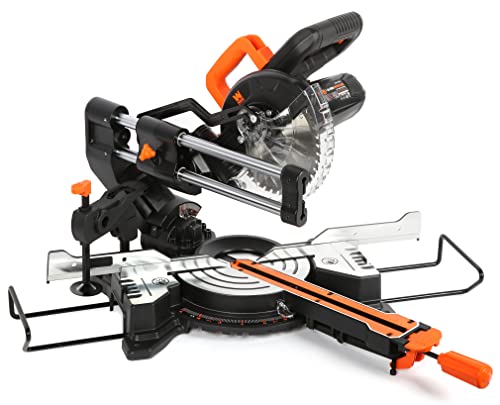
WEN MM0713 Compact Sliding Miter Saw
What We Like
- Dual-rail slide for flush-against-wall use
- LED cutline guide for accuracy
- Includes table extensions and dust bag
- Onboard carrying handle for portability
Trade-offs
- Single-bevel design limits left-side compound cuts
- 32.4 lb weight requires a sturdy bench
The unique dual-rail slide system is the key here, letting you tuck this saw tight to a wall without sacrificing its 11.5-inch crosscut capacity. That makes it a serious contender for anyone with a narrow workshop or a permanent installation against a back wall. The 9.5-amp motor handles standard dimensional lumber, and the integrated LED line is a thoughtful touch for precise cuts in low light. This is a saw built for the space-conscious user who still needs sliding capability.
With its dual-rail slide system, the WEN MM0713 can operate flush against a wall, which saves significant space in a crowded workshop. This compact design does use a single-bevel function, so cuts with an angle must lean to the left. Compared to the 17.4-pound Ryobi ONE+ cordless model, this saw’s 32.4-pound weight makes it less ideal for frequent transport.
Product photos
SI FANG Mini Miter Chop Saw

What We Like
- Extremely compact at just 9 inches long
- Handles precise cuts in brass, wood, and plastic
- Includes two blades for different material types
- Adjustable miter gauge for angled cuts
Trade-offs
- 1/2-inch cut depth limits stock thickness severely
- Not designed for cutting standard lumber or ferrous metals
With a cut depth of just half an inch and a total weight under four pounds, this tool is designed for precision on a bench, not for construction on a site. It handles miter cuts from zero to forty-five degrees in materials like wood dowel and brass cases, where a large saw would be impractical. The compact size, roughly nine inches long, allows it to fit into a small workspace while its six thousand RPM motor provides the speed for detailed work. A hundred-tooth HSS blade is included for soft metals and wood, and a separate two-inch cut-off wheel is designed for cutting ferrous metals like steel.
The clear trade-off is capacity, as this tool will not handle dimensional lumber or large trim. It is a specialist for small-scale joinery in light materials. For broader DIY tasks, a cordless model like the Ryobi 18-Volt ONE+ Miter Saw offers greater portability at over seventeen pounds. This mini chop saw excels in the niche where accuracy on tiny parts matters more than power.
Product photos
How We Evaluated Mini Miter Saws
Our research focused on specifications, manufacturer documentation, and patterns across professional tool reviews and owner testimonials. We prioritized criteria that define a capable and convenient compact saw. This process identified the models that consistently deliver on their promises for users in real workshops and on jobsites.
Key criteria included cutting capacity relative to blade size, portability features like weight and handle design, and accuracy systems such as LED shadow lines or laser guides. We also considered the practical implications of power source, weighing the freedom of cordless operation against the unlimited runtime of a corded model. Understanding a miter saw operation guide helped frame these evaluations.
A research-based evaluation has limits. We cannot report on long-term durability from years of daily use, only on the patterns of feedback from owners who have. For tasks like cutting small pieces safely, always consult the manual and follow best safety practices, as our research cannot replicate every on-site scenario.
What To Look For In Mini Miter Saws
A great mini miter saw maximizes its smaller footprint without sacrificing the precision and power you need. Focus on finding the right balance of cutting capacity, portability, and accuracy features for your specific projects. Understanding the nuances of small miter saws will help you make an informed choice.
Look for a blade size (7-1/4″ to 8-1/2″) that matches your material, a weight you can carry comfortably, and an accurate cut guide. Cordless models offer freedom but require battery investment, while corded saws provide constant power.
Cutting Capacity & Blade Size
A “mini” saw typically uses a 7-1/4-inch or 8-1/2-inch blade. The trade-off for a compact size is a reduced maximum cut depth and width compared to a 10-inch saw. A sliding rail system is crucial for increasing crosscut capacity, allowing many of these compact miter saws to handle a full 2×12 board. Check the maximum cut at 90 degrees and at a 45-degree miter to ensure it meets your needs for trim, framing, or other common stock.
Portability & Power Source
Weight is a primary factor, with models ranging from under 18 pounds to over 30. An integrated carry handle significantly improves transport. Cordless models, often powered by common 18V or 20V tool batteries, offer ultimate jobsite flexibility but require you to own compatible batteries and chargers. For the ultimate in mobility, our research on portable miter saws highlights designs built for easy carrying. Corded models are simpler and provide unlimited runtime but tether you to an outlet.
Accuracy & Usability Features
Precision is non-negotiable. Look for systems that help you line up cuts perfectly, such as an LED shadow line that casts the blade’s shadow or a laser guide. An easy-to-adjust miter detent plate with positive stops at common angles speeds up repetitive work. Other helpful features include a tall fence for supporting material vertically, good dust collection for cleaner indoor use, and table extensions for supporting long workpieces.
- Check the miter and bevel ranges to ensure they cover your project angles.
- Feel the weight yourself if possible; 25 pounds feels very different after carrying it all day.
- Verify battery compatibility if choosing cordless; straying from your existing tool platform adds significant cost.
- Consider the footprint and whether the saw’s sliding rails need rear clearance or can sit flush against a wall.
- Read the manual for specific instructions on how to use a miter saw safely and effectively.
For most DIYers, a 7-1/4-inch sliding corded saw offers the best balance of capacity, value, and simplicity.
Mini Miter Saws Compared
The table below provides a quick side-by-side comparison of key specifications for all ten mini miter saws we researched.
| Product | Blade Size | Weight | Max Crosscut |
|---|---|---|---|
| SKIL 7-1/4-Inch Single Bevel Miter Saw | 7-1/4 inches | 31.0 pounds | 2×10 at 0 degrees |
| Makita 18V X2 Cordless Dual Slide Miter Saw | 7-1/2 inches | 28.2 lbs | 2" x 12" at 90° |
| Bosch GCM18V-07SN Profactor Cordless Miter Saw | 7-1/4 In. | 26.0 pounds | 8-1/4 inches |
| DeWalt 20V MAX Cordless Miter Saw | 7-1/4 inches | 30.0 pounds | N/A |
| Makita LS0816F Slide Compound Miter Saw | 8-1/2" | 30.9 pounds | 8-1/2" |
| Ryobi 18-Volt ONE+ Cordless Miter Saw | 7-1/4 inches | 17.4 pounds | N/A |
| Ryobi 18V ONE+ Compound Miter Saw Kit | 7-1/4 in. | 25 pounds | N/A |
| SEESII 8-Inch Cordless Sliding Miter Saw | 8-inch | 25 lbs | Up to 4×12 inches |
| WEN MM0713 Compact Sliding Miter Saw | 7.25-inch | 32.4 pounds | 11.5 inches |
| SI FANG Mini Miter Chop Saw | 2" cut-off wheel | 3.9 pounds | N/A |
Frequently Asked Questions
What is the best mini miter saw?
The best overall mini miter saw is the SKIL 7-1/4-Inch Single Bevel Miter Saw. It combines a compact rail design that minimizes wall clearance with a helpful LED shadow line for accuracy, and it offers ample power for a corded tool. This makes it an excellent choice for workshop-based DIY or professional trim work where space is limited.
What is the best mini saw for wood?
For cutting wood, the best mini saw depends on your needs. The SKIL saw mentioned above is fantastic for general woodworking. For intricate miter work on trim, the Makita LS0816F Slide Compound Miter Saw offers an exceptionally wide 47-degree miter range to the left and right, ideal for complex crown molding installations.
What is the best mitre saw for the money?
Value means getting capable performance without a premium price. The WEN MM0713 Compact Sliding Miter Saw provides excellent value with useful table extensions and a dust bag. Its dual-rail slide design also allows it to be placed flush against a wall, which is a major space-saving benefit for the budget-conscious DIYer.
What is the best small cordless mitre saw?
The best small cordless miter saw is the Makita 18V X2 Cordless Dual Slide Miter Saw for its power and cutting capacity, due to its dual-battery design and sliding system. For portability, the Ryobi 18-Volt ONE+ Cordless Miter Saw is the lightest option, weighing seventeen point four pounds.
Can a mini miter saw cut a 4×4?
A standard 7-1/4-inch or 8-1/2-inch mini miter saw cannot cut through a 4×4 post in a single pass due to its limited blade diameter and cutting depth. You would need to make cuts from two opposite sides, rotating the workpiece, or use a larger 10-inch or 12-inch saw designed for that capacity.
The Bottom Line
The SKIL 7-1/4-Inch Single Bevel Miter Saw is the best overall choice for the DIYer or pro who needs a precise, powerful saw that doesn’t demand a lot of workshop real estate. Its compact rail system and LED cut guide make it accurate and space-efficient for most trim and framing tasks.
If your priority is maximum cordless power, choose the Makita 18V X2 Cordless model. For extreme portability, the Ryobi 18-Volt ONE+ is remarkably light. Hobbyists working with tiny parts should look at the SI FANG Mini Miter Chop Saw. Ultimately, matching the saw’s cutting capacity and power source to your most common project materials is the single most important decision you’ll make.
