
10 Best Router Fences in 2026
This post contains affiliate links. As an Amazon Associate, we earn from qualifying purchases.
Our best overall router fence is the Woodpeckers SF-PRO Universal Router Table Fence for its independent three-way micro-adjustment and universal fit. For a top value, consider the Kreg Precision Router Table Fence, while the JessEm Mast-R-Fence III is the premium Canadian-made choice. The right fence transforms a router table from a basic tool into a precision instrument for joinery and edge work.
Without it, achieving consistent, square cuts is a constant struggle, and dust control becomes messy. We researched specifications, expert recommendations, and owner feedback to compile this list of ten standout options, helping you match a fence to your specific router table and workshop needs.
Top 10 Router Fences in the Market
Certain content that appears on this site comes from Amazon. This content is provided "as is" and is subject to change or removal at any time.
The Best Router Fences, Reviewed
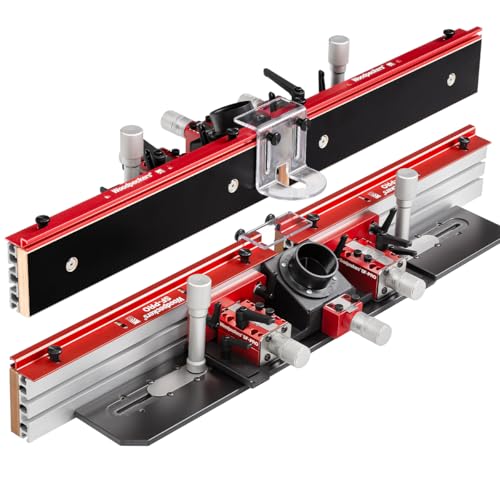
Woodpeckers SF-PRO Universal Router Table Fence
What We Like
- Independent three-way micro-adjustment for infeed, outfeed, and full fence.
- Universal fit for most edge-rail and T-track router tables.
- Includes sacrificial fences and featherboard track for added functionality.
- Precise machining with micrometer dial graduations.
Trade-offs
- Fence offsets require shims, not a built-in mechanism.
- Universal fit requires adapter track nuts for installation.
Independent micro-adjustment on the infeed, outfeed, and the entire fence body lets you dial in fit and reveal for joinery with .001-inch precision. It’s built in Ohio with the solid feel you expect, and the universal mounting system means it will likely outlive your current router table. If your projects demand repeatable, hair-splitting accuracy and you’re tired of fussing with a basic fence, this is the upgrade.
You trade some speed for that precision. According to research comparisons, fence offsets can be handled with shims, which is less convenient than a dedicated mechanism. The design includes a dust port for standard hoses, adjustable sacrificial fences, and tracks for accessories like featherboards, delivering pro-level features in a universal package that fits most tables.
Product photos
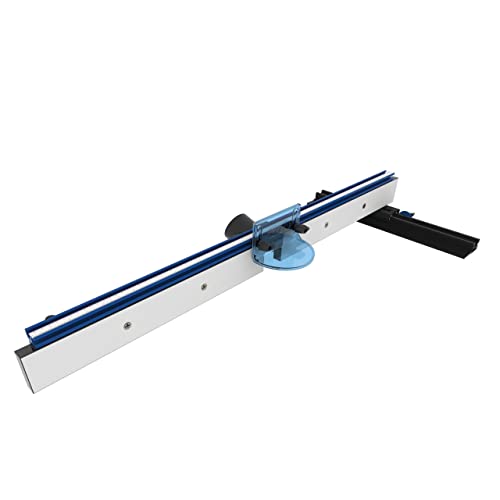
Kreg Precision Router Table Fence
What We Like
- T-square system ensures fence stays parallel
- Microadjuster wheel simplifies precise setup
- One-handed sliding and dual-lock system for easy use
- Durable, easy-to-install construction
Trade-offs
- At 4.0 inches wide, fence face offers less material support than some models
- Fence face width is 4.0 inches.
Kreg’s fence uses a T-square adjustment system to keep it parallel to a miter gauge, a design focused on alignment. A measuring scale allows fence adjustment relative to the router bit, and a microadjuster wheel is included to simplify setup. The product is described as versatile, easy to install, and durable, aiming to help woodworkers close the gap between idea and outcome.
Weighing 6.5 pounds, this fence is lighter than others like the 19-pound JessEm Mast-R-Fence III, and its face is 4.0 inches wide. It is designed to slide easily with one hand and features both a paddle lock and a quarter-turn lock for securing its position.
Product photos
JessEm Mast-R-Fence III Router Table Fence

What We Like
- Heavy, rigid 19-pound construction for stability
- Flat, solid phenolic base for precision work
- Durable stainless steel hardware throughout
- Includes unique fence face shimming system
Trade-offs
- At 19 pounds, it's a substantial piece of shop equipment
- 39-inch length may overhang some smaller router tables
Built entirely in a Canadian facility, the JessEm Mast-R-Fence III is a 19-pound router fence with a solid phenolic base. That base provides a flat mounting surface, while its stainless steel hardware is noted for a lasting appearance. The construction suggests a focus on durable materials for shop use.
Its 39-inch length and 19-pound weight indicate a substantial component for a router table. This heft suits a dedicated workstation rather than frequent repositioning. For a stable, fixed setup, the fence’s design provides a solid platform.
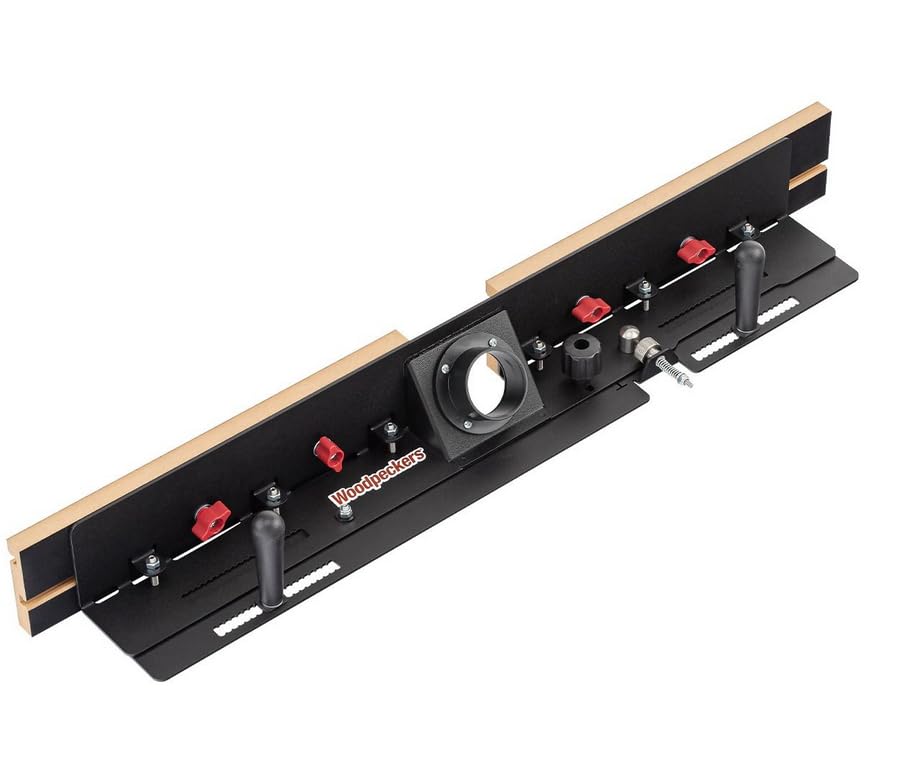
Woodpeckers Router Table Fence with Micro-Adjust
What We Like
- Built-in dust collection port for 2-1/2" hose
- Fits nearly any router table from 17" to 25"
- American-made with adjustable, replaceable fence faces
Trade-offs
- Fence offset requires shims instead of built-in control
- Adjustments lack the speed of more premium systems
A quarter-turn moving the fence just four-thousandths of an inch lets you dial in cuts without guesswork, making it a serious upgrade for any router table. This fence suits woodworkers who want professional-grade precision and built-in dust collection without a massive investment. Its broad compatibility with slot spacing from 17 to 25 inches means it will bolt right onto most shop-built or commercial tables, delivering reliable performance right away.
You trade some speed and convenience for that value. For example, aligning the fence around a bit’s centerline is smoother and safer, but setting a precise offset requires shims instead of a dedicated control like on the Woodpeckers SF-PRO Universal. That’s the practical compromise. If your projects demand frequent, rapid fence reconfigurations, the SF-PRO’s three-way micro-adjustment is faster, but for methodical work where every thousandth counts, this fence delivers the essential accuracy.
Rockler Router Table Fence with Micro-Adjustment

What We Like
- Micro-adjust knob for precise fence positioning
- Includes pre-installed dust port and heavy-duty bit guard
- Fits all past and present Rockler router tables
- Features adjustable sub-fences and T-tracks for accessories
Trade-offs
- Designed exclusively for Rockler tables, limiting universal use
A micro-adjust knob lets you dial in the fence position for operations like dados and rabbets, replacing the need for tapping and bumping into place. This makes it the definitive upgrade for anyone with a Rockler router table, past or present. The system brings together the expected ProMax features into a cohesive kit that’s ready to work. It includes comfortable top-mounted knobs for fast adjustments, jointer bars for snipe-free jointed cuts, and T-tracks for adding accessories.
The primary trade-off is its dedicated compatibility. While the fence fits all Rockler tables perfectly, woodworkers with other brands must look elsewhere. For those seeking a fence with more granular, multi-directional fine-tuning, a model like the Woodpeckers SF-PRO Universal with its 3-way micro-adjustment offers greater control at the expense of being a more complex system. The Rockler fence excels by providing a straightforward, precision-focused solution specifically engineered for its own ecosystem.
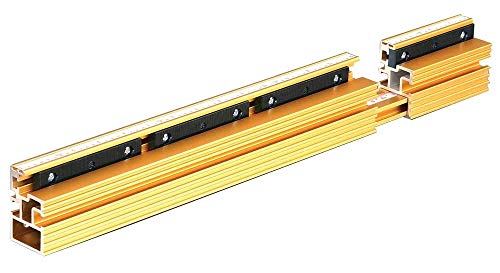
INCRA Telescoping Flip Fence
What We Like
- Telescoping design adjusts from 18 to 31 inches.
- Engineered for outstanding rigidity and performance.
- Directly compatible with INCRA's Flip Shop Stop.
Trade-offs
- Maximum 31-inch width limits work with very wide panels.
- Specific compatibility may limit use to INCRA ecosystem.
Its telescoping range adjusts from 18 to 31 inches, providing a versatile work envelope that can be quickly dialed in for different project sizes. This design suits woodworkers who value a streamlined, space-efficient system. The fence is compatible with the INCRA Flip Shop Stop, creating a cohesive, precision-focused setup.
The trade-off for that compact, telescoping design is a maximum working width of 31 inches. When compared to a more substantial fence like the JessEm Mast-R-Fence III, which weighs 19.0 pounds, the 3.1-pound INCRA prioritizes modularity and quick adjustment over mass. It’s a focused tool for precision work within its designed range.
O'SKOOL Router Table Fence System

What We Like
- Comes as a ready-to-use kit with multiple accessories
- Front T-tracks accept 1/4" bolts for accessory mounting
- Rear knobs for adjusting fence face opening
- Bit guard shields the cutter area for safety
Trade-offs
- Adjustment relies on knobs, lacks micro-adjust mechanism
A 32-inch aluminum fence that arrives as a complete kit makes it a compelling starting point for anyone building their own table or upgrading a basic one. You get a featherboard for workpiece control, an adjustable stop for repeat cuts, and a dedicated bit guard right in the box. The melamine-faced fence can be adjusted to open around the bit, and the front T-track lets you add aftermarket jigs. This bundle suits a woodworker who wants a functional, accessory-ready system without sourcing each piece separately.
This fence system comes ready to work with most router tables, so you can set it up quickly without custom fabrication. Its adjustment relies on four rear knobs to slide the melamine faces open and closed around the bit, a straightforward method that lacks the fine-tuning of a dedicated micro-adjust mechanism. For general routing and edge profiling, the provided functionality is substantial, but intricate joinery requiring minute, repeatable adjustments will be more challenging.
Product photos
Taytools Deluxe Router Table Fence

What We Like
- Built-in 1/32 or 1/16 inch shim system
- T-tracks on top and front for accessories
- Includes bit guard, feather board, and stop
- Anodized aluminum extrusion resists humidity changes
Trade-offs
- Dust port ID is 2-1/4 inches.
- Adjustment uses threaded knobs, not a dial.
The standout feature is the clever built-in shim system, where sliding aluminum bars into offset tracks lets you shift the outfeed fence face precisely by 1/32 or 1/16 inch. This is a shop-built solution made factory-ready, perfect for woodworkers who frequently need that exacting control for jointing or eliminating tear-out. The fence is built from a thick, stable aluminum extrusion and comes ready to work with its included accessories. It makes a solid, functional choice for the pragmatist who values a dedicated, repeatable setup trick over a multitude of adjustment knobs.
Taytools designed this fence around a clever shim system for fine-tuning the outfeed face, a specific solution for tasks like reducing tear-out. Its 32-inch length provides a stable guide for many projects, though fences like the 36-inch Woodpeckers SF-PRO offer a longer surface. Adjustment comes from four rear-mounted knobs, and dust collection connects via a port with a 2-1/4 inch interior opening.
Product photos
Rockler Aluminum Router Table Fence

What We Like
- Laser-straight aluminum extrusion resists humidity warping
- Tool-free adjustments for fence faces and position
- Full-length T-track accepts flip-down stops and accessories
- Coated MDF faces provide a smooth, friction-free surface
Trade-offs
- Dust collection requires a separately sold accessory kit
- No micro-adjustment mechanism for fine-tuning fence position
A 32-inch aluminum extrusion provides a dead-straight reference surface that won’t bow with shop humidity, making it a reliable foundation for repeatable cuts. This fence suits a woodworker who values a solid, straightforward setup over complex adjustments. The tool-free knobs let you shift the entire fence or its MDF faces quickly, which is perfect for changing bit sizes or switching between operations without hunting for a wrench.
This fence centers on a 32-inch aluminum extrusion, which provides a laser-straight reference surface that won’t warp with humidity changes, ensuring consistent cuts. Tool-free adjustments are possible with its comfortable knobs for moving the MDF faces and the entire fence assembly. A full-length T-track on top allows for adding flip-down stops and other accessories to expand its functionality.
POWERTEC Router Table Fence System

What We Like
- Includes a dedicated rail guide coping sled
- Coping sled has sacrificial block and toggle clamp
- Fence has universal T-slots for accessories
- Dust port and flip stop are built-in
Trade-offs
- Coping sled handles workpieces only up to 5 inches wide
The inclusion of a dedicated coping sled is what sets this system apart. That sled, with its sacrificial block and heavy-duty toggle clamp, is engineered for stable, controlled end-grain work like tenons and rail-and-stile doors, preventing the board from spinning into the bit. For a woodworker focused on precise joinery, this bundled accessory transforms the fence from a simple guide into a specialized jig. The fence itself is a solid, full-featured unit with a dust port, flip stop, and T-slots, making it a practical core for a general-purpose router table.
This system’s 24-inch fence length makes it a compact fit for smaller router tables, but it offers less support for wider panels than longer fences like the 39-inch JessEm Mast-R-Fence III. Its included coping sled adds significant function for joinery work, though it accepts workpieces only up to five inches wide. The package is a targeted solution for users whose projects center on end-grain cuts and rail-and-stile doors.
How We Evaluated Router Fences
Our evaluation was based on thorough research of manufacturer specifications, technical documentation, and insights from expert woodworking publications. We focused on criteria critical for router fence performance: adjustment precision, build quality and rigidity, compatibility with different table systems, and integrated features like dust collection and accessory mounting. Analyzing patterns in owner feedback helped us understand real-world durability and ease of use. As a research-led guide, we cannot provide hands-on performance data, but we can highlight the design strengths and trade-offs that informed our rankings.
What To Look For In Router Fences
Choosing the right fence depends on your router table, your projects, and your need for speed versus precision. A good fence should be rigid, stay parallel to the miter slot, and offer a method for fine-tuning its position relative to the cutter.
Look for a fence with a solid mounting system, a material that resists flexing, and a mechanism for micro-adjustment or precise shimming. Consider built-in dust ports and T-tracks for accessories based on your workflow.
Adjustment Precision
The ability to make tiny, repeatable fence movements is crucial for precision joinery like dadoes and box joints. Look for systems offering micro-adjustment, often via a dial or wheel, allowing you to “sneak up” on a perfect fit. Some fences use a built-in shim system (like 1/32″ or 1/16″ increments) for controlled offsets, while others rely on separate shims, which are more versatile but slower. Our research into top-rated router fences shows that independent infeed and outfeed adjustment is a premium feature for advanced techniques.
Build Quality & Rigidity
A fence must be dead-straight and resist flexing under pressure to ensure cuts are square and consistent. Heavy materials like cast iron or thick, machined aluminum extrusions provide mass and stability. The connection between the fence face and its base must be strong; single-piece extrusions or rigid bracketing prevent racking. For a fence to serve as the foundation of your work, exploring professional router tables can give context for the level of rigidity required in a pro shop environment.
Compatibility & Features
Your fence must physically fit your router table’s mounting system, whether it uses edge rails, T-tracks, or bolt patterns. Universal fences offer adaptability, while brand-specific models guarantee straightforward integration. Integrated dust collection ports, typically for two and a half inch hoses, improve shop cleanliness. Front and top T-tracks allow you to add featherboards, stops, and other router table accessories for specialized operations and enhanced safety.
- Check your table’s mounting slot spacing before buying a universal fence.
- Ensure the fence face is tall enough to support your typical workpiece.
- Look for replaceable or sacrificial faces to protect the fence from bit damage.
The most versatile fence for you balances the precision you need with the features that fit your existing table.
Router Fences Compared
The following table provides a quick overview of our top picks to help you compare their key attributes at a glance.
| Product | Length | Weight | Dust Port Compatibility |
|---|---|---|---|
| Woodpeckers SF-PRO Universal Router Table Fence | N/A | N/A | 2-1/4" and 2-1/2" hoses |
| Kreg Precision Router Table Fence | 38.8 inches | 6.5 pounds | N/A |
| JessEm Mast-R-Fence III Router Table Fence | 39.0 inches | 19.0 pounds | N/A |
| Woodpeckers Router Table Fence with Micro-Adjust | N/A | 15.0 pounds | Accepts 2-1/2" or 2-1/4" hose |
| Rockler Router Table Fence with Micro-Adjustment | N/A | N/A | 2-1/2'' diameter |
| INCRA Telescoping Flip Fence | 18" to 31" telescoping | 3.1 Pounds | N/A |
| O'SKOOL Router Table Fence System | 32 inches | 8.8 pounds | 2-1/2 inch OD |
| Taytools Deluxe Router Table Fence | 32 inches | N/A | 2-1/4 inch ID |
| Rockler Aluminum Router Table Fence | 32-inch | N/A | N/A |
| POWERTEC Router Table Fence System | 24 inches | 14.3 pounds | Accepts 2.5" ID hose |
Frequently Asked Questions
What is the best router fence?
The best overall router fence for most woodworkers is the Woodpeckers SF-PRO Universal Router Table Fence. It wins for its exceptional three-way micro-adjustment system, which allows precise, independent control of the infeed, outfeed, and entire fence position, combined with a universal fit for most common router tables.
How tall should a router table fence be?
A router table fence should typically be tall enough to provide stable support for your workpiece, often between 3 to 6 inches. The ideal height depends on your common tasks; a taller fence offers better support for vertical panel work, while a shorter one may provide better visibility and access to the bit for edge profiling.
Is the INCRA fence worth it?
This fence is worth it if you have an INCRA router table system and value its unique telescoping design for easy width adjustment. It offers direct compatibility with other INCRA accessories like the Flip Shop Stop, making it an excellent choice for that specific, precision-focused ecosystem.
Do you need a fence for a router?
Yes, you need a fence for a router table for most operations. It provides a straight, square reference surface to guide the workpiece past the cutter, ensuring consistent, parallel cuts. It is essential for jointing edges, cutting dados and rabbets, and any operation where the workpiece must travel in a controlled, straight line.
What is the difference between a split fence and a solid fence?
A split fence has independently adjustable left and right sections (infeed and outfeed), allowing for precise jointing operations by offsetting one side slightly. A solid, one-piece fence is simpler and more rigid but lacks this specific jointing capability. The choice depends on whether you need to true up board edges on your router table.
The Bottom Line
The Woodpeckers SF-PRO Universal Router Table Fence is the best overall choice for woodworkers who demand uncompromising precision and versatility from a single fence system. If you’re on a budget, the Kreg Precision Router Table Fence delivers excellent value and accuracy, while owners of Rockler tables should look at the dedicated Rockler Router Table Fence with Micro-Adjustment for straightforward integration. Ultimately, ensuring the fence you choose is compatible with your router table’s mounting system is the single most important step before considering any other feature.
