
What Is a 23 Gauge Pin Nailer: The Almost Invisible Fixing
This post contains affiliate links. As an Amazon Associate, we earn from qualifying purchases.
A 23 gauge pin nailer is a specialized pneumatic or cordless finishing tool designed to drive extremely thin, headless pins. With a wire diameter of roughly 0.6mm, these pins create a hole that’s almost invisible to the naked eye, making the tool essential for high-end cabinet work, delicate trim, and any project where surface appearance is critical. For those unfamiliar, a common question is: what is a 23 gauge pin nailer?
That near-invisibility comes with a trade-off. The pin provides minimal holding strength on its own. Its real job is to act as a temporary clamp, holding pieces perfectly in place while your wood adhesive cures. This guide explains where these tools excel, where they fall short, and the specific models and specs that define their performance.
Key Takeaways
- A 23 gauge pin leaves a hole roughly 0.6mm wide, often needing no filler, while an 18-gauge brad nail leaves a 1.0mm hole that typically requires filling.
- These tools provide clamping force, not structural strength; you must use them alongside wood adhesive for any lasting hold.
- Pneumatic models like the Porter-Cable PIN138 require 70-100 PSI of clean, dry air, while cordless models like the Milwaukee M12 offer portability but limited shots per charge.
- Jamming is the most common operational headache, often caused by low-quality pins with inconsistent wire diameter or improper magazine loading.
- Always wear ANSI Z87.1-rated safety glasses with side shields when operating; the tool can launch a pin or debris at high speed.
23-Gauge Pin Nailer Uses and Limitations
When considering what is a 23 gauge pin nailer, think of it not as a fastener, but as a third hand. Its primary role is in fine woodworking where even the smallest brad nail head would be an eyesore or where the material is too delicate for a thicker nail. That means attaching intricate crown molding, securing thin cabinet face frames, or assembling small craft projects without splitting the wood.
The pins are too fine to provide structural holding strength on their own, so they are used primarily to hold workpieces in position while adhesive cures, or to fix very thin or delicate materials where a brad nail would cause splitting or visible damage.
This is the tool’s core limitation. If you try to use it to hang a picture frame or secure a shelf bracket, it will fail. The holding power comes from the glue, not the pin. For my own cabinet builds, I treat the pin nailer as the final piece of a puzzle, it locks everything in place for the 24 hours it takes the wood glue to fully set, leaving me with a clean, unmarred surface. It’s a specialist, not a generalist.
Where a Pin Nailer Excels (and Where It Doesn’t)
Here’s a quick look at the jobs a 23-gauge pin nailer is built for versus the tasks where you should reach for a different tool.
| Best For | Not For | Why |
|---|---|---|
| Installing delicate trim (e.g., rope molding) | Framing or structural work | Zero structural holding power. |
| Holding cabinet parts during glue-up | Hanging mirrors or heavy decor | Pin will pull straight out under load. |
| Assembling small wood crafts/models | Attaching baseboard to drywall alone | Cannot penetrate drywall reliably; needs a stud. |
| Attaching veneers or thin stock | Fastening into hardwoods without pre-drilling | High risk of bending the pin or splitting the wood. |
23 Gauge vs 18 Gauge: The Finish Difference
This is the most common comparison, and the numbers tell the story. A 23 gauge pin measures about 0.6mm in diameter. An 18 gauge brad nail is nearly twice as thick at 1.0mm. That tiny difference changes everything.
An 18-gauge brad nailer is your shop workhorse. It drives a nail with a small head that provides genuine holding power for trim, baseboards, and general carpentry. You’ll almost always need to fill the hole it leaves. The 23-gauge pin nailer trades that holding power for surface finish. The hole it makes is very small, which can minimize the need for filler in some finishing applications.
So which should you buy? For many projects, a brad nailer offers greater versatility due to its holding power. If you later find yourself deep in cabinet builds or furniture making where finish is everything, then add a pin nailer. Owning both gives you the perfect tool for both strength and subtlety.
Key Specs and Models to Compare
Not all 23-gauge pin nailers are the same. Power source, nail length capacity, and ergonomics differ sharply between models. Here are four major players, pulled straight from their official spec sheets.
| Model | Power Source | Nail Length Range | Key Feature | Operating Pressure |
|---|---|---|---|---|
| Porter-Cable PIN138 | Pneumatic | 5/8″ to 1-3/8″ | Magazine holds 130 fasteners; 70-100 PSI range. | 70-100 PSI |
| DEWALT DWFP2350K | Pneumatic | 5/8″ to 2″ | World’s first with tool-free jam release. | Not Specified |
| Milwaukee M12 2540-20 | Cordless (Battery) | 1/2″ to 1-3/8″ | Up to 750 pins per charge with CP1.5 battery. | N/A |
| Grex P650 | Pneumatic | 3/8″ to 2″ | Extended length range for thicker materials. | Max 120 PSI |
This table reveals a clear split. Pneumatic tools like the Porter-Cable PIN138 and Grex P650 require a compressor, while cordless models offer portability. The cordless Milwaukee M12 sacrifices some capacity, you get up to 750 pins per charge with the specific CP1.5 battery, for complete portability, a godsend for installers moving around a job site.
Where this goes sideways: Assuming air pressure is all that matters. The Porter-Cable manual states, “Air volume is as important as air pressure. Restricted air flow will prevent the tool from receiving an adequate volume of air, even though the pressure reading is high.” A cheap, thin hose or a clogged filter can starve your nailer even with the regulator set to the correct pressure.
One spec disagreement is worth noting: maximum air pressure. The Porter-Cable PIN138 manual caps it at 100 PSI, warning that higher pressure may damage the tool. The Grex owner’s manual states a maximum of 120 PSI. Exceeding either manufacturer’s limit risks blowing seals or damaging the internal piston. When in doubt, follow the lower limit printed on your specific tool.
Operational Guide and Common Problems
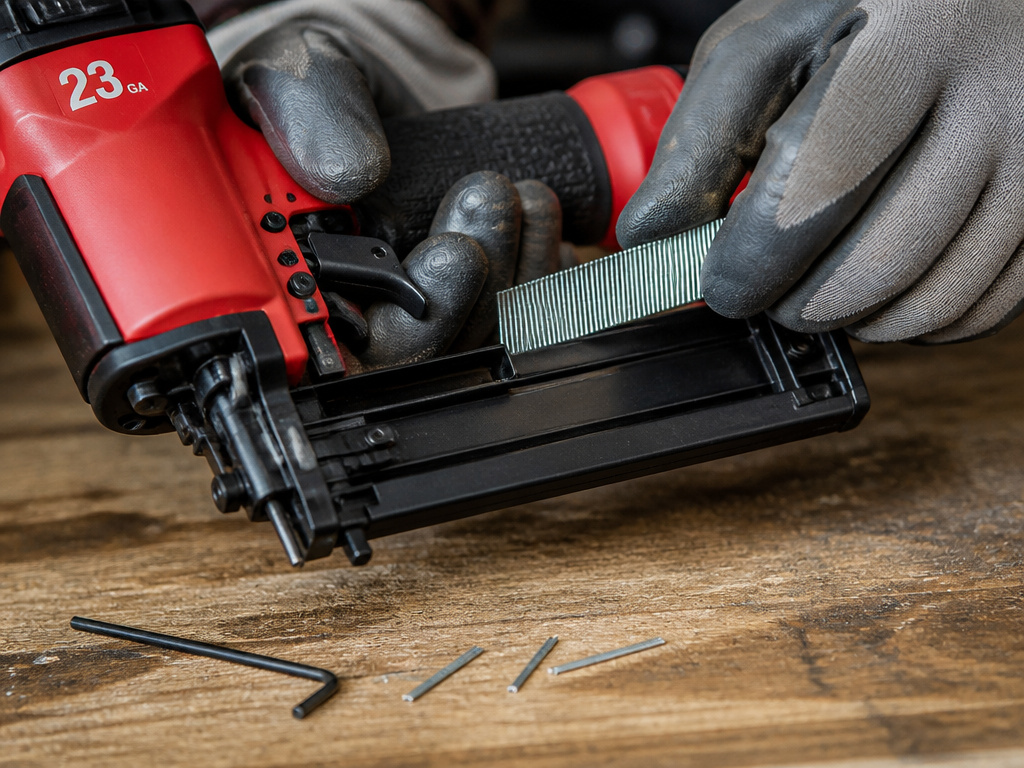
Using a pin nailer is straightforward, but its fine gauge makes it prone to specific issues that heavier nailers don’t face.
Loading and Depth Adjustment
- Disconnect the tool from its air supply or remove the battery.
- Depress the magazine release and slide the tray open. Load a strip of pins with the points facing down toward the nose of the tool. A backward strip is a guaranteed jam.
- Close the magazine until it clicks securely. A loose magazine bolt is another top cause of jams.
- Reconnect power. Test fire into a scrap piece to check depth. Use the tool-free adjustment wheel, usually at the nose, to set the pin flush or slightly recessed.
The Universal Jam Procedure
A jam isn’t a matter of if, but when. The most common culprits are damaged pins, debris in the magazine, or pins loaded upside down. Here’s the universal fix:
- Disconnect the air hose or battery. Never try to clear a jam under power.
- Open the magazine and remove any remaining pin strip.
- Look for the jam access port or nose piece. On newer models like the DEWALT DWFP2350K, this is a tool-free lever. On others, you may need a hex key to remove the nose piece.
- Clear the obstruction with a pair of needle-nose pliers or a stiff wire. Avoid metal picks that can scratch the driver blade.
- Reassemble, reload, and test fire into scrap before resuming work.
I learned this the hard way with a generic brand pin nailer. A single batch of off-brand pins, with inconsistent wire diameter, caused a jam every dozen shots. Swapping to a quality brand of pins turned it into a reliable tool overnight. The difference wasn’t the nailer; it was the 0.6mm wire being held to a tighter tolerance.
Essential Safety and Maintenance
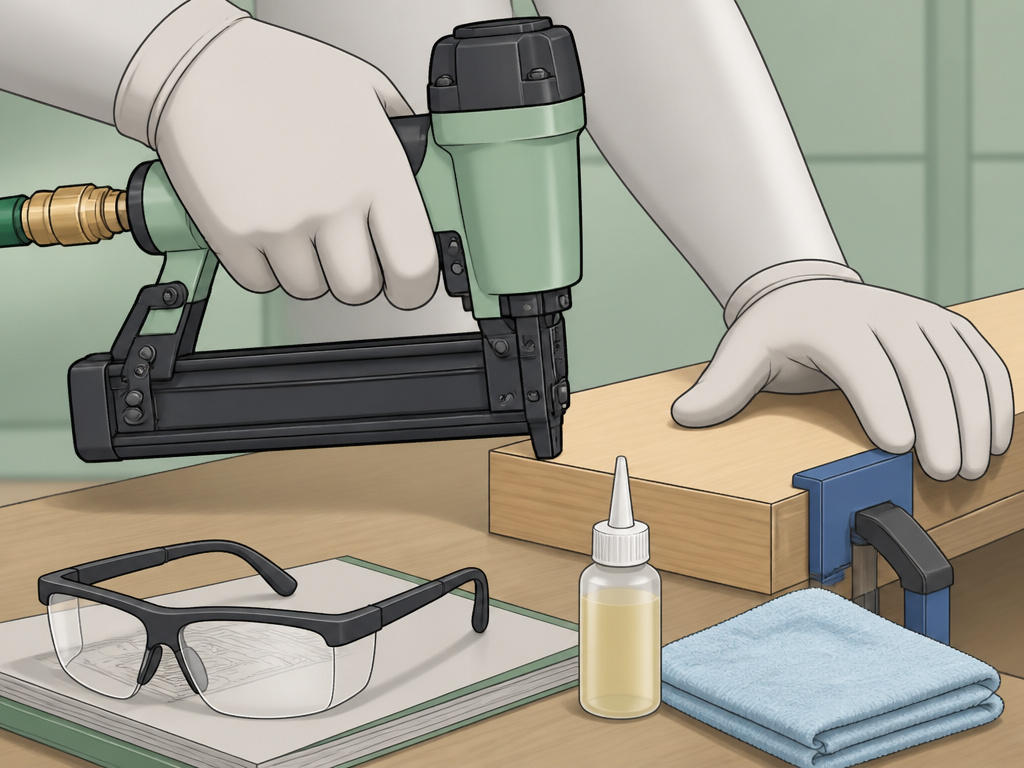
A tool that drives a metal pin at high speed is inherently dangerous. The safety rules aren’t suggestions.
Before you start:
- Eye protection which conforms to ANSI specifications and provides protection against flying particles both from the FRONT and SIDE should ALWAYS be worn. The Porter-Cable manual is unequivocal on this. Standard safety glasses marked ANSI Z87.1 are the minimum.
- Secure your workpiece. Clamp it down. Holding it with your other hand is asking for an accident.
- Keep your finger off the trigger until the nose is pressed firmly against the work. The double-action trigger on tools like the Milwaukee M12 allows for sequential driving.
Long-Term Care
These are simple tools, but they demand clean, dry air. A few drops of air-tool oil in the hose connection monthly will keep the O-rings and internal seals from drying and cracking. Never use brake fluid, gasoline, or strong solvents to clean the tool, they degrade plastic housings and seals.
The Porter-Cable PIN138 operator’s manual warns that moisture in the line can freeze, locking up the tool, and recommends using air-tool lubricant or permanent antifreeze (ethylene glycol) as a cold-weather lubricant. Don’t store the tool in a freezing environment, either; ice forming on the internal valves can cause failure.
Common 23 Gauge Pin Nailer Brands and Models
Several manufacturers offer 23 gauge pin nailers, each with specific features. The DEWALT DWFP2350K is noted for its tool-free jam release and drives pins up to 2 inches long. Milwaukee’s M12 2540-20 is a cordless model offering up to 750 pins per charge and a double-action trigger. Grex offers multiple models like the P635, P645, and P650, which vary in the length of fastener they can accommodate, from 3/8 inch up to 2 inches.
Frequently Asked Questions
What would I use a 23 gauge pin nailer for?
Use it for any fine woodworking where the fastener must be invisible or where the material is too thin for a thicker nail. Primary applications include installing delicate trim (cove, rope, bead molding), assembling cabinet face frames, attaching veneer, building small boxes or models, and holding parts during glue-ups for furniture.
What is better, a 23 gauge or 18 gauge nailer?
Neither is universally better; they serve different purposes. An 18-gauge brad nailer is better for general trim work where holding power is needed and filling nail holes is part of the process. A 23-gauge pin nailer is better for finish-critical cabinet and furniture work where you want the fastener to disappear. Most advanced workshops have both.
What are the common problems with 23 gauge pin nailers?
Jamming is the most frequent problem, often caused by low-quality pins with inconsistent wire diameter, dirt in the magazine, or pins loaded backward. Other issues include weak driving power (usually from insufficient air volume, not low pressure), and pins failing to sink flush (requiring depth adjustment).
Can a pin nailer be used without glue?
Technically yes, but you shouldn’t rely on it. The pin’s holding strength alone is minimal. It’s designed to hold pieces in perfect alignment while the adhesive sets. Using it without glue is like using a single staple to hold a bookshelf together, it might work temporarily, but it will fail under any real stress or load.
The Bottom Line
A 23-gauge pin nailer is a precision instrument for the final stage of fine woodworking. It’s the tool you reach for when the look of the finished piece matters more than the speed of assembly. For most DIYers tackling a mix of projects, an 18-gauge brad nailer is the more practical first purchase. But if your work regularly involves cabinets, furniture, or delicate trim, adding a pin nailer to your arsenal will improve your finish quality in a way no other tool can.
Remember its two rules: always pair it with quality wood glue, and never skip the ANSI-rated safety glasses. The difference between a flawless installation and a frustrating afternoon often comes down to the pins you buy, spend a little more for a brand known for consistent wire diameter. Your tool will jam less, and your projects will look that much cleaner.
