
Can I Use 30 Degree Nails in a 34 Degree Nailer?
This post contains affiliate links. As an Amazon Associate, we earn from qualifying purchases.
Whether you can use 30-degree nails in a 34-degree nailer is a point of disagreement among manufacturers; SENCO says they are interchangeable, while RYOBI, Milwaukee, and Interchange Brands warn it may cause damage or injury. The angle number is less important than the nail’s head shape (clipped, offset full round) and its shank diameter and length. Ignoring these specs risks jams, misfires, and can void your tool’s warranty.
The real-world answer depends on the specific nailer in your hand. A modern tool designed for 30-34° nails will handle a wide range, while a tool that specifies “34° only” in its manual is telling you something. The biggest mistake is assuming all 30° and 34° nails are the same, they aren’t. You might ask, can i use 30 degree nails in a 34 degree nailer?
What follows is a breakdown of the three things you must check before loading a strip: head design, manufacturer warnings, and a safe test process. By the end, you’ll know exactly what to look for on a nail strip and your tool’s nameplate.
Key Takeaways
- The nail head design (clipped vs. Offset full round) is the primary gatekeeper, not the 4-degree angle difference.
- Manufacturer manuals disagree. SENCO says it’s fine, while RYOBI, Milwaukee, and Interchange Brands warn it may cause damage or injury. Your warranty hinges on this.
- Always perform a five-step physical check on the nail strip and fire a test nail into scrap wood before committing to a full project.
What the 30° and 34° Numbers Actually Mean
The angle refers to the slant of the nail magazine, not the nail’s driving path. A 34-degree magazine sits at a steeper angle than a 30-degree one. This design allows the tool’s nose to fit into tighter corners, like where a wall meets a ceiling in framing. The nails themselves are collated (held together) on a paper or plastic strip at that same angle so they feed smoothly.
The collation angle is a packaging specification. It dictates how the nails are glued together on a strip to match the magazine’s slope for reliable feeding.
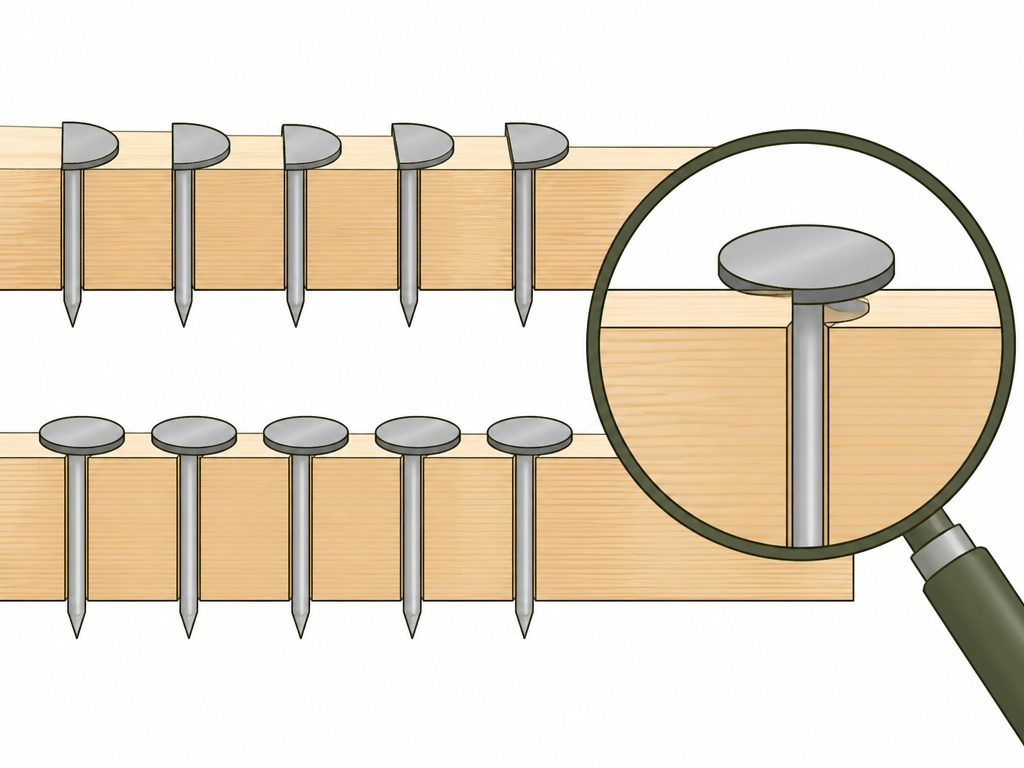
For decades, 34-degree nails were almost exclusively “D” or clipped-head design. The clipped portion allowed them to pack tightly on the strip at the steeper angle. Thirty-degree nails, introduced later, often used a full round head. This is where the real compatibility issue was born: a magazine designed for sleek, clipped heads might not feed a bulkier round head smoothly. That’s the old rule.
Modern nail design has blurred these lines. Innovations like SENCO’s ProHead offset full head design, standard by late 2024, are engineered to feed reliably in both 30- and 34-degree tools. The head is round for strength but offset on the shank to allow tight collation. When a manufacturer like SENCO says the 30/34 distinction is “essentially irrelevant,” this engineered head is what they’re talking about.
What Manufacturers Actually Say (and Why They Disagree)
Here’s where you find the real answer, and it’s not consistent. Pulling the manuals reveals two clear camps.
| Manufacturer / Source | Position on 30° in 34° Tool | Key Quote / Reason |
|---|---|---|
| SENCO | Yes, interchangeable. | “Recent innovations… Have made the 30- and 34-degree nail distinction essentially irrelevant.” |
| RYOBI | Warns against it. | “Using nails outside these specifications may result in misfires, jams, or damage to the tool.” |
| Milwaukee | Warns against it. | “Use only recommended fasteners… Other fasteners could result in tool malfunction, leading to injury.” |
| Interchange Brands | Warns against it. | “WARNING: Be sure to use only the genuine nails recommended…” |
| Tree Island Steel | Implies compatibility. | States its 33° paper strip nails “Fits most 30º-34º framing nailers.” |
SENCO states the 30- and 34-degree nail distinction is essentially irrelevant due to modern nail design, while RYOBI, Milwaukee, and Interchange Brands warn that using nails outside their specified parameters may cause misfires, jams, damage, or injury. Their tools are tested and certified with specific nails. If you use something else and the tool malfunctions or someone gets hurt, that’s on you. They also void the warranty for it.
Where this goes sideways: Assuming one manufacturer’s permissive stance applies to your different brand of tool. A SENCo nail might run fine in your Milwaukee, but if the manual says not to do it, you own all the risk.
This isn’t just corporate caution. A misfire or jam can happen in a fraction of a second, sending a nail somewhere you didn’t intend. The warranty for the Clarke CFN34 Framing Nailer is invalid if the product is found to have been abused or tampered with, or not used for its intended purpose, for a period of 12 months from the date of purchase. That’s a tangible consequence.
The Short Answer: Head Design, Not Just Angle
Forget the degree number for a second. Look at the nail’s head. This is the part that must glide through the magazine and sit correctly under the driver blade.
- Clipped Head (“D” Head): A segment of the round head is clipped off. This is the traditional design for 34-degree nails. They feed in tight-packed strips.
- Full Round Head: A complete, round head. Traditionally for 30-degree or straight collation. Offers maximum holding power.
- Offset Full Round Head (e.g., SENCO ProHead): A full round head that’s stamped off-center on the shank. This allows the heads to nest, enabling tight collation on a strip while keeping the full head’s strength. This is the design that bridges the compatibility gap.
If your 34-degree nailer is older or a budget model, it was almost certainly designed for clipped heads. Trying to force a strip of traditional full-round heads into it is asking for a jam, which is the core of the can i use 30 degree nails in a 34 degree nailer dilemma. A modern 30-34° tool, like the RYOBI 18V ONE+ HP Brushless or Milwaukee M18 FFN, is specified to accept a range of nail angles and dimensions. That’s why their spec sheets list a range.
A Step-by-Step Checklist Before You Try It
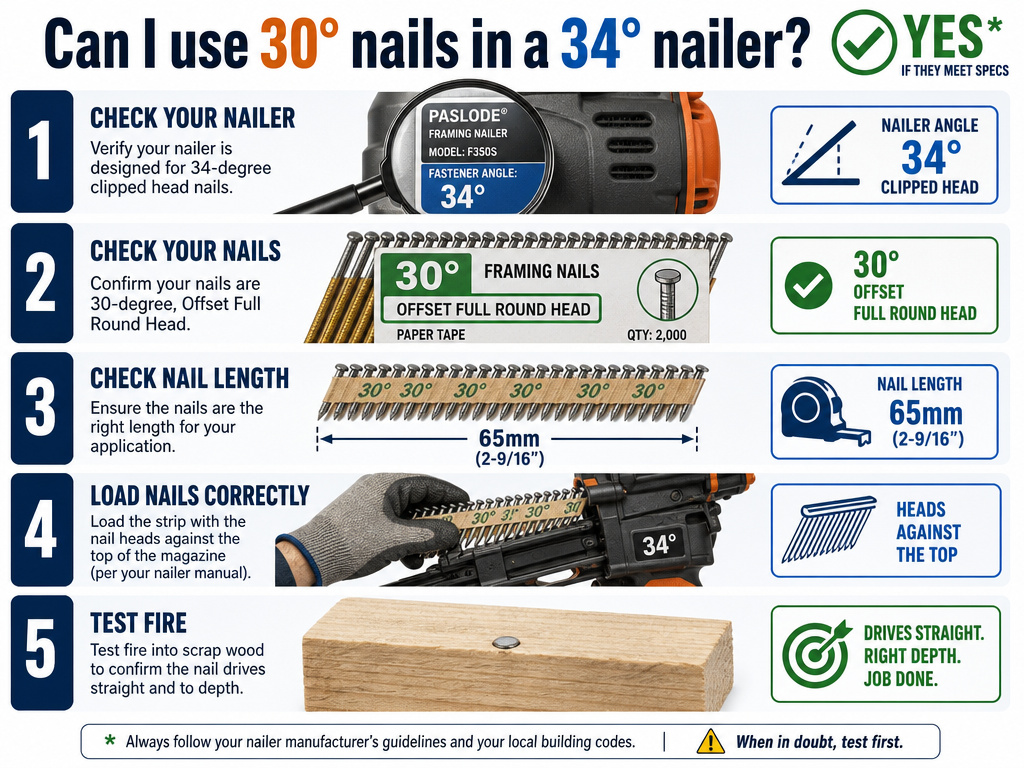
Don’t just guess. If you have a strip of 30-degree nails and a 34-degree tool, follow this list.
- Check the Tool’s Nameplate. It’s usually on the magazine or handle. Does it say “30-34°” or just “34°”? A range on the nameplate is a good first sign.
- Check the Nail Strip Label. What head type does it show? If it says “offset full round” or “ProHead,” you’re likely safe. If it says “clipped head,” that’s fine for a 34° tool. If it’s an old strip of standard full-round heads, pause.
- Compare Physical Dimensions. This is critical. Even with the right head, the nails must match your tool’s size capacity. For example:
- The RYOBI 18V ONE+ HP accepts 10GA nails from 50mm – 90mm long with a shank size of 2.87mm – 3.3mm.
- The Tacwise KDH90V 90mm 34° Angled Strip Nailer accepts nail lengths from 50mm (2”) to 90mm (3 3/8”).
- The Interchange Brands NF6515-34 drives nails 1-1/4″ to 2-1/2″ (32 to 65mm) with a specific 0.072″ (1.8mm) shank. A nail that’s too long, too thick, or too thin will jam.
- Do a Dry Fit. Unplug the tool (or remove the battery). Pull back the magazine follower and try to slide a few nails from the strip into the magazine by hand. Do they slide smoothly, or do they bind?
- Fire a Test Nail. If everything above checks out, load a short strip. Fire one nail into a thick piece of scrap wood. Listen and watch. A clean, deep drive with a solid thunk is good. A weak drive, a mis-fire, or a strange grinding noise means stop.
This method moves you from speculation to evidence.
The Warranty and Safety Stakes
To be clear. Using unapproved nails isn’t just about a temporary jam; it’s about assuming risk when you ignore the can i use 30 degree nails in a 34 degree nailer warnings.
The Milwaukee M18 FFN and Interchange Brands NF6515-34 manuals explicitly state that using other fasteners could lead to tool malfunction and injury. If that happens and you need a repair, the first thing the service tech will check is whether you used the right nails. A warranty claim will be denied.
Beyond the warranty, consider the failure modes. A jammed nail can be a minor annoyance or a major problem. A jammed nail may require disassembly to clear, which can void the warranty if the tool was misused. This takes time and introduces small parts you can lose. A more severe malfunction could damage the driver blade or piston, expensive repairs.
Common mistake: Thinking a few test nails prove long-term compatibility. A nail that runs for 10 shots might cause wear or a deep jam on the 50th. The tool wasn’t engineered for it.
Environmental Factors That Change the Game
Your work environment plays a role, too. For the Interchange Brands NF6515-34 nailer, reduce air pressure to 60 to 80 psi in cold conditions and do not store it in a cold environment; keep it warm until use. A nail strip that works fine at 70°F might behave differently at 40°F. In humid and hot weather, the paper strip used for nail collation often gets damaged.
Furthermore, building codes matter. Some disaster-prone regions do not allow clipped-head nails for structural framing due to their lower holding capacity. Due to comparatively low holding capacity, “D” or clipped head nails are not allowed in many regions prone to natural disasters.
Does where you live change the answer?
Your local building codes and the nails available at suppliers can directly impact whether you should mix nail angles. In many regions prone to natural disasters, clipped head or ‘D’ head nails are not allowed due to their lower holding capacity. This can limit the types of collated nails you find on shelves. Also, using nails not explicitly recommended for your tool could void the manufacturer’s warranty. While modern nail design has made the 30- versus 34-degree distinction largely irrelevant for function, local regulations and warranty concerns are practical factors you must consider before proceeding. Always check what your specific project and location require.
Frequently Asked Questions
Can a 34 degree nailer shoot 30 degree nails?
It can, but not all will, and not all 30-degree nails are suitable. The tool must be designed for a range (30-34°), and the nails must have a compatible head design (like offset full round) and correct physical dimensions (length, shank diameter). Always check your manual and test first.
Can you shoot 30 degree nails in a 28 degree nailer?
No. The angle difference is too significant. A 28-degree nailer uses a different collation system (often wire-weld) and a much shallower magazine angle. The nail strip will not fit or feed. This is a hard compatibility line you should not cross.
What is a 34 degree framing nailer used for?
Its steep magazine angle allows it to fit into tight corners and against obstructions, making it ideal for standard wall framing, roof sheathing, and building decks. It typically uses paper-collated, clipped-head or modern offset full-head nails.
What nails can I use in a 30 degree nailer?
30-degree nailer is designed for nails collated at a 30-degree angle, which are most commonly full-round head or offset full-round head designs. Always verify the specific length and shank diameter your model accepts, like the 50-90mm, 2.8-3.3mm range for the Milwaukee M18 FFN.
The Bottom Line
The question isn’t really “can you,” but “should you, with your specific tool and nails.” If your nailer’s manual lists a 30-34° range and your nails are a modern, offset full-round head of the correct size, you’re probably fine. SENCO states that its ProHead offset full head design has made the 30- and 34-degree nail distinction essentially irrelevant.
If your manual warns against it, like those from RYOBI, Milwaukee, or Interchange Brands, you are gambling with the tool’s function, your safety, and the warranty. In that case, the answer is to use only the genuine nails recommended for the tool. They’re cheaper than a repair bill or a trip to the clinic.
For most DIYers working on a critical project, the path of least regret is to match the nails to the tool’s exact specification. It’s the one variable you can completely control.
