
What Is CFM on an Air Compressor: The Number That Matters
This post contains affiliate links. As an Amazon Associate, we earn from qualifying purchases.
CFM (Cubic Feet per Minute) is the volume of air an air compressor can deliver per minute. It’s the measure of airflow, while PSI measures pressure. For any air tool to work, you must match its required CFM at its required PSI to your compressor’s output. A Chicago Pneumatic CPS 185 delivers 189 CFM at 100 PSI; a Harbor Freight 6-gallon model delivers 2.5 SCFM at 90 PSI. The CFM rating, not horsepower or tank size, is the single most important spec for determining which tools a compressor can run.
That gap between volume and pressure is where most people buy the wrong machine. You can have a massive tank full of high-pressure air, but if the pump can’t deliver enough volume fast enough, your tool will stall. This is why understanding what is cfm on an air compressor is critical. The compressor works, the tank is full, but the job stops.
What follows: a breakdown of what “CFM at 90 PSI” actually means, how to decode a tool’s air demands, and the straightforward math to size a compressor for a home shop. We’ll use real specs from manufacturer manuals to show you where the bottlenecks happen.
Key Takeaways
- Your compressor’s CFM at the required PSI is the only spec that determines tool compatibility. A compressor’s CFM output must meet or exceed a tool’s CFM requirement for it to run properly.
- PSI and CFM have an inverse relationship; as the outlet pressure increases, the volume of air the pump can deliver typically decreases.
- Always check a tool’s continuous CFM requirement, not its “average” use. A tool with a continuous CFM requirement higher than the compressor’s output will cause the compressor to struggle or the tool to stall.
- A larger tank does not increase CFM; it only provides a buffer of stored air, letting a low-CFM pump keep up with short, high-demand bursts.
- If a tool sputters or the compressor never shuts off, your CFM is too low. The fix is a larger compressor, not a bigger tank.
What CFM Actually Measures – Volume, Not Pressure
Think of CFM as the diameter of a garden hose and PSI as the water pressure. You can crank the pressure (PSI) sky-high, but if the hose is a trickle (low CFM), you’ll never fill a bucket quickly. In compressor terms, CFM is the actual free air delivery (FAD) – the volume of atmospheric air the pump can ingest, compress, and spit out in a minute.
Manufacturers measure this against international standards. For example, Chicago Pneumatic certifies its CPS 185 KD T4F’s 189 CFM output at 100 PSI as tested per ISO 1217 ed.3 1996 annex D. That standard ensures you’re comparing real delivered air, not a theoretical maximum.
ISO 1217 is the global benchmark for displacement compressor performance. When a spec sheet cites it, the CFM number is a verified, repeatable measurement of actual air delivery, not marketing fluff.
The air coming out is also hot. That same Chicago Pneumatic unit has an approximate air outlet temperature of 200°F (93°C). You’ll feel that heat radiating from the hose. An aftercooler or air dryer manages this, but the raw CFM is measured before that heat dissipates.
The CFM vs PSI Relationship – Why Pressure Cuts Flow
This is the part that reframes every compressor purchase. CFM and PSI are linked. As the pressure setting on your regulator goes up, the volume of air the pump can push out usually goes down. It’s a simple mechanical limit.
Look at the data from real product sheets:
| Compressor Model | CFM/SCFM @ 40 PSI | CFM/SCFM @ 90 PSI | CFM/SCFM @ 100 PSI |
|---|---|---|---|
| Craftsman 919.195414 | 7.4 SCFM | 5.8 SCFM | – |
| Harbor Freight 29-Gal | 6.3 SCFM | 5.3 SCFM | – |
| Chicago Pneumatic CPS 1600-150 | – | – | 1600 CFM |
| Chicago Pneumatic CPS 1600-150 | – | – | 1450 CFM @ 150 PSI |
See the drop? The Craftsman loses 1.6 SCFM between 40 and 90 PSI. The industrial Chicago Pneumatic unit sheds 150 CFM when pushed from 100 to 150 PSI. This is why you must find your tool’s CFM requirement at its operating PSI. Always check a tool’s specific CFM requirement at its operating PSI. As outlet pressure increases, the volume of air a pump can deliver typically decreases, as seen in manufacturer specs. At the right pressure, you’re already undersized.
For more on how these two forces interact, our guide on CFM vs PSI breaks it down with more examples.
SCFM vs CFM – The “Standard” Matters
You’ll see both terms. CFM is Cubic Feet per Minute. SCFM is Standard Cubic Feet per Minute. The “standard” part adjusts the measurement to a baseline of temperature, pressure, and humidity (usually 68°F, 14.7 PSI, and 0% relative humidity).
For the home user, the difference is academic. Manufacturers use SCFM for smaller, electric compressors (like the Craftsman and Harbor Freight models above) because it provides a stable comparison point. Industrial diesel units like the Chicago Pneumatic often report CFM (FAD). The critical move when you compare a what is cfm on an air compressor spec is to compare numbers from the same type of rating. Don’t compare a compressor’s SCFM to a tool’s CFM requirement without checking the standard.
Where this goes sideways: Assuming SCFM and CFM are interchangeable. They’re close, but Always buy a compressor with a CFM buffer over your tool’s requirement to account for real-world conditions. Always buy a compressor with a 20-30% CFM buffer over your tool’s requirement.
The nuances between these ratings matter when you’re pushing limits. Our article on SCFM vs CFM explains when the difference will bite you.
How to Match Compressor CFM to Your Tools
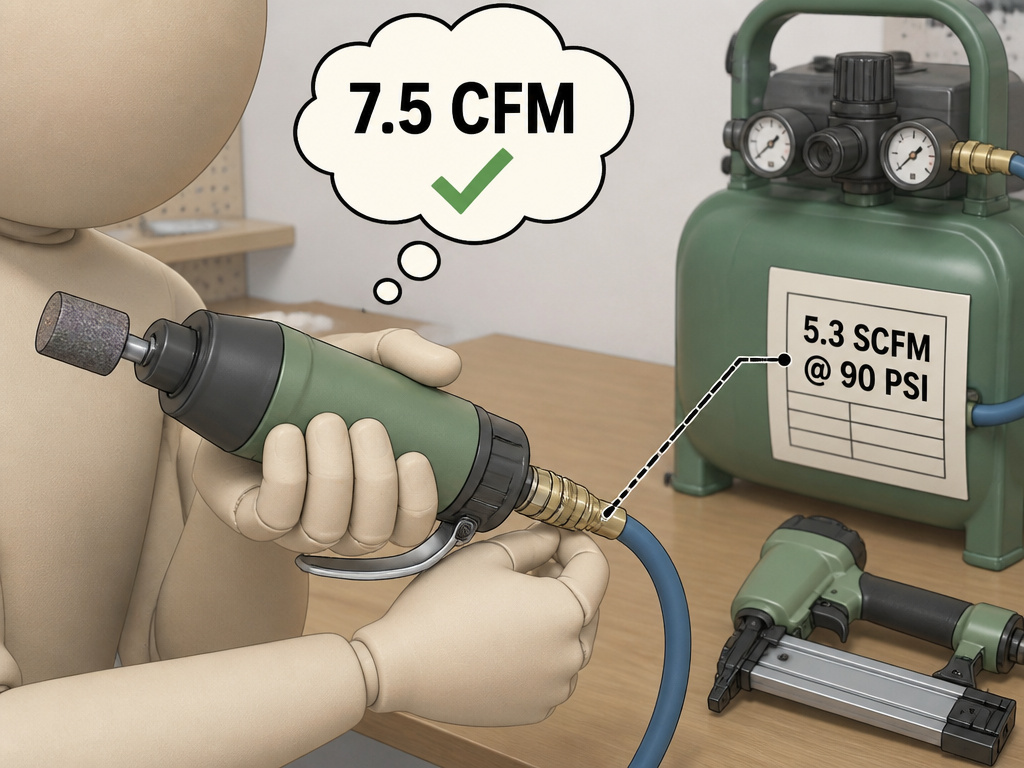
This is the practical math. Forget horsepower. Ignore the tank for a moment. Find the tool in your shop with the highest continuous CFM demand. That’s your benchmark.
- Find the tool’s true CFM. Check the manual or tool plate. Look for “CFM at X PSI” or “Air Consumption.” Find the tool’s true CFM requirement by checking its manual or tool plate. An impact wrench’s air consumption is often listed as an average or burst requirement.
- Find your compressor’s CFM at that PSI. Pull the spec sheet. For the Harbor Freight 29-Gallon (Model 58507), it’s 5.3 SCFM at 90 PSI.
- Apply the margin. If your tool needs 5 CFM at 90 PSI, a 5.3 CFM compressor will run it, but the pump will cycle constantly, building heat and wearing out fast. You want at least 6.5 CFM.
Here’s a quick reference for common tools, but always verify with your specific model:
| Tool | Typical PSI | Typical Continuous CFM | Can a 5.3 CFM Compressor Run It? |
|---|---|---|---|
| Framing Nailer | 90 | 2-3 CFM | Yes, easily. |
| Die Grinder | 90 | 4-6 CFM | Maybe at the low end, but will struggle. |
| Orbital Sander | 90 | 6-8 CFM | No. Will stall or never reach pressure. |
| Impact Wrench (1/2″) | 90 | 4-5 CFM (burst) | Yes, for short bursts. |
For a full list, our air tool CFM requirements chart is the place to bookmarked.
A Real Sizing Example
For example, your shop might have a die grinder (needs 5 CFM at 90 PSI) and a framer nailer (needs 2.5 CFM at 90 PSI). You only use one at a time.
Your benchmark is the die grinder at 5 CFM. Adding a 50% safety margin gets you to 7.5 CFM.
Now, look at compressors. The Craftsman 919.195414 delivers 5.8 SCFM at 90 PSI. That’s below our 7.5 CFM target. This compressor will run the die grinder, but the pump will run nearly non-stop, the motor will get hot, and it will likely trip its thermal overload on a long job. You need to step up to a larger model. This is the core of figuring out what size air compressor you need.
Why Tank Size Is a Buffer, Not a Power Boost
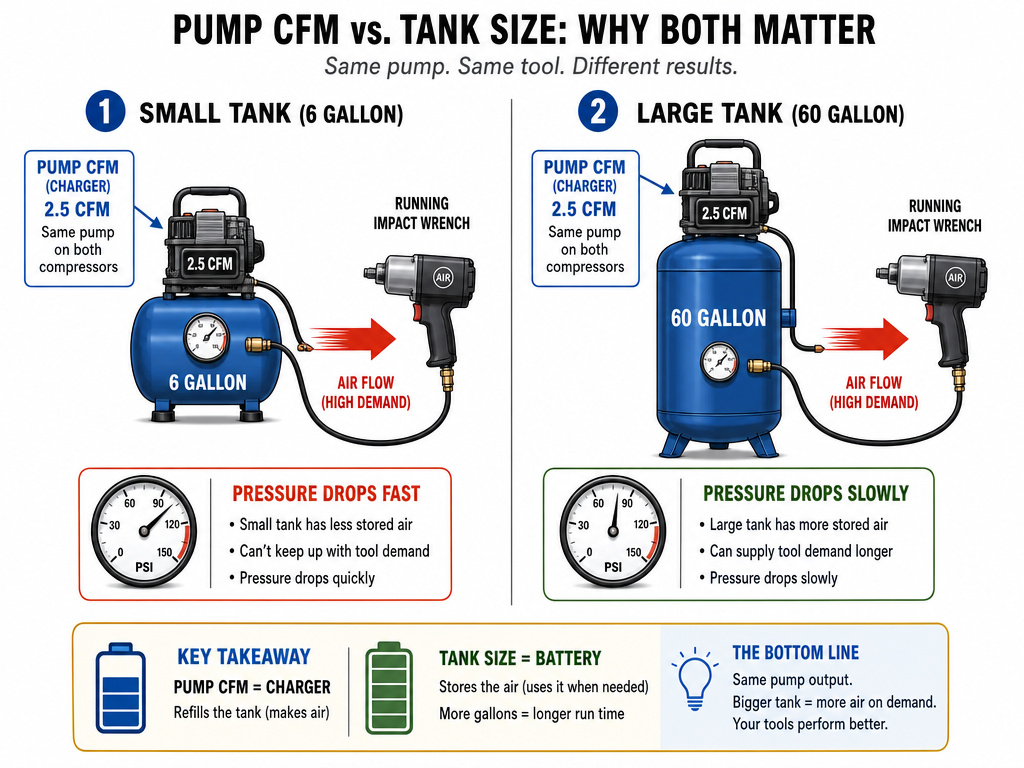
A bigger tank doesn’t increase your CFM. It gives a low-CFM pump more time to recover. Think of it as a battery: the pump (CFM) is the charger, the tank is the battery capacity.
A 6-gallon tank at 150 PSI holds a certain amount of air. A tool drawing more CFM than the pump supplies will cause tank pressure to drop. The pump, if it’s only a 2.5 CFM pump like the Harbor Freight 6-Gallon Professional, will struggle to refill the tank fast enough if the tool’s continuous CFM demand is higher. The pressure will drop, and the tool will stop.
A 60-gallon tank like on the DeWALT DXCMV5076055 holds much more air. That same 5 CFM tool can run for longer before the pressure drops enough to trigger the pump. The pump’s CFM output, which is the answer to what is cfm on an air compressor, determines the maximum continuous airflow, while the tank provides a buffer. The tank size smooths out demand but doesn’t change the pump’s maximum flow rate. Understanding air compressor tank size is key to managing expectations.
Troubleshooting Low CFM Symptoms
Your compressor runs constantly. Your sander loses power after 30 seconds. These are classic low-CFM signs. Before you buy a bigger machine, check these fixes.
- Check for leaks. Check for leaks, as they can reduce effective airflow to your tools. With the tank pressurized and the pump off, listen for hissing or spray soapy water on connections.
- Verify hose diameter. Use an appropriately sized hose to minimize restriction for high-CFM tools. Upgrade to a 3/8″ or 1/2″ inner diameter hose for tools needing over 5 CFM. The difference is immediate.
- Clean the intake filter. A clogged air filter starves the pump, cutting its CFM output. The DeWALT manual calls for weekly inspection, more often in dusty conditions.
- Consider altitude. Air is thinner at high altitude. The Harbor Freight manual states higher altitudes require compressors with greater output. The Harbor Freight manual states higher altitudes require compressors with greater output.
The part nobody mentions: A failing check valve can make a compressor struggle to build pressure, mimicking low CFM. If the pump cycles but the tank gauge barely moves, this valve is the first suspect.
If you’ve checked all this and the tool still stalls, the diagnosis is simple: you need a compressor with a higher CFM rating. The tool’s demand exceeds the pump’s supply. This is also where understanding the compressor’s duty cycle – the percentage of time it can run without overheating – becomes critical.
The Horsepower Myth and Real-World CFM
Horsepower (HP) is a measure of input power, not output air. Marketing departments love a big HP number. But a well-designed pump can deliver more CFM per horsepower than a cheap, inefficient one. The Chicago Pneumatic CPS 185 delivers 189 CFM at 100 PSI. That’s roughly 3.8 CFM per HP.
Don’t shop by horsepower. Shop by the verified CFM at your required PSI. The relationship between motor power and airflow is complex, which we cover in detail in our explainer on air compressor horsepower.
What is PSI and how does it relate to CFM?
PSI, or pounds per square inch, is the measure of air pressure inside your compressor’s tank and air lines. Think of it as the force that pushes the air out. CFM, or cubic feet per minute, is the volume of air flowing out. The two ratings work together. A tool needs a specific PSI to operate, like a minimum force, and a continuous CFM to keep running. For example, a compressor might deliver 5.3 SCFM at 90 PSI. This means it can sustain that flow rate while maintaining the required 90 PSI of pressure at the tool. You need both numbers to be right for your tools.
Why does CFM drop when PSI goes up?
It’s harder for a compressor to push air into a space that’s already highly pressurized. As the pressure (PSI) it’s working against increases, the volume of air it can deliver each minute (CFM) typically decreases. You can see this in compressor specs. One model delivers 1600 CFM at 100 psi, but only 1450 CFM at the higher pressure of 150 psi. Similarly, a smaller compressor might deliver 6.3 SCFM at 40 psi, but just 5.3 SCFM at 90 psi. The motor and pump are working harder to achieve the higher pressure, which reduces the overall flow rate it can sustain.
What’s the difference between theoretical CFM and actual CFM?
Theoretical CFM, sometimes called displaced CFM, is a calculated number based on the pump’s piston size and motor speed in a perfect world. Actual CFM, often listed as Free Air Delivery (FAD) or SCFM, is what you really get at the outlet. It accounts for real-world factors like friction, heat, and internal pump leakage. This is the number that matters for your tools. Manufacturers test actual CFM to standards like ISO 1217 to provide a reliable figure, such as 189 CFM at 100 psi. Always use the actual delivered CFM, not the theoretical one, when matching a compressor to your air tools.
Frequently Asked Questions
What happens if my compressor’s CFM is too low for my tool?
Your air tool will not operate correctly. It will likely sputter, lose power, or stall completely as the compressor struggles to replenish the air being consumed. The compressor motor will also run continuously, never reaching its cut-out pressure, which can lead to overheating and premature wear.
Is a higher CFM rating always better when choosing a compressor?
Not necessarily. A higher CFM compressor is more capable but is also larger, heavier, more expensive, and consumes more power. You should match the compressor’s output to your most demanding tool’s requirement, with a small buffer. Oversizing can be unnecessary for a home garage, while undersizing will render tools unusable.
Can I use two small compressors together to achieve a higher total CFM?
Technically, yes, but it is impractical and not recommended. You would need a specialized manifold and check valves to combine their outputs safely and effectively. For consistent high-CFM needs, investing in a single correctly sized compressor is a far more reliable and simpler solution.
Why do some tools list two different CFM requirements?
Many tools specify both an average and a continuous CFM. The continuous CFM is the critical number for sizing your compressor, as it represents the steady airflow the tool consumes when running. The average may be lower, factoring in idle time, but your compressor must be able to meet the peak continuous demand.
Before You Go
One rule most guides skip: if you’re buying a compressor for a tool that runs continuously—like a sander, grinder, or blast cabinet—ignore the tank size entirely. Your only question is: does the compressor’s CFM at the tool’s PSI exceed the tool’s requirement by at least 30%? If the answer is no, walk away. You’re buying a headache.
The math is simple. The specs are in the manuals. Find your tool’s number, find your compressor’s number at the same pressure, and compare. Let the CFM decide. Everything else is just noise about a metal tank.
