
Flex Shaft Rotary Tool Pros and Cons: What the Manuals Say
This post contains affiliate links. As an Amazon Associate, we earn from qualifying purchases.
A flex shaft rotary tool separates the motor from the handpiece with a flexible cable, delivering precise, fatigue-free control for detailed work like engraving and polishing. The trade-off is mandatory maintenance, lubrication every 25–50 hours, and a hard limit on torque and bend radius that rules out heavy-duty grinding or cutting.
That precision comes with a manual in your hand. This isn’t a tool you just use; it’s a tool you maintain. The real pros and cons are printed in the OEM service guides, and they decide whether this tool fits on your bench or gathers dust after the first project. Understanding the flex shaft rotary tool pros and cons is therefore essential.
What follows is a breakdown pulled straight from the manufacturer PDFs: the torque ceilings, the bend radius debates, the lubrication schedules that prevent failure, and the one mistake that burns out an electric feed motor in two weeks.
Key Takeaways
- A flex shaft attachment turns your standard rotary tool into a detailer, while a dedicated flex shaft tool like a Foredom is built for all-day torque and has a heavier-duty motor.
- Maintain a 4-inch or larger bend radius (per Foredom) or a 6-inch minimum radius (per ITM and Dremel manuals); sharp kinks generate heat that can melt the sheath or disengage the core within minutes.
- Lubricate the shaft core every 25–50 hours of use (per APEXFORGE MA1 and Foredom manuals); skipping this causes friction, overheating, and a telltale burnt-rubber smell.
- Never exceed the accessory’s maximum rated speed; a burr rated for 15,000 RPM will shatter at 35,000 RPM, sending fragments across your shop.
- For sustained, professional-grade carving and polishing, a dedicated Foredom SR or TX Series motor is the default choice over an attachment.
Flex Shaft 101: Attachment vs. Dedicated Tool
What’s the difference between a $40 add-on and a $300 bench-mounted unit? It’s not just price. It’s the entire design philosophy. A flex shaft attachment, like the Dremel 225-01 or the ITM 5000225-01, is an accessory for your existing rotary tool. You screw it onto the housing, and it turns your handheld grinder into a more precise instrument. It’s a great entry point.
A dedicated flex shaft tool, like those in the Foredom CC, S, or TX Series, is a system. The motor is separate, often mounted to a bench or a hanging bracket. It’s engineered to run for hours, with components meant to be serviced and replaced. The Foredom TX Series motor, for example, has a maximum speed rating of 15,000 RPM, while the LX Series has a maximum speed rating of 5,000 RPM, specs that dictate the kind of work you can do.
The flexible shaft may become disengaged if the motor of your rotary tool is not elevated higher than the working end of the flex-shaft. A rotary tool stand is recommended to hold the rotary tool at the proper height. . ITM Flexible Shaft Manual (5000225-01)
This single line from the manual explains half the frustration new users have. If the motor isn’t higher than your hand, gravity works against the inner core’s engagement. The tool stops under load, and you’re left wondering if it’s broken. A dedicated tool’s motor is always hung correctly.
The Core Trade-Off: Precision vs. Maintenance
The pros are visceral. You hold a handpiece that weighs a few ounces, not a two-pound motor. Your wrist isn’t fighting vibration and weight, so your control goes up and fatigue goes down. You can carve a intricate relief in wood, polish the inside of a ring, or deburr a tiny machined part without your hand shaking after ten minutes, which is a key part of the flex shaft rotary tool pros and cons.
The cons are logistical. This isn’t a “use it and toss it in a drawer” tool. The flexible shaft is a consumable part. The Foredom TX manual states it plainly: “There is no way to avoid ultimate wear and under normal conditions a flexible shaft machine may require several replacement shafts and sheaths during its lifetime.”
| The Trade-Off | The Pro (Benefit) | The Con (Cost/Maintenance) |
|---|---|---|
| Ergonomics & Control | Reduced weight and vibration at the handpiece allows for precise, fatigue-free detail work. | Requires proper setup (motor elevation, secure mounting) to function correctly. |
| Power Delivery | Delivers consistent motor power to the bit without the bulk of the motor in your hand. | Torque is limited by the shaft. Foredom CC/S/SR/TX/LX shafts tolerate 12 lbs. of torque; heavier-duty TXH/LXH handle 28 lbs. |
| Versatility | One motor can drive countless handpieces and accessories for grinding, sanding, carving, and polishing. | Requires matching accessory speed ratings, shank sizes, and understanding material-specific RPM limits. |
| Durability | High-quality systems (Foredom, etc.) are built for professional, repairable long-term service. | Demands regular, scheduled maintenance (cleaning, lubrication) to prevent premature failure. |
The maintenance schedule is the line in the sand when you compare a flex shaft rotary tool pros and cons. If the idea of greasing a cable core every few weeks of use sounds like a chore, this tool isn’t for you. If that sounds like a fair trade for the control it gives you, read on.
The Real Pros: Where a Flex Shaft Unlocks New Work
Unmatched Ergonomics for Detail Work
This is the killer feature. The motor’s weight and vibration are isolated on your bench. What’s in your hand is just the handpiece and a lightweight, flexible cable. This changes everything for fine engraving, jewelry work, or detailed wood carving. You’re not steering a vibrating mass; you’re guiding a precise tip. The difference in control after an hour is dramatic.
Access to Tight, Awkward Spaces
Trying to polish the inside of a curved sculpture or sand deep inside a model prototype with a standard rotary tool is a clumsy fight. The bulky motor housing gets in the way. A flex shaft handpiece slithers into those spaces. The cable bends around obstructions, letting you position the bit exactly where you need it while keeping your hand and the motor in a comfortable, stable position.
Sustained Power for Polishing and Carving
A dedicated flex shaft tool like the Foredom 1/6 HP Series SR runs at speeds up to 18,000 RPM. This is the tool for buffing jewelry for hours on end or carving large wood pieces. The motor is designed to manage heat, and the foot pedal allows you to adjust power continuously. An attachment on a consumer-grade rotary tool will overheat under the same load.
System Versatility and Professional Workflow
Think of it as a small-scale router table setup. One powerful, mounted motor can drive a variety of handpieces, each optimized for a different task. You might have a keyless chuck handpiece for quick bit changes, a precision collet handpiece for engraving, and a reciprocating handpiece for carving. You swap the handpiece, not the entire tool. This is how jewelry benches and professional carving shops are set up.
The Real Cons: Maintenance, Limits, and Cost
Non-Negotiable Maintenance Schedule
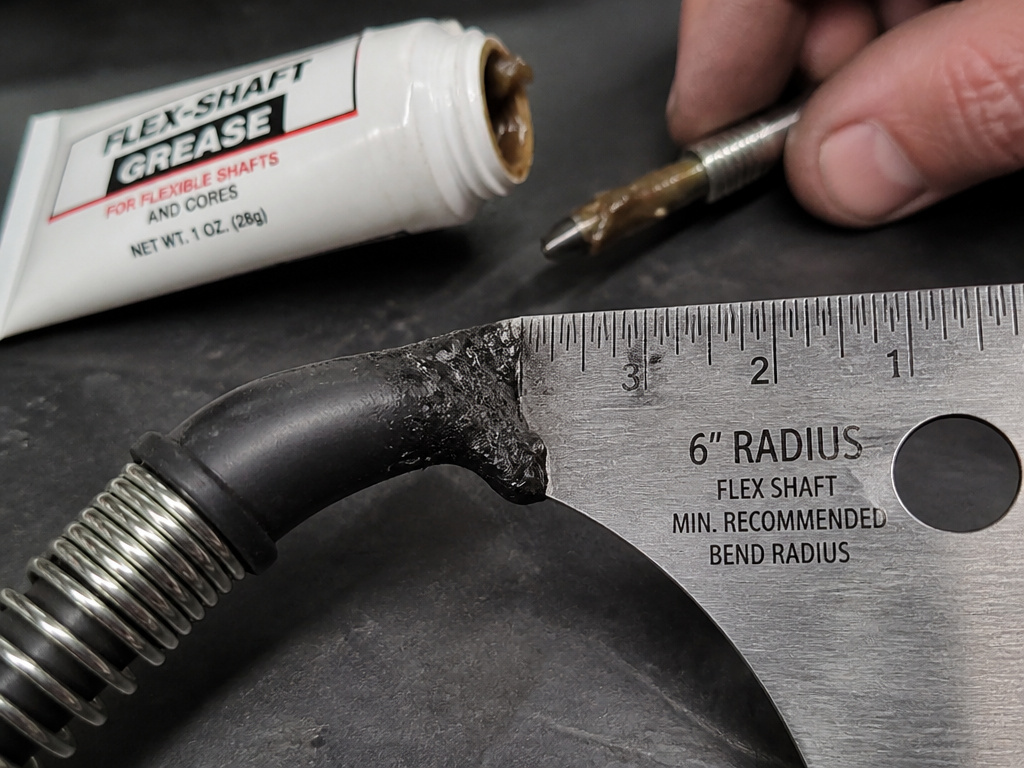
This is the biggest drawback, and it is unavoidable. The inner steel core of the flexible shaft rotates inside a stationary sheath. Without lubrication, metal grinds on metal. It gets hot, the grease burns away, and the cable fails.
The manuals disagree on the exact interval, but they agree it’s mandatory:
- APEXFORGE MA1 Manual: Lubricate after every 25-30 hours of use.
- Foredom TX Manual: Check, clean, and re-lubricate every 50 hours of use.
Skipping this leads to a specific sequence: first a faint smell of hot metal or burnt grease, then increased vibration and wobble at the handpiece, then complete seizure or disengagement. The repair is a new shaft and sheath.
Hard Physical Limits: Bend Radius and Torque
You cannot treat this cable like a garden hose. Sharp bends are the fastest way to kill it.
Where this goes sideways: Kinking the shaft to get into a tight corner. The inner core binds against the sheath, friction spikes, and the protective jacket can melt or tear at the bend point within a single project.
Manufacturers specify a minimum bend radius, but even here, their guidance differs. It’s a rare case of direct disagreement in the manuals:
- ITM (5000225-01) & Dremel Manuals: State a 6-inch minimum radius.
- Foredom (CC, S, SR, TX, LX Series): Recommend a 4-inch or larger radius.
A conservative rule is to use the larger 6-inch radius as a minimum, which is safe for all models, though Foredom specifies a 4-inch or larger radius.
Torque is another ceiling. The flexible shaft cannot transmit infinite force. The Foredom CC, S, SR, TX, and LX Series are rated for 12 lbs. of torque. The heavier-duty TXH and LXH models handle 28 lbs.. Try to drive a large-diameter router bit or force a dull burr through hardened steel, and you’ll hit this limit. The shaft will stall, the motor will groan, and you risk twisting the core inside the sheath.
The Cost of Entry and Upkeep
A dedicated flex shaft system like a Foredom is an investment. A dedicated system like a Foredom is a serious workshop purchase. This isn’t an impulse buy. You are also committing to a system of consumables: replacement shafts, sheaths, specific greases, and handpieces. It’s a tool ecosystem.
The Learning Curve of Speed and Accessories
A standard rotary tool is relatively forgiving. A flex shaft system is less so. You must match your accessory to the tool’s speed capability. As the Dremel 4300 manual warns, accessories must have a rated speed at least equal to the tool’s operating speed. Running a burr rated for 20,000 RPM at 35,000 RPM is asking for it to disintegrate. You also need to understand that certain materials, like plastics or precious metals, often require 15,000 RPM or less to avoid melting or burning from friction heat.
Step-by-Step Maintenance: Beating the Biggest Con
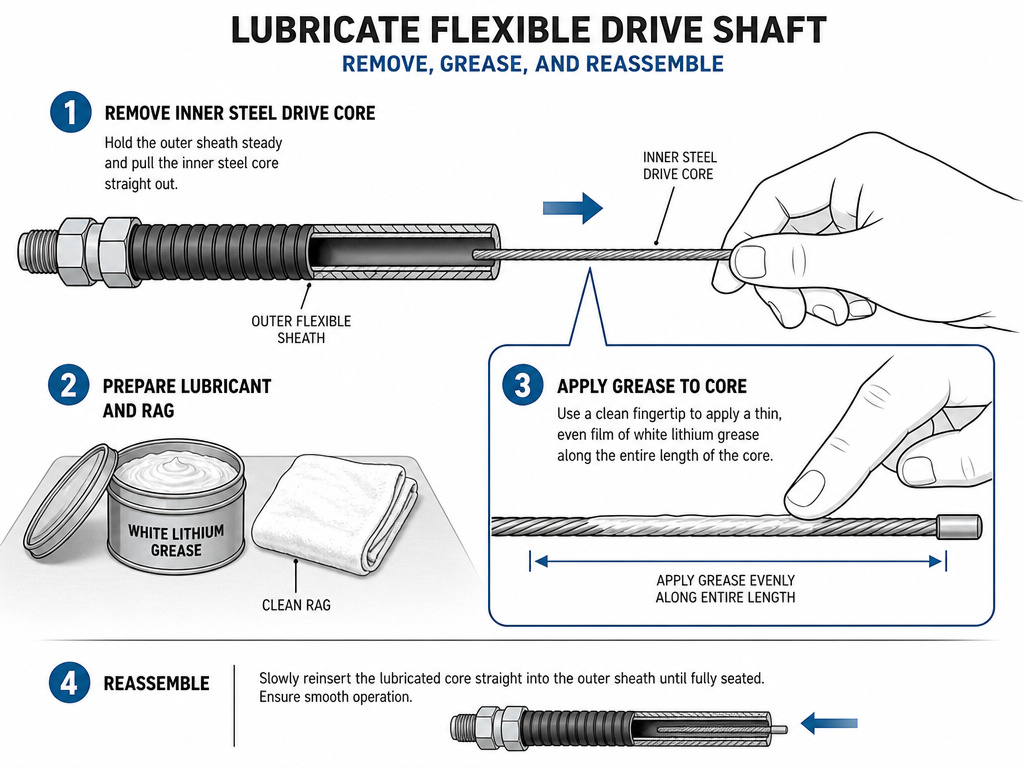
The maintenance is mandatory, but it’s simple. Here’s the direct procedure from the manuals, condensed into a actionable list. Set a timer on your phone to track runtime.
- Disconnect Power. Always unplug the motor before any service. This is the first step in every manual.
- Remove the Handpiece. Pull the handpiece straight off the end of the flexible shaft sheath.
- Detach the Shaft from the Motor. Unscrew the entire shaft/sheath assembly from the motor housing. For some models, you may need to loosen a set screw on a motor coupling first.
- Extract the Inner Core. Firmly pull the inner steel drive core out of the outer plastic or rubber sheath.
- Clean and Grease. Wipe the core clean with a rag. Apply a very thin film of high-quality white lithium or flexible shaft grease (like Foredom’s MS10008). Use your fingertip or a small brush. Coat evenly, but don’t glob it on. > Applying too much grease to the flexible driver can cause the unit to overheat. > . APEXFORGE MA1 Manual
- Reassemble and Adjust. Reinsert the greased core into the sheath. Reattach the assembly to the motor. Before putting the handpiece back on, adjust the sheath so the exposed tip of the core extends 3/8″ beyond the sheath. Tighten all connections.
- Run and Check. Reattach the handpiece, plug in the motor, and run it at a low speed for 2-3 minutes. This warms and distributes the grease. Wipe any excess that seeps out of the sheath-handpiece joint.
Do this every 25-30 hours for peace of mind, or stretch to 50 if you’re using a Foredom and your work is light. The 200-hour “deep clean with solvent” interval in the Foredom manual is for professionals; most hobbyists will simply replace the shaft by that point.
Flex Shaft vs. Standard Rotary Tool: When to Choose Which?
This tool is a sidegrade to a different type of work.
Reach for your standard rotary tool (like a Dremel 4300) when:
- The job requires portability or overhead work (e.g., grinding a weld in a tight ceiling space).
- You’re making quick, rough cuts, grinds, or sanding on easily accessible surfaces.
- The project is a one-off and setting up a dedicated system isn’t worth the time.
- You need the 5,000–35,000 RPM speed range for high-speed cutting or polishing with appropriate bits.
Invest in a flex shaft system (attachment or dedicated) when:
- Precision is paramount: You’re doing jewelry work, model making, engraving, or intricate carving.
- Ergonomics matter: You have projects that take longer than 30 minutes, where hand fatigue from tool weight becomes a factor.
- Access is limited: You need to work inside cavities, deep curves, or around obstructions.
- You work at a bench: You have a dedicated workspace where a motor can be securely mounted.
For the DIYer who does occasional detail work, a flex shaft attachment is a way to explore this capability. For the serious crafter, jeweler, or carver who spends hours at the bench, a dedicated Foredom SR or TX Series tool is an investment. Corded rotary tools, especially those considered among the best corded rotary tools, often form a compatible base for these attachments, offering the sustained power a flex shaft needs.
Troubleshooting Common Flex Shaft Problems
The symptoms are usually clear. Here’s what they mean and how to fix them, according to the service manuals.
| Symptom | Likely Cause | Immediate Fix |
|---|---|---|
| Tool stops under load / shaft disengages | 1. Motor not elevated above work point. 2. Sharp bend in shaft. 3. Worn or dry inner core. |
1. Raise motor on a stand. 2. Straighten shaft to a 6″+ radius. 3. Lubricate or replace shaft. |
| Handpiece wobbles or vibrates excessively | 1. Accessory not fully seated in collet. 2. Damaged or worn collet. 3. Bent inner core from kinking. |
1. Turn off, re-insert bit fully. 2. Replace collet. 3. Inspect and replace shaft. |
| Overheating motor or sheath | 1. Excessive grease in shaft. 2. Dull accessory causing high load. 3. Blocked motor ventilation slots. |
1. Disassemble and wipe excess grease. 2. Use a sharp bit, reduce pressure. 3. Clean motor vents with compressed air. |
| Burning smell from sheath | Extreme friction from lack of lubrication or a severe kink. | Stop immediately. Let cool, then disassemble, inspect for melted sheath, and lubricate or replace. |
Most problems trace back to setup (elevation, bend radius) or maintenance (lubrication). The manuals are relentless on these points for a reason. Following the correct techniques for rotary tool setup is half the battle.
Dremel vs Foredom vs budget rotary tool comparison
Key differences emerge in torque, speed, and design philosophy. A Dremel 4300 rotary tool is a handheld unit with a rated speed of 5,000 to 35,000 RPM and a chuck capacity for small accessories. In contrast, Foredom’s bench-mounted systems are built for heavier, sustained use. Their TX Series motors reach 15,000 RPM, while the LX Series maxes out at 5,000 RPM. More critically, Foredom’s TX and LX series tolerate up to 12 lbs. Of torque, with their TXH and LXH models withstanding 28 lbs. Budget brands like the Kogan 170W tool offer variable speeds up to 35,000 RPM but typically have lower power output and smaller collet capacities, making them suitable for lighter, intermittent tasks rather than professional-grade material removal.
User reviews and experiences with flex shaft tools
User experiences often highlight the practical realities of maintenance and durability. Many find that following the manufacturer’s specific lubrication schedule is critical to prevent premature failure, though schedules vary. Some brands recommend lubrication every 25-30 hours, others suggest every 50 hours. A common point of failure mentioned is not elevating the motor higher than the working end of the shaft, which can cause the flexible shaft to disengage. Users of professional systems note that under normal conditions, a flexible shaft machine may require several replacement shafts and sheaths during its lifetime, which is an expected part of long-term ownership. Proper accessory selection, ensuring the shank fits the collet and the accessory’s rated speed matches the tool, is another frequent lesson learned from user reports.
Frequently Asked Questions
Is a Dremel flex shaft attachment worth it?
For less than the cost of a Foredom handpiece alone, it is absolutely worth it if you already own a compatible Dremel rotary tool and want to try detailed work. It significantly improves your tool’s performance for engraving, polishing, and light carving. Just be prepared to follow the maintenance rules. It will not turn your tool into a professional-grade flex shaft system, but it opens the door.
What is the difference between a Dremel and a flex shaft?
Dremel is a brand of rotary tool, a handheld motor you grip directly. A flex shaft is an accessory for that tool (or a component of a dedicated system) that separates the motor from the handpiece via a flexible cable. You attach a Dremel-branded flex shaft to a Dremel tool to gain the benefits of remote operation and precision.
Which rotary tool has the best flex shaft?
For attachments, the Dremel 225-01 is the standard for a reason, it’s reliable and widely compatible. For dedicated systems, Foredom is the industry benchmark. The Foredom SR Series is a legendary reversible motor popular with carvers, while the TX Series offers modern features and a powerful 15,000 RPM top speed. Your choice depends on whether you need the versatility of a reversible motor or the higher RPM for polishing.
Can a flex shaft handle heavy grinding or cutting?
No. This is a critical limitation. Flex shafts are for precision material removal, not brute force. They have strict torque limits (12 lbs. For most models) and are not designed for side-loading, which is what happens with grinding wheels or cutting discs. Using a flex shaft for heavy grinding will quickly overheat it, damage the core, and void any warranty. For that work, use an angle grinder or a standard rotary tool held directly.
The Bottom Line
A flex shaft rotary tool is a precision instrument with a service manual. The pros, incredible control, ergonomics, and access, are real, but they are leased, not owned. Your payment is a tube of grease and ten minutes of maintenance every few weeks of use.
If your work lives in the details, the last pass of a polish, the fine line of an engraving, the delicate shaping of a carving, then this tool is indispensable. Start with an attachment on your existing cordless rotary tool or a powerful corded model like one of the best cordless rotary tools. If you find yourself using it constantly, the step up to a dedicated Foredom system feels less like an expense and more like hiring a full-time assistant.
But if your projects are about removal, not refinement, cutting bolts, grinding welds, shaping large stock, this tool will frustrate you. Its limits are real and printed in bold. For that work, a standard rotary tool or an angle grinder is the right tool for the job. Choose based on the work you actually do, not the work you imagine.
