
10 Best Saw Blades To Cut Laminate Flooring in 2026
This post contains affiliate links. As an Amazon Associate, we earn from qualifying purchases.
For a blade that balances exceptional durability with clean, precise cuts, we chose the Diablo PergoBlade PCD Saw Blade as the best overall. The best for clean cuts is the Diablo Saw Blade for Laminates, and the best for maximum life is the DEWALT PCD Laminate Cutting Blade.
Laminate flooring is notoriously hard on blades due to its abrasive, sandpaper-like surface layer. Choosing the wrong blade can lead to chipped edges, rapid dulling, and a frustrating installation experience. This guide is based on research into specifications, manufacturer designs, and patterns in professional feedback to help you select a blade that matches your tools and project needs.
Top 10 Saw Blades For Laminate Flooring in the Market
Certain content that appears on this site comes from Amazon. This content is provided "as is" and is subject to change or removal at any time.
The Best Saw Blades For Laminate Flooring, Reviewed
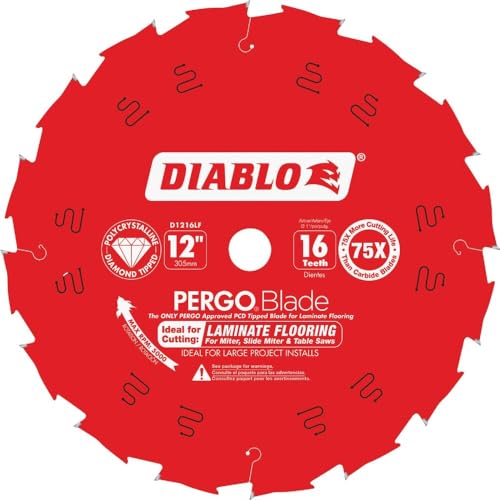
Diablo PergoBlade PCD Saw Blade
What We Like
- PCD teeth last up to 75 times longer than standard carbide
- Anti-vibration design for clean, precise cuts
- Non-stick coating reduces heat and friction
- Anti-kickback design for safer operation
Trade-offs
- 16-tooth count is aggressive for ultra-fine finish cuts on some materials
- 2.3-pound weight requires a saw with sufficient power
- 1-inch arbor may need an adapter for saws with smaller arbors
This blade’s Polycrystalline Diamond teeth can last up to 75 times longer than standard carbide, making it a highly cost-effective choice for large-scale flooring work. Its unique geometry and laser-cut anti-vibration design work together to stabilize the blade for clean, precise cuts on materials like laminate and engineered wood. An advanced non-stick coating also reduces heat and friction, which contributes to smoother cutting and helps extend the blade’s life even further.
The 16-tooth configuration is designed for fast, durable cuts through flooring materials, not for producing a fine finish on delicate surfaces. Compared to other laminate-focused blades like the 64-tooth Freud model, this one prioritizes speed and longevity over a polished edge. For the primary job of ripping and cutting flooring planks, however, the design ensures consistent performance from the first cut to the last.
Product photos
Diablo Saw Blade for Laminates

What We Like
- TiCo Hi-Density carbide for application-specific performance.
- Perma-SHIELD coating resists heat, gumming, and corrosion.
- Super thin kerf enables fast and clean cuts.
- Designed specifically for laminates and non-ferrous metals.
Trade-offs
- Requires a sliding miter saw or table saw, limiting tool compatibility.
- Specific design excludes use with standard chop saws.
A super thin laser cut kerf removes less material, which drastically reduces chipping and tear-out on laminate’s fragile surface. That makes this the right choice for installers who prioritize a pristine, factory-edge finish. Its Perma-SHIELD Non-stick Coating also protects from heat and gumming, a common issue when cutting bonded materials.
The major trade-off is your saw choice. You must use it with a sliding miter saw or table saw, as the manufacturer explicitly warns against chop saws. That’s a significant limitation for some workshops. If you need a dedicated laminate blade for a standard miter saw, the Diablo PergoBlade PCD is designed for that specific pivot-style cut. This D1296L, however, delivers its cleanest work on a sliding or table-mounted platform.
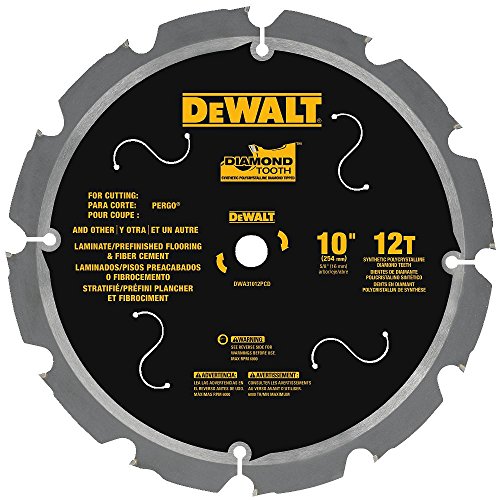
DEWALT PCD Laminate Cutting Blade
What We Like
- PCD teeth for maximum blade life
- 100X longer life in laminate vs. carbide
- Specifically engineered for laminate flooring
Trade-offs
- 12-tooth design prioritizes speed over a fine finish
- Weighs 1.6 pounds, heavier than some jigsaw blade options
The DEWALT PCD Laminate Cutting Blade uses Synthetic Polycrystalline Diamond teeth designed for maximum life, specifically for laminate and pre-fabricated flooring. This means installers can expect it to last up to 100 times longer on average than a standard carbide blade when cutting this material, reducing downtime for blade changes. It’s built for marathon cutting sessions where longevity is the primary concern over a polished finish.
With only 12 teeth, this blade is configured for durability in laminate, not for a fine finish. Compared to other products in the category, like the 64-tooth Freud blade or the 60-tooth Norske Tools blade, it has a significantly lower tooth count. Its engineered lifespan is the defining feature for powering through large flooring jobs, where a perfectly smooth cut edge is often less critical than continuous operation.
Product photos
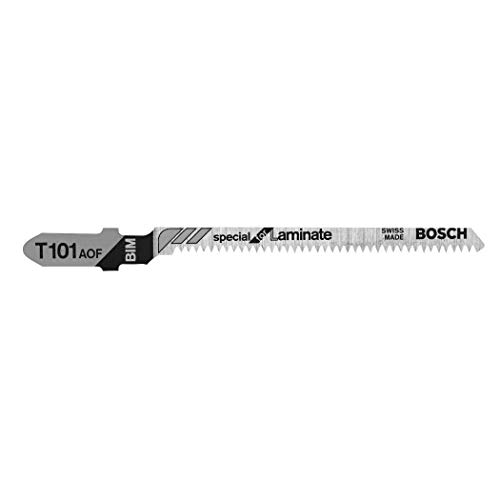
Bosch T101AOF Jigsaw Blade Set
What We Like
- Bimetal construction for durability.
- 20 TPI design for clean cuts in laminate.
- Five-piece pack for extended use.
- Specifically designed for scroll or curved cuts.
Trade-offs
- Set includes only five blades.
- Blade length is 3-1/4 inches.
The 20-tooth-per-inch design on these bimetal blades is engineered for clean, controlled cuts in abrasive materials like laminate flooring. That tooth geometry, paired with their narrow profile, makes them the clear choice when your project calls for intricate scrollwork or tight-radius curves that a circular saw simply can’t handle. This set is for the installer who needs to navigate around vents, pipes, or create custom transitions without chipping the delicate laminate surface.
Designed for scroll or curved cuts in laminate flooring, these Bosch blades turn a jigsaw into a specialist for detailed finish work. Their 20-tooth design prioritizes a clean edge on abrasive materials, so they excel at intricate tasks where maneuverability matters more than straight-line speed. Compared to a larger circular saw blade like the Diablo PergoBlade, a jigsaw’s inherent strength is in its control for curves, not in long, board-length rip cuts.
Product photos
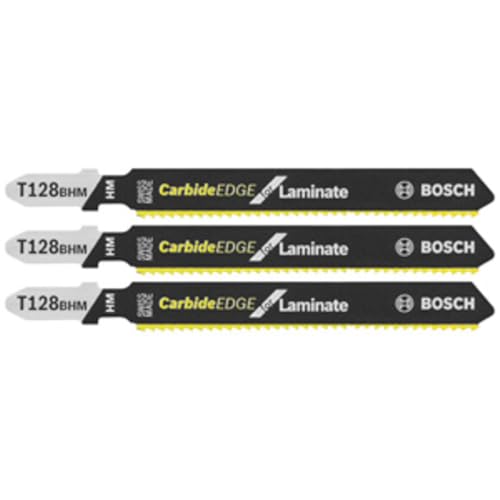
Bosch T128BHM3 Carbide Jigsaw Blades
What We Like
- Carbide brazing for 10x longer life than standard blades.
- Advanced tooth design for clean cuts on brittle materials.
- Thin kerf reduces heat and material extraction.
- Fine-tuned specifically for laminate flooring performance.
Trade-offs
- 3-5/8 inch length limits cut depth for thicker materials.
- Jigsaw-specific; requires a compatible T-shank jigsaw.
- Three-piece pack offers fewer blades than some competing sets.
Bosch uses carbide brazing technology to deliver a blade life claimed to be ten times that of standard bi-metal blades. This extended durability comes from the carbide strip construction, which is fine-tuned specifically for high-pressure laminates. A 14-tooth-per-inch count and a thin blade kerf ensure extra-clean, chip-free cuts while reducing heat, which protects the material during detailed jigsaw work.
These blades are specialized for jigsaw use on laminates, making them ideal for detailed cuts like notches and cutouts. For long, straight rip cuts, a dedicated circular saw blade would be the appropriate tool. They excel in the controlled, intricate work required for a full laminate installation.
Product photos
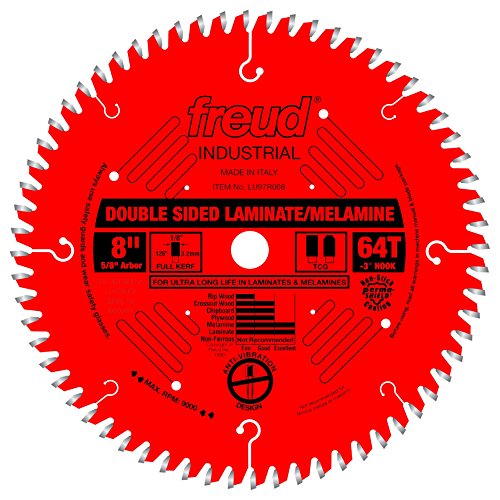
Freud Laminate Melamine Saw Blade
What We Like
- Laser-cut anti-vibration slots for reduced chatter.
- Triple Chip Grind design for long blade life.
- Negative hook angle prevents aggressive grabbing.
- Non-stick coating reduces drag and pitch buildup.
Trade-offs
- 8-inch diameter limits depth of cut on a table saw.
- 64 teeth require slower feed rates for best results.
The Freud blade’s combination of a Triple Chip Grind and a -3-degree hook angle is the key to its clean work. This design is engineered to shear through the tough laminate surface without chipping the delicate top layer, delivering that coveted splinter-free edge. It’s built for the installer who values a flawless finish right off the saw, minimizing the need for touch-up work. The laser-cut anti-vibration slots are a critical detail, keeping the cut smooth and steady, which directly translates to a crisper line.
That kerf creates more waste and demands more power from your saw compared to a thin-kerf alternative. While excellent for finish cuts on a miter saw or a table saw with sufficient depth capacity, the 8-inch size can’t match the crosscutting depth of a larger blade like the Diablo PergoBlade for certain applications. This blade excels in precision, not necessarily in raw cutting capacity or speed.
Product photos
Norske Tools Melamine Plus Saw Blade

What We Like
- Special 35-degree ATB tooth design for ultra-smooth cuts
- C4 micro-grain carbide tips for durable sharpness
- Anti-vibration slots reduce noise during operation
- Compact 8-1/4 inch size fits many portable circular saws
Trade-offs
- Smaller diameter limits depth of cut versus 10-inch or 12-inch blades
- Designed for finishing, not for heavy-duty ripping or demolition work
A 35-degree high ATB tooth design is engineered specifically to slice through laminate surfaces without chipping the decorative top layer, which is the primary challenge when cutting flooring. This makes the Norske Tools blade a focused tool for the finish carpenter or serious DIYer who needs clean edges for visible cuts. Its 60-tooth carbide-tipped configuration and laser-cut body aim for a vibration-free cut, so your saw stays steady in the cut and leaves a glue-ready edge.
Designed as an ultimate finishing blade, the Norske Tools Melamine Plus prioritizes a polished edge over raw cutting speed. Its 8-1/4 inch diameter and 60-tooth configuration with a 35-degree high ATB design are engineered for ultra-smooth cuts in materials like melamine and laminates. This makes it a specialist for final passes where a clean, chip-free result is the primary goal, rather than for rapid, deep cuts through thick stock.
Product photos
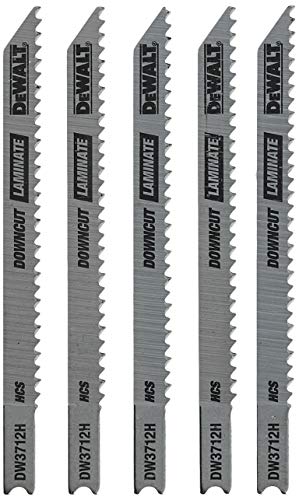
DEWALT Laminate Down-Cut Jigsaw Blades
What We Like
- Manufactured in the United States
- Five blades per pack
Trade-offs
- U-shank, not T-shank
- 10 TPI tooth configuration
These blades are designed for down cutting, a feature specified for laminate work. They are sold as a five-pack, which provides multiple blades for a single project. Each blade is four inches long with ten teeth per inch.
The 4-inch length and 10-tooth configuration handle standard laminate flooring planks well, but for thicker composite materials or very dense laminates, a blade with more teeth or a carbide edge might leave a finer finish. Compared to the Bosch T101AOF set, which uses a finer 20 TPI and a T-shank, the DeWalt’s U-shank is better suited for older tool inventories, while the Bosch geometry is optimized for ultra-smooth scoring cuts. Your jigsaw’s shank compatibility is the deciding factor.
Product photos
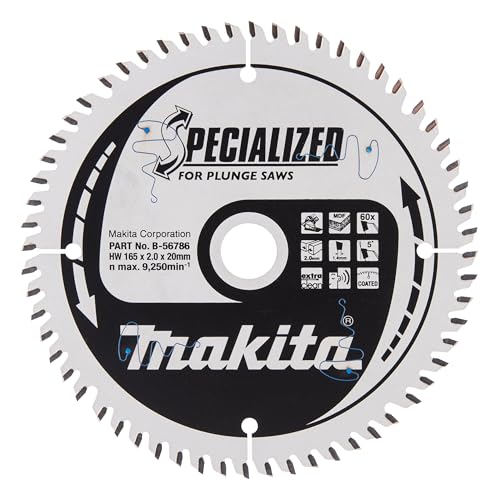
Makita Cordless Plunge Saw Blade
What We Like
- ATB design cuts laminate and MDF cleanly
- Laser-cut slots reduce noise and vibration
- Fluorine coating minimizes pitch buildup
- Lightweight for easy handling and swapping
Trade-offs
- 6-1/2 inch diameter limits depth of cut
- Smaller blade size than 10 or 12-inch laminate blades
This 6-1/2 inch blade is purpose-built for the specific world of Makita cordless track saws. Its 60-tooth ATB design and fluorine coating are engineered to deliver a fine, smooth cut in laminate and MDF with minimal chipping and gumming, which is exactly what you need for a clean floor installation. That laser-cut body keeps the saw running quieter and steadier in your hands on long track runs. If you’ve already invested in that Makita cordless plunge saw system, this blade is the obvious, optimized choice for your flooring work.
The blade has a 6-1/2 inch diameter and weighs 0.6 pounds. Its design is specific to a particular Makita cordless saw model. Compared to other products like the 12-inch Diablo PergoBlade, it has a smaller diameter.
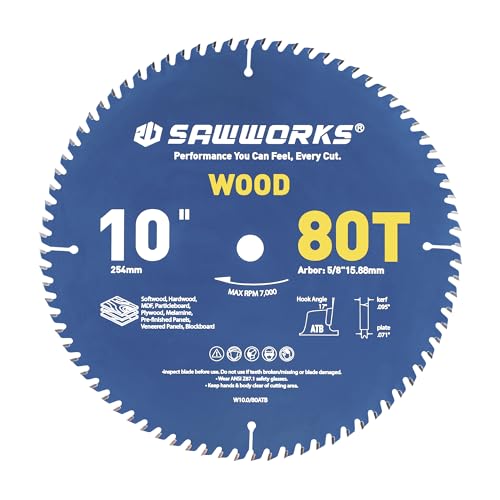
SawWorks 10-Inch 80T ATB Blade
What We Like
- 80-tooth ATB design for ultra-fine, smooth cuts
- Hardened steel body resists warping during use
- Expansion slots dissipate heat effectively
- Standard 5/8" arbor fits most 10" table saws
Trade-offs
- High tooth count is slower for long rip cuts than a 16T blade
- Designed for finish cuts, not for fast bulk material removal
The 80-tooth Alternate Top Bevel configuration is the core of this blade. That dense, fine-tooth pattern is engineered to slice through laminate and veneered panels without chipping the surface, leaving a clean edge that often needs no additional sanding. This makes it a perfect match for the cabinetmaker or meticulous DIYer installing laminate flooring where every visible cut must be flawless. It’s built for the final, precise trim on a board, not for quickly breaking down a whole stack of planks.
The 80-tooth ATB configuration delivers a clean, smooth cut, making this blade ideal for applications like cabinet making and furniture construction where edge quality is the priority. That ultra-fine finish comes at the expense of speed, as a dense 80-tooth blade will cut more slowly than a blade with fewer teeth, such as the 16-tooth Diablo PergoBlade. Its purpose is precision joinery and finishing work, not rapid material removal.
Product photos
How We Evaluated Saw Blades For Laminate Flooring
This guide is based on a review of manufacturer specifications for tooth material, design, and compatibility. It also considers expert summaries and common patterns from professional installer feedback regarding durability and cut quality. Key criteria include a blade’s longevity when cutting abrasive materials, the quality of the cut finish to limit chipping, and tool compatibility to ensure a proper fit for your saw. While this approach does not replicate the wear from extensive use, it highlights the blades that professionals frequently recommend for this demanding application.
What To Look For In Saw Blades For Laminate Flooring
The right blade turns a difficult, chip-prone job into a smooth process. Your saw choice is the first step, and the blade must complement it.
Prioritize tooth material for longevity, tooth count and design for a clean edge, and ensure the blade’s diameter and arbor size are compatible with your specific saw.
Tooth Material & Longevity
Laminate’s top wear layer contains aluminum oxide, the same abrasive used in sandpaper, which rapidly dulls standard blades. For longevity, Polycrystalline Diamond (PCD) teeth offer the most extreme durability, lasting up to 100 times longer than carbide in laminate. Premium carbide-tipped blades, like those with TiCo or C4 micro-grain tips, provide a strong balance of sharpness and life for most DIY projects. Understanding the difference between carbide and steel blades highlights why harder materials are non-negotiable here.
Tooth Design & Cut Quality
Tooth count and grind determine the finish. A higher tooth count (like 60 to 80 teeth on a 10-inch blade) generally produces a smoother, chip-free cut ideal for visible edges. A Triple Chip Grind (TCG) or Alternate Top Bevel (ATB) design helps shear through the laminate cleanly. For fast, rough cuts where the edge will be hidden, a lower tooth count (like 12-16 teeth) is acceptable. The technique for cutting laminate with a circular saw often involves cutting with the good side down to further prevent chipping.
Compatibility & Specifications
Always match the blade to your saw. Confirm the arbor size (commonly 5/8″ for table saws, 1″ for some miter saws) and that your saw has the power to handle the blade’s weight and kerf. A thin-kerf blade reduces strain on a lower-powered saw. Jigsaw blades require checking the shank type (T-shank or U-shank) and length for your cut depth. For detailed work, exploring jigsaw blades is essential.
- Check your saw’s manual for the maximum blade diameter and correct arbor size.
- For circular saws, ensure the blade’s rotation direction matches your saw.
- For finish cuts, look for blades with anti-vibration slots or non-stick coatings.
- Consider buying a multi-pack for jigsaw blades, as they can break or dull quickly. If you also work with vinyl plank flooring, a blade designed for laminate often works well.
A blade designed specifically for laminates or melamine will outperform a general-purpose blade every time.
Saw Blades For Laminate Flooring Compared
The following table compares key specifications to help you see the differences at a glance.
| Product | Diameter | Tooth Count | Tooth Material/Design |
|---|---|---|---|
| Diablo PergoBlade PCD Saw Blade | 12 inches | 16 teeth | Polycrystalline Diamond (PCD) |
| Diablo Saw Blade for Laminates | 13.9 inches | N/A | TiCo Hi-Density |
| DEWALT PCD Laminate Cutting Blade | 10 inches | 12 teeth | Synthetic Polycrystalline Diamond (PCD) |
| Bosch T101AOF Jigsaw Blade Set | N/A | 20 TPI | Bimetal |
| Bosch T128BHM3 Carbide Jigsaw Blades | N/A | 14 TPI | Carbide-strip |
| Freud Laminate Melamine Saw Blade | 8 inches | 64 | Triple Chip Grind (TCG) |
| Norske Tools Melamine Plus Saw Blade | 8-1/4 inch | 60 teeth | 35-degree high ATB |
| DEWALT Laminate Down-Cut Jigsaw Blades | N/A | 10 TPI | Down-cutting |
| Makita Cordless Plunge Saw Blade | 6-1/2 inches | 60 teeth | ATB (Alternate Top Bevel) |
| SawWorks 10-Inch 80T ATB Blade | 10 inches | 80 ATB | ATB (Alternate Top Bevel) |
Frequently Asked Questions
What type of saw blade is best for cutting laminate flooring?
A blade with carbide or Polycrystalline Diamond (PCD) teeth is essential due to laminate’s abrasive surface. For circular and miter saws, a blade specifically labeled for laminates or melamine with a high tooth count (60-80T) will give the cleanest finish. For jigsaws, use a fine-tooth bimetal or carbide blade.
How many tooth blade to cut laminate flooring?
For a 10-inch blade on a table or miter saw, aim for 60 to 80 teeth for a smooth, chip-free finish on visible edges. Lower tooth counts (40 or below) cut faster but leave a rougher edge, which is acceptable for cuts that will be hidden under molding.
How can I cut laminate flooring without it chipping?
Use a sharp, fine-tooth blade designed for laminates. When using a circular saw, cut with the finished side of the plank facing down. When using a table saw or miter saw, cut with the good side up and use a zero-clearance throat plate or masking tape over the cut line to support the laminate’s top layer.
What is the best tool to cut laminate flooring with?
A sliding miter saw is ideal for making fast, accurate crosscuts on planks. A table saw is best for rip cuts. For curved cuts or notches, a jigsaw with the appropriate blade is necessary. A good guide to choosing a saw can help you decide based on your project scope.
Can I use the same blade for laminate and vinyl plank flooring?
Often, yes. Both materials have similar construction and are abrasive. Blades designed for laminate, especially those with a fine finish, typically work very well for vinyl plank flooring. Always check the manufacturer’s recommendations for your specific blades for vinyl.
The Bottom Line
For most installers tackling a significant laminate job, the Diablo PergoBlade PCD Saw Blade is the best overall choice, offering remarkable longevity and clean cuts. If you’re on a tighter budget and using a circular saw, consider the Norske Tools Melamine Plus Saw Blade for its excellent value and finishing performance. For intricate scroll work, the Bosch T101AOF Jigsaw Blade Set is the clear pick. Ultimately, investing in a blade specifically engineered for laminate’s abrasive nature is the single most important factor for a professional-looking, frustration-free installation.
