
Biscuit Joiner vs Pocket Hole Jig: Which Is Right for You?
This post contains affiliate links. As an Amazon Associate, we earn from qualifying purchases.
Choose a biscuit joiner for seamless edge-to-edge panel glue-ups where alignment is critical and you want no visible fasteners. Choose a pocket hole jig for fast, strong right-angle assemblies like face frames and cabinet carcasses, where speed and mechanical clamping matter more than a perfectly hidden joint. For most hobbyists building cabinets, shelves, or furniture, a pocket hole jig is the more versatile and beginner-friendly first tool.
That distinction between alignment and fastening is the whole game. It decides not just which tool you buy, but which joints you can even attempt, how your shop workflow runs, and what the finished piece looks like inside and out. A classic comparison is the biscuit joiner vs pocket hole jig.
What follows is a breakdown of strength numbers pulled from actual tests, the specific sounds and feels of each tool in use, and the one mistake that makes beginners scrap their first project with either system. We’ll walk through the specs, the best-fit applications, and where you might actually need both tools in your shop.
Key Takeaways
- The biscuit’s primary role is alignment, not strength, making it best for edge-to-edge panel glue-ups like tabletops.
- Pocket screws provide immediate mechanical clamping, making them ideal for fast assembly of face frames, cabinets, and right-angle joints.
- In one informal racking strength test, a pocket hole joint averaged 86.3 lb of force to fail, versus 68.7 lb for a biscuit joint, but professional publications note that direct, comparable numeric strength figures from a single controlled test are not typically provided.
- Biscuit joints require glue and clamps and a full cure time, while pocket hole joints can be assembled and moved immediately.
- For a first woodworking joinery tool, a pocket hole jig is more versatile; add a biscuit joiner only if you frequently build wide panels.
The Core Difference: Alignment vs. Fastening
A biscuit joiner is a specialist. It cuts a small, football-shaped slot (the mortise) into the edge of a board. You add glue, insert a compressed wood biscuit, and mate it with a corresponding slot in the adjoining board. The biscuit’s job is to stop the boards from sliding out of alignment when you clamp them. The strength comes from the long-grain glue line, not the biscuit itself.
The primary function of a biscuit is alignment, ensuring flush surfaces across a joint. While the glue provides the majority of the strength, the biscuit prevents slippage during clamping and helps distribute stress.. Wood Magazine
A pocket hole jig is a mechanic. It guides a special stepped drill bit to bore an angled hole through one piece of wood, creating a pocket for a screw that pulls the second piece tight from the side. The screw provides immediate mechanical clamping force. You can often skip traditional clamps, and the joint is strong enough to handle right away. This is why it dominates cabinet and face frame construction.
The physical experience differs immediately. A biscuit joiner plunges with a sharp, high-RPM whine, and you feel a slight kick as the blade exits the wood. A pocket hole jig is all about setup: you feel the drill bit chatter as it bores through, and the final turn of the screw delivers a firm, satisfying cinch.
Strength Showdown: What the Numbers Actually Say
Everyone wants to know which joint is stronger. The answer is frustratingly situational, but some numbers give us a baseline.
In a specific, informal racking strength test (pulling a joint apart at an angle), a biscuited joint averaged 68.7 lb of force to break. A pocket hole joint with glue averaged 86.3 lb. That’s a difference of 17.6 lb in favor of the pocket hole in that particular test configuration.
| Joint Type | Average Racking Strength | Primary Strength Source | Typical Failure Mode |
|---|---|---|---|
| Biscuit Joint | ~68.7 lb | Glue bond along wood grain | Biscuit shears or wood splits around slot |
| Pocket Hole Joint | ~86.3 lb | Screw holding power in wood | Screw pulls out or wood tears around threads |
These aren’t universal constants. Sources disagree on comparative strength: some tests show pocket holes are stronger in racking, while others note a well-executed glued joint (which a biscuit reinforces) can sometimes exceed pocket screw strength in pure shear.
Where this goes sideways: Assuming biscuits add significant strength. Sources like Wood Magazine state the biscuit’s primary function is alignment, with glue providing most strength, while numerous woodworking discussions argue relying solely on biscuits for structural integrity is a misapplication.
The real disagreement among sources isn’t about these numbers, it’s about what “stronger” means in the context of a biscuit joiner vs pocket hole jig. Fine Woodworking notes pocket-hole joinery is “fast and strong” for carcasses. Meanwhile, Wood Magazine’s joint strength tests show that a well-executed glued butt joint (which a biscuit reinforces) can sometimes exceed a pocket screw’s strength in pure shear. The screw is faster and more reliable for the home shop; the perfected glue joint is a higher ceiling for the meticulous craftsman.
Best Applications: When to Reach for Which Tool

Your project dictates the tool in the biscuit joiner vs pocket hole jig choice. This isn’t a matter of preference; it’s a matter of joint geometry.
When the Biscuit Joiner Excels
- Edge-to-Edge Panel Glue-Ups: Aligning multiple boards for a tabletop, cabinet side, or wide shelf. The biscuits keep faces flush, minimizing sanding.
- Miter Joint Reinforcement: Adding a biscuit across the corner of a picture frame or cabinet door adds alignment and some shear strength without visible fasteners.
- T-Joints on Edge Grain: Joining a shelf (end grain) to a cabinet side (edge grain). The biscuit aligns and provides more glue surface than end grain alone would offer.
The process is simple but demands patience. You cut slots, apply glue, insert biscuits, clamp, and walk away for hours. The result is clean, with no visible hardware.
When the Pocket Hole Jig Dominates
- Face Frame Assembly: Joining rails and stiles at right angles for cabinet boxes. The Kreg K5‘s tool-free thickness adjustment makes this incredibly fast.
- Cabinet Carcass Construction: Screwing together the sides, top, bottom, and back of a cabinet. Immediate clamping means you can assemble an entire box in minutes.
- Attaching Aprons to Table Legs: Where the pocket is hidden on the inside, providing a strong mechanical connection.
- Drawer Boxes: The pocket holes are concealed inside the drawer, leaving a clean exterior.
Speed is the hallmark. With a Kreg jig set for your material thickness, anywhere from 1/2″ to 1-1/2″, you can drill a pocket, drive a screw, and have a solid joint quickly. No clamps, no waiting.
The Learning Curve and Workflow Impact
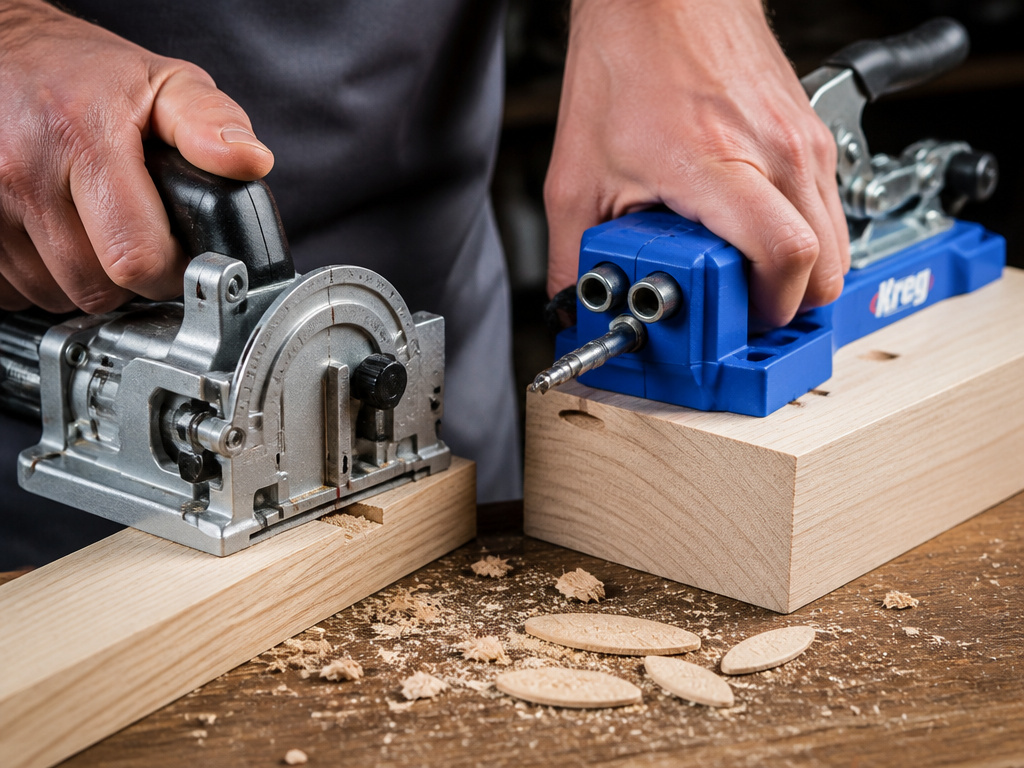
Don’t overthink it. A pocket hole jig is easier to learn. The steps are foolproof: set the jig’s stop collar for your wood thickness, clamp the workpiece, drill, and screw. The feedback is immediate and obvious, a tight joint or a stripped screw.
A biscuit joiner has fewer moving parts but more nuance. You must set the fence height and plunge depth correctly for your biscuit size (common sizes include #0, #10, and #20). The sound tells you a lot. A clean, crisp cut means the blade is sharp and the motor is happy; a labored groan means you’re plunging too fast or the wood is too hard.
I learned this the hard way on an early tabletop project. I was using a biscuit joiner for alignment but rushing the glue-up. I didn’t get the boards perfectly aligned in the clamps, assuming the biscuits would pull them flush. They didn’t. The result was a panel with a slight ridge at every joint that required hours of aggressive planing to fix. The biscuit prevents sliding; it doesn’t correct for poor initial placement.
Tool-Free Setup Wins.
The Kreg K5’s tool-free thickness adjustment significantly improves workflow efficiency. The DeWalt DW682K biscuit joiner’s preset depth stops are fast, but you still need to measure and set the fence for each new board thickness. That extra time per setup adds up over a large project.
Space, Cost, and the “Do I Need Both?” Question
The reality is this. Most home workshops are tight on space. A biscuit joiner is a dedicated, single-purpose tool about the size of a small circular saw. A pocket hole jig is often a bench-top fixture or even a portable clamp-on model. The jig wins on footprint.
Cost breaks down like this:
- Biscuit Joiner: A capable model like the DeWalt DW682K or Makita PJ7000 is an investment. The consumables (biscuits) are cheap.
- Pocket Hole Jig: The entry cost is lower. A full Kreg K4 or K5 system costs less than a DeWalt DW682K or Makita PJ7000 plate joiner. The consumables (special stepped drill bits and screws) are recurring costs.
Common mistake: Buying a biscuit joiner because you think it’s the “professional” choice. For a hobbyist building shop cabinets and bookshelves, a pocket hole jig will see ten times the use. Start there.
Do you need both? Only if your work regularly includes both major panel glue-ups and extensive face-frame/carcass construction. For a one-off tabletop, you can align boards with cauls and careful clamping. For a one-off cabinet, pocket holes will do the job. Buying both is a luxury for the specialized workflow.
Hybrid Approach: Using Both Tools on One Project
Here’s a non-commodity insight most guides miss: you can use both tools on a single project to play to their strengths. It’s not an either-or choice.
Imagine building a freestanding kitchen island with a butcher-block top and a cabinet base.
- Use the biscuit joiner to align the hardwood strips for the butcher-block top. The invisible joints and perfect alignment are worth the glue-up time for this showpiece surface.
- Use the pocket hole jig to assemble the cabinet base carcass, face frame, and drawers. The speed and strength are perfect for the structural, unseen parts of the build.
This approach respects the nature of wood. The solid wood top will move with humidity; the biscuit joints allow for a tiny amount of that movement. The plywood cabinet box is dimensionally stable; the pocket screws will hold it rigidly together for decades.
Which tool is better for alignment?
For aligning boards during assembly, the biscuit joiner is the dedicated tool. Its primary function is to create perfectly aligned, flush surfaces for edge-to-edge joints, like when making wide panels for tabletops or cabinet sides. The compressed wood biscuit fits into matching slots, preventing the boards from slipping while clamping and ensuring a flat seam. This alignment minimizes sanding and results in a clean, seamless appearance with no visible fasteners. In contrast, a pocket hole jig creates angled holes for screws, which pull parts together tightly but do not inherently provide the same level of precise edge-to-edge registration during a glue-up.
Is this a professional tool or a DIY tool?
Both tools have roles in professional and DIY shops, but their suitability differs by task. Pocket hole jigs are often highlighted for their speed and ease, making them exceptionally popular for DIY projects, quick repairs, and constructing face frames or cabinet carcasses where immediate clamping and strength are needed. They are straightforward to set up and use. Biscuit joiners are valued in professional settings for specific alignment tasks in fine woodworking and cabinetry, particularly for invisible edge joints. However, sources disagree on their usefulness: professional publications value them for specific alignment tasks, while some woodworkers argue their uses are limited and beginners might find more versatile techniques. The choice depends on the project’s demands for speed versus precision alignment.
Frequently Asked Questions
Are biscuit joiners obsolete?
No, but their role is more specialized than it was in the 1990s. For high-end cabinet shops and furniture makers focused on flawless panel glue-ups, they are still a valuable tool. For the average DIYer, they’ve been surpassed in versatility by pocket hole jigs and affordable doweling jigs.
What is better than a biscuit joiner for alignment?
For pure alignment in edge-to-edge glue-ups, careful clamping with properly placed cauls is free and often just as effective. For adding strength and alignment, a doweling jig (like a JessEm or Milescraft kit) creates a tighter-fitting joint than a biscuit and is often more affordable.
Can you use pocket holes for edge-to-edge joints?
Technically, yes, but it’s rarely recommended. You’d have to drill the pockets on the face of one board and screw into the edge of the other, which is weak and leaves visible screw heads on the surface. It’s a last-resort repair technique, not a recommended joinery method.
How long does a biscuit joint take to cure?
You need to leave the joint clamped for the glue to cure. A pocket hole joint is strong enough to handle immediately after the screw is driven home.
Is a biscuit joiner worth it for a beginner?
Probably not. The skills it teaches, glue-up technique, alignment, patience, are valuable, but a beginner will get more mileage, faster results, and greater confidence from mastering a pocket hole jig first. Add a biscuit joiner later if you find yourself constantly building tabletops or wide panels.
The Bottom Line
For most woodworkers, especially those starting out or with limited shop time, the Kreg pocket hole system is the right first choice. It’s faster, more forgiving, and tackles a wider range of common projects like cabinets, face frames, and shop furniture.
The DeWalt or Makita biscuit joiner is a specialist you add later. Buy it when you’ve built a few tabletops with cauls and are tired of the fuss, or when you’re ready to tackle projects where an invisible, perfectly aligned glue line is the entire point.
Your final decision should listen to the project. If the joint is edge-to-edge and will be seen, lean towards biscuits and their required patience. If the joint is a right-angle connection, often hidden, and you need to move on to the next step, pocket screws are your friend. Understanding that distinction is what separates a pile of parts from a piece of furniture.
