
Cordless vs 12v Tire Inflator: Which Is Right for You?
This post contains affiliate links. As an Amazon Associate, we earn from qualifying purchases.
In the cordless vs 12v tire inflator decision, a cordless inflator runs on a rechargeable tool battery and can be used anywhere, while a 12v inflator plugs into your car’s outlet and provides continuous power. For topping off tires and carrying in a go-bag, cordless wins. For sustained inflation of multiple large tires from flat, a 12v model is the reliable choice.
That battery-versus-wire difference isn’t just about where you use it. It’s the engine that drives every other trade-off: power output, run time, and what you can actually expect each tool to do for you on a cold morning.
What follows: a breakdown of three key numbers you must check before buying, the specific scenario where each type fails, and the long-term cost of ownership most guides skip. You’ll learn why manufacturer flow-rate claims are often misleading, which inflator type is a genuine hazard in cold weather, and how to match your vehicle’s power system to the right tool without spending twice.
Key Takeaways
- For topping off a single car tire or inflating sports gear, a cordless inflator offers unmatched convenience and speed.
- When inflating multiple truck or SUV tires from flat, the continuous power of a 12v inflator with the engine running beats a cordless model’s limited battery and duty cycle.
- Always check the CFM (cubic feet per minute) rating at 30 PSI, not at 0 PSI, for a true picture of inflation speed as pressure builds.
- The average lifespan of a high-quality lithium-ion power tool battery is 3–5 years or 500–800 charge cycles, factor that into the long-term cost.
- For inflating large-volume items like air mattresses, both portable inflator types are too slow; use a dedicated high-volume pump instead.
Power and Speed: Why CFM and PSI Tell Different Stories
Everyone looks at the maximum PSI number first. It’s the headline spec, and it matters for hitting that 35 PSI target in your car’s tire. But PSI is the destination, not the journey. How fast you get there is measured in CFM, cubic feet per minute. This is where the cordless vs 12v inflator debate gets messy, because manufacturers measure it differently.
The Milwaukee M12 Compact Inflator claims 0.88 CFM at 0 PSI. That’s its free-flow, no-back-pressure rate. The Ryobi ONE+ 18V model lists 0.8 CFM at 30 PSI, a more realistic gauge of performance under typical tire-inflation pressure. The DEWALT 20V MAX inflator provides both numbers: 0.9 CFM at 0 PSI, but only 0.6 CFM at 30 PSI. See the problem? Comparing a 0 PSI rating to a 30 PSI rating is like comparing a sprinter’s time on flat ground to one running uphill.
The EVparts4x4 blog states that high-quality 12v models usually have a higher CFM rate and can inflate a large truck or SUV tire from flat to full faster than many cordless competitors. However, Consumer Reports highlights the convenience and speed of cordless inflators for topping off tires or small items, while MotorTrend recommends a 12v inflator for multiple large, low-pressure tires due to its continuous power supply.
This isn’t academic. That higher CFM under load is why sources like MotorTrend recommend a 12v inflator when you’re facing multiple large, low-pressure tires. The cordless unit might start strong, but as pressure climbs past 20 PSI, its flow rate can plummet. As pressure climbs, the flow rate of a cordless unit can drop significantly, which can extend inflation time.
Here’s a quick decoder for those spec sheets:
| CFM Reported At | What It Tells You | Best For Comparing |
|---|---|---|
| 0 PSI | Maximum theoretical airflow with no resistance. | Raw motor power potential. |
| 30 PSI | Real-world performance under typical tire-inflation pressure. | Actual speed for topping off a car tire. |
| Both 0 PSI & 30 PSI (like DEWALT) | Shows how much performance drops as pressure builds. | Understanding the tool’s limitations for large-volume tasks. |
The part nobody mentions: If you’re using a cordless inflator on a cold battery, its effective CFM can drop significantly as lithium-ion chemistry is less efficient in the cold. Lithium-ion chemistry doesn’t like the cold. You’ll hear the motor labor, and a job that took five minutes in summer can stretch past ten.
Portability and Convenience: More Than Just a Cord
The cordless inflator’s big sell is obvious: no cord. You can toss it in a backpack to top up a bicycle tire at the park, or keep it in a kitchen drawer for pool toys. The 12v model is tethered to your car’s outlet, which limits its range to the length of its power cord.
But “portability” has layers. A cordless tool isn’t just portable; it’s self-contained. You don’t need the car keys. You don’t need to open the door or start the engine. For a quick 5 PSI top-off on a frosty morning, that’s the difference between a 90-second job and a 5-minute production.
Common mistake: Assuming a cordless inflator’s battery is always ready. Lithium-ion batteries lose charge just sitting in the tool. If you store it in the trunk over winter and a flat tire strikes in February, you might only get halfway through the job before it dies.
A 12v inflator, by contrast, is always “charged” as long as your car battery has juice. The trade-off is you must be near the vehicle, and you should run the engine to avoid draining the car’s battery during a long inflation job. That means idling the car, which isn’t ideal for the environment or your fuel bill.
Consider the physical experience. The Ryobi ONE+ cordless inflator is lightweight. The Milwaukee M12 Compact Inflator is a dense 3.3 lbs. You operate it with one hand. A typical 12v inflator is a box you place on the ground, connected by a hose. You bend over to read the gauge and fiddle with the chuck. One is an active tool; the other is an appliance you babysit.
Real-World Scenarios: Matching the Tool to the Task
You don’t buy an inflator for a vague future need. You buy it for specific, predictable jobs. Here’s where the rubber meets the road, based on documented recommendations from Consumer Reports and hands-on tests.
The Weekly Commuter (Topping Off)
Your dashboard light pings for 28 PSI, and you’re at 25. This is cordless territory. Consumer Reports notes that for topping off tires or inflating small items, a cordless inflator offers unmatched convenience and speed. Grab the Milwaukee M12 from your trunk, set the digital gauge to 35 PSI, and let it run until complete. No cord, no fuss, no need to start the car. Done.
The Road Trip / Off-Roader (Filling Flats)
You’ve aired down your truck’s tires for a sandy trail, or you’ve picked up a nail 100 miles from home. Now you need to go from 15 PSI back to 35 PSI, or from flat to full, on four large tires. This is where the 12v plug-in shines. As MotorTrend points out, the continuous power supply of a 12v inflator connected to the vehicle’s battery (with the engine running) provides consistent performance without concerns about battery depletion. A cordless model might handle one tire, but by the second or third, its battery will be low and its motor hot, many have a 50% duty cycle (10 minutes on, 10 minutes off) to prevent overheating.
Beyond Car Tires
What about bikes, balls, or air mattresses? The EVparts4x4 blog breaks it down cleanly:
| Item to Inflate | Cordless Inflator | 12v Inflator | Final Call |
|---|---|---|---|
| Car/Truck Tires | Excellent for top-ups | Excellent for all uses | 12v for heavy-duty; cordless for convenience. |
| Bicycle Tires | Excellent | Good (if car is nearby) | Cordless is the clear winner for portability. |
| Sports Balls | Excellent | Good (if car is nearby) | Cordless is more practical. |
| Air Mattress | Poor (too slow) | Poor (too slow) | Use a dedicated high-volume (HVLP) pump. |
The air mattress line is critical. Both portable inflators move air slowly. Filling a queen-size mattress could take 15+ minutes and overheat the motor. Know the tool’s limits.
Battery Life and Runtime: The Cold, Hard Math
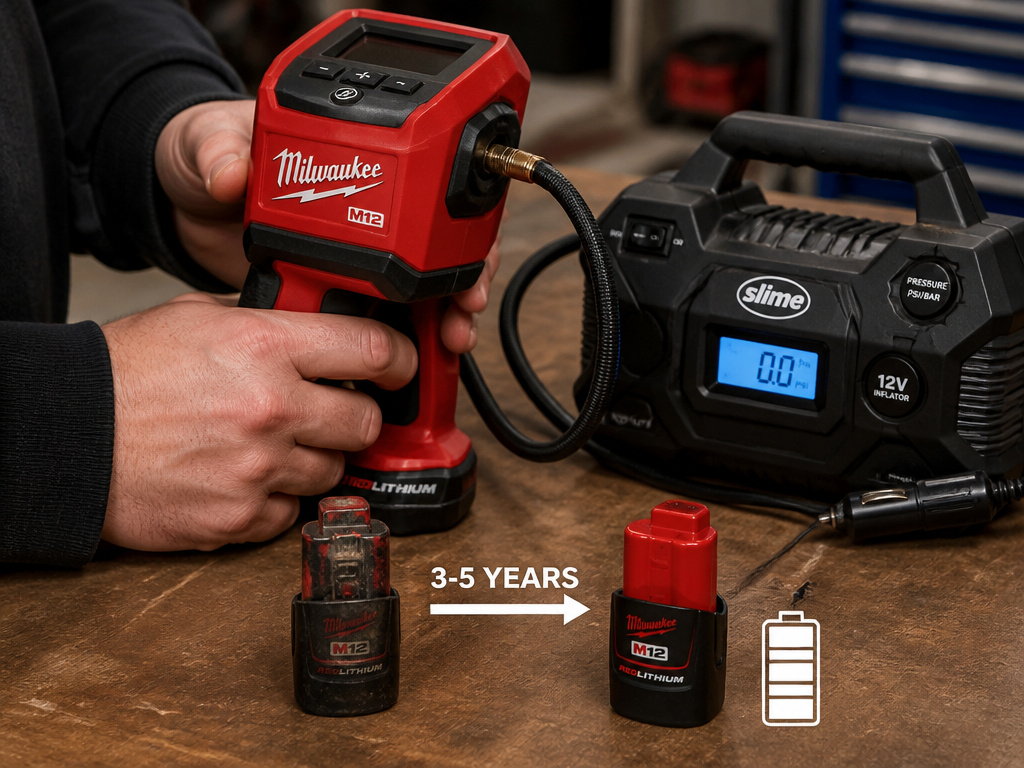
“How many tires can I fill?” It’s the first question anyone asks about a cordless inflator. The honest answer is: it depends. Battery capacity (measured in Amp-hours, or Ah), tire size, starting pressure, and even outdoor temperature all play a role.
The Milwaukee M12 illustrates this. It runs on M12 REDLITHIUM batteries. A fully charged 4.0 Ah battery holds more energy than a 2.0 Ah pack. But that energy gets spent faster when the pump is working against high pressure. From a near-flat state, inflating a single standard car tire can consume a significant portion of a cordless inflator’s battery charge. An SUV tire will take more.
Industry data suggests the average lifespan of a high-quality lithium-ion power tool battery is between 3-5 years or 500-800 charge cycles. Investing in a brand with a good battery ecosystem is key to long-term value for cordless models. Source: EVparts4x4 blog (citing industry data).
That’s the hidden long-term cost. The inflator body might last a decade, but the battery will need replacement within 3-5 years of regular use. Factor that into your decision. A 12v inflator has no such consumable, its “battery” is your car’s alternator, which is designed for this kind of load.
The duty cycle is another runtime killer. The Milwaukee M12 Compact Inflator has a documented 50% duty cycle (10 minutes on, 10 minutes off). If you’re pushing it on a large tire in warm weather, it might thermal-cut-off before the job is done. You’re left waiting, with a half-inflated tire. A 12v inflator, drawing steady power from a running engine, doesn’t have this limitation. Its motor is often built for longer, sustained operation.
Ownership Factors: Durability, Accuracy, and Hidden Costs

You’ve compared power and portability. Now look at what happens after year one. Build quality, gauge accuracy, and replacement parts separate a tool that frustrates you from one that lasts.
Durability
A more expensive 12v model might feature a durable metal body instead of plastic. It might have a brass screw-on tire chuck instead of a flimsy plastic lever-type. A brass chuck provides a more secure, leak-free seal and will outlast plastic counterparts by years. Cordless models, living a rougher life in trunks and garages, benefit from rubber over-molding and tight seam construction. The Milwaukee M12 feels solid; some cheaper brands have housings that creak under hand pressure.
Gauge Accuracy: The +/- Game
This is a massive, overlooked differentiator. The Milwaukee M12’s gauge accuracy is +/- 3%. At a target of 35 PSI, a +/- 3% accuracy represents a variance of just over 1 PSI. The DEWALT 20V MAX inflator claims +/- 1 PSI. That’s a tighter tolerance, meaning more consistent pressure from tire to tire. Why does this matter? Consistent tire pressure affects wear, fuel economy, and handling. If your inflator’s gauge is off by 5%, you’re driving on under- or over-inflated tires without knowing it.
Hidden Costs
For cordless: replacement batteries, as mentioned. For 12v: fuse replacement. Many 12v inflators have an inline fuse on the plug. If you draw too much current or short the connection, that $2 fuse blows. It’s a cheap fix, but you need to have spares. Also, consider the wear on your car’s 12v outlet (cigarette lighter socket). Cheap plugs can loosen or melt the socket over time. Higher-end models use better materials and often include alligator clips for direct battery connection, bypassing the fragile outlet entirely.
The 12v Clarification: Cigarette Lighter vs. Battery Clamps
When we say “12v inflator,” most people picture the plug that goes into the dashboard socket. That’s correct, but it’s not the whole story. There’s a second type: the 12v inflator with alligator clips designed to clamp directly onto your vehicle’s battery terminals.
The dashboard-plug type is convenient but power-limited. The socket is fused for a specific amperage, which limits power draw. The direct-to-battery type can often draw more current than the dashboard outlet allows, potentially enabling a more powerful motor. The trade-off is you have to pop the hood and clip onto the battery, a step too far for some, but a necessity for running a high-CFM inflator or using it on a vehicle with a dead battery or a faulty outlet.
Where this goes sideways: Assuming all 12v inflators are created equal. The direct-connect models are the true “heavy-duty” option for trucks and RVs, while the lighter-plug models are better suited for passenger car emergencies. Check the amperage rating on the unit’s label before you buy.
This distinction solves a common forum complaint: “My 12v inflator blew the fuse in my car.” It was probably trying to pull more amps than the dashboard circuit could handle. If you need serious power, get the clamp-on kind and keep jumper cables in the car for the connection.
Cordless vs 12v Tire Inflator: The Head-to-Head Verdict
Enough theory. We can compare them directly on the workbench. This table isn’t about which is “better”, it’s about which is better for you.
| Feature | Cordless Tire Inflator | 12v Tire Inflator |
|---|---|---|
| Best For | Ultimate portability, quick top-offs, bikes/balls. | Reliability on long trips, large/multiple tires, sustained use. |
| Power Source | Rechargeable lithium-ion battery pack. | Vehicle’s 12v outlet (lighter socket) or direct battery clamps. |
| Key Limitation | Battery life, duty cycle, cold-weather performance. | Cord length, requires vehicle to be on, fuse/outlet limitations. |
| Inflating a Flat Car Tire | Possible with a full, high-capacity battery. May be slow. | Reliable and consistent, especially with engine running. |
| Long-Term Cost | Includes eventual battery replacement (~3-5 years). | Virtually none beyond potential fuse/wear items. |
| Ease of Use | One-handed operation, standalone unit. | Set on ground, manage hose and cord. |
Choose a cordless inflator if…
Your primary use is maintaining tire pressure on 1-2 family vehicles. You value the ability to inflate a bicycle tire in the garage or a soccer ball in the backyard without dragging out extension cords or starting a car. You’re okay with the discipline of keeping the tool charged and understand its limitations for large-volume jobs. The Milwaukee M12 Compact or Ryobi ONE+ are strong contenders here.
Choose a 12v inflator if…
You drive a truck, SUV, or RV. You take long road trips or go off-roading where airing down and re-inflating multiple large tires is common. You want a “set it and forget it” tool that lives in your vehicle and is always ready, with no battery to maintain. You prioritize raw inflation speed over ultimate portability. Look for models with a high CFM-at-30-PSI rating and robust construction.
How loud is a cordless vs 12v tire inflator
Noise is a practical difference. Cordless inflators are generally quieter than 12v models. The electric motor in a cordless unit is smaller and designed for intermittent use, which often translates to less overall racket. A 12v inflator plugged into your vehicle’s power outlet uses a more powerful motor to achieve higher airflow, and that extra power comes with more noise. For quick top-offs in a quiet neighborhood or a garage late at night, the lower noise of a cordless inflator can be a real benefit. If you’re working on a roadside or in a shop where noise is less of a concern, the louder 12v unit’s performance may outweigh the sound.
Frequently Asked Questions
Which is better, cordless or corded tire inflator?
The word “corded” usually refers to a 110v AC plug-in model for home garage use, not a 12v DC car inflator. Between cordless and 12v, “better” depends on the task. For portable convenience and quick jobs away from an outlet, cordless is better. For sustained, powerful inflation where you have access to your vehicle, a 12v model is better.
Are 12v tire inflators good?
Yes, 12v tire inflators are excellent for their intended purpose: providing reliable, continuous power from your vehicle to inflate tires. They are generally faster than equivalently priced cordless models for filling large tires from a low pressure. Their main drawback is being tethered to the car.
Are cordless tire inflators any good?
Cordless tire inflators are very good for light to medium-duty tasks. As noted by Consumer Reports, they offer unmatched convenience for topping off tires or inflating small items. Their performance is limited by battery capacity and motor cooling, so they struggle with multiple large tires from flat. For their core use case, convenient, portable inflation, they are excellent tools.
Which cordless tire inflator did Consumer Reports recommend?
Consumer Reports’ specific model recommendations are behind a paywall. However, their testing highlights that for topping off tires or inflating small items, a cordless inflator offers unmatched convenience and speed. When evaluating models, look for features they prioritize: accuracy, speed, and ease of use.
The Bottom Line
Forget finding a single “best” inflator. The right choice is the one that disappears into your routine. If you check tire pressures monthly and hate dragging out cords, a cordless model will feel like a revelation. If you manage a fleet of vehicles or regularly air down for off-road adventures, a robust 12v inflator is essential.
One rule cuts through the noise: if your use case involves inflating anything larger than a standard car tire from a significantly low pressure, lean toward the 12v option. The continuous power simply beats battery limitations and duty cycles every time. For everyone else, the vast majority of drivers, the cordless inflator’s grab-and-go utility is worth the trade-off in peak power. Just remember to check its charge before the first frost.
