
Combination Square vs Double Square: Which Should You Buy?
This post contains affiliate links. As an Amazon Associate, we earn from qualifying purchases.
Combination square vs double square: the combination square adds a 45 degree face, while the double square has two square faces and fits tight spaces. Phil Lowe of Fine Woodworking keeps both within reach: a 12-in. Combination square and a 4-in. Double square.
The missing angled head explains the rest. A double square has no angled head, so the rule’s graduations run in both directions and you never have to flip it. A combination square makes you reverse the rule regularly, because Woodcraft says the ruler is graduated differently on all four edges. Then there’s the harder question of which one is actually square, since the accuracy claims on these tools measure different things.
Below you’ll find the design split, a task-by-task table, machine setup and miter work, the accuracy claims side by side, a test to run at your own bench, and a default pick for each kind of buyer.
Key Takeaways
- Choose the combination square for 45 degree work, depth and marking-gauge jobs, and flatness checks on big parts. Choose the double square for tight spots and pockets.
- Published accuracy figures (0.004 in., 0.0015 in., 0.0008 in. Per inch) measure different things, so don’t rank squares by them.
- Starrett’s own 13A page publishes no squareness tolerance, so test whichever square you buy.
- A draw-flip-draw check doubles the error, but it doesn’t verify the edge you pressed the head against.
- Makers and testers disagree on head material. Starrett calls forged steel longer wearing, and Lowe preferred cast iron, so there’s no agreed winner.
Where the Two Designs Split: Head, Rule, and the Missing 45
Starrett says its founder invented the combination square in 1877. The double square keeps the sliding rule and drops the angled head. That one change explains almost every difference below.
A combination square pairs a sliding steel rule with a head carrying 90 degree and 45 degree faces. Starrett fits most square heads with a spirit level and hardened scriber. A double square swaps the angled head for a flat head with two square faces, so the rule’s graduations read in both directions without reversing the blade.
The combination square head
The head gives you both a 90 degree and a 45 degree face, which is why Woodcraft lists a miter square among its jobs. The same guide names depth gauge, marking gauge, try square, straightedge, and small level. A 12-in. Head also accepts 18, 24, and 36 in. Blades, per Woodcraft.
Think of it as the chef’s knife of layout tools. It does a bit of everything, and you reach for it first.
A well-made head feels solid. Woodcraft says the rule should slide smoothly, the lock post should rotate easily, and the tightened locknut should never let the rule slip or creep. Starrett’s reversible lock bolt allows the blade to be turned over or end-for-end with the bolt and nut left in place, which keeps blade and head aligned.
The double square head
A double square is the paring knife. Starrett says the faces of the 13A head are ground square, and the 4-in. Satin chrome blade slides and locks. Starrett lists that head at 2-9/32 in. By 7/16 in., with no level.
Lowe points to two payoffs of the flat head. A 4-in. Double square fits into small spaces, like the back of a pin board. And with no angled head, he reads the graduations in both directions without removing and reattaching the blade.
Popular Woodworking adds a trick. Tighten the head at the end of the blade and the double square becomes a try square.
Combination Square vs Double Square: Which Wins for Which Job?
Neither wins everywhere. Lowe reaches for the 12-in. Combination square most often for measuring, laying out parts, and checking flatness or squareness. Popular Woodworking describes the same tool as relatively heavy and sedentary, something you hang on a rack near the bench. The double square is the one it suggests for an apron or tool-belt pocket.
| Task | Better pick | Why |
|---|---|---|
| Mark or check a 45 degree angle | Combination square | Only one with the angled head |
| Reach into a small space | 4-in. Double square | Fits where a big head can’t |
| Read the rule from both directions | Double square | No blade reversing |
| Depth or marking-gauge work | Combination square | Woodcraft lists both uses |
| Repeat a measurement, center a joint | Double square | Locks at length, flips for a right angle line |
| Check flatness on large parts | 12-in. Combination square | Lowe’s most-used size |
Popular Woodworking shows the repeat-measurement move well. Set the blade to protrude the distance you want and transfer it to the workpiece. Flip the square and use the longer part of the blade to draw a right angle line. For a bridle joint, it centers the first pair and then locks the blade to telegraph the setting to the rest.
If I could keep only one, it’d be the 12-in. Combination square. It covers the 45s and the machine checks. Add the double square once you start laying out small parts.
Here’s how I’d split buyers:
- Beginner building shop projects: the 12-in. Combination square first.
- Hand-tool woodworker: add the 4-in. Double square, Lowe’s pairing.
- Machinist, toolmaker, patternmaker: Starrett says its 13 series double squares are very popular with exactly these trades.
- Framer or remodeler working from a belt: the double square rides in a pocket while the combination square waits on the rack.
I come from construction and repair, not fine joinery. The small-part joinery case above comes from Lowe and Popular Woodworking, not from my own bench.
What Three Machine Checks Do Each Square Handle Best?
Three checks come up constantly: blade to table, fence to table, and a miter angle. Woodcraft describes machine setup as squaring bits and blades to tables and fences, and the combination square handles it. Hold the head on the table and bring the rule to the saw blade (unplugged, always). A gap between rule and blade means the blade is out of square.
Jointers need the same fence-to-table check. On combination jointer planers, the fence has to sit square to the table before you trust an edge, and a 12-in. Head and rule reach across it.
Sander tables are cramped. Lowe says a 4-in. Double square fits small spaces more easily. A table set close to the abrasive on disc sanders is that kind of space, in my view. Tools for Working Wood goes further and says the Starrett 13 handle is accurate enough to square up machinery and fences.
Miters belong to the combination square because only it has the 45 degree face. Whichever of the miter saws you run, a square is how you confirm the 90 and 45 settings against the fence. If you need 45s often and want a double square’s size, a dedicated 45 degree square is the alternative.
Do the Accuracy Claims on These Squares Mean the Same Thing?
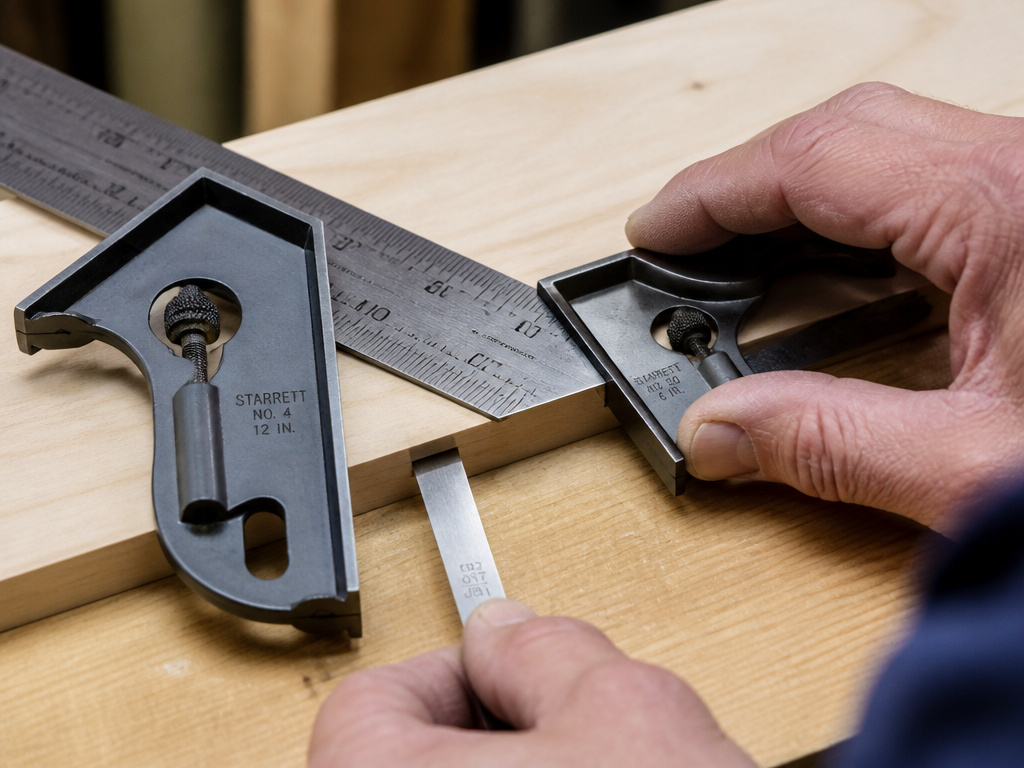
PEC guarantees its 12-in. Combination square to within 0.004 in. Over the blade, citing Federal Specification GGG-S-656E from 29 January 1996. Woodpeckers quotes the same 0.004 in. For its 6-in. DSQ-ST-20 double square, but as total accumulated error over the full blade. Same number. Different measurement.
| Square | Claim | What the maker cites |
|---|---|---|
| PEC 12-in. Combination | 0.004 in. Over blade | GGG-S-656E |
| iGaging 12-in. Combination | 0.005 in. Over 12 in. | Older GGG-S-656C |
| Starrett 11H-6-4R | -0.002 to 0.004 in. Length | GGG-R-791H (rule only) |
| Woodpeckers DSQ-ST-20 | 0.004 in. Accumulated error | Full 6-in. Blade |
| Benchmark double square | 0.0015 in. Per blade length | Maker claim |
| iGaging 34-4466-S | 0.0008 in. Per inch | “Meets Federal Specifications” |
The Starrett row needs a footnote. McMaster-Carr says GGG-R-791H sets standards for the blade’s accuracy, graduations, and size. That’s the rule, not the head squareness, so it can’t be compared with PEC’s figure. The iGaging figures come from retailer listings only.
Starrett’s 13A page publishes no squareness tolerance at all. Owners report mixed results. In a Sawmill Creek double square quality thread, one woodworker found a new Starrett 13A and two Lee Valley double squares about 1/32 in. Off against his other squares, and returned them. Another member in the same thread has three Starretts (4, 6, and 12 in.), all square.
Is a double square as accurate as a combination square? Forum owners split. One doubts it because the shorter head gives less registration surface. Another says a double square from a reputable maker is as square as a combination square at any size. Nobody in these sources measured against a certified reference, so treat both as opinion.
How to Check a Square Before You Trust It
The combination square I use for layout has held its square for years, and that’s spared me more bad measurements than I can count. So I was slow to believe a square could drift. Then I read one owner’s report: a Starrett C11H head found out of square with no known drop or damage.
The error was identical against 12, 18, and 24 in. Blades. Same error on three blades points at the head or the edge you tested against, not at any one rule.
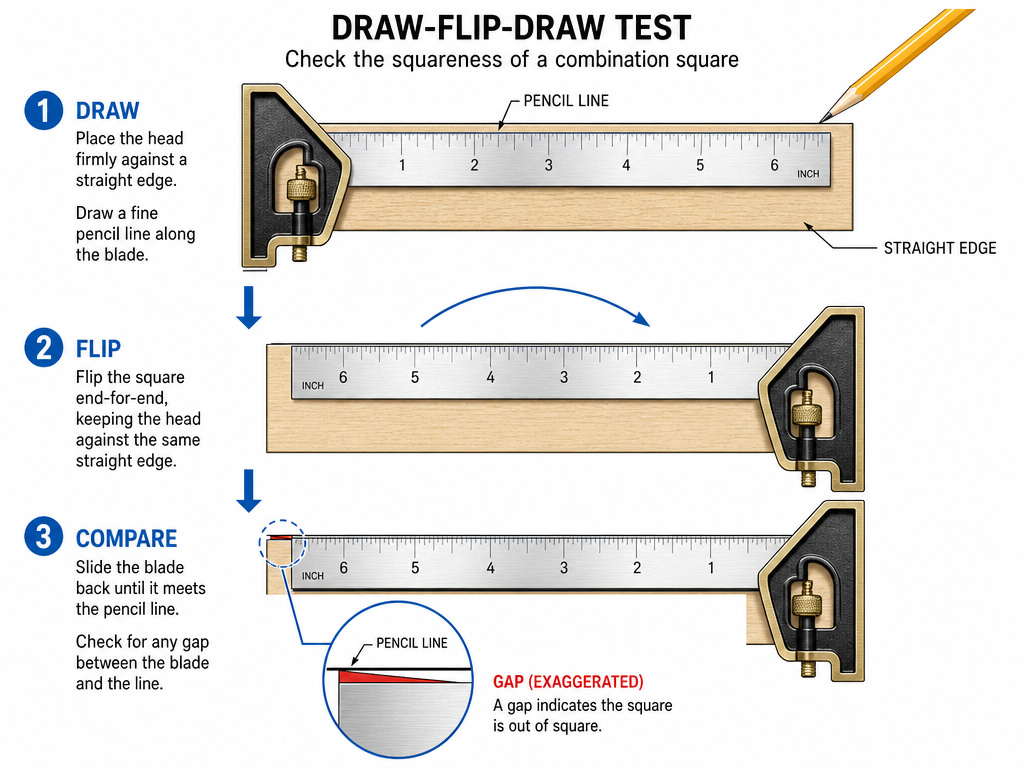
The draw-flip-draw test
Run this on every square you own, double squares included.
- Clean the head and blade, then pick a straight edge. Starrett warns that burrs on metal or knots on wood throw squareness off, so a dirty head or a bumpy edge gives a false answer.
- Press the head against the edge and draw a fine line along the blade.
- Flip the square so the head stays on the same edge, then bring the blade to the line. A square that’s out gets doubled error in this position. Per a Sawmill Creek poster, that’s why a small gap becomes easy to see.
- Repeat with the head slid to the other end of the blade.
Hold the lines up to a light and check for a gap. Light between blade and line is your answer.
What the flip test misses
Where this goes sideways: The flip test compares the square to an edge you assumed was straight. A bowed edge fools it, and you’ll “fix” a square that was fine.
Festool Owners Group members raised a second limit. Squares are calibrated on their inside edges, so testing the blade’s outside edge against the head’s inside edge relies on the blade edges being parallel. One member checks by butting a trusted square against the 90 degree angle, feeling for rock, and holding the pair to a light.
If a square fails, owners disagree on the fix. One suggests carefully filing the shoulder the rule rides on. Others point to Starrett’s calibration service for older squares instead. Call the maker first.
Is a Starrett Worth It, or Does PEC Do the Job?
A famous name still publishes no tolerance on its double square. That’s the Starrett 13A situation, and it’s why I don’t treat the name as a spec.
Head material is a separate argument. Starrett offers forged hardened steel (described as longer wearing) or cast iron, with all bearing surfaces accurately ground. Woodcraft says the best squares use forged or tempered steel. Lowe chose cast iron where both were offered, calling it strong enough for woodworking and less expensive.
Cost is the other lever. Woodcraft says quality squares cost a multiple of hardware-store versions. Popular Woodworking says double squares run from the very expensive, highly accurate Starrett to cheap mass-produced imports.
Whatever you buy, check these:
- Etched rule. Lowe found etched rules easier to read than stamped ones.
- 4R graduations (1/8, 1/16, 1/32, 1/64 in.) for US woodworking. Starrett’s 16R adds quick-reading 50ths and 100ths.
- Satin chrome. It cuts glare under bright light.
- Smooth slide, easy lock post, no creep.
- Metric option. PEC sells 4R, 16R, metric, and English/Metric versions, and Woodpeckers lists a 150 mm metric double square.
Keep it clean, too. Starrett’s own advice is a clean square against a flat surface.
Do You Cut Joinery by Hand, or Mostly Build and Repair?
For one purchase, I’d buy the PEC 12-in. 4R 2-piece combination square. The maker guarantees 0.004 in. Over the blade, the blade is 1 in. Wide and 0.085 in. Thick with etched 4R markings, and the cast-iron head carries a level and a scribe. Starrett’s 11H-6-4R is the 6-in. Alternative if you want a smaller head.
If you add a double square, the Starrett 13A is the one I’d look at first. The 4-in. Blade is hardened steel, and Tools for Working Wood says the handle is ground square to the blade on both sides. Test it on arrival, because owner reports are split.
The Woodpeckers DSQ-ST-20 has a spring-loaded index pin at every full inch, an anodized aluminum head, and 1/16 and 1/32 in. Scales. It’s a different tool than Lowe’s 4R pick, which also includes 1/64 in. The iGaging 34-4466-S set offers a 4-in. And 6-in. Pair, but I found no maker datasheet for it.
How do you avoid reading the wrong side of a double square?
A double square has a head on a sliding blade, and the head sits in the middle of the work. Set the blade at a length, and part of the blade sticks out on one side while the rest sticks out on the other. It is easy to read the number from the wrong end, or to measure from the wrong face of the head.
The fix is a habit. Before you lock the blade, decide which face of the head touches the work and which end of the blade you are reading. Lock it, then check the setting against that same face. Fine Woodworking’s Phil Lowe notes that with no angled head, the graduations can be used in both directions without removing and reattaching the blade. That flexibility is handy, but it means both ends carry marks.
Tighten the blade firmly, since a double square tightened at the end of the blade works like a try square. Glance at the graduations, confirm the scale, and only then mark.
Frequently Asked Questions
What are the differences between a combination square and a double square?
Combination square has a head with 90 degree and 45 degree faces, and Starrett fits most with a level and scriber. A double square has a flat head with two square faces and no angled face. The double square reads the rule in both directions without removing the blade.
What is the most accurate square for woodworking?
No source here compares them head to head, and the makers’ accuracy numbers measure different things. For the highest accuracy, Starrett recommends its TS True Squares, down to 1/4 second. For a bench, test any square you buy.
Is a Starrett combination square worth it?
Starrett offers forged hardened steel heads it calls longer wearing. Lowe preferred cast iron as strong enough for woodworking and less expensive. One Starrett owner reported a head out of square with no known drop or damage. The short answer is yes if you value wear life, no if you only need accuracy per dollar.
What are combination squares good for?
Woodcraft lists depth gauge, marking gauge, miter square, try square, straightedge, and small level. You also use them to check joints and set up machines. The sliding rule does the measuring.
Can a double square replace a combination square?
Not for 45 degree work, since it has no angled face. For machine setup, Tools for Working Wood says the Starrett 13 handle is accurate enough to square up machinery and fences. For most shops, I’d still own a 12-in. Combination square first.
The Bottom Line
In the combination square vs double square question, the answer for one purchase is the 12-in. Combination square. The double square is what you add when small-part layout starts to matter.
Your first step this week: run the draw-flip-draw test on every square you own, starting with the one you trust most. If the two lines don’t meet, don’t use that square for machine setup until you’ve cross-checked it against a trusted square.
One caveat applies to all of it. If you rarely cut miters and mostly work in small joinery, flip my order and buy the 4-in. Double square first.
