
10 Best Combination Square For Woodworking in 2026
This post contains affiliate links. As an Amazon Associate, we earn from qualifying purchases.
The Swanson TC132 12-Inch Combination Square is our best overall pick because its cast zinc head, deeply etched markings and firm brass lock make it a dependable all-round layout tool. If you want finer graduations, the Starrett 12-Inch Combination Square is the Best 4R Graduated Blade. The IRWIN 12-Inch Metal-Body Combination Square suits humid shops.
A combination square has one main job: giving you a true 90 or 45 degree line you can trust. Blade length matters too. A 12-inch blade handles panels and carcass checks, but it is clumsy on small joinery, where a 4 or 6 inch square is easier to hold.
We built this guide from specifications, manufacturer details, expert round-ups and patterns in owner feedback. You get 10 squares, from single 12-inch blades to full multi-head sets and a compact indexing square, with plain notes on who each one suits.
Top 10 Combination Squares For Woodworking in the Market
Certain content that appears on this site comes from Amazon. This content is provided "as is" and is subject to change or removal at any time.
The Best Combination Squares For Woodworking, Reviewed
Swanson TC132 12-Inch Combination Square
What We Like
- Cast zinc head with solid feel
- Deeply etched 8ths, 16ths, 32nds marks
- Brass bolt and nut lock firmly
- Built-in level vial and scriber
Trade-offs
- Graduations stop at 32nds, with no finer marks
- Zinc head, where Starrett lists a steel square
- Ranked just behind the Irwin in one round-up
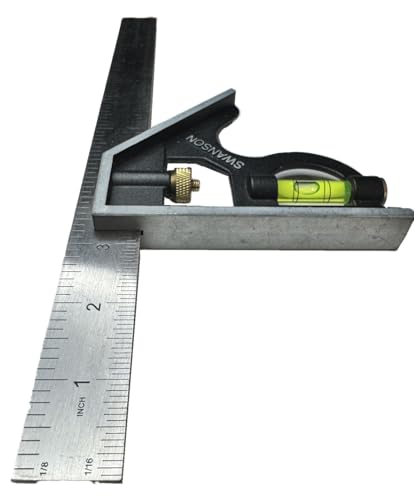
A cast zinc head with a brass bolt and nut means the blade slides smoothly and locks down firmly, so your setting stays put while you scribe a line across a board. That’s exactly what you want from a layout tool you reach for all day. The stainless blade carries deeply etched marks in 8ths, 16ths, 32nds and cm/mm, which resist rust in a damp shop and stay easy to read. Add the built-in level vial and a scriber stored in the handle, and one tool covers try square, miter square, depth gauge and straight edge work. For a woodworker who wants one dependable square, this is a sensible place to start.
Graduations that stop at 32nds are the main limit here, so if your joinery calls for tighter fractions you’ll want a different rule. The head is cast zinc, while the Starrett 12-Inch Combination Square is listed as a steel square, which may appeal to buyers who prefer that traditional feel. An expert round-up placed the Irwin first and this Swanson close behind, so the Irwin deserves a look too. Its listing shows 0.9 pounds against the Swanson’s 0.8, a slight difference in weight between the two.
Starrett 12-Inch Combination Square

What We Like
- 4R graduations read down to 64ths
- Hardened steel blade resists wear and shock
- 12-inch blade spans wide layout work
- Square head handles mitering and depth gauging
Trade-offs
- At 1.2 pounds, heavier than Crescent Lufkin's 0.5
- Single 12-inch blade is clumsy for small joinery
A 4R blade graduated in 8ths, 16ths, 32nds and 64ths means you can mark fine joinery layouts straight off the steel without hunting for a second rule. The quick-reading 32nds scale speeds up everyday marking, and the hardened steel blade stands up to rough shop use, high-impact knocks and plain wear. Owners in woodworking forums lean on a 12-inch combination square because it can check a carcass for square, scribe parallel lines and lay out mortises, rabbets and lap joints. That range makes it a sound first square for a serious hobbyist, and the same layout work carries over to a professional bench.
The trade-off is heft and reach. At 1.2 pounds, this square is noticeably heavier than the Crescent Lufkin L12CS at 0.5 pounds, which you will feel if you carry it in an apron all day. A single long blade is also awkward inside tight cabinet work, so many owners add a shorter blade or a small double square later. The Woodpeckers inDexable 6-inch is one example of a smaller option. Owners also advise confirming you are buying a genuine Starrett, since copies with the logo are out there.
Crescent Lufkin L12CS Combination Square
What We Like
- Laser etched numbers resist wear
- Integrated level in extruded square head
- Brass scribe stores in the handle
- Markings in inches and centimeters
Trade-offs
- Weighs 0.5 pounds, lighter than Starrett's 1.2 pounds
- Extruded head is not a cast iron body like PEC Tools
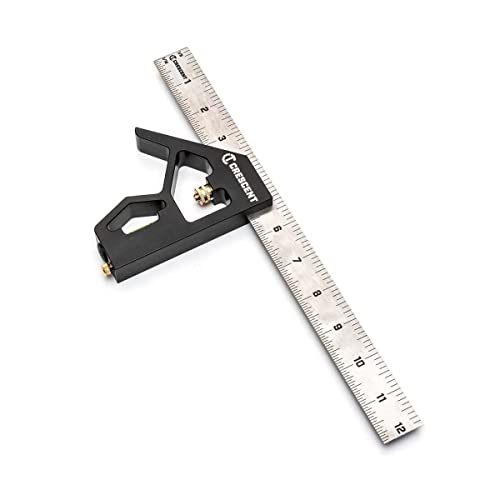
Laser etched numbers mean the graduations won’t rub off after seasons of sliding the blade across rough lumber, and that matters more than it sounds. A marking you can’t read is a cut you second-guess. The etching is built to protect against wear, so the scale stays legible long after a printed one would fade. Add the integrated level in the head and the brass scribe that stores in the handle, and you get a square that handles layout, plumb checks and line marking. You won’t need a second tool in your apron. It suits a woodworker who wants clear, durable readings at a sensible weight.
Mass is the catch here. At 0.5 pounds, this square is light next to the 1.2 pound Starrett model, and some people prefer a heavier head for steady, planted reference work on a bench. The extruded head is designed for drop durability and accuracy, but it isn’t the cast iron body you get with the PEC Tools 12-Inch model. The dual inch and centimeter markings are handy when plans mix units, since you won’t need a separate rule for the metric ones. For everyday shop layout, the readable scale is the main draw.
PEC Tools 12-Inch Cast Iron Combination Square
What We Like
- Made in USA with hardened, tempered blade
- Micro-fine 4R graduations down to 64ths
- Cast iron head with level vial and scribe
- Reversible lock bolt clamps blade in head
Trade-offs
- Owner feedback favors 4 and 6 inch double squares
- 12-inch blade is awkward for small parts
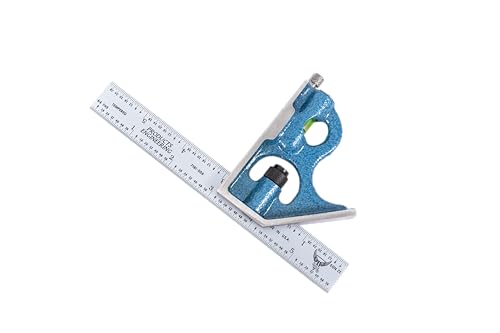
Micro-fine 4R graduations down to 64ths mean you can read a layout line much more finely than a standard 16ths rule allows, which matters when you are marking joinery or setting a fence. The blade is hardened and tempered with a no-glare satin chrome finish, so the markings stay easy to read under shop lights instead of washing out in reflection. The cast iron head carries a level vial and a hardened scribe, and the reversible lock bolt clamps the blade so your setting holds while you work. That makes it a solid pick for anyone who wants American-made construction and repeatable accuracy on a 12-inch blade.
Size is the catch with this set. A 12-inch blade is great for fences, stock and machine tables, but it gets awkward on small parts. One owner says they reach for 4 and 6 inch double squares more often than their 12-inch Starrett combination squares. If your work is mostly small joinery, a compact square will see more use.
IRWIN 12-Inch Metal-Body Combination Square
What We Like
- Rustproof stainless steel blade resists shop humidity
- Marks both 45° and 90° lines
- Cast zinc body adds durable, steady mass
Trade-offs
- Zinc body is lighter than Starrett's 1.2 pounds
- Only 45° and 90° marking, no other angles
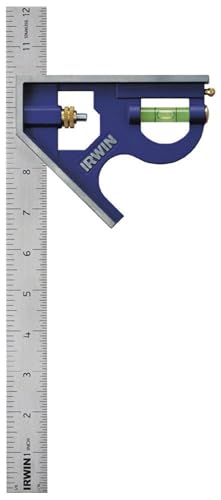
A stainless steel blade means this square won’t blush with rust when the shop turns damp. That is a real advantage if your workspace is a garage or basement where tools sit for weeks between projects. The black scales are precision-etched, which gives you crisp contrast against the bright blade when you are scribing a cut line. The 12-inch length covers most board widths you will square up, and the 45° and 90° faces handle miters and crosscuts. It also works as a gauge for transferring measurements, which saves you from reaching for a second tool.
The head is the catch with this IRWIN. A cast zinc body keeps the whole square at 0.9 pounds, which is easy to hold against a board edge, but it will not give you the heft of a heavier head. Starrett’s 12-inch square weighs 1.2 pounds, so if you like a dense tool that settles against the stock, that one has the edge. Cast iron, like the PEC Tools head, is another route for that feel. This IRWIN is also limited to 45° and 90° marking, so odd angles need a different tool. For everyday layout, though, the blade is the main reason to buy it.
Johnson 400EM Combination Square
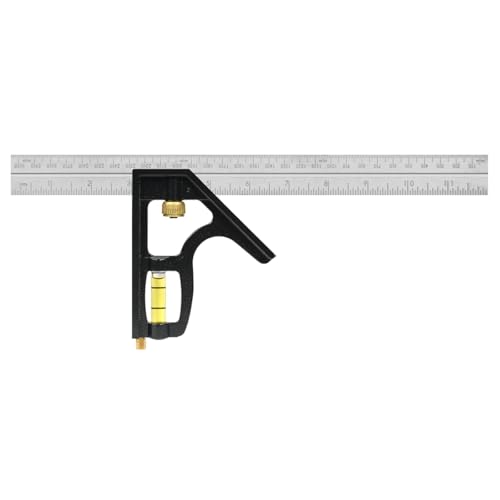
What We Like
- Inch and millimeter graduations on one blade
- Stamped markings that never fade or degrade
- Built-in level vial for level and plumb
- Auto-Lock blade assembly holds alignment
Trade-offs
- Failed a squareness check in a research round-up of 10 squares
- Only 45° and 90° marking, no other angles
Having inch and millimeter markings on the same stainless blade means you can work from an imperial cut list and a metric plan without grabbing a second tool. The inch side runs down to 1/32, which is fine enough for most furniture layout, and the stamped graduations are permanently imprinted, so they will not wear away under a pencil or a rag. The CNC-machined head and Auto-Lock blade assembly are aimed at holding alignment. Add the built-in level vial, and you can check plumb on a post or level on a shelf without reaching for something else. For a woodworker who bounces between measurement systems, that flexibility is the real draw here.
Squareness is the catch with this Johnson, and it matters because a combination square exists to give you a true 90 degrees. In a round-up that checked ten squares, six passed and this one was among four that showed some deviation from true. Reviewers liked everything else about it, but a square that is slightly off undermines its main job, so it is smart to check it against a known reference before trusting it on joinery. For rough layout, marking 45° miter cuts, and checking depth, it still does plenty, thanks to the stainless blade with inch and millimeter graduations and the built-in level vial for checking level and plumb.
Product photos
Starrett 12-Inch Combination Set
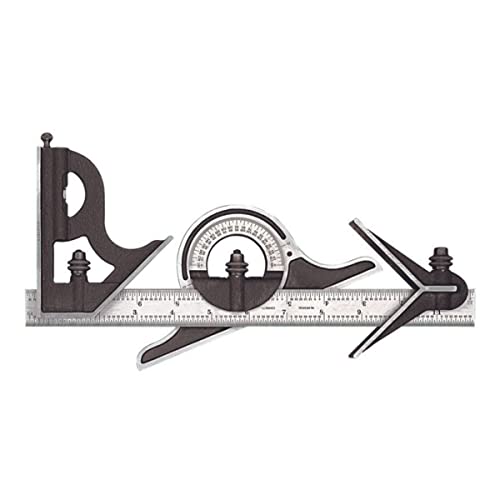
What We Like
- Four-piece set: rule, square, protractor, center head
- Protractor reads 0 to 180 degrees both ways
- Hardened steel heads for heavy shop use
- Made in the USA by Starrett
Trade-offs
- At 2.2 pounds, it outweighs the 1.2-pound Starrett square
- Four heads are overkill if you only mark square lines
- Center head is a separate attachment to keep track of
One purchase gets you a 12-inch rule plus square, protractor and center heads, which covers layout jobs that usually call for several separate tools. That matters when you go from marking a rabbet to checking a carcass for square to finding the middle of a round leg. The protractor head has revolving turrets with double graduations running 0 to 180 degrees in opposite directions, so angles above or below the blade can be read directly. Hardened steel construction and Starrett’s made-in-USA heritage point to a kit built to last through hard jobs. Woodworkers who like building a layout kit in one go will appreciate it.
Here’s the catch. At 2.2 pounds, the full set is heavier than the standalone Starrett 12-Inch Combination Square at 1.2 pounds, and you’ll carry heads you may never touch. If your work is mostly marking square lines and checking joints, the single square does that job and is easier to hold in an apron pocket. The set rewards people who will actually use the protractor and center heads for angled joinery or turning stock. Owner feedback also stresses buying a genuine Starrett rather than a lookalike, so buy from a reputable seller. Treat it as a long-term investment, not a quick fix.
Product photos
PEC Tools 4-Piece Combination Square Set
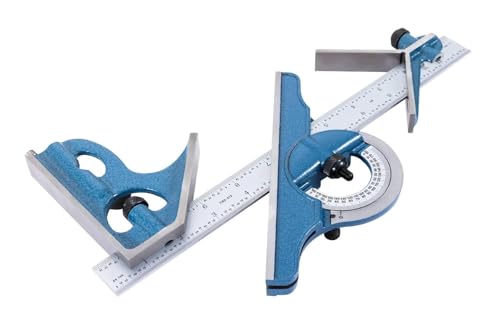
What We Like
- Four pieces: square, protractor, center head, blade
- Cast iron heads with hammertone powder coat
- 4R graduations down to 64ths
- Square head includes level vial and scribe
Trade-offs
- Only one 12-inch blade, so small joinery needs another tool
- Protractor and center head are extras if you only square stock
Four heads on one 12-inch blade means a single kit covers squaring, 45° miters, angle setting and finding the center of round stock. For a woodworker building a layout kit from scratch, that saves you from buying three separate tools and wondering which blade fits which head. The 4R graduations run down to 64ths, so you can read fine measurements straight off the rule. The square head also carries a bubble level and a scribe, which handles marking a line and checking a surface without reaching for anything else.
Focus is the catch with this set. If all you do is check a square corner, the protractor and center head are extra pieces to keep track of in the drawer. Owner feedback I found also suggests some woodworkers who already own Starrett squares reach for shorter 4-inch and 6-inch double squares more often than a 12-inch blade. A long blade is not always the one you grab. Compared with the Swanson TC132, which has a zinc body and a stainless rule, this set trades simplicity for versatility and a cast iron build.
Woodpeckers inDexable 6-Inch Combination Square

What We Like
- Indexing every 1 inch locks the head
- Laser-cut scribing guide on 1/16" centers
- Laser-engraved graduations won't rub off
- Head gives both 45° and 90° angles
Trade-offs
- 6-inch rule can't span wide boards like Swanson's 12-inch
- Indexed stops only every 1 inch, not anywhere
- Mini rule needs a separate set for longer reach
Indexing every 1 inch means the head clicks into a known position and stays there, so you can set a repeatable distance and scribe a line without the head creeping. That is the whole point of this little square. If you spend your time marking joinery, setting up small machine cuts or scribing parallel lines on narrow stock, the lock-in positions save you from re-measuring every time. The laser-cut scribing guide on 1/16″ centers adds fine reference marks, and the laser engraved graduations are meant to stay put, since they won’t rub off or wear through with handling.
Reach is the catch with this one. With a 6-inch rule, you cannot lay out across a wide panel or check a long board edge the way the Swanson TC132 with its 12-inch rule can. The 1-inch indexing also means you are working in set steps, so odd settings still need the usual lock-and-slide approach. Think of this as a precision small-work companion, not a do-everything layout tool. The good news is that you can build out your own set from individual components if you later want a longer rule or a different head. For small, repeatable setups, it is a smart pick.
Product photos
Johnson 415 Structo-Cast Combination Square
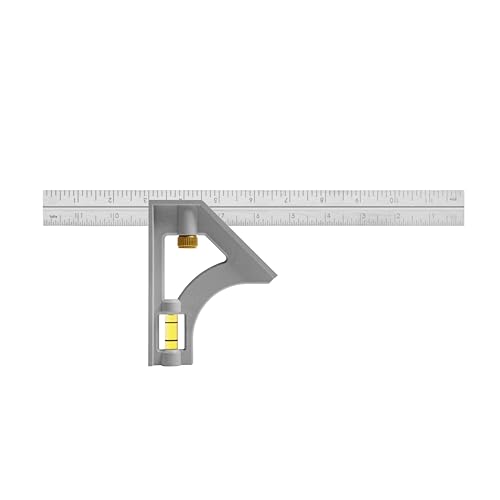
What We Like
- High-impact molded reversible head
- Stamped 1/32-inch graduations never fade
- Auto-Lock blade assembly for alignment
- Built-in level vial checks plumb
Trade-offs
- Molded head, while the Starrett uses steel
- Finest marks are 1/32 inch, no metric
Built around a heavy-duty, high-impact molded head, this square is meant to take the bumps of a busy shop without falling apart. The head is reversible, so you can flip it for different layout jobs, and the Auto-Lock blade assembly is designed to keep the blade aligned once it is set. That matters when you are marking a run of identical cuts and cannot afford the setting to drift between marks.
The stainless steel blade carries graduations down to 1/32 inch, stamped in permanently, so the markings should not fade or wear away with handling. From there the tool covers a lot of ground: it checks 45° and 90° angles, marks miters, measures depth, and has a built-in level vial for level and plumb. That range suits a woodworker who also does general carpentry, tool setup, and the occasional metalworking or masonry task.
The head material is the catch. A molded head is built for toughness, but some woodworkers prefer an all-steel head, such as the one on the Starrett steel combination square. The graduations stop at 1/32 inch, so very fine layout work may call for a different tool.
Product photos
How We Evaluated Combination Squares For Woodworking
This is a research-led guide. We compared manufacturer specifications, expert round-ups, woodworking forum discussions and patterns in owner feedback. We did not run our own bench tests, so we do not claim measured results of our own.
Four criteria mattered most. First, squareness, because a square that is off defeats its purpose. One round-up checked squares by marking a line, flipping the tool and marking again, and a few models showed deviation. Second, blade quality: hardened steel and clear, durable graduations. Third, head material and weight, since a heavier cast head usually holds steadier. Fourth, the lock and extras such as a level vial and scribe.
A research-based approach has limits. Individual tools vary, and a square can be out of true straight from the box regardless of brand. Check any square you buy before you rely on it.
What To Look For In Combination Squares For Woodworking
Most of the difference between these squares comes down to accuracy, blade length and how well the head locks. Here is how to weigh each one for woodworking.
Look for a head that stays square to the blade, a hardened steel blade with readable graduations, and a lock that does not slip. Choose 12 inches for general layout, or 4 to 6 inches for small joinery. Cast iron or steel heads feel steadier than lighter ones.
Squareness and Head Material
The head sets the square’s accuracy. Cast iron and forged steel are the strongest materials, and heavier heads tend to resist shifting. Light-duty models can bend or move with repeated use, and then they no longer strike true lines.
Our picks cover cast zinc (Swanson TC132, IRWIN), cast iron (PEC Tools), hardened steel (Starrett) and molded or extruded heads (Johnson 415, Crescent Lufkin). Whatever you choose, check it. Mark a line along the blade edge, flip the square, and mark again from the same spot. Any gap between the lines means the square is out of true. The same squareness matters when aligning a table saw fence, where a head that wobbles will mislead you.
Blade Length and Graduations
For general layout, a 12-inch blade is the usual choice. It spans wide boards, checks a carcass for square, and marks mortises, tenons, rabbets and lap joints. For small parts, a 12-inch blade is clumsy, and many owners lean on 4 or 6 inch double squares for joinery.
Graduations differ. The Starrett and PEC Tools squares read down to 64ths (4R), the Swanson stops at 32nds, and the Johnson 400EM adds millimeters. Hardened and tempered blades keep their shape, and etched or engraved marks outlast pressed ones.
Lock, Level and Extras
A knurled knob or a firm bolt and nut should clamp the blade with no slip. Grab the head, tighten the lock, and try to move the blade up and down and side to side. Any wiggle is a red flag.
Extras add value when they are well made. A scribe that fits snugly, a level vial, and a rustproof blade for damp shops all earn their place. If you are also shopping for the best table saws, a steady 12-inch square is a handy partner for checking blade height and angles.
- Hold the blade up to the light and sight along the edge for bows or bends.
- Tighten the lock and test for any slip or wiggle.
- Run the flip-and-mark squareness check.
- Confirm the scribe seats snugly in the head.
- Look for machined edges free of pitting or rough paint.
Rule of thumb: buy the heaviest, best-locking 12-inch square you can justify, then add a 4 or 6 inch square for small joinery.
Combination Squares For Woodworking Compared
The table below lines up all 10 squares so you can compare head type, blade length and graduations at a glance before you choose.
| Product | Blade Length | Blade Material | Head | Graduations |
|---|---|---|---|---|
| Swanson TC132 12-Inch Combination Square | 12 inches | Stainless steel | Cast zinc | 8ths, 16ths, 32nds, cm/mm |
| Starrett 12-Inch Combination Square | 12 inches | Hardened steel | Square head | 4R: 8ths to 64ths |
| Crescent Lufkin L12CS Combination Square | 12 inches | N/A | Extruded square head | Inches and centimeters |
| PEC Tools 12-Inch Cast Iron Combination Square | 12 inches | N/A | Cast iron | 4R: 8ths to 64ths |
| IRWIN 12-Inch Metal-Body Combination Square | 12 inches | Stainless steel | Cast zinc | N/A |
| Johnson 400EM Combination Square | 12 inches | Stainless steel | CNC machined | 1/8, 1/16, 1/32 in plus mm |
| Starrett 12-Inch Combination Set | 12 inches | Hardened steel | Square, protractor, center, rule | 4R |
| PEC Tools 4-Piece Combination Square Set | 12 inches | Tempered carbon steel | Cast iron | 4R (8ths to 64ths) |
| Woodpeckers inDexable 6-Inch Combination Square | 6 inches | Stainless steel | N/A | N/A |
| Johnson 415 Structo-Cast Combination Square | 12 inches | Stainless steel | High-impact molded | 1/8, 1/16, 1/32 inch |
Frequently Asked Questions
Which combination square is best for woodworking?
The Swanson TC132 12-Inch Combination Square is our best overall pick for most woodworkers. It combines a cast zinc head, deeply etched 8ths, 16ths and 32nds marks, a firm brass lock, a level vial and a scriber. If you need finer reading, choose the Starrett 12-Inch Combination Square, which reads to 64ths.
Which brand of combination square is considered the best?
No single brand wins every category. Starrett is widely favored by owners for shop precision, and its 4R blade reads to 64ths. Swanson leads our list for all-round value, while PEC Tools offers fine graduations with a cast iron head. Buy from a trusted seller, since owners warn that poor copies carry well-known brand names.
Is a Starrett combination square worth it?
It is worth paying more for if you want long-term precision. The Starrett 12-Inch Combination Square has a hardened steel blade, 64ths graduations and a square head that handles mitering and depth gauging. The trade-offs are weight, at 1.2 pounds, and a single long blade that feels clumsy on small joinery work.
Should I get a 12-inch or a smaller combination square?
A 12-inch square is the better first choice because it spans wide boards and checks carcasses for square. Smaller 4 to 6 inch squares are easier on dovetails and small parts. The Woodpeckers inDexable 6-Inch Combination Square suits that work, with its indexed stops every 1 inch. Many woodworkers end up owning both.
How do I check that a combination square is accurate?
Draw a line along the blade edge against a flat, straight edge. Flip the square over, line it up at the same spot, and draw a second line. If the two lines do not match exactly, the square is out of true. Also tighten the lock and try to wiggle the blade, since any play means trouble.
The Bottom Line
The Swanson TC132 12-Inch Combination Square is the best overall choice for woodworkers and DIYers who want one dependable 12-inch square for layout, depth checks and quick level checks. It is not for anyone who needs graduations finer than 32nds or an all-steel head.
If you want finer reading and a long-lasting steel build, the Best 4R Graduated Blade is the Starrett 12-Inch Combination Square. For a humid shop, the Best Rustproof Stainless Blade is the IRWIN 12-Inch Metal-Body Combination Square. For small joinery, the Woodpeckers inDexable 6-Inch Combination Square, our Best Indexing Small Square, is easier to handle. To build a full layout kit, look at the Best Complete Set from Starrett or the Best Multi-Head Set from PEC Tools.
Whichever you pick, accuracy comes first. Run the flip-and-mark squareness check when it arrives, and make sure the lock holds without wiggle.
