
How Long Do Cordless Power Tools Last?
This post contains affiliate links. As an Amazon Associate, we earn from qualifying purchases.
*Cordless power tools last as long as their batteries, typically 500 charge cycles to 80% capacity per the Atlas Copco spec, and their mechanical components, which can endure many years of regular use before failure.* The tool itself often outlives multiple battery packs.
That 500-cycle figure is a manufacturer’s benchmark, not a death sentence. It’s the point where the battery holds 80% of its original charge, not where it stops working. The real lifespan question hinges on three things you control: how you charge, where you store, and how hard you push the tool. A common question is how long do cordless power tools last.
What follows: the sourced numbers that define a cycle, the storage rules manufacturers actually disagree on, the one repair that’s almost never worth it, and the warranty fine print that tells you how long the maker expects the battery to last.
Key Takeaways
- A lithium-ion battery is considered to have reached its end of life after about 500 full charge cycles, when it holds 80% of its original capacity (Atlas Copco).
- Storage temperature and charge level directly impact longevity. Storing a battery fully charged at high heat can cut its life in half.
- Warranty periods signal expected durability. A five-year battery warranty (like some Milwaukee packs) means the manufacturer expects it to last that long under normal use.
- The motor and gearbox often outlast the battery. A well-maintained brushed motor tool can run for a decade; brushless models typically last longer.
- Replacing the battery is almost always cheaper than repairing the tool. When a tool fails, diagnose the battery first.
The 500-Cycle Benchmark and What It Really Means
The Atlas Copco Li-Ion battery guide states a battery reaches 80% of its nominal capacity after around 500 charge/discharge cycles. That’s the industry’s technical endpoint. You’ll find similar figures echoed across brands, because they all use the same lithium-ion chemistry at their core.
A charge cycle is counted when you use 100% of the battery’s capacity, not each time you plug it in. Using 50% and charging twice equals one cycle. This benchmark means after 500 full uses, the battery will take 20% less runtime to reach empty.
For most DIY users wondering how long do cordless power tools last, it will take several years to hit that 500-cycle mark. A contractor running batteries down daily might reach the 500-cycle benchmark much sooner. The key is that 80% capacity. Your drill won’t just die; it’ll gradually run for 45 minutes instead of an hour. That slow fade is why many people think their tool is “lasting forever” when its battery is actually degrading.
Where this goes sideways: Counting cycles in your head. You can’t. Instead, track runtime. When a fully charged battery completes a job it used to breeze through, you’re seeing the cycle count in action.
What Wears Out First: Battery vs. Tool
The battery is the consumable. The tool is the durable good. They age on different timelines.
A cordless drill’s mechanical parts, the chuck, gearbox, trigger switch, and motor, are built to withstand thousands of hours of use. A brushed motor can last a decade with basic maintenance (cleaning air vents, brushing out carbon dust). A brushless motor, lacking physical brushes that wear down, pushes that even further.
The battery, however, is fighting chemistry. Lithium-ion cells degrade with each cycle, heat, and time. Even if you never use it, a battery stored fully charged will lose capacity. This mismatch is the core of the cordless experience when considering how long do cordless power tools last: you’ll likely buy two or three replacement batteries for the same tool body.
Common mistake: Blaming the tool for weak power. Nine times out of ten, it’s a tired battery. Before you retire a faithful drill, try a fresh battery pack. The difference can be staggering.
The Motor Longevity Table: Brushed vs. Brushless
| Motor Type | Typical Lifespan | Failure Mode | Cost to Replace |
|---|---|---|---|
| Brushed | 5-10 years | Brush wear, commutator pitting | Moderate (parts + labor) |
| Brushless | 10+ years | Electronic controller failure | High (often requires whole assembly) |
| DC (Cheap/Disposable) | 1-3 years | Overheating, winding burnout | Not economical |
The takeaway? Invest in brushless if you use tools daily. For weekend projects, a brushed motor is a smarter buy. The battery will still need replacing first.
The Storage Temperature Tightrope
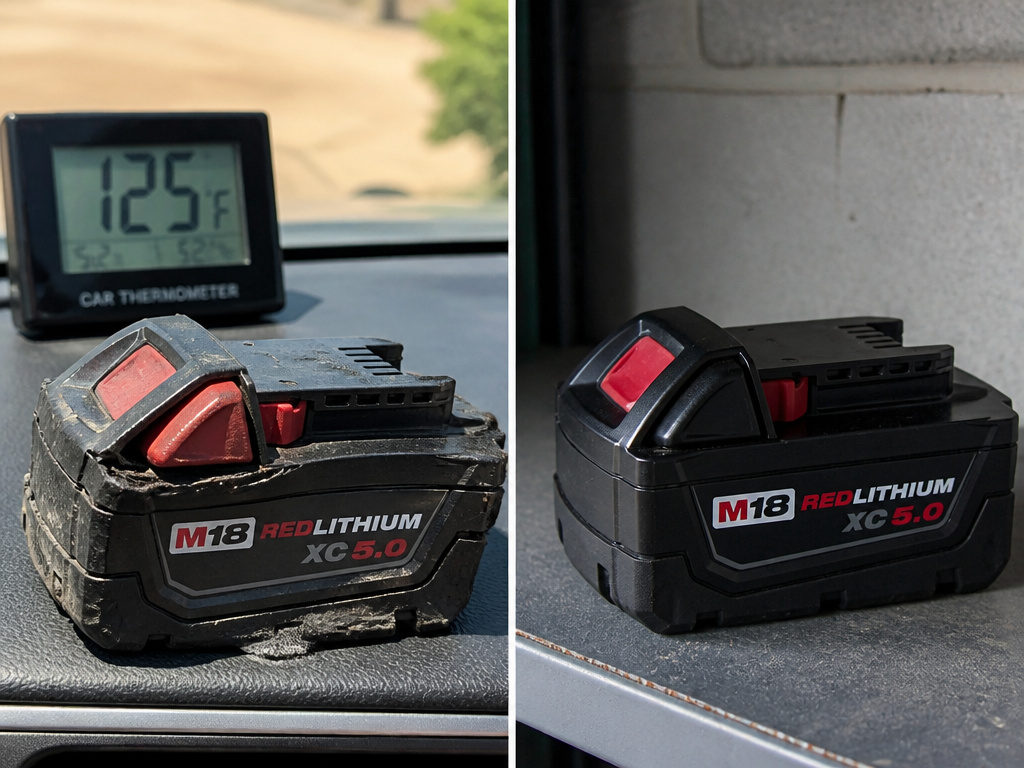
Heat is a battery’s silent killer. Cold isn’t great, but heat accelerates chemical decay exponentially. Manufacturers give ranges, but the sweet spot is narrow.
Atlas Copco recommends storage between 10°C and 20°C (50°F to 68°F) with less than 50% relative humidity. Milwaukee warns against any place where temperature may exceed 120°F (50°C), like a vehicle in summer. Bosch permits a wider band for operation and storage, from -20°C to +50°C.
Never store batteries in a regular refrigerator. The Atlas Copco guide is explicit: high humidity inside a fridge corrodes terminals and can damage the battery management system. A cool, dry basement shelf beats a damp fridge every time.
Leaving a battery pack in a hot truck or uninsulated garage loft shaves months off its life. You can feel the consequence: a battery stored in high heat can become damaged, and its plastic casing may even warp. That’s heat damage, and it’s irreversible.
The Charging Habit That Adds Years (And the One That Subtracts)
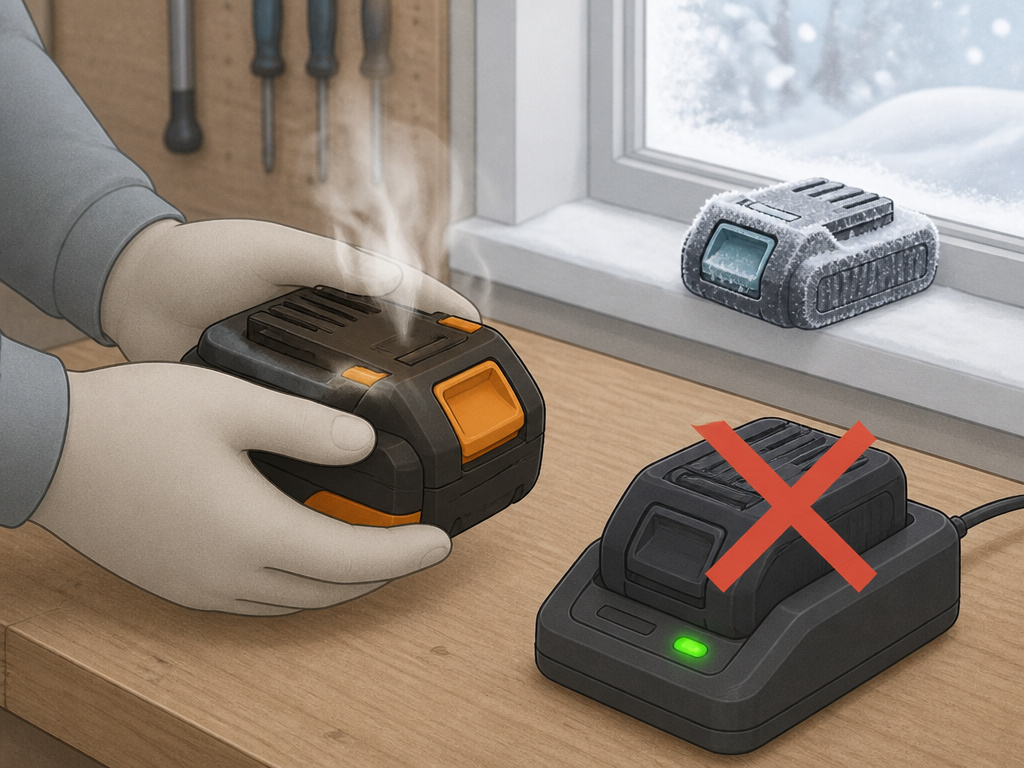
How you charge is just as important as where you store. The rule is simple: avoid the extremes.
Do not charge a cold battery. The Atlas Copco guide states you should never charge below 0°C due to safety risks. Bosch (general) recommends charging batteries at an ambient temperature between 0°C and +35°C. Let a cold battery warm to room temperature first.
Unplug after full charge. Modern chargers have trickle modes, but leaving a battery sitting at 100% for weeks induces stress. That’s why the *Optimal storage charge is a point of contention: – *Atlas Copco recommends storing at 30-40% state-of-charge. – WEN advises charging after each use so batteries are fully charged when needed.
The distinction is this. For short-term readiness (tools you use weekly), follow WEN. For long-term storage (off-season tools, backups), follow Atlas Copco. A battery left at 100% charge for long-term storage loses more capacity than one stored at a partial charge.
The part nobody mentions: Taping a trigger “on” in storage. The Milwaukee manual warns this can deeply discharge a battery beyond recovery. Always store batteries separate from the tool.
Warranty as a Lifespan Indicator
Read the warranty. It’s the manufacturer’s confidence interval. Milwaukee’s warranty for certain M18, V18, and V28 battery packs is five years or 2000 charges, whichever comes first. The first 1000 charges or two years are free replacement; the rest are pro-rated.
That’s a direct signal. They expect those packs to last five years of professional use. A standard one-year battery warranty (common on many value brands) sets a lower expectation.
A tool’s warranty often covers mechanical defects for a similar period, 3 to 5 years for major pro brands. If the gearbox fails in year two, that’s a warranty claim. If it fails in year seven, you’re weighing repair cost against a new tool. This is the unspoken timeline of tool ownership.
When to Repair vs. Replace
This is a simple cost equation. For the tool itself, if the repair cost is high relative to a comparable new tool’s price, replacement is often smarter. Technology improves, and new tools often have better features.
For batteries, replacement is almost always the answer. Rebuilding a lithium-ion pack requires specialized equipment and knowledge. A new OEM battery is a safer option.
Exception: High-end, system-compatible tools. It can be worth replacing the motor on a $300 brushless drill if the alternative is buying into a new battery platform. For a very inexpensive tool, repair is often not economical.
Signs Your Battery or Tool Is Nearing the End
Don’t wait for a complete failure. Watch for these symptoms.
For batteries:
- Swelling or bulging case. Stop using immediately. This is a safety hazard.
- Runtime dropping significantly from its original performance.
- Failure to hold charge. Sitting on the shelf, it self-discharges unusually quickly.
- Charger rejecting it. Modern chargers detect unhealthy cells and will refuse to charge.
For tools:
- Strange noises (grinding, screeching) from the gearbox.
- Loss of power with a known-good battery.
- Smell of burning insulation or visible smoke (obvious, but it happens).
- Erratic behavior (trigger intermittent, direction switch unreliable).
When you see these, start planning your next purchase. Pushing a tool too far can be dangerous.
How do major tool brands compare for battery life?
Comparing brands directly on battery longevity is difficult because they all rely on similar lithium-ion chemistry. The real differences often appear in their warranty terms, which reflect the manufacturer’s confidence in their product. For instance, some Milwaukee M18, V18, and V28 battery packs come with a warranty covering five years or 2000 charges, with free replacement for the first two years or 1000 charges. Other brands may offer shorter standard warranties, like one year for some packs. These warranty periods are a practical indicator of the minimum lifespan you can expect from the battery under normal use, regardless of the brand name on the tool.
Frequently Asked Questions
Do DeWalt or Milwaukee batteries last longer?
Warranties provide the clue. Some Milwaukee packs carry a five-year warranty, which is among the longest. Some brands offer warranties of three years or more. In practice, with similar care, high-capacity batteries from both will deliver a comparable number of cycles, the 500-cycle rule still applies. Longevity often comes down to the user’s charging and storage habits more than the brand on the label.
Should I leave my power tool battery plugged in all the time?
No. While modern chargers are designed to prevent overcharging, keeping a battery at 100% voltage for extended periods accelerates aging. For storage longer than a week, the Atlas Copco guide recommends unplugging and storing at a 30-40% charge. For daily users, it’s fine to leave it on the charger overnight occasionally, but don’t make it a permanent habit.
What is the average lifespan of power tool batteries?
In years, the average is 3-5 for typical DIY use. In cycles, it’s the 500-cycle benchmark to 80% capacity. A battery used lightly once a month might last 8+ years but still degrade due to time. A battery used hard daily might only last 18 months. “Average” is less useful than understanding your own usage pattern.
How long do DeWalt 20V batteries last?
DeWalt’s 20V MAX batteries use the same lithium-ion technology as other brands. Their lifespan will also be in the neighborhood of 500 full charge cycles to 80% capacity. A 5.0Ah battery used for moderate DIY may provide several years of service.
Can I repair a swollen lithium-ion battery?
No. A swollen battery indicates internal cell failure and gas buildup. It is a significant fire and explosion risk. Do not puncture, charge, or use it. Dispose of it properly at a designated battery recycling center. The only safe “repair” is replacement with a new pack.
The Bottom Line
A cordless tool’s lifespan isn’t a mystery. It’s a combination of a consumable battery (500 cycles) and a durable tool body (5-10+ years). Your control lies in the middle: store batteries cool and partially charged, avoid deep discharges, and don’t blame the tool for a tired battery.
Most guides skip this, but your first move when a tool feels weak should be to borrow a known-good battery from a friend or another tool in your system. If power returns, you’ve just saved the cost of a new drill. If not, you’re looking at a mechanical fix.
And one rule to take away: if you’re buying into a cordless system, plan for the battery replacement cost upfront. That $200 kit will have additional costs over time for battery replacement. Knowing that changes the value proposition between brands. Choose the one whose other tools you’ll want, because the battery is the ticket you’ll be repurchasing.
