
Air Compressor Extension Cord vs Longer Air Hose
This post contains affiliate links. As an Amazon Associate, we earn from qualifying purchases.
Air compressor extension cord vs longer air hose comes down to one physical principle: electricity suffers over distance far more than air pressure does. An extension cord causes voltage drop, which overheats and can burn out your compressor’s motor. A longer air hose causes a minor pressure drop, which might just slow your tool down a bit. For most setups, adding hose is the safer, manufacturer-preferred method.
The voltage drop problem isn’t theoretical, it’s a measurable power loss that turns into heat inside your motor windings. That’s why every manual you pull has a warning section. The real question in the air compressor extension cord vs longer air hose debate isn’t just which is better, but how far you can push each method before the trade-offs become failures.
What follows is a breakdown of the numbers from the manuals themselves, the real cost comparison everyone skips, and a decision flowchart for when you absolutely must use a cord.
Key Takeaways
- Running an air compressor on an undersized extension cord causes permanent motor damage from overheating, often voiding the warranty.
- Major brands like Porter-Cable and DeWalt state that if a cord must be used, it should be no longer than 50 feet and must be 12 AWG or larger (never 14 or 16 AWG).
- A longer air hose is almost always the better choice; for a 50-foot reach, a 3/8″ hose often costs less than a compliant 50-foot, 12-gauge extension cord.
- Always plug into a GFCI outlet for safety, and use only UL-listed, 3-wire outdoor extension cords if you go that route.
- Ignoring your compressor’s manual on this point isn’t just risky, it shifts liability to you if the motor fails.
What Your Compressor Manual Actually Says (And Why)
Open the manual for any Porter-Cable, DeWalt, or DeVillbiss compressor. The language isn’t subtle. The Porter-Cable CPFAC2600P manual states plainly: “Using extension cords is not recommended.” It then immediately advises attaching extra air hoses instead. Others, like the DeWalt D55167 manual, begrudgingly allow for a cord if you follow strict rules.
The reason is voltage drop. When a high-draw motor like a compressor’s starts, it needs a surge of power. A long, thin extension cord acts like a bottleneck. The motor struggles, draws more current to compensate, and that extra energy has nowhere to go but into heat. One unnamed manual from Home Depot warns this can cause “permanent damage to internal switches and overheating of the electric motor or its capacitor.”
You can sometimes smell it before you see smoke, a faint scent of hot insulation or burnt dust from the motor housing. By then, the damage is done.
Common mistake: Assuming any heavy-duty-looking extension cord will work. “Heavy-duty” is a marketing term, not a spec. A cord labeled for outdoor use might still be a dangerous 16 AWG wire inside a thick jacket.
The 50-Foot Rule and Why It Exists
While manuals from DeWalt, Porter-Cable, and DeVillbiss converge on 50 feet as a maximum if a cord must be used, the Unnamed Air Compressor Manual (Home Depot) implies a stricter maximum of just 25 feet. The DeVillbiss D26368, Porter-Cable D24938, and DeWalt D55167 manuals all specify: “If an extension cord must be used, it should be no longer than 50 feet (15.2 m).”
This isn’t arbitrary. It’s the practical limit before voltage drop for a 15-20 amp compressor motor on a 120V circuit becomes severe, even with thick wire. The University of Texas EHS factsheet provides guidelines for safe use, stating that for a 50-foot cord with a 16-20 amp device, 12 AWG or 10 AWG should be used.
For devices drawing 16-20 Amps (like air compressors), use a 12 gauge (Heavy Duty) or 10 gauge (Extra Heavy Duty) extension cord up to 50 feet in length.
, University of Texas EHS extension cord guidelines
But here’s where sources disagree. Another manual (likely for a Home Depot-branded unit) has a table that says “Do Not Use” for any extension cord between 26 and 100 feet, implying a hard maximum of just 25 feet. This stricter stance shows that some manufacturers see any cord use as a liability they want to avoid entirely.
| Manual Source | Stance on Extension Cords | Max Length If Allowed | Minimum Gauge |
|---|---|---|---|
| Porter-Cable CPFAC2600P | Not recommended | 50 feet (if used) | 12 AWG |
| DeWalt D55167 | If must be used | 50 feet | 12 AWG |
| Unnamed (Home Depot) | NOT RECOMMENDED | 25 feet (implied) | 12 AWG |
| University of Texas EHS | Guidelines for safe use | 50 feet (12 AWG), 100 feet (10 AWG) | 12 AWG for 50ft |
The takeaway? If your manual specifies a maximum length like 50 feet, that is your manufacturer-recommended ceiling. Other sources, like the University of Texas EHS, provide guidelines for longer cords (e.g., 100 feet with 10 AWG), but manufacturer instructions take precedence. And your extension cord must be 12 AWG or larger, with 10 AWG being better for a full 50-foot run.
Choosing a Safe Extension Cord: A Spec Checklist
If you’ve weighed the risks and still need a cord, get the specs right. A safe cord isn’t just thick; it’s built for the environment.
- Gauge (AWG) is Everything: You need 12 AWG or larger. 10 AWG is better for 50-foot runs. Never use 14 or 16 AWG. The wire diameter increases as the gauge number decreases, so 10 is thicker than 12.
- Length: Stick to 50 feet maximum. Every foot adds resistance. If you need 100 feet, the University of Texas EHS says you must step up to a 10 AWG (Extra Heavy Duty) cord, and even then, it’s the practical maximum before performance tanks.
- Construction: It must be a 3-wire cord with a 3-blade grounding plug and a 3-slot receptacle. No exceptions.
- Rating: Look for UL listed and markings for outdoor use (“ACCEPTABLE FOR USE WITH OUTDOOR APPLIANCES, STORE INDOORS WHEN NOT IN USE”).
- Connection: Plug the cord into a GFCI outlet first, then connect your compressor. A GFCI is “strongly recommended” per the manuals because damp workshops are a shock hazard.
Where this goes sideways: Buying a cord labeled “air compressor ready” that’s actually 16 AWG. The packaging lies; the wire gauge printed on the cord itself doesn’t. Unroll it and check.
The Longer Air Hose Alternative: How to Do It Right
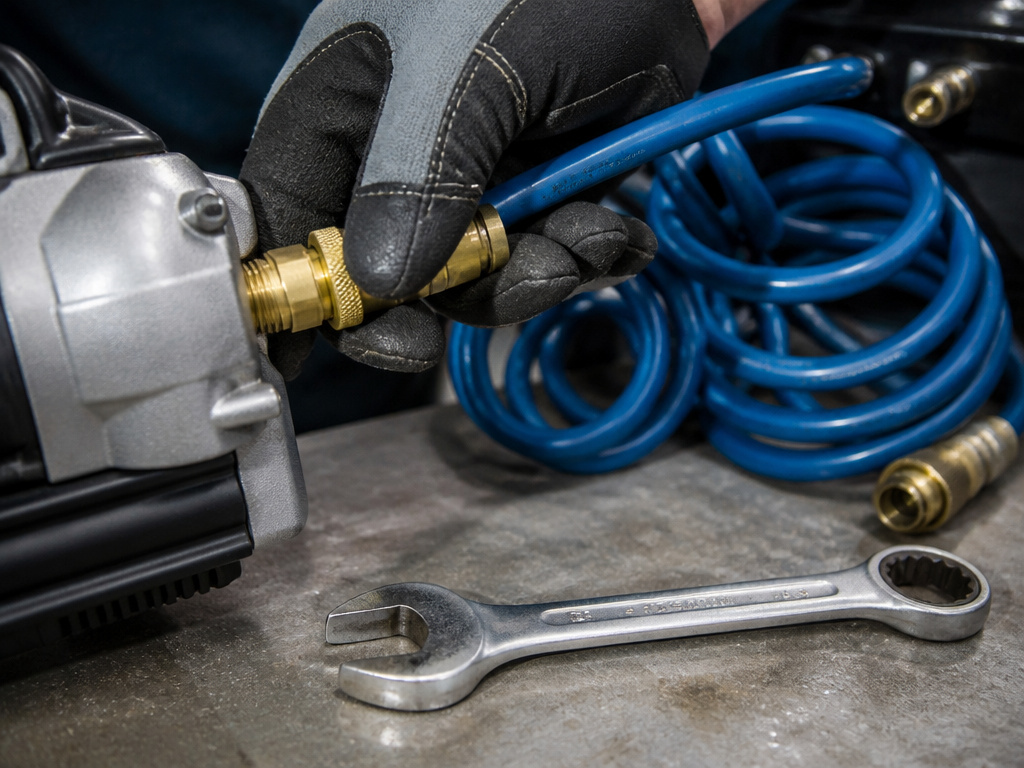
The manuals’ unanimous fallback advice is simple: use a longer air hose. The logic is mechanical, not electrical. Air pressure drops over distance due to friction, but this loss is predictable, manageable, and doesn’t cook your motor.
The DeWalt D55167 manual gives a clear baseline: “Always use a minimum 3/8″ (9.5 mm) or greater air hose rated at 300 psi.” This is your starting point when choosing an air hose. A 3/8-inch inner diameter (ID) is the sweet spot for most home shops, balancing airflow with flexibility.
For longer runs, using a larger diameter hose can help offset pressure drop. A product like the VEVOR HAH12100 Hybrid Air Hose (1/2″ x 100ft) is rated for 300 PSI working pressure and stays flexible from -40 to 140°F. One user noted it’s “excellent as a short attachment” for a nail gun but might snag on a long construction site drag, a reminder that hose durability depends on your abuse level.
Worth knowing before you start: Overtightening brass fittings into aluminum tool ports is a common mistake. It strips the threads and creates a permanent leak. Hand-tight, then a quarter-turn with a wrench is plenty.
Pressure Drop: The Air Hose’s Hidden Tax
Yes, longer hoses lose pressure. The drop isn’t catastrophic, but you should account for it. Friction inside the hose reduces the PSI that reaches your tool. The smaller the hose diameter and the longer the run, the greater the drop.
For example, running a framing nailer that needs 90 PSI at the tool through 100 feet of 1/4-inch hose might require you to set your regulator to 110 PSI at the tank. With a 3/8-inch hose, the drop is less severe. This is why understanding air hose diameter matters for performance.
Extension Cord vs. Hose: A Real-World Cost and Value Comparison
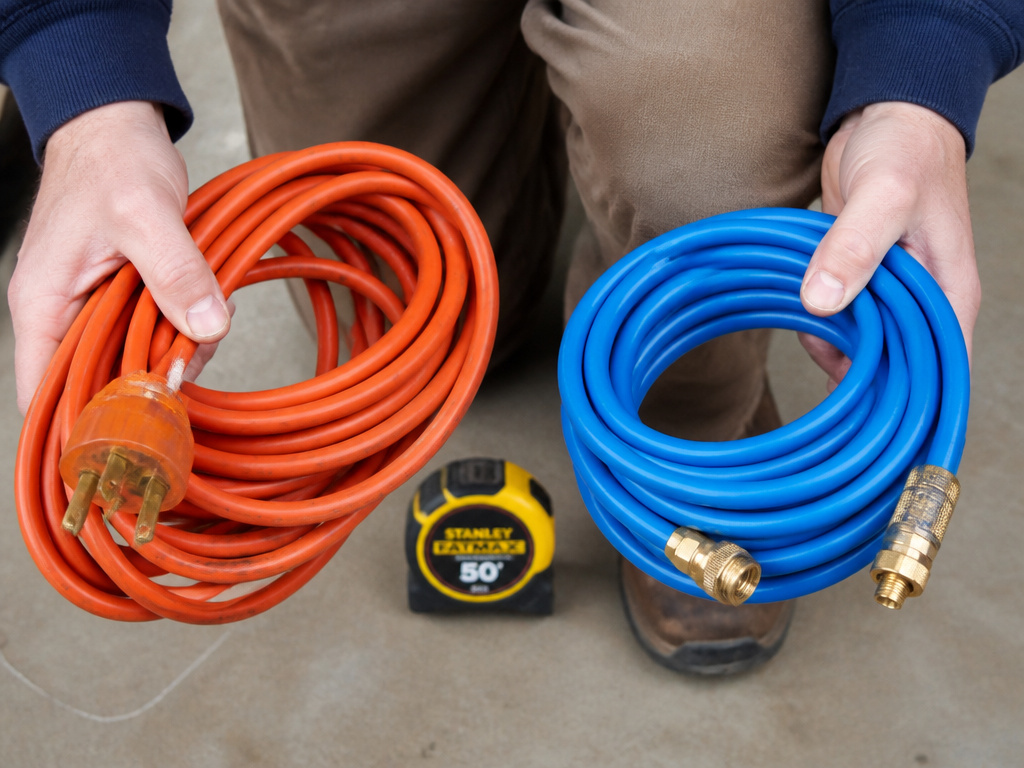
Let’s talk numbers, without prices. What does it actually cost to extend your reach 50 feet?
A 50-foot, 12-gauge, outdoor-rated, UL-listed extension cord that meets all the manual specs is a specialty item. It’s heavy, stiff, and represents a significant investment.
A 50-foot, 3/8-inch ID, 300 PSI rubber or hybrid air hose is a standard shop item. The value comparison in the air compressor extension cord vs longer air hose choice often favors the hose, which adds permanent utility to your shop.
But the value comparison is lopsided. The cord protects you from a single point of failure (motor burnout). The hose not only protects your compressor but also adds a permanent, flexible utility to your shop. You can always use another hose segment later. A 50-foot cord you can’t use with your compressor is just a very expensive cord.
Decision Flowchart: When You Absolutely Must Use a Cord
Sometimes, a hose isn’t possible. The outlet is fixed, the compressor can’t move, and you need to work 40 feet away. Here’s the step-by-step safety check.
- Check the Manual First: What is your compressor’s amp draw? What does it say about cords? This overrides everything.
- Measure the Exact Distance: Don’t guess. Use a 50-foot cord for a 40-foot need; don’t use a 100-foot cord coiled up.
- Buy the Cord Last: Ensure it’s 12 AWG (or 10 AWG), 3-wire, UL-listed, and outdoor-rated. Inspect it for damage.
- Plug into GFCI: Always use a Ground Fault Circuit Interrupter outlet.
- Do a Test Run: Start the compressor and let it cycle once. Feel the cord along its length after a minute. If it’s warm to the touch, it’s undersized. Stop immediately.
If any step fails, the answer is no. Move the compressor, use a longer hose, or run a temporary dedicated circuit. For help on making secure connections, our guide covers how to connect an air hose to a compressor.
Practical user experiences and workarounds
Users often find that the simplest workaround is to avoid the extension cord entirely. Following the manuals, they attach an extra length of air hose to reach the work area. For portable compressors, users sometimes seek ways to minimize electrical resistance between the power source and the motor. This provides a more direct, lower-resistance power path. The core principle from user experience is to minimize electrical resistance between the power source and the motor. Using a longer, properly rated air hose is consistently reported as the more reliable and less frustrating method compared to managing a bulky, high-gauge extension cord.
Inrush current and its impact on cord selection
An air compressor motor demands a large surge of power the instant it starts. This inrush current is the primary reason for strict cord rules. A thin or long cord cannot deliver this surge efficiently, creating a significant voltage drop. The motor then strains to start, drawing even more current. That excess energy converts to heat in the cord and the motor’s windings. Manufacturer manuals warn this overheating can cause permanent damage to internal switches and the motor itself, leading to premature failure. Selecting a cord is about managing this surge. You need a thick, heavy-gauge wire to act as a wide pipeline, not a bottleneck, for that initial power demand.
Frequently Asked Questions
Can I use an extension cord for my air compressor?
You can, but it is not recommended by most manufacturers. If you must, the cord must be a heavy-gauge (12 AWG or larger), grounded, outdoor-rated cord no longer than 50 feet, plugged into a GFCI outlet. The safer alternative is always to use a longer air hose.
Do you lose air pressure with a longer hose?
Yes, all hoses have some pressure drop due to friction. The loss is greater with longer hoses and smaller diameters. You can compensate by increasing the pressure at the regulator or by using a larger diameter hose (e.g., 3/8″ instead of 1/4″) for long runs.
How long can my air compressor hose be?
Technically, very long, hundreds of feet. Practically, you are limited by pressure drop and tool requirements. For most home shops, a hose length of 100 feet is common, but the practical limit depends on pressure drop and tool requirements. Always ensure the hose is rated for your compressor’s maximum pressure; for example, the DeWalt D55167 manual specifies a hose rated at 300 PSI.
Is it better to use a longer air hose or a longer extension cord?
It is almost always better to use a longer air hose. Air hoses cause minimal, manageable pressure drop. Extension cords cause voltage drop, which can damage the compressor motor, void warranties, and create a fire or shock hazard.
Before You Go
The manuals draw a clear line: extension cords are a last resort, and longer hoses are the intended solution. The 50-foot, 12-gauge rule exists because beyond that, the electrical risks spike while the pneumatic trade-offs remain linear.
One final, unspoken rule: if you bypass the manual’s guidance and your compressor motor burns out, that repair bill is yours alone. Manufacturers document these warnings precisely to delineate liability. Your safest path is to treat your air hose as your primary extension tool and view any electrical cord as a temporary, carefully vetted workaround.
For your next project, before you reach for that cord, ask if you could solve it with another 25-foot hose segment and a coupler. Nine times out of ten, that’s the right tool for the job.
