
Aluminum Oxide vs Silicon Carbide Sandpaper
This post contains affiliate links. As an Amazon Associate, we earn from qualifying purchases.
Aluminum oxide sandpaper excels on wood and metal with its durable, self-sharpening grain, while silicon carbide sandpaper dominates wet sanding and finishing on hard, brittle materials like glass, paint, and composites with its sharper, faster-cutting grain. Picking the wrong one means wasted sheets, clogged discs, and a scratched finish.
Now, we can get specific. Aluminum oxide sits at 9 on the Mohs hardness scale; silicon carbide is 9.5. That half-point gap isn’t academic. It changes how the grains fracture, how long they last, and what happens when you add water. The choice between aluminum oxide vs silicon carbide sandpaper dictates whether your sander loads up with gummy paint swarf in three passes or keeps cutting cleanly for a full panel.
What follows is a head-to-head breakdown of hardness, durability, and cost, plus a material-by-material guide. This includes the grit progression that works, the facts on wet sanding, and a clear “if material=X, use Y” rule.
Key Takeaways
- Match the grain to the material: aluminum oxide for wood and general metal prep, silicon carbide for wet-sanding paints, glass, and composites.
- Respect the 0.5 Mohs hardness gap. Silicon carbide’s sharper grain cuts faster but fractures more readily on ductile metals like mild steel.
- For wet sanding, silicon carbide is the default. One source states aluminum oxide is not ideal and can clog or break down faster with water.
- A grit progression is essential. Jumping from 80-grit aluminum oxide to 220-grit silicon carbide embeds deep scratches that later polishing can’t fix.
- On automotive clear coats, pair silicon carbide with stearate coatings and light pressure (1.5–2.5 psi) to reduce loading and maintain a predictable scratch field.
The Mohs 9 vs. 9.5 Difference
Saint-Gobain Abrasive Materials data puts aluminum oxide at a Mohs hardness of 9. Silicon carbide measures 9.5. This isn’t a minor spec-sheet war. That half-point difference explains why one abrasive feels like a steady workhorse and the other like a scalpel.
Aluminum oxide grains are tougher and blockier. They fracture slowly, micro-shearing to expose fresh cutting edges over a longer lifespan. You get a consistent cut that’s perfect for the repeated, abrasive-heavy work of shaping wood or knocking down metal welds. Silicon carbide grains are sharper and more brittle. They are made to microfracture easily under pressure, always offering a fresh, sharp cutting edge. This gives silicon carbide a blistering initial cut rate on hard, brittle substrates.
According to industry abrasive-grain data, silicon carbide rates 9.5 on the Mohs hardness scale versus 9 for aluminum oxide, but the harder grain is also more brittle, so it fractures and dulls faster under heavy pressure than aluminum oxide’s tougher, self-sharpening grain.
It’s cutting faster, but you’ll go through more sheets. This trade-off between cut rate and sheet life is the core of the aluminum oxide vs silicon carbide sandpaper choice.
Aluminum Oxide: The Durable Workhorse
Think of aluminum oxide as your shop’s utility player. Its toughness and self-sharpening nature make it the default for general woodworking, metal prep, and drywall. On hardwoods like oak or maple, aluminum oxide’s slightly gentler edges reduce scratch tear-out in the early grits, leaving a surface that’s ready for finer papers without embedded debris (see our guide on sandpaper for wood).
For metal, the story is similar. Aluminum oxide handles the aggressive removal of rust and old paint. According to powertoolbase.com, its durability makes it a strong performer on sanding discs and belts, where silicon carbide would wear down too quickly, whether you use hook and loop discs or PSA. While some start with 320-grit aluminum oxide for rust removal, coarser grits like 220 are often recommended for better rust removal and metal prep.
Where this goes sideways: Using aluminum oxide for wet sanding a cured lacquer or paint film. The grain can clog and break down faster when wet, turning your paper into a gummy, ineffective smear tool within a dozen passes.
It’s not a boutique product; it’s the shop towel of abrasives, always there, always doing its job.
Silicon Carbide: The Sharp Finisher
If aluminum oxide is the grinder, silicon carbide is the polisher. Its sharp, brittle grain is the secret weapon for achieving ultra-smooth finishes on hard materials. This is the abrasive you use when the job demands precision, not just stock removal.
Silicon carbide dominates wet sanding. When you add water, two things happen: the abrasive temperature drops, reducing thermoplastic smearing, and the swarf forms a suspended slurry instead of a sticky paste. The grain’s sharp geometry cuts rather than plows, creating a finer, more uniform scratch pattern. That’s why it’s the go-to for color-sanding automotive clear coats, leveling guitar lacquer, or polishing stone and glass.
On very ductile metals (e.g., mild steel, aluminum without lubricant), silicon carbide can glaze and fracture too readily, losing life. Aluminum oxide or zirconia may be more economical there.
Head-to-Head: Best Uses by Material
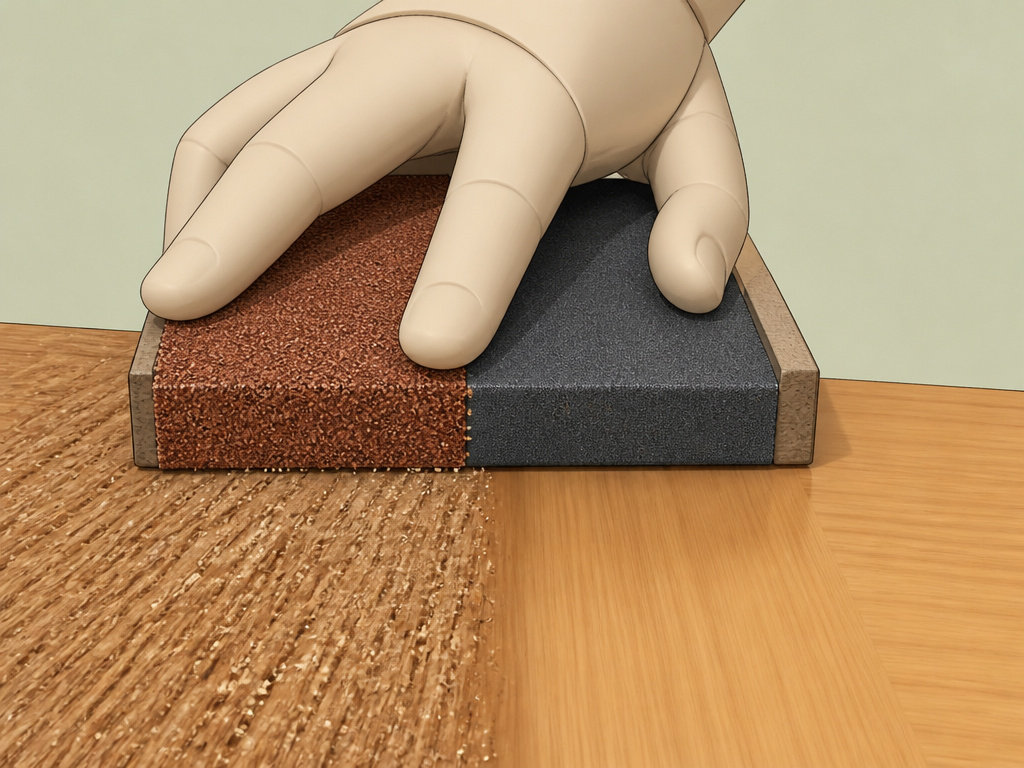
This is where the rubber meets the road. Your material dictates the winner. A generic “which is better” question in the aluminum oxide vs silicon carbide sandpaper discussion is pointless without context.
| Material | Aluminum Oxide Best For | Silicon Carbide Best For | Key Reason |
|---|---|---|---|
| Wood (Hardwoods, Softwoods, MDF) | General smoothing, stock removal, prep for staining. | Final ultra-smooth pre-finish sanding at high grits (400+). | AO’s toughness handles tear-out; SiC’s sharpness delivers a glass-smooth surface. |
| Metal (Steel, Iron) | Rust removal, paint stripping, shaping with power tools. | Final polishing, wet sanding before paint (with lubricant). | AO lasts on discs/belts; SiC’s sharpness can glaze on ductile metals if used dry. |
| Painted Surfaces / Clear Coats | Primers, harder filled coatings. | Color coats, clear coats, single-stage paints (especially wet). | Durability vs. Edge sharpness. SiC’s cool-cutting reduces loading on thermoplastics. |
| Glass, Plastic, Composites | Not recommended. | Cutting, shaping, finishing. | SiC’s hardness can cut where AO will skate or dull. |
| Drywall | Feathering edges, general smoothing. | Not typically used. | AO’s durability suits the high-volume, abrasive nature of drywall work. |
For lacquer finishes, the rule is even tighter. Between build coats, stay at 320 grit. Save 400-600 grit for the single pass right before your final coat only. Running silicon carbide wet on a cured lacquer film keeps the film from gumming up the paper mid-sheet. This is why the purpose-built 3M Wetordry 320 grit sandpaper (99421NA) is marketed specifically for sanding between coats of lacquer.
The Head-to-Head Grit Choice Table
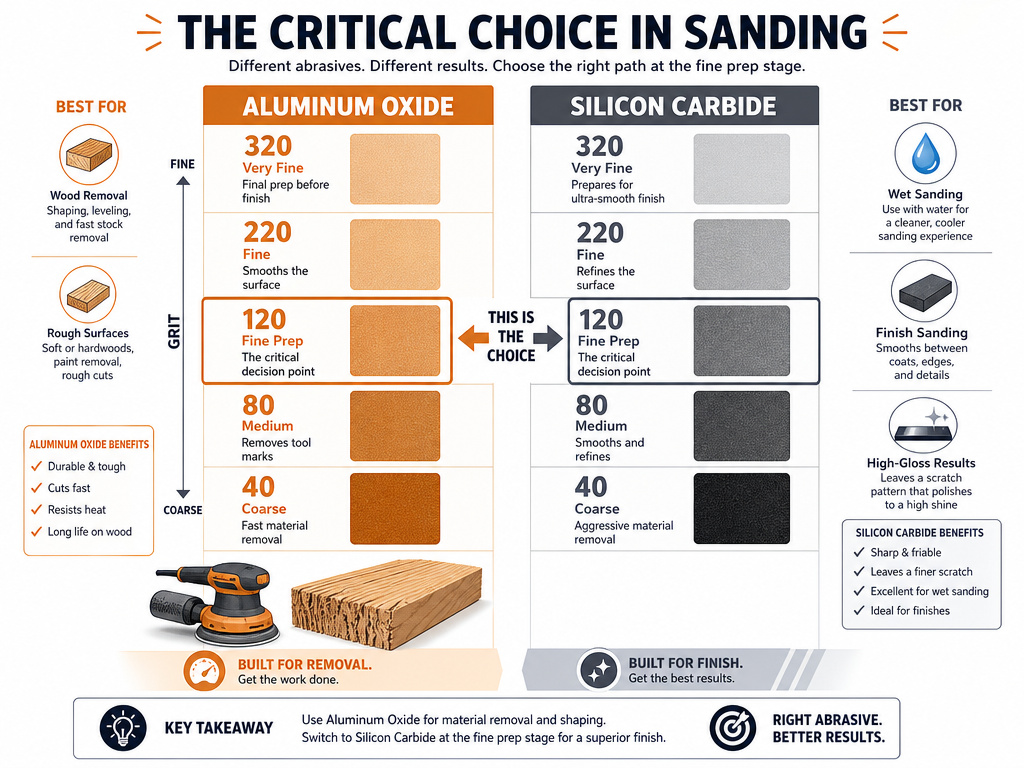
Grit progression isn’t a suggestion; it’s the law for a good finish, which is why consulting a sandpaper grit chart is essential. This table maps a typical workflow from rough to ready, showing where each abrasive takes the lead.
| Stage | Target Grit | Primary Abrasive | Tool / Method | If You Skip This… |
|---|---|---|---|---|
| Rough Stock Removal | 60–80 | Aluminum Oxide | Random Orbital Sander / Belt Sander | Deep scratches remain, requiring 2–3x more work in later stages. |
| Initial Smoothing | 120–180 | Aluminum Oxide | Random Orbital Sander / Sanding Block | Surface inconsistencies hide until the finish is applied, then show as waves. |
| Fine Prep / Scuffing | 220–320 | Aluminum Oxide or Silicon Carbide | Sanding Block / Hand Sanding | The next coat (paint, stain) has nothing mechanical to grip, risking peeling. |
| Between Finish Coats | 320–400 | Silicon Carbide (Wet) | Hand Sanding / DA Sander with Lubricant | The film gums up the paper, creating debris nibs and an uneven surface. |
| Final Pre-Coat Leveling | 400–600 | Silicon Carbide (Wet) | Hand Sanding with Block | Micro-scratches remain, preventing a perfectly smooth final sheen. |
| Polishing / Rubbing Out | 800–3000+ | Silicon Carbide (Wet) | Specialized Pads / Block | The finished surface looks hazy or swirly under direct light, never achieving full clarity. |
The jump from “Fine Prep” to “Between Finish Coats” is critical. This is where you must decide: dry with aluminum oxide for a toothy grip, or wet with silicon carbide for a slurry-cleared, level surface. For paints and clears, wet silicon carbide wins every time.
Silicon Carbide’s Wet-Sanding Domain
For color-sanding automotive clear coat, a recommended progression is: defect knockdown with P1500–P2000, refinement with P2500–P3000, pre-polish with P3000–P5000. This entire sequence assumes silicon carbide paper, usually film-backed and often with a stearate topcoat.
The process is a dance of pressure, fluid, and timing. Aim for 1.5–2.5 psi at the pad, just enough to keep it fully seated. Maintain a traverse speed of 150–200 mm/s with a 50% overlap. Too slow raises heat and melts the paint; too fast doesn’t fully replace the scratch pattern. For dry sanding with extraction, use short duty cycles of 20–30 seconds, then blow-off with filtered air.
For wet sanding, use a surfactant in your water: one drop of dish soap per spray bottle. Refresh the sanding sheet often: wipe or rinse the sheet every 2–3 passes on paint.
The goal isn’t to grind. It’s to create a uniform, matte scratch field that the next compound can uniformly erase. When you see loading, the water starts beading irregularly on the sheet, rotate to a fresh section or replace the disc. Grinding with a loaded disc creates rogue, deep scratches that add hours of corrective polishing, a problem mitigated by using open coat sandpaper.
Cost, Durability, and the Real Price Tag
Silicon carbide is often slightly more expensive per sheet than aluminum oxide. But comparing sticker prices is a rookie mistake. You must factor in life per sheet and job suitability.
On a large woodworking project, aluminum oxide will outlast silicon carbide by a significant margin. You might use fewer sheets of aluminum oxide to do the work of more sheets of silicon carbide on the same task. For that job, aluminum oxide is cheaper. Conversely, wet-sanding a car hood with aluminum oxide is a futile exercise in clogged paper and frustration. The silicon carbide sheet, while more expensive, is the only tool that will get the job done without wasting your time. Therefore, for that job, it’s cheaper.
Your tool choice also dictates economics. According to powertoolbase.com, silicon carbide is better for hand sanding metal as it wears down quickly on power tools, while Equalle.com notes that on very ductile metals like mild steel, silicon carbide can glaze and fracture too readily, making aluminum oxide more economical. If you’re running a power sander, the cost-per-hour of constantly replacing silicon carbide discs can be prohibitive. In that context, aluminum oxide or a tougher ceramic grain is the economical choice.
What are the different types of aluminum oxide and silicon carbide?
The common brown aluminum oxide is a general-purpose workhorse, but you’ll also find white and pink variants. These lighter-colored types are often purer or treated for a sharper, cleaner cut on finishes where you want to minimize visible scratches. Silicon carbide typically comes in a dark green or black color. The key difference is performance, not just hue. Silicon carbide grains are sharper at equivalent grit sizes compared with aluminum oxide. This makes it the preferred choice for wet sanding and cutting cured finishes like lacquer or automotive clear coats without gumming up the paper.
Does sandpaper generate heat and how do I manage it?
Friction from sanding creates heat, which can damage your workpiece or clog the abrasive. Managing heat is a practical necessity. For dry sanding with dust extraction, use short, controlled duty cycles followed by a thorough blow-off with clean air to cool the abrasive and clear debris. When wet sanding, the water or lubricant acts as a coolant. Refresh the sanding sheet often by wiping or rinsing it every few passes to maintain its cutting ability and draw heat away from the surface. This is especially critical for fine-grit work on materials like paint or metal where heat can cause softening or discoloration.
Frequently Asked Questions
Is silicon carbide sandpaper better than aluminum oxide?
It’s not universally better; it’s specifically better for certain tasks. Silicon carbide is superior for wet sanding, working on hard brittle materials (glass, composites), and fine finishing on paints and clear coats. Aluminum oxide is better for general wood and metal sanding, especially with power tools, due to its longer life and steady cut.
When should I use aluminum oxide sandpaper?
Reach for aluminum oxide for the majority of DIY and workshop tasks: sanding raw wood, removing rust from metal, prepping drywall, or any general stock removal where durability matters more than an ultra-fine scratch pattern. It’s your first-choice abrasive for everything except final wet-finishing.
What are the downsides of silicon carbide?
The main downside is reduced durability, especially under heavy pressure or on ductile metals. It can glaze and fracture too quickly on materials like mild steel or aluminum, making it less economical. It’s also generally not recommended for dry sanding softwoods, as it can load with resin and dust.
What is silicon carbide sandpaper used for?
Its primary uses are wet sanding cured paint films (automotive clear coats, lacquer), polishing and shaping glass/stone, finishing composites and plastics, and any application where a sharp, cool-cutting abrasive is needed to avoid loading and achieve a fine surface.
Can I use aluminum oxide for wet sanding?
Most sources advise against it. Research indicates aluminum oxide is “not ideal” for wet sanding and can clog and break down faster. One manufacturer explicitly labels its aluminum oxide product as “Dry sandpaper.” While you can physically do it, silicon carbide is the correct tool designed for the job.
The Bottom Line
Here’s the simple rule: for dry work on wood and metal, start with aluminum oxide. For any wet sanding or finishing on paint, glass, or brittle plastics, switch to silicon carbide. The half-point Mohs hardness difference isn’t marketing, it’s a functional divide that dictates grain behavior under pressure, heat, and water.
Don’t overthink your first purchase. Grab an assortment of aluminum oxide in coarse to medium grits for grunt work, and finer grit silicon carbide for your finishing kit. That covers the majority of what a DIYer or hobbyist will face. The pros will dive deeper into stearate coatings, film backings, and specific grit progressions like the P1500–P5000 sequence for clear coat. But that’s tuning for perfection. The foundational choice is already made: match the grain to the material’s hardness and the job’s need for lubrication. Everything else is refinement.
