
10 Best 2 Stage Air Compressors in 2026
This post contains affiliate links. As an Amazon Associate, we earn from qualifying purchases.
Our best overall two-stage air compressor is the Campbell Hausfeld 60-Gallon 2-Stage Air Compressor, which delivers reliable high pressure on a compact footprint. For industrial power, the Ingersoll Rand 2475N7.5 is unmatched, while the Ingersoll Rand 2340L5-V wins for fitting into tight workshops. Choosing the right two-stage compressor means balancing immense power with the realities of your shop’s space and electrical service.
These units are permanent fixtures that power demanding tools, not casual accessories. Our research focuses on pump durability, tank capacity, and real-world usability to help you invest in a compressor that won’t leave your tools gasping for air.
Top 10 Two-Stage Air Compressors in the Market
Certain content that appears on this site comes from Amazon. This content is provided "as is" and is subject to change or removal at any time.
The Best Two-Stage Air Compressors, Reviewed
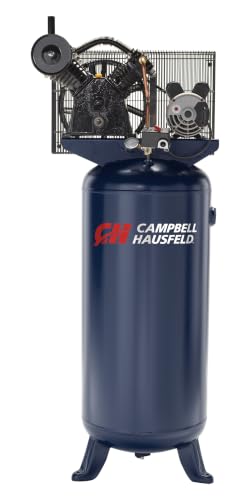
Campbell Hausfeld 60-Gallon 2-Stage Air Compressor
What We Like
- Two-stage cast-iron pump for durability
- Substantial 60-gallon tank on a compact footprint
- 175 PSI maximum supports demanding air tools
Trade-offs
- Requires a dedicated 230/240V electrical circuit
- At 255 lb, it's a permanent, stationary installation
A 7.6 SCFM air delivery at 90 PSI means this compressor can confidently run a professional-grade paint sprayer or a die grinder without constant motor cycling. The two-stage cast-iron pump is built for the long haul, translating to years of reliable weekend projects or daily shop use. Its 60-gallon tank strikes a smart balance, storing plenty of air while the vertical design keeps its footprint to a tidy 23 by 23 inches. For the serious home workshop or a small professional garage, this unit delivers capable, station-class performance without monopolizing the floor.
A dedicated 230V electrical supply is required for installation, and the unit’s 255-pound weight makes it a stationary fixture after setup. When compared to heavier 80-gallon models like the Quincy Air Master, this compressor offers a more space-efficient form factor and lower weight, but it provides less air reserve and maximum CFM. It is a suitable choice when you need two-stage performance but your space or electrical panel cannot accommodate the largest industrial units.
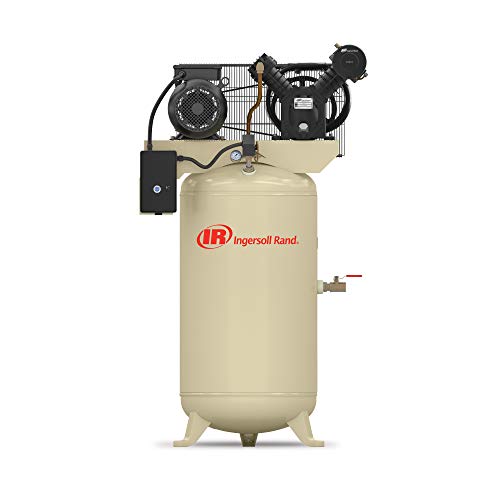
Ingersoll Rand 2475N7.5 Two-Stage Air Compressor
What We Like
- Cast iron pump rated for 15,000+ hours
- All-Season Select synthetic lubricant lasts 2,000 hours
- Individually cast cylinders simplify maintenance
- 80-gallon tank sustains demanding applications
Trade-offs
- Weighs 611 pounds, requiring permanent installation planning
- 38 x 24 x 70 inch footprint demands significant floor space
A 7.5 HP motor paired with a 100% continuous duty cycle means this compressor won’t flinch under a full shop load. The 80-gallon tank and 175 psig maximum pressure deliver the steady, high-volume air needed to run multiple tools or heavy sanders and grinders without lag. It’s built for the professional who treats their compressor like a piece of shop infrastructure. The cast iron construction and synthetic lubricant that lasts four times longer than conventional oil point to a machine designed for decades of service, not just years.
You pay for that capability with a substantial physical footprint and a 611-pound weight that cements its status as a permanent installation. This isn’t a unit you move around. Compared to a more compact two-stage like the Campbell Hausfeld 60-gallon model, the Ingersoll Rand demands more floor space and a more sturdy electrical setup. For a large dedicated shop where air is the lifeblood of daily work, those are acceptable trade-offs for unflinching performance.
Ingersoll Rand 2340L5-V Two-Stage Air Compressor

What We Like
- Cast iron construction for 100% continuous duty
- Compact 24-inch depth for tight workshops
- Overhung crankshaft for easier maintenance
- 60-gallon vertical tank saves floor space
Trade-offs
- At 430 pounds, moving it requires serious planning
- 5 HP motor demands a dedicated 230V circuit
A 24-inch depth means this 60-gallon compressor can tuck into a corner where a wider model simply wouldn’t fit. That’s the core appeal for a workshop where every square foot counts. It’s built with a cast iron pump designed for non-stop running, so it can handle extended sanding or painting sessions without a hiccup. This compressor suits a serious DIYer or a small shop owner who needs reliable, high-pressure air but doesn’t have the floor space for a sprawling unit.
Its compact footprint comes with a weight trade-off; at 430 pounds, it’s a permanent installation. You’ll need help and a solid plan to get it into place. Compared to the 60-gallon Campbell Hausfeld, this Ingersoll Rand is significantly heavier. It offers a more sturdy, continuous-duty cast iron construction in a package that’s nine inches narrower. If your space is truly constrained, this compressor delivers professional-grade endurance without demanding a huge footprint.
Quincy Air Master 271CS80VCB 2 Stage Air Compressor

What We Like
- 7.5 HP motor provides substantial power
- Large 80-gallon air storage capacity
- Industrial 230V single-phase electrical compatibility
- Two-stage pump design for high pressure
Trade-offs
- Heavy 643 lb weight complicates placement
- Requires dedicated 230V single-phase electrical service
- Substantial physical footprint demands significant floor space
An 80-gallon tank and a 7.5 HP motor mean this compressor can feed multiple air-hungry tools in a busy shop without waiting for the pump to catch up. That makes it a solid fit for professional workshops or serious fabrication spaces where continuous, high-volume air is non-negotiable. You’re paying for industrial-grade capacity that keeps sandblasters, impact wrenches, and spray guns running without a hiccup.
Weighing 643 pounds, this Quincy compressor is a permanent shop installation that requires bolting down and a dedicated 230V circuit. Its substantial mass means you won’t be relocating it once it’s set. This unit provides an 80-gallon air reserve for sustained, demanding work.
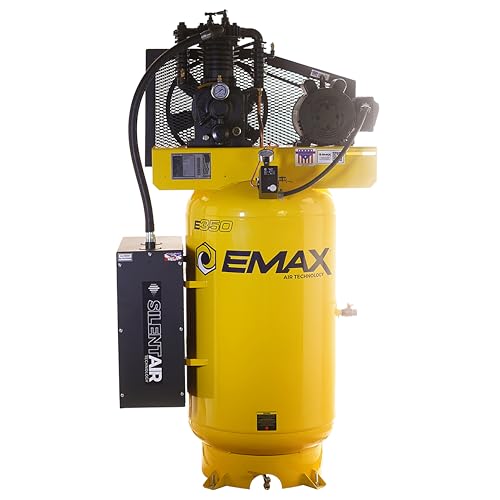
EMAX E350 80-Gallon Two-Stage Air Compressor
What We Like
- Silent Air System reduces noise up to 25%
- Pressure-lubricated pump runs 35% cooler
- Includes oil for the first maintenance
- Industrial-grade U.S.-made components
Trade-offs
- Weighs 715 pounds, requiring a permanent installation
- Occupies a 39 by 32 inch floor footprint
- Single-phase 5 HP motor limits it to 19 CFM
An integrated noise reduction system lowers sound levels by up to a quarter, which transforms the shop environment. You can hold a conversation without shouting while this compressor runs. Its 5 HP motor delivers 19 CFM at 100 PSI, a substantial air supply for demanding tasks. This unit is built for the professional or serious hobbyist who spends long hours in the shop and values a workspace that doesn’t punish the ears.
This quiet, industrial build has a substantial physical presence. At 715 pounds and standing over six feet tall, the E350 is a permanent shop fixture. You’ll need a concrete pad and a dedicated 230V circuit, making it a poor choice for a mobile service truck.
Industrial Air 80-Gallon Two-Stage Air Compressor

What We Like
- High 22.1 CFM output runs demanding tools
- Integrated control panel for easy operation
- Industrial-grade motor resists voltage fluctuations
Trade-offs
- Massive 623 lb weight requires permanent installation
- 80-inch height needs significant vertical clearance
- 7.5 HP motor requires dedicated 230V circuit
With an air delivery of 22.1 cubic feet per minute, this compressor can effortlessly run multiple sanders, impact wrenches, or a large sandblaster without waiting for the tank to recover. That high-flow output is why it’s the right choice for a busy professional shop where continuous, high-demand air is non-negotiable. The rugged, all-cast-iron build speaks to a long service life, handling the heat and stress of daily use far better than lighter-duty pumps.
This capability requires a substantial physical footprint. If your space is more constrained but you still need serious air, consider a slightly smaller package like the 60-gallon Campbell Hausfeld. That model offers a two-stage design, though with less air reserve.
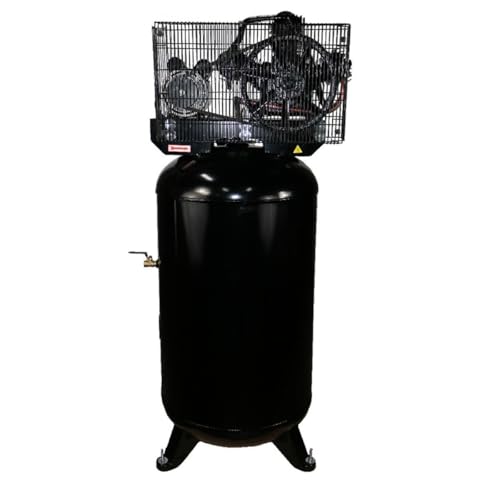
ATLAS AF6 80-Gallon Two-Stage Air Compressor
What We Like
- Large 80-gallon tank for extended tool use
- Two-stage pump delivers up to 175 PSI
- Made in the USA construction
- Quiet operation for a more pleasant workshop
Trade-offs
- Massive 418-pound weight complicates placement
- 75-inch length demands significant floor space
- Single-phase 220V power requires a dedicated circuit
An 80-gallon vertical tank and a two-stage pump delivering up to 175 PSI provide a large reservoir of high-pressure air for demanding tools. This ATLAS compressor is built for the serious home shop or small professional garage where American-made durability is a priority. Its extremely quiet operation is a major perk, letting you hold a conversation or listen to the radio while it runs.
That capability comes with a substantial footprint. At 418 pounds and over six feet long, you need a permanent, level spot with a 220V outlet, making it a poor fit for cramped spaces. For raw air volume in a stationary unit, it stands with giants like the Quincy Air Master, but its vertical design is more space-efficient than the horizontal Campbell Hausfeld, if you have the ceiling height.
Product photos
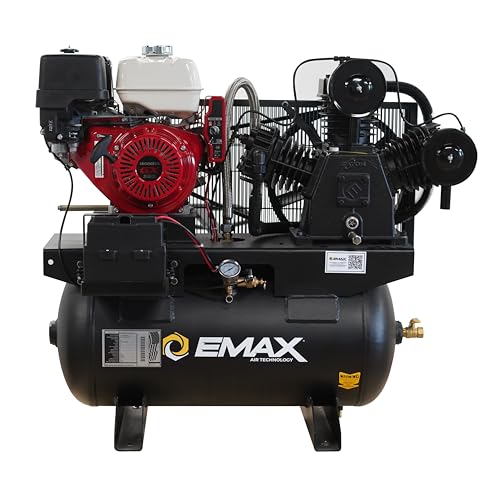
EMAX MAXFLO Truck-Mount Air Compressor
What We Like
- Compact 30-gallon tank designed for truck mounting
- Industrial-grade two-stage cast iron pump
- Powerful 13HP Honda GX390 engine
Trade-offs
- At 430 pounds, it requires a heavy-duty truck bed for mounting.
- The 48 by 46-inch footprint occupies significant truck bed space.
- Gas engine operation requires ventilation and fuel management.
With an output up to 26 CFM at 100 PSI from its 13HP Honda engine, this compressor can supply enough air to run several impact wrenches or a sizable sandblaster continuously. That capacity is essential for mobile service rigs. Its 30-gallon horizontal tank and compact footprint are engineered to fit securely in a truck bed or on a service trailer. This makes it a self-contained power source for remote job sites where electrical outlets are scarce, suiting contractors who need industrial air power on the go.
This truck-ready package has a substantial 430-pound weight and large footprint, which demands a dedicated, sturdy vehicle setup. Compared to a stationary unit like the 80-gallon EMAX E350, you’re sacrificing a larger air reservoir and potentially longer tool run time for ultimate portability. For a fixed workshop, that stationary 80-gallon tank is a better fit, but for a mobile technician, this EMAX’s output and form factor are the deciding factors.
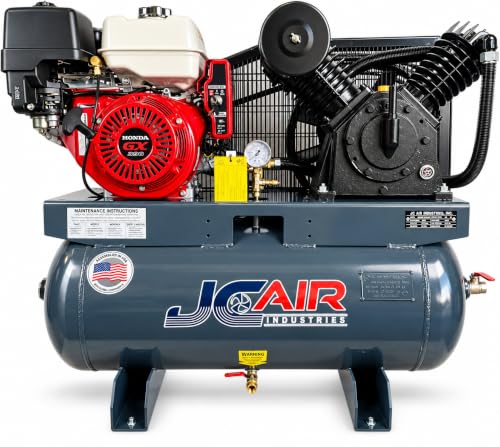
JCAIR Industries AH13030GT 2 Stage Air Compressor
What We Like
- Commercial Honda engine with electric start
- High 24 CFM output for demanding tools
- Truck-mount design for mobile service
- Industrial two-stage cast iron pump
Trade-offs
- At 462 lb, it requires a dedicated truck mount and is not casually portable.
- Gas engine limits use to well-ventilated or outdoor job sites.
- 30-gallon tank is smaller than stationary shop models for continuous high-demand tasks.
Delivering 24 CFM at 175 PSI from a Honda GX390 engine, this compressor generates enough air to run several impact wrenches or a sizable air hammer without stalling. That makes it a serious choice for diesel mechanics and mobile service crews who need reliable, high-volume air far from a shop outlet. The electric start and truck-mount configuration are built for a professional rolling out of a service truck at a remote breakdown.
This truck-mount design trades the portability of smaller units for a substantial 462-pound weight, making it a permanent fixture on a service vehicle. Compared to a stationary 60-gallon model like the Campbell Hausfeld, it offers less tank capacity but provides gas-powered independence from electrical outlets. The unit defines its workspace as any location a pickup truck or utility body can reach.
Product photos
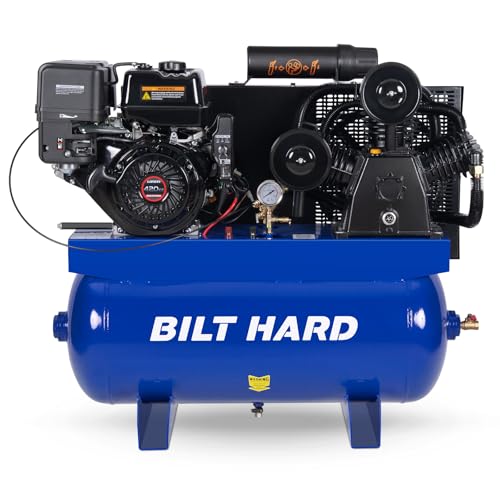
BILT HARD 30-Gallon Gas Air Compressor
What We Like
- High 24 SCFM output runs multiple tools
- Gas engine with electric start for true portability
- Durable cast iron W-type pump reduces vibration
- Compact 30-gallon tank balances capacity and footprint
Trade-offs
- Gas engine requires outdoor or extremely well-ventilated use
- Battery for electric start is sold separately
- Smaller tank means more frequent pump cycles during sustained use
With 24 SCFM at 90 PSI, this compressor delivers enough air to run a framing nailer and a spray gun back-to-back without waiting for the tank to refill. That makes it a serious contender for contractors who need reliable air away from a shop outlet. The 13.5HP gas engine and dual-start system mean you can fire it up at a remote site, and the compact 30-gallon tank fits on a service truck without dominating the bed. It’s built for the user who needs pro-level air volume but doesn’t have the space or electrical setup for a massive stationary unit.
The BILT HARD 30-gallon tank provides ample air storage to reduce pump cycling during extended use, making it suitable for garages and mobile service vehicles. A 30-gallon capacity is smaller than stationary 60 or 80-gallon models, such as the Campbell Hausfeld, but its compact footprint offers portability those larger units lack. This gas-powered compressor brings two-stage, cast-iron durability to job sites without power outlets, though it requires fuel and regular engine maintenance.
Product photos
How We Evaluated Two-Stage Air Compressors
Our evaluation centered on manufacturer specifications and documented patterns in owner feedback. We prioritized the cast-iron pump construction that defines long-term durability, the tank capacity that determines how long you can run tools, and the CFM output that dictates which pneumatic tools you can actually power.
We also weighed practical installation factors like weight, footprint, and electrical requirements, critical details for these permanent shop fixtures. As a research-based guide, we cannot account for the specific acoustics of your workspace or the exact fit in your garage, which are best judged in person.
What To Look For In Two-Stage Air Compressors
A two-stage compressor is a major investment for your workshop. The right choice hinges on matching its heavy-duty capabilities to your specific air needs and shop constraints.
Focus on CFM at your tool’s required PSI, not just maximum pressure. Ensure the pump is cast iron for longevity, and measure your space for the tank’s permanent footprint. Verify you have the correct 230V circuit before buying any stationary electric model.
Air Delivery: CFM and PSI
The compressor’s job is to deliver air, measured in Cubic Feet per Minute (CFM) at a specific Pounds per Square Inch (PSI). Always check the CFM rating at the PSI your tools require, not just the maximum PSI the tank holds. A high-CFM tool like a sandblaster or large sander might need a high volume of air to run continuously.
A two-stage design compresses air in two steps, allowing it to generate higher pressures more efficiently, typically up to 175 PSI, which helps maintain steady tool performance. This makes a two-stage unit essential for running multiple tools or high-demand applications without waiting for the pump to cycle.
Pump Construction and Duty Cycle
The pump is the heart of the compressor. For a two-stage model meant for serious use, a cast-iron pump is non-negotiable for dissipating heat and ensuring longevity under load. Look for pumps rated for 100% continuous duty, meaning they can run without a cooldown period.
Some industrial models feature pressure-lubricated pumps with dedicated oil systems that run cooler and last for thousands of hours. Oil-lubricated designs generally last longer and run quieter than oil-free pumps, but require periodic maintenance. This durable construction is the core difference between a shop-grade unit and a lighter-duty one.
Tank Capacity and Form Factor
Tank size, measured in gallons, dictates your air reserve. A larger tank means the pump cycles less often, providing longer run times for tools before the motor kicks on. For a home shop running one or two tools intermittently, a 60-gallon tank is often sufficient.
For continuous use with multiple tools or high-CFM applications, an 80-gallon or larger tank is preferable. Also consider the tank’s shape: a vertical tank saves floor space, while a horizontal tank offers a lower profile. Remember, these tanks are permanently mounted on heavy frames; you must plan for the unit’s full footprint and vertical clearance.
Power Source and Installation
Stationary two-stage compressors almost always require a dedicated 230-volt electrical circuit, which may need professional installation. Confirm your shop’s electrical capacity first. Gas-powered models offer true portability for job sites without power but are for outdoor use only due to fumes and noise. The unit’s weight, which can be several hundred pounds, makes it a permanent installation; ensure your floor can support it and you have a path to its final location.
- Verify the voltage and phase (single-phase is standard for homes) of an electric model.
- For gas models, check if the electric start requires a separate battery.
- Measure doorways and planned placement area, including overhead clearance for tall vertical tanks.
- Plan for adequate ventilation and noise considerations, as these are not quiet machines.
Your most important check is confirming your electrical service can handle the compressor’s motor before it arrives.
Two-Stage Air Compressors Compared
The table below compares the key specifications of our top picks to help you see the differences in power, size, and application at a glance.
| Product | Motor Power | Tank Capacity | Max Pressure |
|---|---|---|---|
| Campbell Hausfeld 60-Gallon 2-Stage Air Compressor | 3.7 HP | 60-Gallon vertical | 175 PSI |
| Ingersoll Rand 2475N7.5 Two-Stage Air Compressor | 7.5 HP | 80-gallon ASME | 175 psig |
| Ingersoll Rand 2340L5-V Two-Stage Air Compressor | 5 HP | 60 gallon vertical | N/A |
| Quincy Air Master 271CS80VCB 2 Stage Air Compressor | 7.5 HP | 80 Gallon | N/A |
| EMAX E350 80-Gallon Two-Stage Air Compressor | 5 HP | 80-gallon vertical ASME | N/A |
| Industrial Air 80-Gallon Two-Stage Air Compressor | 7.5 HP | 80 gallons | 175 PSI |
| ATLAS AF6 80-Gallon Two-Stage Air Compressor | 5hp running motor | 80-gallon vertical | 175 PSI |
| EMAX MAXFLO Truck-Mount Air Compressor | 13HP Honda GX390 | 30-gallon horizontal | 175 PSI |
| JCAIR Industries AH13030GT 2 Stage Air Compressor | 13HP Honda gas engine | 30-gallon horizontal | 175 PSI |
| BILT HARD 30-Gallon Gas Air Compressor | 13.5HP gas engine | 30-gallon steel | 180 PSI |
Frequently Asked Questions
What is the best two-stage air compressor?
The best model depends on your needs. For most serious DIYers and small shop owners, the Campbell Hausfeld 60-Gallon 2-Stage Air Compressor offers the best balance of power, a manageable 60-gallon tank, and a relatively compact footprint. It provides the high pressure needed for demanding tools without overwhelming a home garage.
Is a 2 stage air compressor worth it?
A two-stage compressor is worth the investment if you regularly use high-demand air tools like sanders, sandblasters, or paint sprayers. The two-stage design operates more efficiently, provides higher pressure (typically 175 PSI), and delivers more consistent air flow for continuous use. For lighter, intermittent tasks, a single-stage compressor may be sufficient.
Who makes the highest quality air compressors?
Brands like Ingersoll Rand, Quincy, and Campbell Hausfeld are consistently noted for manufacturing high-quality, durable two-stage compressors. These companies use industrial-grade components like cast-iron pumps and build units rated for continuous duty, which is essential for professional or heavy DIY use. Our air compressor reviews delve deeper into brand reputations and model performance.
What is the best 2-stage 60 gallon air compressor?
Our top choice in this category is the Campbell Hausfeld 60-Gallon model for its overall value and capable performance. For workshops with severe space constraints, the Ingersoll Rand 2340L5-V is an excellent 60-gallon option with a notably compact depth. You can explore more options in our guide to the best 60 gallon air compressors.
What size air compressor do I need for a shop?
Start by adding up the CFM requirements of the air tool you use that needs the most air, then add a safety margin. For a home shop running tools like an impact wrench or die grinder, a compressor delivering a high volume of air at 90 PSI is a good target. For professional shops running multiple tools, look for a high CFM output and a large 80-gallon tank. The resource on shop air compressors can help you calculate your needs.
The Bottom Line
For the serious home shop owner needing reliable, high-pressure air without consuming excessive floor space, the Campbell Hausfeld 60-Gallon 2-Stage Air Compressor is the best overall investment. If your budget is tight but you need mobile power, consider the BILT HARD 30-Gallon Gas Air Compressor, while professionals requiring non-stop air should look to the industrial-grade Ingersoll Rand 2475N7.5. Before you commit, the single most critical step is verifying your workspace has the necessary 230V electrical circuit to power a stationary two-stage compressor, it’s the foundation everything else is built upon.
