
10 Best Air Compressors For Air Tools in 2026
This post contains affiliate links. As an Amazon Associate, we earn from qualifying purchases.
Our best overall air compressor for air tools is the Klutch 20-Gallon Air Compressor, which wins for its powerful oil-free pump and excellent portability. For heavy-duty shop work, the Ingersoll Rand 2340N5-V is unmatched, while the RyanTek 15-Gallon offers exceptionally quiet operation. The right compressor eliminates frustrating pressure drops and motor strain, letting you focus on your project. This guide is based on specifications, manufacturer data, and patterns in owner feedback. We cut through the noise to help you match a compressor’s capabilities to your specific air tools.
Top 10 Air Compressors For Air Tools in the Market
Certain content that appears on this site comes from Amazon. This content is provided "as is" and is subject to change or removal at any time.
The Best Air Compressors For Air Tools, Reviewed
Klutch 20-Gallon Air Compressor

What We Like
- Oil-free pump for minimal maintenance
- Large rubber wheels and handle for portability
- Thermal overload protection for motor safety
- Rubber foot stabilizers reduce vibration
Trade-offs
- At 90 lb, it's hefty for frequent relocation
- 4.2 SCFM may struggle with continuous high-draw tools
A 20-gallon tank paired with a 4.2 SCFM output gives you a solid reservoir for running common air tools like nailers, impact wrenches, and ratchets without constant cycling. The oil-free pump means you can set it up and forget about routine maintenance, while the thermal protection guards the motor during longer jobs. This combination of capacity and practical design makes it a reliable centerpiece for a home workshop where you need dependable air without the complexity of a larger industrial unit.
Balancing a 20-gallon tank size with a 90-pound weight means it’s built for shop mobility, not for carrying. Its large rubber wheels and ergonomic handle let you roll it around a garage easily, but the unit’s mass makes it a cart-based tool. For continuous high-demand tasks, its 4.2 SCFM at 90 PSI flow rate determines how quickly it can supply air, which is a key consideration when choosing a compressor for extended tool use.
Ingersoll Rand 2340N5-V Air Compressor

What We Like
- Durable cast iron construction for long life
- 100% continuous duty cycle for non-stop work
- 14.3 CFM delivery runs demanding air tools
Trade-offs
- At 435 pounds, it requires a permanent, reinforced floor installation
- 68.5-inch height demands significant vertical clearance
- Stationary design offers zero portability for job sites
A 5 HP motor pushing 14.3 CFM at 90 PSI means this compressor won’t gasp when you’re running a die grinder and an impact wrench back-to-back. It’s built for the professional shop where tools are in use all day, every day. The 80-gallon tank and 175 PSI max pressure provide the massive air reserve needed for sandblasters or large sanders, eliminating the frustrating wait for the pump to catch up. This is the unit you install and forget, trusting it through years of heavy use.
The trade-off is absolute permanence. Weighing over 400 pounds and standing nearly six feet tall, this isn’t something you move around. It demands a dedicated corner of your shop with proper electrical hookup. You’re investing in a cornerstone for your workspace.
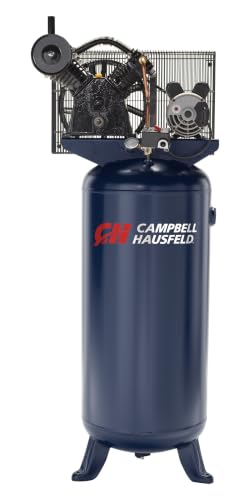
Campbell Hausfeld 60-Gallon Air Compressor
What We Like
- Large 60-gallon tank for extended tool runtimes
- Two-stage cast-iron pump for durable 10,000-hour life
- 175 PSI maximum supports demanding air tools
- Vertical design saves valuable shop floor space
Trade-offs
- Requires a dedicated 230V electrical circuit for installation
- Weighs 255 lbs, making it a permanent stationary fixture
- Large 77-inch height may not fit in low-ceiling garages
A 60-gallon tank paired with a two-stage cast-iron pump means you can run a grinder or sander for long stretches without waiting for the compressor to catch up. This is the heart of a serious home shop. It suits the woodworker or mechanic who has outgrown smaller compressors and needs reliable air for back-to-back tasks, offering the capacity of a pro-grade unit without the pro-grade price tag. The 175 PSI maximum gives you plenty of headroom to dial in pressure for finicky tools like paint sprayers.
This is a stationary compressor, not a plug-and-play machine. You’ll need an electrician to install a dedicated 230V outlet, and its 255-pound weight means you must carefully choose its permanent spot in your shop. Compared to a portable unit like the Klutch 20-Gallon, you gain a massive 60-gallon air reserve but sacrifice all mobility.
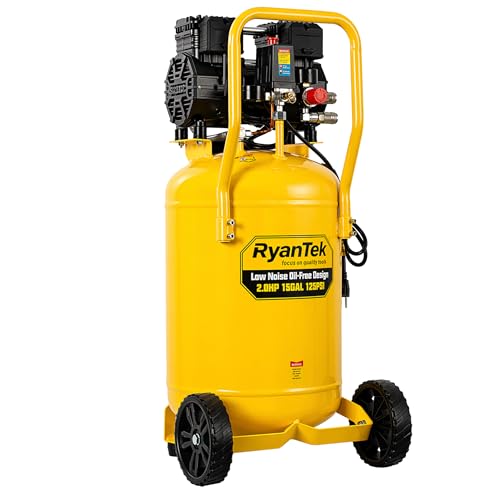
RyanTek 15-Gallon Quiet Air Compressor
What We Like
- Exceptionally quiet 66 dB operation for indoor use
- Oil-free pump delivers clean air for sensitive tasks
- Vertical design with wheels for easy mobility
- Side-mounted handle protects gauge and power switch
Trade-offs
- 68.3 lb weight requires significant effort to lift
- 15-gallon tank is smaller than many stationary compressors
Operating at 66 dBa, the RyanTek 15-Gallon compressor runs quietly enough for indoor use and sensitive tasks, a clear advantage in a home garage or workshop. Its oil-free technology ensures clean air output, which is essential for applications like spray painting where contaminants are a concern. The vertical tank design with integrated wheels and a handle creates a portable footprint, so you can easily move the unit to different work areas instead of relying on long hose runs.
The unit delivers 4.5 CFM at 90 PSI, which supports continuous use with nail guns and inflation but may require planning for tools with higher air demand. Weighing 68.3 pounds, its mobility relies on the integrated wheels, as the weight makes lifting it impractical. Its 125 PSI maximum pressure handles a wide range of pneumatic tools for auto repair, painting, and woodworking, positioning it for home and workshop applications where quiet operation is valued.
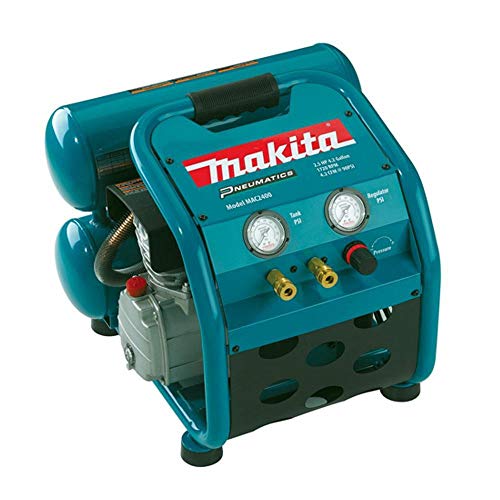
Makita MAC2400 Big Bore Air Compressor
What We Like
- Cast iron Big Bore pump for faster recovery
- Roll-cage protects unit in harsh jobsite conditions
- Low AMP draw reduces breaker trip risk
- Oil lubrication extends pump life and runs cooler
Trade-offs
- Lacks a listed tank gallon capacity for extended tool runs
- Oil-lubricated pump requires periodic maintenance
The 4.2 CFM at 90 PSI output means this compressor can handle demanding tools like framing nailers or impacts without constant waiting for pressure to rebuild. Its entire design is built for punishment, with a cast iron pump housed inside a full roll-cage. That makes it a natural fit for contractors who move a compressor between rough sites where it will get knocked around. The oil-lubricated system and big bore cylinder are built to last for years under daily use, not just occasional weekends.
Roll-cage construction provides complete protection to withstand extreme jobsite environments, meaning it can handle being knocked around in a truck bed or on a busy worksite. This is a stout, industrial-grade portable, not a lightweight unit for casual home use. For tasks requiring a much larger air supply, a stationary unit like the Campbell Hausfeld 60-Gallon has a bigger tank. However, for running air tools where reliability and toughness are priorities, the MAC2400’s built-in roll cage is a core advantage.
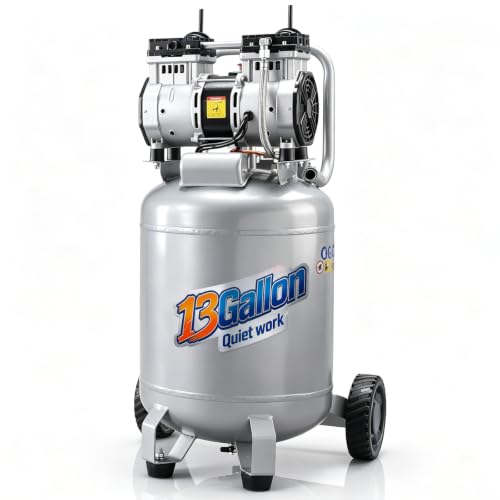
VEVOR 13-Gallon Oil-Free Air Compressor
What We Like
- Oil-free design eliminates maintenance
- Quiet 66 dB operation for indoor use
- Large 13-gallon tank for sustained tasks
- Rolls easily on two 7-inch rubber wheels
Trade-offs
- 71-pound weight is substantial for a portable unit
- 4.6 CFM delivery limits high-demand tools like sanders
A 66 dB noise level makes this one of the quietest compressors you can run in a garage without disturbing the whole house. That, combined with its oil-free pump, means you can set it up and forget about maintenance, focusing on your project instead. The 13-gallon tank and 4.6 CFM flow are a solid match for a homeowner or serious DIYer running nailers, inflators, or a spray gun for moderate periods. It delivers enough air for common tasks without the complexity of an oil-lubed system.
With an output of 4.6 SCFM at 90 PSI, this compressor cannot sustain tools with high air consumption like large pneumatic sanders. Its capacity suits intermittent use with nailers, inflators, or spray guns rather than continuous industrial operation. For a home shop, the balance of air delivery with low maintenance and quiet running is often the right compromise.
Product photos
Metabo HPT EC914S Pancake Air Compressor

What We Like
- Higher 200 PSI for heavy-duty tasks
- 4 CFM flow runs multiple nailers at once
- Simultaneously powers up to 5 brad nailers
Trade-offs
- 6-gallon tank requires more frequent refills than 20+ gallon models
Delivering 4 CFM at 90 PSI from a 6-gallon tank means this compressor can keep up with a busy crew. It’s built to run two framing nailers or five brad nailers simultaneously without lag. That reliable air supply is key when finishing a sheathing job or trimming out a house before the crew moves on. Its 200 PSI maximum pressure provides a solid reserve for stubborn fasteners, giving you consistent driving power flush after flush. For contractors who specialize in framing, siding, or finish work, this unit’s balance of output and portability hits a clear sweet spot.
Its 6-gallon tank means the compressor will cycle more often during heavy, continuous work than a stationary 20-gallon model like the Klutch. That is the trade-off for a 42-pound unit built for easy transport and loading onto a jobsite. You are choosing this model for its high-pressure output in a portable form, not for silent operation.
Product photos
CRAFTSMAN 33-Gallon Vertical Air Compressor

What We Like
- Oil-free pump for zero-maintenance operation
- Two couplers allow simultaneous tool use
- Vertical design saves valuable floor space
- 175 max PSI provides strong pressure reserve
Trade-offs
- At 154 lb, it's not easily moved by one person
- 5.1 CFM may be insufficient for high-demand tools like sanders
- Requires a dedicated, sturdy space due to size and weight
Two high-flow quick couplers let two users operate tools from this single compressor simultaneously. Its 33-gallon tank and oil-free pump provide extended run time with minimal maintenance. This setup suits a busy home shop where multiple people might be working on a project.
You are trading some portability for that shared capability. At over 150 pounds, you’ll wheel it into position and leave it there. Compared to a stationary two-stage unit like the Campbell Hausfeld 60-Gallon, this compressor has a smaller footprint and runs on standard household current. However, it can’t sustain the continuous airflow needed for a professional spray gun or die grinder. This model is a bridge between a portable pancake and a full shop compressor, optimized for two users, not one heavy-duty tool.
Product photos
Ingersoll Rand SS3J5.5GH Gas Compressor

What We Like
- Gas engine provides cordless jobsite freedom
- 100% continuous duty allows for non-stop operation
- Two quick disconnects for running multiple tools
- Wheelbarrow design eases movement over rough terrain
Trade-offs
- At 226 pounds, it requires significant strength to load and unload
- Gas operation rules out indoor use due to fumes
- Its 43-inch length demands ample truck bed or trailer space
Gas power means this compressor goes wherever the work is, with no electrical outlet required. Its 100% continuous duty rating prevents it from cycling off and stalling tools like grinders during extended operation. The design suits framing crews or roofers running nail guns far from power. Two quick-connect outlets let a partner work alongside you from the same source.
You pay for that capability in mass and bulk. The 226-pound wheelbarrow design offers portability, but the weight makes solo loading difficult. Compared to the 435-pound Ingersoll Rand 2340N5-V, it is significantly lighter and more mobile. For a contractor moving between sites, that mobility is essential. For a fixed location, a stationary compressor avoids the need for fuel.
Product photos
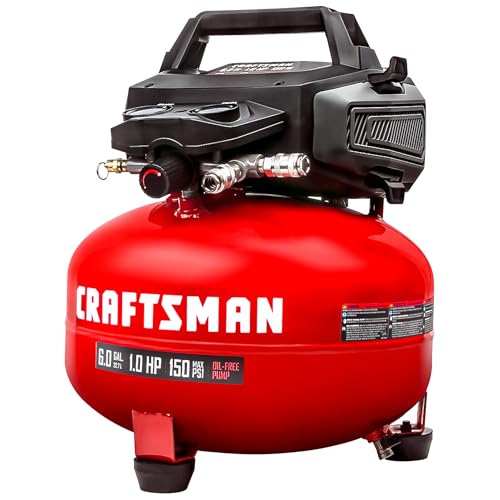
CRAFTSMAN 6-Gallon Pancake Air Compressor
What We Like
- Lightweight, 30.8 lb build with a carry handle
- Dual quick couplers for multiple tools
- Oil-free pump requires no maintenance
- Compact pancake tank saves floor space
Trade-offs
- 2.6 SCFM output limits sustained use of high-demand tools
- 6-gallon tank refills more often than larger stationary units
- Only 150 PSI max pressure, less than some 200 PSI pancakes
With a 6-gallon tank and a maximum pressure of 150 PSI, this compressor provides portable air for intermittent tool use. The oil-free motor requires no maintenance, so it can be stored without special preparation, and dual quick couplers allow two tools to be connected simultaneously for small projects. Its compact build and carry handle make the 30.8-pound unit easy to move from a garage to a driveway.
The air delivery of 2.6 SCFM at 90 PSI means tools that demand a continuous high volume of air will cause the compressor to cycle frequently. This can interrupt longer tasks like sanding or paint spraying. While the Metabo HPT pancake model offers a higher 200 PSI maximum pressure, the Craftsman’s performance is suited for the general home improvement, woodworking, and automotive tasks listed in its features.
Product photos
How We Evaluated Air Compressors For Air Tools
Our research focused on manufacturer specifications and documentation to verify core performance metrics like CFM (cubic feet per minute) delivery, tank size, and duty cycle. We also analyzed expert round-ups to understand how different models perform with real-world tools and scrutinized patterns in owner feedback for insights into long-term reliability and common pain points.
Key criteria included air delivery for your tools, portability and physical footprint, and long-term durability based on pump type and construction. Since this is a research-based evaluation, we cannot verify real-world noise levels or the exact lifespan of individual components, but we highlight models consistently praised for these traits.
What To Look For In Air Compressors For Air Tools
Choosing the wrong air compressor means your tools will stall, your projects will drag, and your patience will wear thin. You need a unit that delivers enough air, fits your space, and is built to last for your type of work.
Match the compressor’s CFM output to your most demanding air tool, ensure the tank size supports your work pace, and decide between oil-free convenience and oil-lubricated durability. Portability and noise level are critical for job sites and home workshops, respectively.
Air Delivery (CFM) and Tank Size
Air delivery, measured in CFM at a specific PSI, is the most critical spec. A framing nailer might need 2-3 CFM, while a die grinder can require 4-6 CFM. The tank acts as a reservoir; a larger gallon capacity lets you use tools longer before the pump kicks on to refill it.
For intermittent use with nailers, a 6-gallon tank may suffice, but continuous sanding or painting demands a 20-gallon or larger tank to avoid constant cycling.
Portability and Physical Footprint
Consider where the compressor will live and how often you’ll move it. Portable “pancake” or “hot dog” compressors are lightweight with a handle, ideal for job sites. Wheelbarrow-style units on large wheels tackle rough terrain. Stationary vertical tanks save floor space but require a permanent, sturdy location and often a 230V outlet. For contractors, a durable portable air compressor with a protective roll cage is essential.
Durability and Maintenance
The pump is the heart of the system. Oil-lubricated pumps, often with cast-iron construction, run cooler, quieter, and typically last longer, but require periodic oil changes. Oil-free pumps are maintenance-free and provide clean air for painting, but often have a shorter lifespan and run louder. For high-use environments, a cast-iron pump and a 100% duty cycle rating are indicators of a compressor built for the long haul, like those suited for powering impact wrenches.
- Check the duty cycle: a 100% rating means it can run continuously without overheating.
- Look for thermal overload protection to prevent motor burnout.
- Prefer ball valves for easy tank draining to prevent internal rust.
- Ensure the unit’s power requirements (volts/amps) match your workshop’s electrical supply.
Always choose a compressor whose CFM rating exceeds the requirement of your most air-hungry tool.
Air Compressors For Air Tools Compared
Use the table below to quickly compare the key specifications and strengths of our top picks.
| Product | Tank Capacity | Air Delivery @ 90 PSI | Max Pressure | Motor Power |
|---|---|---|---|---|
| Klutch 20-Gallon Air Compressor | 20 Gallon | 4.2 SCFM | N/A | 2 HP |
| Ingersoll Rand 2340N5-V Air Compressor | 80-gallon | 14.3 CFM | 175 PSI | 5 HP |
| Campbell Hausfeld 60-Gallon Air Compressor | 60 gallons | 7.6 SCFM | 175 PSI | 3.7 HP |
| RyanTek 15-Gallon Quiet Air Compressor | 15 gallons | 4.5 CFM | 125 PSI | 2HP |
| Makita MAC2400 Big Bore Air Compressor | N/A | 4.2 CFM | N/A | 2.5 HP |
| VEVOR 13-Gallon Oil-Free Air Compressor | 13 gallons | 4.6 SCFM | 125 PSI | 2 HP |
| Metabo HPT EC914S Pancake Air Compressor | 6 Gallon | 4 CFM | 200 PSI | N/A |
| CRAFTSMAN 33-Gallon Vertical Air Compressor | 33 gallons | 5.1 CFM | 175 PSI | N/A |
| Ingersoll Rand SS3J5.5GH Gas Compressor | N/A | N/A | 135 psi | 5.5 HP |
| CRAFTSMAN 6-Gallon Pancake Air Compressor | 6 gallons | 2.6 SCFM | 150 PSI | 1.0 HP |
Frequently Asked Questions
What is the best air compressor for air tools?
The best model depends on your specific tools and workspace. Our top overall pick, the Klutch 20-Gallon Air Compressor, offers a great balance of tank capacity, oil-free maintenance, and portability for a home workshop.
What is a good size air compressor to run air tools?
A good size matches your tool’s CFM demands. For nailers and inflators, a 6-gallon portable unit often works. For sanders, grinders, or impact wrenches used continuously, you typically need at least a 20-gallon tank and a pump delivering 5+ CFM at 90 PSI to avoid constant motor cycling.
Which brand of air compressor is considered the most reliable?
Brands like Ingersoll Rand and Rolair have long-standing reputations in professional shops for durable, cast-iron compressors built for continuous duty. For portable job-site use, Makita and Metabo HPT are frequently noted for their solid construction and reliable performance under tough conditions.
What’s the difference between oil-lubricated and oil-free air compressors?
Oil-lubricated compressors use oil to cool and seal the pump, generally running quieter and lasting longer with proper maintenance. Oil-free compressors use sealed bearings and Teflon rings, requiring no oil changes and providing clean air, but they often run louder and may have a shorter service life.
Can I run multiple air tools from one compressor?
Yes, if the compressor’s CFM output meets or exceeds the combined CFM requirement of all tools running simultaneously. Many models feature dual couplers for this purpose. However, a small tank will deplete quickly, causing frequent pump cycles, so a larger tank is beneficial for multi-tool setups.
The Bottom Line
For most home workshop owners running a variety of pneumatic tools, the Klutch 20-Gallon Air Compressor is the best overall choice, blending sufficient air delivery with easy, oil-free maintenance. If your budget is tight, start with the CRAFTSMAN 6-Gallon Pancake Air Compressor; for non-stop professional shop work, invest in the Ingersoll Rand 2340N5-V.
Ultimately, the single most important factor is matching the compressor’s CFM and tank capacity to the air demands of your specific tools, buying too little air power is the surest path to frustration.
