
10 Best Air Compressors For Automotive Shop in 2026
This post contains affiliate links. As an Amazon Associate, we earn from qualifying purchases.
For an automotive shop needing a reliable stationary air source, the DEWALT DXCM603 60-Gallon Stationary Air Compressor is our best overall for its high airflow and versatile motor. The Ingersoll Rand 2340L5-V is the top choice for high-performance, continuous duty, while the VEVOR 60-Gallon Heavy-Duty model offers solid value for budget-focused operations.
Choosing the wrong compressor leads to pressure drops, tool stalling, and rework. You need one sized to run your specific pneumatic tools without interruption. Our research compares ten models on critical factors like CFM output, tank capacity, and duty cycle to help you invest confidently.
Top 10 Air Compressors For Automotive Shops in the Market

Certain content that appears on this site comes from Amazon. This content is provided "as is" and is subject to change or removal at any time.
The Best Air Compressors For Automotive Shops, Reviewed
DEWALT DXCM603 60-Gallon Stationary Air Compressor

What We Like
- High air flow for demanding pneumatic tools
- Motor operates on both 208V and 230V
- 175 max psi provides strong reserve pressure
Trade-offs
- Single-stage design limits efficiency for continuous high-demand use
The 5 HP motor and 60-gallon ASME tank deliver the high air flow and pressure reserve needed to run an impact wrench or sander without constant cycling. It’s a workhorse built for the daily grind of an automotive shop, offering the right balance of power and tank capacity to keep a bay productive. The motor’s ability to run on either 208V or 230V single-phase power adds practical flexibility for many shop electrical setups.
As a single-stage unit, it can’t match the air delivery or efficiency of a true two-stage compressor like the Campbell Hausfeld 60-Gallon model under sustained, heavy load. That’s the trade-off for its straightforward design and sturdy performance. For a shop running one or two tools at a time with occasional high-demand bursts, this DEWALT provides reliable, no-fuss power that gets the job done.
Ingersoll Rand 2340L5-V Two-Stage Air Compressor
What We Like
- Cast iron design for 100% continuous duty
- Built for high-pressure operation without interruption
- Overhung crankshaft for easier maintenance
Trade-offs
- Weighs 430 lb, requiring a permanent, reinforced floor
- 60-gallon tank is smaller than some 80-gallon competitors
Its 100% continuous duty cast-iron design means this compressor can run all day without a break, which is the core of a true shop workhorse. The 5 HP motor and 60-gallon tank support this sustained operation. Individually cast cylinders, an overhung crankshaft, and a one-piece connecting rod are thoughtful touches for the owner who values serviceability as much as raw power.
The trade-off is its substantial 430-pound weight, which demands a dedicated, solid concrete pad. Compared to the 239-pound DEWALT 60-Gallon Vertical Air Compressor, the Ingersoll Rand is significantly heavier. This heavier construction is about durable, stationary performance, not portability.
Quincy Air Master 271CS80VCB Air Compressor

What We Like
- 7.5 HP motor provides significant power.
- 80-gallon tank offers large air reserve.
- Two-stage design for higher pressure efficiency.
- 230V single-phase power suits most shop wiring.
Trade-offs
- At 643 lb, it requires a permanent, reinforced floor installation.
- Its substantial footprint demands significant dedicated floor space.
- Single-phase power limits it compared to industrial three-phase units.
With an 80-gallon tank and a 7.5 HP two-stage pump, this Quincy compressor can supply air for extended periods before the motor needs to cycle on. That capacity suits operations where several air tools might be used in sequence or together. The large reserve helps maintain consistent pressure during demanding tasks.
Its 643-pound weight demands a solid, permanent installation on a concrete floor. For comparison, the VEVOR 80-Gallon Oil-Free model weighs 264.6 pounds and has a smaller footprint. The Quincy’s substantial build requires significant floor space and careful placement planning.
EMAX 80-Gallon Two-Stage Air Compressor

What We Like
- High 26 CFM airflow for demanding tools
- Designed for 50,000 hours of pump life
- 200 PSI maximum offers substantial pressure reserve
Trade-offs
- Extremely heavy at 650 pounds, requiring permanent placement
- Large 75-inch height needs significant vertical clearance
- Manual tank drain requires user diligence for maintenance
A 26 CFM airflow at 100 PSI is what separates shop-ready compressors from garage toys. The EMAX 80-gallon unit delivers that kind of industrial-grade air supply, meaning it can reliably run multiple impact wrenches or a large sandblaster without lag. Its two-stage, splash-lubricated pump is built for marathon sessions, not sprints. This compressor is for the professional shop where air tools are in constant use and downtime is a direct cost. The 200 PSI maximum gives you a deep reserve for peak demands.
That capability comes with real physical demands. At 650 pounds and standing over six feet tall, this isn’t a tool you simply roll into a corner. It requires a dedicated, level foundation and serious planning for delivery and installation. Compared to a more compact 60-gallon unit like the DEWALT DXCM603, the EMAX demands more floor space and a more substantial initial setup. You’re trading portability for relentless air volume, a fair exchange for a busy bay.
DEWALT 60-Gallon Vertical Air Compressor

What We Like
- Vertical design maximizes floor space
- Oil-lubricated pump for durability
- 155 max PSI supports varied tools
- Large tank enables extended operation
Trade-offs
- 239 lb weight complicates initial placement
- Air delivery is modest for continuous high-demand tools
- 78-inch height requires adequate ceiling clearance
Its 24-inch square footprint is the most decisive feature, allowing this 60-gallon compressor to occupy a tight corner. This makes it a logical choice for a shop where floor space is limited but the air reserve of a large tank is still needed. The oil-lubricated pump and 155 PSI maximum pressure provide reliability and headroom for running impacts, ratchets, and spray guns through intermittent automotive work.
The trade-off for that compact base is in pure air output. At 11.5 SCFM at 90 PSI, it can struggle to keep up with a sandblaster or large die grinder running non-stop. For a busy bay running multiple high-CFM tools concurrently, a unit with a broader footprint, like the 33-inch wide Ingersoll Rand model, may be required. This DEWALT excels as a space-efficient workhorse for general shop duties, not as a foundation for industrial-scale air consumption.
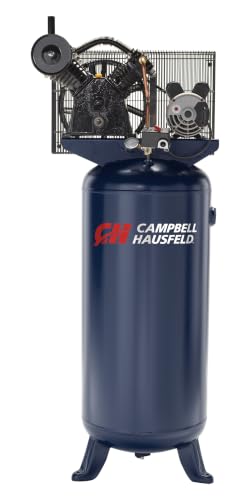
Campbell Hausfeld 60-Gallon Two-Stage Air Compressor
What We Like
- Two-stage cast-iron pump for durability and quieter operation
- 175 PSI maximum pressure for demanding automotive tools
- Vertical 60-gallon tank saves valuable shop floor space
- Oil-lubricated design rated for up to 10,000 hours of pump life
Trade-offs
- At 255 lb, it's a permanent installation requiring two people to move
- Requires a dedicated 230V circuit, not a standard household outlet
A 60-gallon tank with a 175 PSI two-stage pump delivers the steady, high-pressure air needed for sanding, grinding, and painting without the bulk of an 80-gallon unit. Its 23-inch square footprint is a genuine space-saver for a crowded shop. This compressor suits a professional or serious hobbyist who needs reliable air for extended run times but can’t dedicate a full corner to a massive tank. The oil-lubricated cast-iron pump is built for the long haul, a key point of value in a market where many designs are strikingly similar.
With a maximum pressure of 175 PSI, this compressor delivers enough force for demanding pneumatic jobs like grinding and paint spraying. Its two-stage cast-iron pump is engineered for reduced operating noise and a long service life. The 60-gallon vertical tank has a 23 x 23-inch footprint, which helps preserve floor space in a garage or workshop.
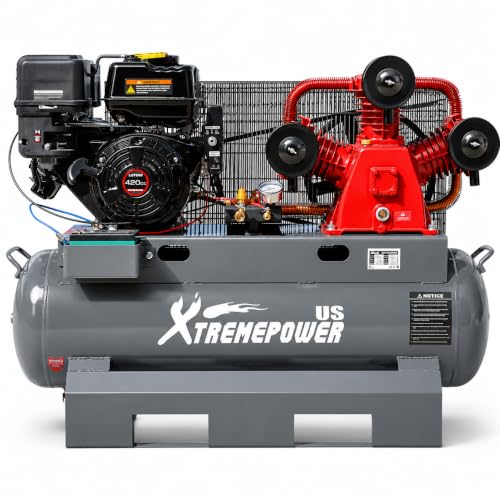
XtremepowerUS 30-Gallon Gas-Powered Air Compressor
What We Like
- Gas engine enables cordless, mobile operation
- Cast-iron pump built for heavy-duty, continuous use
- Explicitly designed for mounting in a truck bed
- Removable cylinders simplify maintenance and cooling
Trade-offs
- At 391.6 pounds, it requires a serious truck to transport
- Gas operation mandates outdoor or extremely ventilated use
A gas-powered 30-gallon compressor is built for mobile, heavy-duty applications away from a fixed power source. Its entire design, from the horizontal tank to the cast-iron pump, is intended for mounting onto a service truck. This means it can supply compressed air for machinery and multiple tools at construction sites or agricultural operations without requiring a workshop outlet. For the mobile technician, it provides capability where grid power is unavailable.
The trade-off is in its size and specialization. Its 391.6-pound weight anchors it to a truck bed; this isn’t a unit you’ll roll around a garage. The 30-gallon capacity provides runtime for variable air demand from low to medium volumes, as noted in its applications. This XtremepowerUS compressor excels by going where the work is, not by staying where permanent power is installed.
Product photos
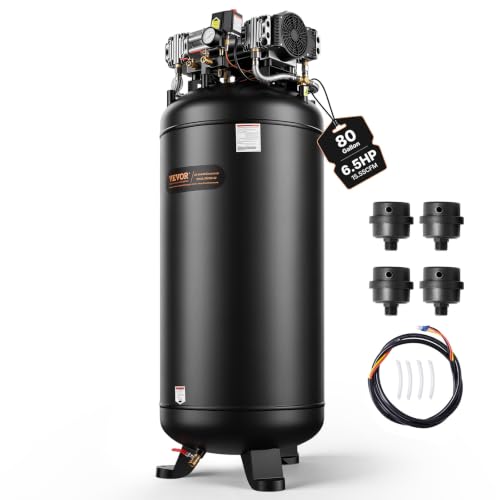
VEVOR 80-Gallon Oil-Free Air Compressor
What We Like
- Massive 80-gallon tank for extended air supply
- Oil-free design eliminates maintenance and potential contamination
- 86 dB operation is relatively quiet for its class
- High-strength cold-rolled steel tank construction
Trade-offs
- 145 PSI max pressure is lower than many two-stage industrial rivals.
- Requires a dedicated 220V single-phase power circuit for operation.
With an air delivery of 15.5 SCFM at 90 PSI, this VEVOR compressor can rapidly inflate its 80-gallon tank, which is described as helping to complete tasks efficiently. Its oil-free pump means no regular oil changes, a simpler setup for shops that want clean air for tools like nail guns or spray guns without that maintenance. The high-strength steel tank is noted for a solid structure and stable performance in harsh environments.
The trade-off for that oil-free convenience and lower weight is ultimate durability and peak pressure. The VEVOR offers a compelling, lower-maintenance alternative for shops that aren’t running air-hungry sandblasters or large sanders all day but still need substantial, reliable air for general automotive tasks.
Product photos
BelAire 318VL 80-Gallon Two-Stage Air Compressor

What We Like
- 7.5 HP motor for demanding air tools
- 80-gallon two-stage tank provides steady air
- Included starter simplifies 230V electrical setup
- Two-year full warranty offers peace of mind
Trade-offs
- Weighs 479 lb, requiring a permanent, reinforced floor location
- 75.7-inch height needs significant vertical clearance
- Single-phase power limits ultimate industrial duty cycles
With a 7.5 HP motor and an 80-gallon two-stage tank, this compressor delivers the air volume needed to run demanding tools consecutively without pressure drop. The included starter handles the high inrush current for the 230V, single-phase motor, so you have a complete package without sourcing a separate component. This combination provides substantial air capacity for shops that need reliable, high-volume air without requiring a three-phase power supply.
The compressor’s size and weight require a dedicated installation space. At 479 pounds and over six feet tall, it is not designed to be moved once placed. Its dimensions are larger than some other vertical models, like the more compact DEWALT DXCM603, so you must plan for its footprint.
Product photos
VEVOR 60-Gallon Heavy-Duty Air Compressor

What We Like
- Large 60-gallon tank for extended air supply
- Belt-driven, oil-lubricated pump for stable operation
- Dual air outlets run two tools simultaneously
- 3mm carbon steel tank for durability
Trade-offs
- Requires a dedicated 230V electrical circuit
- Lower air delivery than two-stage shop compressors
With an 8 SCFM flow at 90 PSI, this compressor is rated for a range of pneumatic tasks. Its dual air outlets are compatible with two tools operating simultaneously. The 60-gallon capacity is designed to meet long-term air demands for industrial manufacturing and large workshops. A 3mm thick carbon steel tank with a powder-coated surface is built for pressure and corrosion resistance.
The single-stage, belt-driven pump delivers 8 SCFM, while other products like the Campbell Hausfeld 60-Gallon Two-Stage Air Compressor list a two-stage design. This VEVOR model reaches a maximum pressure of 155 PSI. Its oil-lubricated system includes an observation mirror for monitoring the oil level.
Product photos
How We Evaluated Air Compressors For Automotive Shops
Our evaluation was based on manufacturer specifications, expert round-ups on professional shop needs, and patterns in owner feedback. We prioritized continuous CFM delivery over maximum PSI, as this determines if a compressor can run demanding tools like sanders and impact wrenches without pressure drop. Tank capacity and physical footprint were also key, as a shop’s floor space and air reserve needs vary widely.
Finally, we assessed power requirements and duty cycle to distinguish between units suited for intermittent use and those built for 100% continuous operation. Since this is a research-based guide, we cannot speak to long-term reliability or noise levels in a specific shop environment.
What To Look For In Air Compressors For Automotive Shops
Your compressor must supply enough clean, dry air to run your tools simultaneously. Getting this wrong means costly downtime and poor results, especially for tasks like painting.
Match the compressor’s CFM to your highest-demand tools, prioritize a two-stage pump for continuous use, and ensure your electrical service can handle the motor’s power requirements.
Airflow (CFM) & Pressure (PSI)
Cubic Feet per Minute (CFM) is the volume of air delivered, and it’s the most important spec for running tools. You must match the compressor’s CFM output to the combined requirements of the tools you’ll run at the same time. For example, a high-CFM tool like a sandblaster can require over 10 CFM, while an impact wrench might need 4-5 CFM.
Maximum PSI matters less for most shop tools, which typically operate around 90 PSI, but a higher max PSI provides a useful pressure reserve in the tank. For critical applications like painting a car, consistent airflow is non-negotiable.
Compressor Stage & Duty Cycle
Single-stage compressors are common and sufficient for intermittent use, but a two-stage compressor is more efficient for continuous, high-demand operation. Two-stage models compress air in two steps, running cooler and delivering higher pressure more consistently, which is ideal for shops running tools like sanders or spray guns for long periods.
The duty cycle indicates what percentage of time a compressor can run; a 100% duty cycle means it’s designed for non-stop operation. For a busy professional shop, investing in a two-stage, continuous-duty model like many of the best professional air compressors is often necessary.
Tank Size & Physical Form
Tank size, measured in gallons, determines your air reserve between pump cycles. A larger tank lets you use air-heavy tools longer before the pump kicks in, reducing cycle frequency and wear. However, large tanks are heavy and demand permanent floor space. Vertical compressors save valuable floor space, a key consideration for cramped shops. Before buying a massive 80-gallon unit, measure your available space and ceiling height, and confirm your floor can support the weight, which can be several hundred pounds.
- Calculate the total CFM of all tools you might run at once and add a 25% buffer.
- Verify your shop’s electrical service (e.g., 230V single-phase) matches the compressor’s requirements.
- Plan for ancillary equipment like air dryers and filters, especially for painting.
- Consider future tool additions that may increase your air demand.
The right compressor feels like an invisible helper, not a bottleneck.
Air Compressors For Automotive Shops Compared
The following table compares the key specifications of our top picks to help you see the differences at a glance.
| Product | Tank Capacity | Motor Power | Max Pressure |
|---|---|---|---|
| DEWALT DXCM603 60-Gallon Stationary Air Compressor | 60 gallon | 5 HP | 175 psi |
| Ingersoll Rand 2340L5-V Two-Stage Air Compressor | 60 gallon vertical | 5 HP | N/A |
| Quincy Air Master 271CS80VCB Air Compressor | 80 Gallon | 7.5 HP | N/A |
| EMAX 80-Gallon Two-Stage Air Compressor | 80 gallons | 7.5 HP | 200 PSI |
| DEWALT 60-Gallon Vertical Air Compressor | 60 gallons | 3.7 HP | 155 PSI |
| Campbell Hausfeld 60-Gallon Two-Stage Air Compressor | 60 gallons | 3.7 HP | 175 PSI |
| XtremepowerUS 30-Gallon Gas-Powered Air Compressor | 30 Gallon | 13.0HP | N/A |
| VEVOR 80-Gallon Oil-Free Air Compressor | 80 Gallon | 6.5 HP | 145 PSI |
| BelAire 318VL 80-Gallon Two-Stage Air Compressor | 80 gallon | 7.5 HP | N/A |
| VEVOR 60-Gallon Heavy-Duty Air Compressor | 60 gallons | 3.7 HP | 155 PSI |
Frequently Asked Questions
What is the best air compressor for an auto shop?
The best compressor depends on your specific tool demands and shop size. For most general automotive shops needing a balance of power and value, a 60-gallon stationary unit like our best overall, the DEWALT DXCM603, is an excellent starting point. Larger shops running multiple high-CFM tools continuously should look at two-stage models like the Ingersoll Rand 2340L5-V.
What size air compressor for automotive shop?
Size your compressor based on the combined CFM requirements of your most demanding tools running simultaneously. A single-bay shop running an impact wrench and air ratchet might manage with 10-15 CFM, but adding a sandblaster or paint gun significantly increases needs. For reliable operation, experts recommend choosing a compressor with a CFM rating at least 25% higher than your calculated peak demand.
What is the most reliable brand of air compressor?
Reliability in this category is often tied to build quality, such as cast-iron pumps and industrial-grade components. Based on manufacturer reputation and owner feedback patterns, brands like Quincy, Ingersoll Rand, and DEWALT are consistently noted for durable, long-lasting designs. However, proper sizing, installation, and maintenance are just as critical to a compressor’s service life as the brand name.
Which brand of air compressor is best for commercial use?
For demanding commercial automotive shops, brands that specialize in industrial-duty equipment tend to lead. Quincy and Ingersoll Rand have long histories in commercial and industrial markets, offering models with 100% duty cycles and serviceable components. These air compressors for professional shops are built for the sustained, high-volume air demand of a busy commercial operation.
How much CFM do I need for an impact wrench?
A typical 1/2-inch impact wrench requires about 4-5 CFM at 90 PSI for general use, but larger models or continuous high-torque applications can demand more. Always check the specific CFM requirement of your tool. For running a single impact wrench alongside other tools, a compressor delivering 15-20 CFM provides a comfortable margin, ensuring you have enough air for continuous tool operation without interruption.
The Bottom Line
The DEWALT DXCM603 60-Gallon Stationary Air Compressor is our best overall pick for its strong airflow and flexible power options, making it a reliable workhorse for most general automotive shops. If your budget is tight, the VEVOR 60-Gallon Heavy-Duty Air Compressor delivers essential capacity, while shops needing non-stop operation for painting or sanding should prioritize the two-stage performance of the Ingersoll Rand 2340L5-V.
Ultimately, the single most important factor is matching the compressor’s continuous CFM output to your actual tool requirements. An undersized compressor will frustrate you daily, while an oversized one wastes space and money. Measure your needs honestly, and your shop’s productivity will thank you.
