
5 Best Air Compressors For Plasma Cutter in 2026
This post contains affiliate links. As an Amazon Associate, we earn from qualifying purchases.
For shops needing a reliable, high-volume air source, the VEVOR 80 Gallon Heavy-Duty Air Compressor is the best overall pick thanks to its powerful 17 SCFM delivery and massive tank. For a quieter workshop, the DEWALT 27-Gallon model excels, while mobile contractors should look at the XtremepowerUS gas-powered unit. Plasma cutting demands clean, continuous air, so choosing the right compressor is crucial for performance and tool life. We researched specifications, expert recommendations, and user feedback to identify the key factors and present five top options for different needs.
Top 5 Air Compressors For Plasma Cutters in the Market
Certain content that appears on this site comes from Amazon. This content is provided "as is" and is subject to change or removal at any time.
The Best Air Compressors For Plasma Cutters, Reviewed
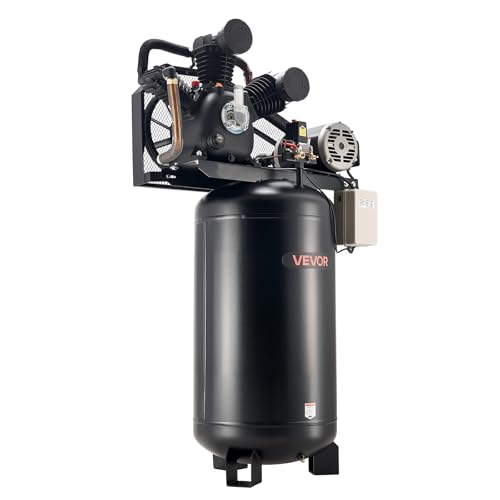
VEVOR 80 Gallon Heavy-Duty Air Compressor
What We Like
- High 17 SCFM air delivery for demanding tools.
- Massive 80-gallon tank reduces compressor cycling.
- Dual air outlets allow two-tool simultaneous operation.
- Belt-driven pump provides stable, efficient performance.
Trade-offs
- Requires a 230V three-phase electrical connection.
- Large 65.5-inch height needs significant shop space.
A 17 SCFM air delivery at 90 PSI is the key spec for running a plasma cutter continuously without stalling. This VEVOR unit’s 80-gallon tank and 10 HP motor are built to supply that volume of air consistently, making it a serious foundation for an industrial shop or large fabrication space. It’s for the user whose workflow demands long, uninterrupted runs with air-hungry tools, where stopping to let a smaller compressor catch up isn’t an option.
The major trade-off is its permanent installation requirement. This makes it a very different beast from a portable unit like the DEWALT 27-Gallon compressor. That model can be rolled around a site, but it can’t match the sustained air volume this VEVOR delivers for heavy plasma cutting.
Product photos
DEWALT 27-Gallon Portable Air Compressor

What We Like
- Oil-free pump reduces maintenance
- Low-voltage motor starts reliably on 110V
- Quiet 78 dBA operation suits indoor shops
- Vertical design fits in tight spaces
Trade-offs
- At 136 pounds, moving it requires a hand truck
- Larger footprint than compact 20-gallon units
Operating at a modest 78 dBA, this air compressor can run in an attached garage or indoors without causing a major disturbance, making it suitable for home improvement projects. Its 27-gallon vertical tank offers a portable air supply that fits into tight spaces, providing a space-efficient solution for a home garage. The oil-free pump and low voltage start motor are designed for maintenance-free use and reliable operation under typical household power conditions.
Its air delivery is rated at 5.1 SCFM at 90 PSI, which is suitable for many portable air tool applications. Compared to an industrial unit like the VEVOR 80-gallon compressor that delivers 17 SCFM, the DEWALT provides a more compact and quieter solution for a different scale of work. This positions it as a vertical portable compressor for garage and home workshop use, rather than for large industrial manufacturing.
Ingersoll Rand Type 30 Air Compressor

What We Like
- Cast iron construction for continuous duty
- Large 60-gallon vertical air tank
- 230V single-phase motor for shop power
- Designed for high-volume, high-pressure runs
Trade-offs
- Weighs 430 pounds, requiring a permanent installation
- Large 69-inch height needs significant vertical clearance
- Stationary design offers no portability
With a 100% continuous duty rating from its cast iron design, this compressor can run at high pressure and volume without interruption. That means it’s built for applications demanding a non-stop air supply, not just short bursts. The 5 HP motor and 60-gallon vertical tank provide the foundation for this sustained output, making it a stationary power source for a dedicated workspace.
Its 430-pound weight and 69-inch height confirm this as a permanent installation, not a portable tool. For users who require mobility, the XtremepowerUS 30-gallon model is a gas-powered alternative with a smaller tank. The Ingersoll Rand’s design prioritizes stationary, high-output operation where air demand is constant.
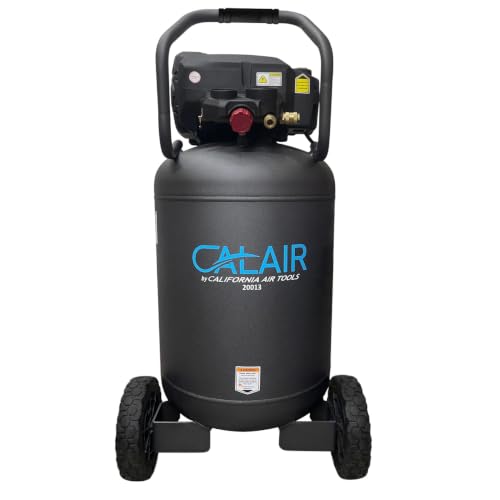
California Air Tools 20-Gallon Air Compressor
What We Like
- Oil-free pump for cold starts and uneven terrain
- 1000-plus-hour pump life cycle before wear
- 20-gallon steel tank with wheels for easy mobility
- High-pressure design for driving demanding tooling
Trade-offs
- 1.3 hp motor provides less power than industrial compressors
- 20-gallon tank is smaller than the VEVOR 80-gallon model
With a pump life cycle rated for over 1000 hours before wear, this compressor is built for long-term use, suiting a serious hobbyist or small shop prioritizing durability. The oil-free pump is designed to function in a variety of temperatures, including cold starts. Its 20-gallon steel tank is mounted on a wheel kit, making it easy to move around a jobsite or garage to deliver the high working pressure needed for tooling.
The 1.3 hp motor trades raw power for the longevity of its oil-free pump, meaning it cannot match the air volume of larger industrial units like the VEVOR 80-gallon compressor. For continuous, high-demand production work, its capacity will be reached more quickly. However, for many garage or shop tasks, this model provides a balance of portability, all-temperature operation, and a pump engineered for extended service life.
Product photos
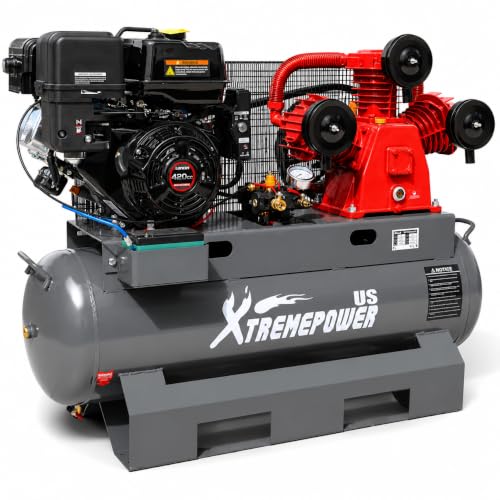
XtremepowerUS 30-Gallon Gas Air Compressor
What We Like
- Gas-powered for true worksite mobility
- Cast iron pump built for heavy-duty service
- Designed to mount in a truck or service vehicle
Trade-offs
- At 391.6 pounds, it requires a vehicle for transport.
- Gas operation adds complexity versus electric models.
With a 30-gallon gas-powered tank, this compressor delivers serious air power where there’s no electrical outlet, making it a mobile solution for remote job sites. It’s built for mechanics or contractors who need to run multiple tools directly from a service truck. The product description states these industrial air compressors work hard for serious industrial auto body and agricultural use. Its key feature is the truck-mount design, which turns any suitable vehicle into a mobile air station.
The trade-off for that mobility is a tank size that’s a compromise. At 30 gallons, it provides good capacity for a service rig, but you’ll get more air storage from a larger, stationary unit like the 80-gallon VEVOR compressor. This model is about bringing industrial-grade air to the field, not being the ultimate shop anchor. You’re choosing job-site flexibility over maximum air volume.
Product photos
How We Evaluated Air Compressors For Plasma Cutters
Our evaluation centered on technical specifications and documented requirements from plasma cutter manufacturers. We prioritized continuous air delivery (measured in SCFM), tank size, and duty cycle ratings to determine which compressors can sustain a cutting arc without overheating or cycling excessively. We also factored in practical concerns like electrical requirements, portability, and noise levels, drawing from expert round-ups and patterns in owner feedback.
This research-focused approach lets us compare models on paper, revealing which units are engineered for the sustained, high-pressure airflow a plasma cutter demands. However, we cannot account for individual shop conditions, such as local voltage stability or the length and condition of air lines, which can affect real-world performance.
What To Look For In Air Compressors For Plasma Cutters
Plasma cutters need a steady stream of clean, dry air at the correct pressure. An undersized compressor will cause poor cuts and frequent stops. Your choice should be based on your cutter’s requirements and your own workflow.
Focus on sustained airflow (SCFM), not just tank size. Ensure the compressor’s flow rating exceeds your cutter’s needs at your operating pressure. Also consider voltage, duty cycle, and portability.
Airflow (SCFM) And Pressure (PSI)
Airflow, measured in Standard Cubic Feet per Minute (SCFM), is the most critical number. A plasma cutter needs a high, continuous SCFM rating to maintain a clean arc. Pressure (PSI) is also important, but most plasma cutters operate between 60-90 PSI; any good shop compressor will reach this. The real challenge is delivering that pressure consistently while the tool is drawing air, which depends on the pump’s SCFM output.
Duty Cycle And Tank Size
The duty cycle indicates how long the compressor motor can run within a 10-minute period. A 100% duty cycle means it can run continuously. For longer cuts, you need a high duty cycle and a large air tank. The tank acts as a reservoir, so the larger it is, the less often the motor must cycle on to replenish air, which reduces wear and prevents pressure drops during your cut.
Power, Portability, And Air Quality
Consider your shop’s electrical supply. Many high-output compressors require 230V circuits. Oil-free pumps offer low maintenance and are better for cold starts, but oil-lubricated models often provide longer pump life. For mobility, look for wheeled tanks or compact footprints. Finally, remember that plasma cutters need clean, dry air. You will likely need an aftercooler, filter, and water separator in your air line setup, regardless of the compressor you choose.
- Check your plasma cutter’s manual for its minimum required CFM at its rated PSI.
- Verify your available electrical outlet (120V or 230V) before choosing a compressor.
- Consider future tool additions; your total SCFM needs are cumulative if running multiple tools.
- Factor in the noise level if your workshop is near living spaces.
- Plan for air line filtration to protect your plasma cutter’s consumables from moisture and oil.
Select a compressor with a flow rate capacity at least 1.5 times your plasma cutter’s consumption for reliable performance.
Air Compressors For Plasma Cutters Compared
To see how these models stack up on key specifications, refer to the comparison table below.
| Product | Motor Power | Air Delivery | Tank Capacity |
|---|---|---|---|
| VEVOR 80 Gallon Heavy-Duty Air Compressor | 10 HP | 17 SCFM at 90 PSI | 80 Gallon |
| DEWALT 27-Gallon Portable Air Compressor | 1.7 HP | 5.1 SCFM at 90 PSI | 27 gallons |
| Ingersoll Rand Type 30 Air Compressor | 5 HP | N/A | 60 gallon |
| California Air Tools 20-Gallon Air Compressor | 1.3 hp | N/A | 20 gallons |
| XtremepowerUS 30-Gallon Gas Air Compressor | 13.0HP | N/A | 30 Gallon |
Frequently Asked Questions
What size air compressor is needed to run a plasma cutter?
Check your plasma cutter’s manual for its required CFM, usually between 3.5 and 6.7 SCFM. A good rule is to choose a compressor with a flow rate at least 1.5 times that number. You also need a tank large enough to prevent the motor from cycling on and off during typical cuts.
Can you run a plasma cutter off an air compressor?
Yes, most modern plasma cutters are designed to run on clean, dry shop air from a compressor. However, the compressor must meet the cutter’s specific CFM and PSI requirements. An undersized unit will lead to poor cut quality, frequent stops, and can damage the tool.
What air pressure should I run my plasma cutter at?
Most handheld plasma cutters operate effectively between 60 and 75 PSI. Always consult your operator’s manual for the specific inlet pressure recommendation for your model. Remember, pressure at the cutter will be lower than at the compressor due to line loss.
What is the best air compressor for a CNC plasma table?
A CNC plasma table requires continuous, high-volume air. Look for a stationary compressor with a 100% duty cycle, a large tank (60 gallons or more), and a high SCFM output, like our VEVOR 80 Gallon or Ingersoll Rand picks. This ensures the table can run long programs without interruption.
Are there plasma cutters with built-in air compressors?
Yes, some manufacturers make all-in-one plasma cutters that integrate the compressor. These are highly portable and simplify setup, but the built-in compressors are typically for lower-amperage, intermittent cutting and cannot match the volume of a dedicated shop compressor.
The Bottom Line
For most serious shops running plasma cutters, the VEVOR 80 Gallon Heavy-Duty Air Compressor is the best overall choice, delivering the high, continuous airflow required for demanding, prolonged cutting sessions. For home workshops where noise and space are concerns, the quiet and space-efficient DEWALT 27-Gallon model is a smart pick, while contractors working off-grid will appreciate the true mobility of the XtremepowerUS gas-powered compressor. Ultimately, matching your compressor’s sustained CFM output to your plasma cutter’s needs is the single most important factor for a successful setup.
