
9 Best Angle Grinder Blades For Tile Cutting in 2026
This post contains affiliate links. As an Amazon Associate, we earn from qualifying purchases.
The ONEGOTOOL Tile Cutter Diamond Blade 3-Pack is the best overall for its excellent balance of value and performance, providing multiple ultra-thin blades for clean cuts. For pros who switch tasks constantly, the Bosch X-Lock excels at quick changes, while the RUBI VIP Turbo Mesh is built to power through hard porcelain. Each blade serves a different need in tile work.
Cutting tile with a grinder demands a blade that matches your material and finish expectations. A poor choice leads to chipping, slow progress, or a blade that wears out too fast. The right blade turns a potentially messy job into a series of precise, controlled cuts.
Our recommendations are based on comparing specifications, manufacturer performance claims, and patterns in professional feedback. We break down the key differences so you can buy with confidence for your specific project.
Top 9 Angle Grinder Blades For Tile Cutting in the Market
Certain content that appears on this site comes from Amazon. This content is provided "as is" and is subject to change or removal at any time.
The Best Angle Grinder Blades For Tile Cutting, Reviewed
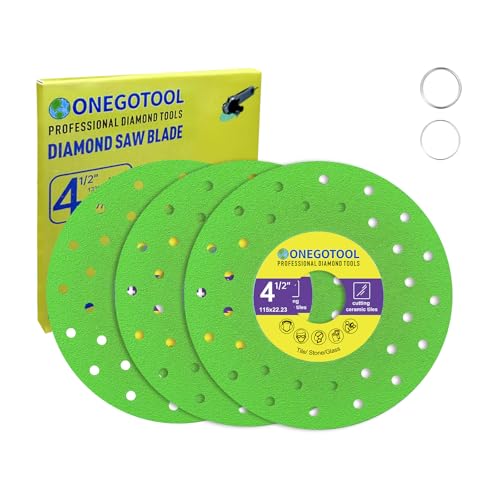
ONEGOTOOL Tile Cutter Diamond Blade 3-Pack
What We Like
- Ultra-thin 0.05-inch blade for clean, narrow cuts.
- One-piece molded construction for durability and safety.
- Dual-sided sanded edges for grinding and polishing versatility.
- Three-blade pack increases overall tooling lifespan.
Trade-offs
- 4.5-inch diameter limits depth of cut versus 5-inch models.
Getting three blades in one pack fundamentally changes the value proposition for anyone facing a big tiling job. The ultra-thin 0.05-inch profile is the key here, minimizing material waste and chipping for a clean finish on porcelain and ceramic. This pack is built for the DIYer or contractor who needs to outfit multiple grinders or simply wants the security of backups on hand without stopping work. The one-piece molded construction promises to hold up under stress, making it a pragmatic choice for high-volume cutting where blade failure is a real concern.
The trade-off is in specialization. While it handles tile and marble well, the lack of any mentioned vibration control or turbo segments means it might not be the first pick for all-day granite work. A blade like the RUBI VIP Turbo Mesh is engineered for that specific long-haul durability. For the majority of bathroom and kitchen tile projects, however, the ONEGOTOOL pack delivers capable performance straight out of the box. You get a sharp, precise cutting tool multiplied by three, which is often exactly what you need to finish the job.
Product photos
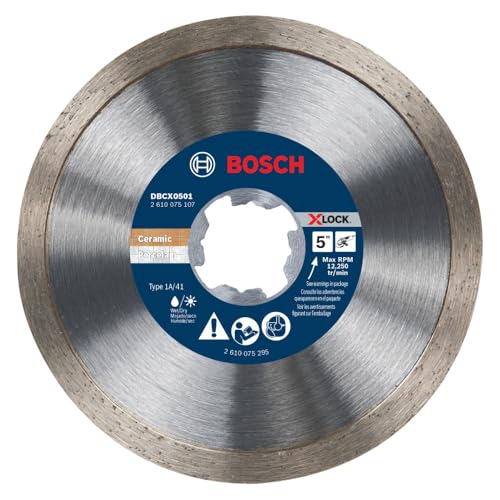
Bosch X-Lock Continuous Diamond Blade
What We Like
- X-Lock system for rapid wheel changes
- Fits both X-Lock and standard arbor grinders
- Continuous rim for smoother cuts in hard materials
- Engineered for professional-grade performance
Trade-offs
- 5-inch diameter limits depth versus larger blades
- Specific rim design is for finishing, not rough cuts
Its X-LOCK system allows for up to five times faster wheel changes than standard 7/8-inch arbor grinders. This can reduce downtime during multi-step projects. The blade’s continuous rim and small diamond grit with a softer matrix are designed for smooth cuts in hard materials like porcelain and marble. That makes it suitable for tasks such as installing tile backsplashes or cutting flooring. Bosch engineers this diamond wheel for professional-grade performance across a range of applications.
A continuous rim blade like this is designed for smooth, precise cuts, not for aggressive material removal. For rapid, rougher cuts in similar materials like granite or porcelain, a turbo-rim blade such as the RUBI VIP Turbo Mesh could be an alternative. While the Bosch DB4543S is also a standard arbor continuous rim blade, this model’s X-LOCK interface provides a quick-change capability. It fits both X-LOCK and standard 7/8-inch arbor grinders across brands.
Product photos
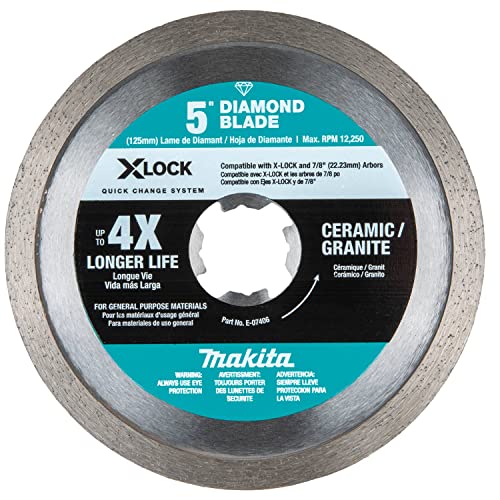
Makita X-Lock Continuous Rim Diamond Blade
What We Like
- X-LOCK system enables tool-free blade changes
- Continuous rim delivers a finer finish
- Optimum bond matrix for faster, smoother cutting
- Claimed up to 4x longer life than competitors
Trade-offs
- Requires an X-LOCK compatible angle grinder to function
- Continuous rim design is less aggressive for rough cuts
Makita claims this blade can last up to four times longer than competitive blades, which means fewer replacements for a user. Its continuous rim is designed to deliver a finer finish than segmented or turbo rim blades, resulting in less edge chipping on ceramic and granite. An optimum bond matrix aims to provide faster, longer lasting, and smoother cutting.
The X-LOCK quick-change system requires a compatible grinder, locking out standard threaded spindles. This system is claimed to allow tool-free changes up to five times faster than a standard mount. For a standard grinder, the Bosch DB4543S is a 4.5-inch continuous rim diamond blade without the proprietary mount.
Product photos
Makita General Purpose Diamond Blade

What We Like
- Continuous rim for a precise, smooth finish
- General purpose design cuts multiple materials
- Expertly balanced core reduces vibration and noise
- Optimum bond matrix for faster, longer-lasting cutting
Trade-offs
- Continuous rim design requires slower, more controlled feed rate
A continuous rim and expertly balanced steel core deliver a smoother, more precise cut than aggressive segmented blades, making it a versatile first choice for mixed-material projects. This blade is built for the user who needs one reliable disc to handle ceramic wall tile, natural stone, and the occasional granite countertop cut without swapping tools. Its general-purpose diamond bond and design prioritize a clean finish across a broad range of materials, not maximum speed on any single one.
This general purpose diamond blade from Makita is designed to handle a mix of tile, granite, ceramic, porcelain, and stone, making it a versatile choice for varied renovation tasks. Its continuous rim delivers a more precise and smoother finish than segmented blades by maintaining constant contact with the material. An expertly balanced premium steel core reduces vibration and noise during operation.
Product photos
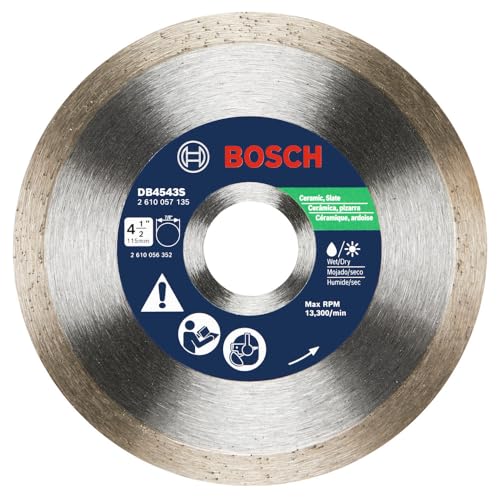
Bosch Standard Continuous Rim Diamond Blade
What We Like
- Continuous rim for fast, durable cuts in tile and slate
- Steel core provides straight cuts with less wobble
- Soft bond formulation for efficient cutting
- Optimized diamond pattern for effective material engagement
Trade-offs
- A 4.5-inch diameter limits depth of cut versus larger blades
- Continuous rim design is for tile, not general masonry materials
A steel core and continuous rim design mean this blade is built to track straight and resist wobble, which is the foundation for a clean, chip-free line in ceramic tile and slate. That solid construction directly translates to the smooth, controlled cuts this blade delivers, making it a reliable choice for finish work where the edge will be visible. If your priority is a polished result on standard tile installations without constant guiding corrections, this blade’s engineered stability handles that job.
This blade’s continuous rim design delivers durable, fast performance specifically in ceramic tile and slate, making it a focused tool for those materials. Its soft bond formulation is intended for upgraded and efficient cutting in those applications. The steel core aims to provide straight smooth cuts with less wobble, which Bosch states contributes to longer blade life.
Product photos
RUBI VIP Turbo Mesh Diamond Blade

What We Like
- Turbo mesh design for faster cutting on hard materials
- Thicker center reduces vibration for smoother operation
- Extra long life diamond edge for durability
- Includes 5/8" adapter for wide machine compatibility
Trade-offs
- 4.5-inch diameter limits cut depth versus larger blades
- Specialized for hard materials, not a general-purpose blade
The turbo mesh design and thicker core are engineered specifically for tough materials like granite and porcelain, allowing this blade to cut faster while resisting the wobble that can ruin a precise line. It’s the blade to reach for when you’re facing dense stone or engineered slabs where other discs would bog down or wear out prematurely. The included 5/8″ ring adapter means it’s ready to mount on most common grinders right out of the package.
Designed specifically for hard materials like granite, porcelain, and slate, this blade’s turbo mesh pattern prioritizes cutting speed and finish quality on dense surfaces. That same aggressive design can be excessive for standard ceramic wall tiles or softer stones, where it risks chipping the material. This RUBI blade trades general versatility for targeted performance on demanding cuts.
DEWALT Continuous Rim Diamond Blade

What We Like
- Extended diamond matrix for long life
- Turbo design cuts brick and block
- Versatile for wet or dry use
Trade-offs
- 0.2 lb weight indicates a standard thickness, not super thin
- Standard arbor requires a compatible adapter for some grinders
A diamond matrix rated for 350 times the life of conventional abrasives means this blade won’t wear out on you halfway through a backsplash project. That longevity, combined with its ability to run wet or dry, makes it a solid, versatile foundation for a DIYer who tackles masonry and tile work without wanting to swap blades constantly. It’s the workhorse you grab when you need to cut a mix of materials, from ceramic tile to patio blocks, and want a single blade that can handle it all.
The trade-off for that versatility is specialization. Think of it as your reliable all-rounder, not your specialist for delicate tile work. For cutting curves in standard ceramic wall tile or notching a brick, its sturdy construction and dual-purpose nature are clear advantages.
Product photos
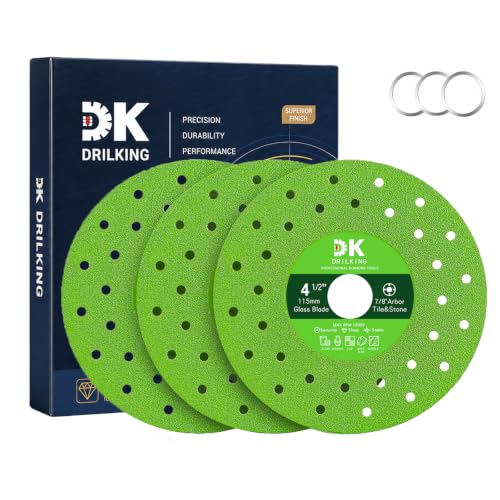
DRILKING Ultra-Thin Diamond Blade 3-Pack
What We Like
- Ultra-thin 1.2mm blade minimizes chipping
- Vacuum-brazed diamond grit for long cutting life
- Solid steel core reduces vibration for safer operation
- Three-blade pack offers convenient replacements
Trade-offs
- 4.5-inch diameter limits cutting depth versus larger blades
- Standard arbor lacks X-Lock quick-change convenience
The 1.2mm blade thickness is the key spec here, allowing for exceptionally clean cuts in tile and stone with minimal material waste. This makes the DRILKING pack a standout for detail work on splashbacks or intricate floor patterns where a chipped edge would ruin the finish. The three-blade set is a practical choice for a weekend renovation, ensuring you have a fresh disc on hand when needed. It’s built for the DIYer or tradesperson who values precision and needs a reliable blade for porcelain, ceramic, or natural stone.
This three-pack of diamond blades fits most 4.5-inch angle grinders, making it a practical choice for common tile and remodeling tasks. Its ultra-thin 1.2mm design aims for smooth, chip-free cuts in materials like porcelain and granite. The vacuum-brazed diamond grit is described as providing longer life than standard bonded discs, and having two extra blades offers convenient replacements for ongoing projects.
Product photos
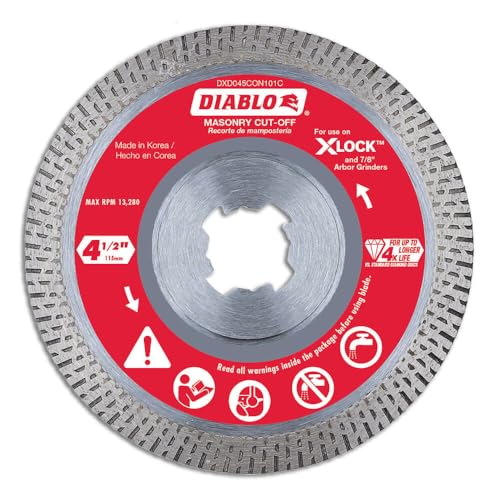
Diablo X-Lock Diamond Continuous Rim Disc
What We Like
- Works with both X-Lock and standard arbor grinders
- Ultra-thin continuous rim for precise, chip-free cuts
- High 13,280 RPM rating for fast-paced work
- Industrial-grade diamond rim for lasting durability
Trade-offs
- Continuous rim design is less aggressive than turbo or segmented blades.
- Specific to tile and stone, not a general-purpose blade.
Backwards compatibility with standard 7/8″ arbors is the key feature here. It means you can upgrade to a premium diamond blade without needing to upgrade your entire grinder, making it a smart, flexible choice for anyone with a collection of standard tools. The industrial-grade diamond and ultra-thin continuous rim are engineered for smooth, chip-free cuts in tile and stone, which is exactly what you need for finish work. This blade is for the pragmatist who wants modern performance without making their existing tools obsolete.
The trade-off for that smooth, clean cut is speed in thicker or harder materials; a continuous rim cuts slower than a turbo-rim blade like the RUBI VIP. Its 4.5″ diameter also gives you slightly less cutting depth than 5″ models from Bosch or Makita. For quick, rough cuts on dense stone, you might feel the pace. But for controlled, precise trimming and finishing on tile installations, where a clean edge is paramount, this Diablo disc delivers exactly what its design promises.
Product photos
How We Evaluated Angle Grinder Blades For Tile Cutting
We researched this category by analyzing product specifications, manufacturer data on blade construction and intended use, and expert round-ups from trade sources. We also looked for consistent patterns in owner feedback regarding cut quality, durability, and real-world performance with materials like porcelain and ceramic.
The most important criteria were the blade’s rim design for cut quality, its compatibility with your grinder’s arbor, and its suitability for your primary material. We prioritized blades that offer a clear advantage for a specific task, like chip-free precision or rapid swapping. You can explore our broader list of best tile blades for more options.
A research-based evaluation has limits; we cannot account for every grinder model or on-site variable. Our goal is to provide a strong, evidence-backed shortlist to inform your purchase.
What To Look For In Angle Grinder Blades For Tile Cutting
Selecting a blade isn’t just about diameter. You must match the blade’s design to your tile material and the type of cut you need. A mismatch can ruin tiles or wear out the blade prematurely.
The core choice is between a continuous rim for smooth, chip-free finishes on visible edges and a turbo or segmented rim for faster cutting in hard materials like porcelain. Always verify your grinder’s arbor size and maximum RPM rating.
Rim Design & Cut Quality
The blade’s rim design dictates its cutting action and final edge quality. A continuous rim has a smooth, unbroken edge that grinds material away, producing the cleanest finish with minimal chipping on glazed ceramic or polished porcelain. This is the go-to for any cut that will be visible.
For harder materials like thick porcelain or natural stone, a turbo rim is often more effective. Its segmented design with gullets clears debris and cuts more aggressively, though it may leave a slightly rougher edge. Some blades, like the RUBI VIP Turbo Mesh, combine these concepts for speed on hard tiles. For the best results, pair your blade choice with one of the best angle grinders for tile.
Arbor Compatibility & Quick-Change Systems
The blade must physically fit and securely lock onto your grinder’s spindle. The standard arbor size for four-and-a-half-inch and five-inch blades is seven-eighths of an inch or M14. Always check your tool’s manual. Some blades include a reducing bushing for wider compatibility.
A major innovation is the X-Lock quick-change system, found on blades from Bosch and Makita. It allows for tool-free swaps in seconds, a huge time-saver for pros. However, it requires a compatible X-Lock grinder. The Diablo blade offers a hybrid design for use on both X-Lock and standard arbors, providing excellent backwards compatibility.
Material & Project Suitability
Not all diamond blades are equal for every tile. Softer ceramic wall tile is forgiving, but dense porcelain, granite, or engineered stone demands a blade with a specific bond matrix and diamond concentration to avoid glazing and rapid wear. A general-purpose blade can handle a mix, but for volume work on a single hard material, a specialized blade will last longer and cut faster.
Your project scope also matters. A three-pack like the ONEGOTOOL or DRILKING offers tremendous value for a multi-day DIY job, ensuring you always have a sharp blade ready. For a single, precise cut, a premium single blade may be sufficient. Proper technique is also crucial; learn the right way to cut tile with an angle grinder to maximize any blade’s performance.
- Check your grinder’s maximum RPM rating against the blade’s rating.
- For wet cutting, ensure the blade is specifically rated for it.
- Consider a dust shroud attachment to control harmful silica dust.
For most DIY tile jobs, a 4.5-inch continuous rim blade provides the best balance of control and cut quality.
Angle Grinder Blades For Tile Cutting Compared
The following table compares the key specifications of our top picks to help you see the differences at a glance.
| Product | Diameter | Rim Type/Design | Primary Materials |
|---|---|---|---|
| ONEGOTOOL Tile Cutter Diamond Blade 3-Pack | 4.5 inches | Dual-sided sanded | Porcelain Ceramic Glass Marble |
| Bosch X-Lock Continuous Diamond Blade | 5 in. | Continuous | Tile, porcelain, marble |
| Makita X-Lock Continuous Rim Diamond Blade | 5 inches | Continuous rim | Ceramic and granite |
| Makita General Purpose Diamond Blade | 4-1/2 inches | Continuous rim | Tile, granite, ceramic, porcelain, stone |
| Bosch Standard Continuous Rim Diamond Blade | 4.5 inches | Continuous rim | Ceramic tile and slate |
| RUBI VIP Turbo Mesh Diamond Blade | 4.5 inches | Turbo mesh | Granite, porcelain, slate |
| DEWALT Continuous Rim Diamond Blade | 4-1/2-Inch | Continuous Rim Turbo | brick, block, and tile |
| DRILKING Ultra-Thin Diamond Blade 3-Pack | 4.5 inches | Ultra-thin | tile, rock Jade , glass, marble, stone, granite and cement |
| Diablo X-Lock Diamond Continuous Rim Disc | 4-1/2" | Continuous, Ultra-Thin | Tile & Natural Stone |
Frequently Asked Questions
What is the best blade for cutting tile with an angle grinder?
The best blade depends on your material and needs. For most DIYers tackling ceramic or porcelain, a continuous rim diamond blade like our Best Overall, the ONEGOTOOL 3-Pack, provides clean, chip-free cuts. For professional speed on hard materials, a turbo rim blade like the RUBI VIP is a better choice.
Can I use the same blade on ceramic and porcelain tile?
Yes, many general-purpose continuous rim blades are designed for both materials. However, porcelain is much harder and will wear a standard blade faster. For frequent porcelain work, a blade specifically formulated for hard materials will offer longer life and more consistent performance.
What’s the difference between a wet and dry cutting blade?
Blades rated for wet cutting can be used with water for cooling, which reduces dust and can extend blade life. Blades for dry cutting are more common for angle grinders and are designed to dissipate heat through their design. Never use a dry-only blade with water, as it can damage the blade’s bond.
Do I need a special blade for cutting natural stone like granite?
Yes. Natural stone is very dense and abrasive. You need a diamond blade with a turbo or segmented rim and a bond matrix designed for hard stone. Using a blade meant for soft ceramic will glaze over and stop cutting effectively, potentially damaging the stone.
Should I choose a blade with a quick-change system like X-Lock?
If you own a compatible X-Lock grinder and frequently switch between cutting, grinding, and polishing tasks, the speed and convenience are significant advantages. If you have a standard grinder or rarely change blades, a traditional arbor blade is more cost-effective and offers a wider selection, including excellent blades for tile saws.
The Bottom Line
For the majority of tile-cutting projects, the ONEGOTOOL Tile Cutter Diamond Blade 3-Pack is the best overall choice. It delivers exceptional value and clean, precise cuts with its ultra-thin design, and having three blades means you can tackle a big job without stopping.
If your budget is tight, this pack is the clear winner. For professionals who need to swap blades in seconds, go directly to the Bosch X-Lock. For cutting extremely hard porcelain or stone, the RUBI VIP Turbo Mesh is your specialist.
Ultimately, matching the blade’s rim design to your tile material is the single most important factor for a successful, chip-free installation.
