
4 Best Cnc Plasma Cutters in 2026
This post contains affiliate links. As an Amazon Associate, we earn from qualifying purchases.
For builders assembling a serious shop system, the Lotos LTP6300DCNC CNC Plasma Cutter is the best overall component, thanks to its built-in CNC interface and non-HF arc start. The Everlast PP80S excels in high-amperage performance, while the Eastwood Versa-Cut 4×4 CNC Plasma Table is the best all-in-one starter kit.
The right choice depends on whether you need a standalone cutter for an existing table or a complete, ready-to-run system. We researched specifications, manufacturer data, and patterns in owner feedback to evaluate four distinct options. This guide cuts through the complexity to help you match the right tool to your workshop goals.
Top 4 CNC Plasma Cutters in the Market
Certain content that appears on this site comes from Amazon. This content is provided "as is" and is subject to change or removal at any time.
The Best CNC Plasma Cutters, Reviewed
Lotos LTP6300DCNC CNC Plasma Cutter

What We Like
- Built-in CNC interface with THC support for table integration
- Non-HF pilot arc protects sensitive CNC electronics
- Dual-voltage operation for 63A shop or 35A portable work
- Clear LED display and adjustable modes for setup control
Trade-offs
- Drag-cut consumables (DC6309) are a separate purchase
- Requires a compatible, external CNC table to function as a CNC
- Needs a clean, dry external air supply and correctly rated circuit
A 63-amp output on 220 volts gives you the muscle to cleanly slice through 3/4-inch steel, which covers the vast majority of shop projects from brackets to art pieces. Combine that with a dedicated CNC interface and arc-voltage output for torch height control, and you have a cutter ready to be the heart of a serious plasma table setup. Its non-HF pilot arc is the right choice for protecting your table’s electronics, and the dual-voltage flexibility means you can still tackle lighter repairs on a standard 110-volt outlet. This makes it a supremely versatile core component for a fabricator looking to build or upgrade a capable CNC system.
This is a plasma power supply only, so buyers will need to provide their own CNC table and air compressor. For a completely integrated, out-of-the-box solution, the Eastwood Versa-Cut 4×4 CNC Plasma Table bundle is the simpler alternative. However, the Lotos LTP6300DCNC delivers a professional-grade foundation for builders who prioritize raw cutting power and control integration. Research mentions it is probably the second most popular option for a specific table kit and has a little bit more cutting power than the LOTOS LTP5500D.
Everlast Welders Canada PP80S Cnc Plasma Cutter

What We Like
- 80-amp output for heavy-duty cutting
- Blowback start works on rusted metal
- Built-in tip saver extends consumable life
- 5-year parts and labor warranty
Trade-offs
- Maximum quality cut speed is 12 IPM on thick steel
- Primarily a cutter component, not a full table system
An 80-amp output with a 60% duty cycle lets you run it at full power for six minutes out of every ten, which is a common rating for sustained shop work. The blowback start simplifies arc initiation on painted or rusted surfaces, a practical feature for real-world materials. Adjustable post-flow control up to 50 seconds and a tip saver function are included to help extend consumable life between cutting jobs.
At 53 pounds, this plasma cutter is a substantial component meant for a stationary setup, as it’s designed to be paired with a separate CNC table. Its capacity for quality cuts extends up to 1-1/4 inches of steel under ideal conditions, with a recommended regular cutting thickness of up to 1 inch. For a buyer who already has a table or is sourcing one independently, like the models from STV Motorsports or Eastwood, this unit provides the dedicated cutting power.
Product photos
Eastwood Versa-Cut 4×4 CNC Plasma Table

What We Like
- All-in-one bundle with plasma cutter and table
- Built-in CNC controller eliminates need for laptop
- Lifetime tech support from the manufacturer
Trade-offs
- 40A cutter limits material thickness versus higher-amp units
- 149-pound weight requires a dedicated, sturdy workshop space
Eastwood bundles a 40A plasma cutter with its 4×4 CNC table and a dedicated controller, so you can begin cutting without needing a separate computer or sourcing components. The controller’s LCD interface is described as intuitive and user-friendly, and it comes preloaded with standard shapes and patterns. It also accepts custom files via a USB slot, which allows for both ready-made projects and custom work.
The trade-off for that convenience is in raw cutting capacity; the 40A unit won’t tackle the same thick plate as a dedicated 63A machine like the Lotos LTP6300DCNC. This setup is about getting a capable, space-efficient fabrication cell running quickly, not pushing the limits of industrial production. For a serious shop ready to invest in a larger, more modular system, a Made-in-USA table like the STV Motorsports SparX510 offers greater size and potential for future upgrades.
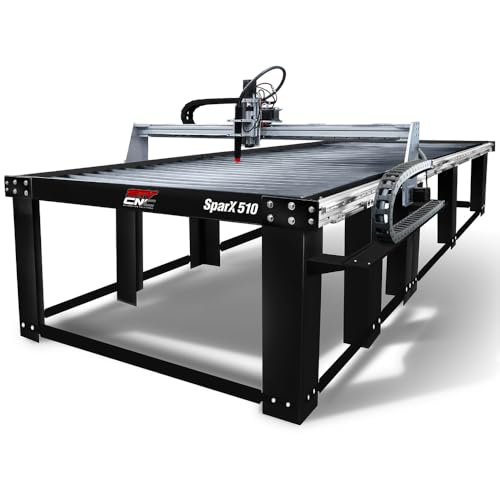
STV Motorsports SparX510 CNC Plasma Table
What We Like
- Built tough in the United States
- Includes full software package and license
- Lifetime support and installation guidance
Trade-offs
- Windows-based software limits OS flexibility
- Requires a separate plasma cutter
Built tough in the USA and designed to handle 3/4-inch steel plates, this table is for serious fabrication where durability matters. It includes a lifetime support package with setup help and tutorials, providing a crucial resource for maintaining shop productivity. The Windows-based control software, included with a license, manages the high-accuracy stepper motors for consistent operation.
You’ll need to supply your own plasma cutter and have the floor space for a substantial table, as the specific footprint isn’t detailed.
Product photos
How We Evaluated CNC Plasma Cutters
Our evaluation reviewed product specifications, manufacturer documentation, and expert round-ups from trusted sources in the fabrication community. We focused on criteria critical for successful CNC integration. This includes the presence and type of CNC interface for remote start and arc voltage feedback, the arc start technology to protect sensitive table electronics, and the cutter’s amperage and duty cycle for intended material thickness. A key limit of this research-based approach is that we cannot verify long-term durability or real-world cut quality across different shop environments and user skill levels.
What To Look For In CNC Plasma Cutters
Choosing between a standalone plasma cutter unit and a complete table system is the first major decision. Key factors include the CNC interface, arc start technology, and power output relative to your material needs.
Look for a non-HF (blowback) arc start to protect CNC electronics, a dedicated CNC port for remote control, and sufficient amperage for your thickest planned cuts. Ensure your air supply and electrical circuit can support the unit’s requirements.
CNC Interface and Arc Start Technology
A CNC-ready plasma cutter requires a dedicated port for remote start/stop signals and arc voltage feedback, which is needed for torch height control (THC). The arc start method is also important. High-frequency (HF) start models can produce electromagnetic interference that disrupts CNC controllers. A non-HF or blowback start, as found on many modern plasma cutters designed for CNC tables, is safer for a table’s electronics and is a necessary feature for integrated systems.
Power Output and Duty Cycle
The rated amperage determines maximum cut thickness, but the duty cycle, how long it can run continuously at a given amperage, is equally important for production work. A 40-amp cutter might handle 1/4-inch steel well, while cutting 1/2-inch plate requires a 60-amp or 80-amp unit. For hobbyist work on thinner materials, a compact 4×4 CNC plasma table with a 40A cutter may suffice, but professional shops will need higher-amperage machines. Always match the power supply to your most common material thickness to avoid overworking the unit.
System Integration: Cutter vs. Complete Table
Determine if you need a component or a turnkey solution. A standalone cutter like the Lotos or Everlast models is for integrating into a separate CNC table frame you build or purchase. A complete system, like the Eastwood bundle, includes the table, controller, and cutter, simplifying setup. When sourcing a table separately, consider its construction, drive system, and software compatibility. Resources on selecting CNC plasma tables or CNC plasma tables for small business can help inform that decision.
- Verify your shop’s electrical service can handle the required circuit (e.g., 240V, 50A+ for high-amperage units). Confirm the unit requires a clean, dry external air supply and that your air compressor meets the CFM and PSI requirements for plasma cutters.
- Check that the included or recommended torch is a machine torch, not a hand torch, for optimal CNC mounting and performance.
A good rule of thumb: your plasma cutter’s amperage should be at least double the rating needed for your most common cut thickness to ensure a healthy duty cycle and clean cuts.
CNC Plasma Cutters Compared
The following table compares key specifications across our picks to highlight their different roles in a workshop.
| Product | Cut Capacity | Amperage Output | Input Voltage |
|---|---|---|---|
| Lotos LTP6300DCNC CNC Plasma Cutter | Up to 3/4 in. clean | 63 Amps | Dual 110V/220V |
| Everlast Welders Canada PP80S Cnc Plasma Cutter | Up to 1-1/4 inches | 80 Amp | N/A |
| Eastwood Versa-Cut 4×4 CNC Plasma Table | N/A | 40A | Dual Voltage |
| STV Motorsports SparX510 CNC Plasma Table | Handles 3/4" steel plates | N/A | N/A |
Frequently Asked Questions
What is the best plasma cutter for a CNC machine?
The best plasma cutter for a CNC machine is one with a dedicated CNC control port, a non-HF blowback arc start to prevent electronic interference, and sufficient amperage for your material. Our top overall pick, the Lotos LTP6300DCNC, exemplifies these features, making it an excellent component for a custom table build.
What are the best brands of plasma cutters?
Established brands like Hypertherm are industry standards for reliability and performance, often found on professional CNC plasma cutting systems. For hobbyist and prosumer markets, brands like Lotos and Everlast offer capable CNC-ready units at more accessible price points, as reflected in our selections.
What is the best CNC controller for plasma cutting?
The best controller depends on your workflow. A dedicated industrial touchscreen controller offers robustness, while a PC-based system using software like Mach3 or LinuxCNC provides flexibility for advanced CAD/CAM work. Some all-in-one tables, like the Eastwood Versa-Cut, use a proprietary built-in controller for simplicity.
Which plasma cutting machine is the best?
The “best” machine depends entirely on your needs. For a high-performance component to add to a table, our Best Overall Lotos LTP6300DCNC is a top choice. For a ready-to-run system, the Eastwood Versa-Cut 4×4 is the best starter kit. For the utmost in cutting power, the Everlast PP80S is the best high-amperage performer.
Should I buy a plasma cutter with a built-in air compressor?
Integrated air compressor models offer portability but typically lack the continuous air volume (CFM) and dryness required for sustained, high-quality CNC cutting. For reliable table operation, a separate, high-quality air compressor for plasma cutters is almost always the better choice.
The Bottom Line
The Lotos LTP6300DCNC is our best overall pick for the workshop builder who needs a powerful, CNC-ready plasma cutter component to integrate into a separate table system. It offers crucial features like a safe arc start and dual-voltage operation.
If your primary need is cutting thick plate, look to the Everlast Welders Canada PP80S for its high-amperage performance. For a complete out-of-the-box solution, the Eastwood Versa-Cut 4×4 CNC Plasma Table bundle is the straightforward choice.
Ultimately, ensuring your plasma cutter has a proper CNC interface and a non-HF arc start is the single most important factor for a successful, reliable automated cutting setup.
