
10 Best Cordless Ratchets in 2026
This post contains affiliate links. As an Amazon Associate, we earn from qualifying purchases.
The DEWALT ATOMIC 20V MAX is our best overall cordless ratchet due to its powerful brushless motor and versatile, oil-resistant design. For a lightweight, high-speed kit, the Milwaukee M12 FUEL earns the Best High-Speed Kit award. The Makita 12V CXT offers unique versatility with interchangeable anvils. This guide helps you choose the right tool to save time and reduce strain on the job.
A cordless ratchet excels where bulkier impact tools can’t reach, speeding up fastener work in tight engine bays or confined panels. The right choice balances torque, size, battery platform, and your specific workflow.
We built this guide by analyzing specifications, manufacturer documentation, and patterns in professional reviews and owner feedback. Below, you’ll find our ranked picks, a detailed comparison, and clear advice on what truly matters for your needs.
Top 10 Cordless Ratchets in the Market
Certain content that appears on this site comes from Amazon. This content is provided "as is" and is subject to change or removal at any time.
The Best Cordless Ratchets, Reviewed
DEWALT ATOMIC 20V MAX Cordless Ratchet

What We Like
- Brushless motor delivers 70 ft-lbs of torque
- Compact design for tight locations
- Onboard LED work light
- Glass-filled nylon resists oils and solvents
Trade-offs
- Tool only: requires separate 20V MAX battery and charger
- At 15.8 inches long, it's less compact than sub-compact models
- Heavier than some 12V platform competitors
Seventy foot-pounds of torque from a brushless motor means this ratchet can handle the stubborn fasteners that stop lesser tools, making it a versatile single solution for both automotive and mechanical work. The compact, low-profile head genuinely lets you sneak into engine bays and tight frames, while the variable speed trigger gives you the finesse for reassembly. It’s the cordless ratchet you grab when you need one tool to do it all, backed by a battery platform many tradespeople already own.
Compatibility with all DEWALT 20V MAX batteries means this ratchet fits directly into an existing tool collection without extra chargers or battery types. Its larger 20V platform results in a tool weighing 2.6 pounds, so it’s not the ideal choice for quick interior jobs where the one-pound Milwaukee M12 Sub-Compact Ratchet excels. For a pro or serious DIYer already using DEWALT 20V tools, it handles most applications without needing a separate, lighter-duty ratchet.
Milwaukee M12 FUEL High Speed Ratchet Kit

What We Like
- Lightweight 1.7-pound design for overhead work
- Complete kit includes battery and charger
- Compact 15-inch length for tight spaces
Trade-offs
- M12 battery platform, not compatible with 18V systems
At 1.7 pounds, this ratchet reduces arm fatigue during overhead or engine bay work. It operates within Milwaukee’s M12 battery system. The kit includes a battery, so it arrives ready for use without separate purchases.
The trade-off for that capable motor and battery is a 15-inch overall length. Compared to the bulkier Ingersoll Rand R3130, however, it saves nearly two pounds, which is a decisive advantage for extended use. You’re selecting a tool optimized for speed and reduced fatigue, not for the absolute minimum clearance.
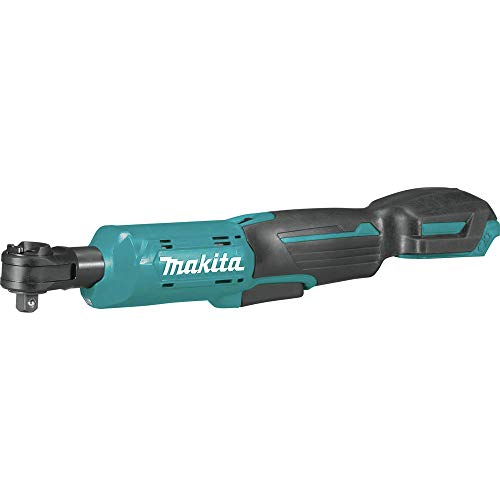
Makita 12V CXT Cordless Ratchet
What We Like
- Interchangeable 3/8" and 1/4" anvils
- Variable speed trigger for control
- Can be used as a manual ratchet
- Electric brake stops quickly
Trade-offs
- Tool only: battery and charger sold separately
- 35 ft.lbs torque is modest for heavy-duty work
The interchangeable 3/8″ and 1/4″ anvils mean you can tackle everything from engine bays to electronics without switching tools. That 35 ft.lbs of torque and variable speed up to 800 RPM handles most light to medium fastening, and the electric brake saves time between sockets. This ratchet fits the technician who needs one tool for a mix of fastener sizes and appreciates the ability to manually ratchet in tight spots.
The 35 ft.lbs limit means it’s not the choice for stubborn suspension bolts, where a higher-torque option like the Ingersoll Rand might be necessary. For general mechanical work where socket size changes frequently, however, its design eliminates a common hassle.
Product photos
Ingersoll Rand R3130 Cordless Ratchet

What We Like
- Steel frame and composite housing for extreme durability
- All-metal gear train for maximum power transfer
- 54 ft-lbs of torque rivals air tool performance
- Variable-speed trigger with electronic brake for control
Trade-offs
- Weighs 3.5 pounds
- Length is 16.1 inches
With 54 ft-lbs of torque, the Ingersoll Rand R3130 delivers the kind of muscle you’d expect from an air tool, making it a reliable choice for breaking loose stubborn fasteners on a shop floor. Its steel-reinforced frame and all-metal gear train are built to withstand daily professional abuse, so it’s a tool you can grab without worrying it’ll give up on a tough job. This is a ratchet for mechanics and fabricators who need industrial-grade strength and prioritize longevity over absolute lightness.
The Ingersoll Rand R3130 uses a steel frame and tough composite housing to protect its internal components from job-site abuse. Its 3.5-pound weight and 16.1-inch length give it a substantial feel that can lead to fatigue during extended overhead use. Compared to a much lighter one-pound option, this cordless ratchet trades some maneuverability for its durable construction.
Milwaukee M12 Sub-Compact Ratchet
What We Like
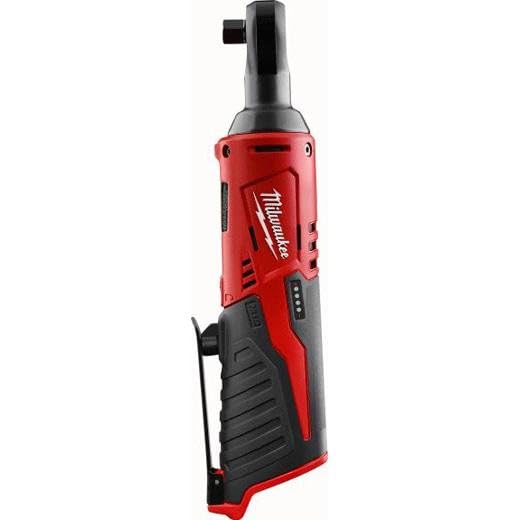
- Recessed direction switch prevents accidental actuation
- Compact head fits easily into tight engine bays
- Built-in LED light for dim workspaces
- Onboard fuel gauge shows battery status
Trade-offs
- Tool only: requires separate M12 battery purchase
- Kickback is noticeable when fastener won't budge
Weighing just one pound with a head only 1.8 inches tall, this ratchet is built for the tight spots others can’t reach. Its low-profile head design allows work in an engine bay without issue, and a recessed forward-backward switch on the back prevents accidental actuations mid-job. That compact form is the primary feature for confined spaces like machinery cavities or crowded engine compartments.
That compact build does come with a trade-off. At 35 ft-lbs, it’s on the lighter side for an impact ratchet. Research confirms it can stall on a tough brake caliper bolt, forcing you to break it loose manually first. You’re trading brute force for accessibility. If you regularly face larger, rusted fasteners, a more powerful option like the DEWALT ATOMIC 20V MAX might be a better fit for your shop, despite its larger size. This Milwaukee excels as a finishing and speed tool, not a breaker of serious corrosion.
DEWALT 20V MAX XR Sealed Head Ratchet

What We Like
- Sealed head and housing resist automotive fluids
- Interchangeable anvil for two drive sizes
- On-board LED light for low-light work
- Trigger lock prevents accidental activation
Trade-offs
- Bare tool only: requires separate battery purchase
- At 16.7 inches long, it's less nimble in very tight spaces
- Heavier than most 12V class ratchets like the Milwaukee M12 Sub-Compact
The DEWALT 20V MAX XR Sealed Head Ratchet delivers 75 ft-lbs of max torque from its brushless motor. Its glass-filled nylon housing is designed to help prevent damage from automotive oils and solvents, which can be relevant for shop environments. An interchangeable anvil design provides the ability to quickly swap between 3/8-inch and 1/2-inch square drives.
This tool measures 16.7 inches long and weighs 3.1 pounds. In comparisons, a review notes that a competing Ridgid model with a battery can be purchased for substantially less than this DEWALT or a Milwaukee sold without batteries. The Milwaukee M12 Sub-Compact Ratchet is listed at 1.0 pounds and 9.5 inches long.
VESSEL 400ER3 Slim Electric Ratchet
What We Like
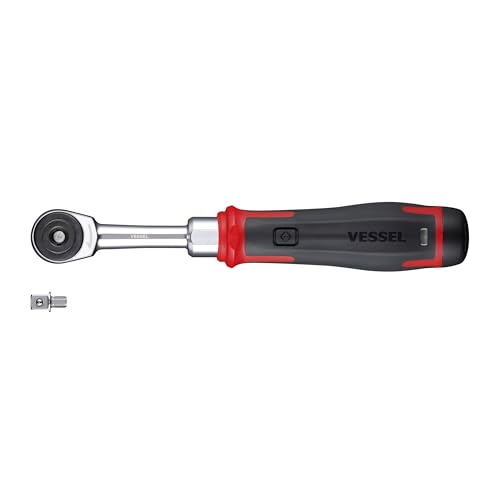
- Extremely light 0.7-pound design
- 60 gears for fine movement in tight spaces
- Convenient USB-C recharging
- Compact, slim profile from Japanese manufacturing
Trade-offs
- Tool-only listing lacks battery and charger
- Lower 400 rpm speed compared to high-torque models
At 0.7 pounds, the VESSEL 400ER3 is a notably light cordless ratchet, which helps reduce arm fatigue during overhead work or in tight spaces. Its 60-gear mechanism provides fine movement for working in narrow spaces, allowing for precise control when threading fasteners. The tool is made in Japan.
The tool’s no-load speed is 400 rpm. It operates as a bare tool and is rechargeable with USB-Type C, requiring a separate power source. For tasks in confined areas where low weight and portable charging are priorities, its slim design offers practical benefits.
Product photos
ADOTOCAM Cordless Ratchet for Milwaukee

What We Like
- Brushless motor for longer lifespan and efficiency
- Extended 5.5" neck for tight-space access
- Variable speed trigger for precise control
- Durable aluminum alloy housing
Trade-offs
- Tool only: requires a separate Milwaukee 18V battery
- No battery or charger included in the purchase
Compatibility with the Milwaukee 18V battery platform is the key feature here, letting you leverage an existing investment in batteries and chargers. That makes this a pragmatic choice for the Milwaukee user who needs a capable ratchet without starting a new battery system. Its 75 ft-lbs of torque from a brushless motor and the slim, extended head are well-suited for automotive and mechanical work where space is tight and power is non-negotiable.
The trade-off is that it’s a tool-only proposition, so its value hinges entirely on you already owning those batteries. For sheer compactness, dedicated 12V systems are lighter and can slip into places this one can’t. But if your shop already runs on red lithium packs, the ADOTOCAM ratchet delivers the core performance you need.
Product photos
AOBEN Cordless Electric Ratchet Kit
What We Like
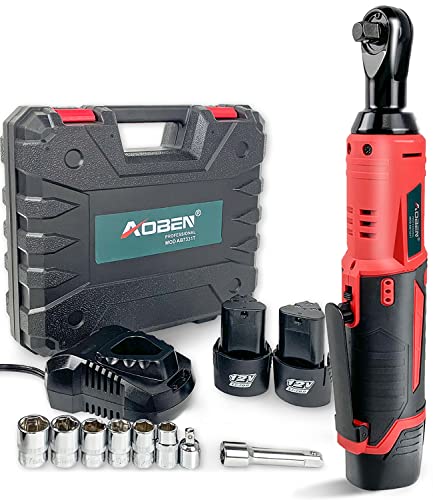
- Complete kit includes two batteries and a charger
- Forward/reverse switch positioned to prevent accidental actuation
- LED work light and battery status indicators
- Air-cooled motor for heat management
Trade-offs
- At 4.4 lbs, it's heavier than the Milwaukee M12 Sub-Compact (1.0 lb)
- Torque is 40 ft-lbs, less than some 18V/20V models
The AOBEN kit includes two batteries and a charger, so it’s ready to use immediately after charging. Its motor delivers 40 ft-lbs of torque and a speed of 280 rpm for removing or installing bolts and nuts. An LED light illuminates the work area, and side lights indicate the remaining battery charge.
At 4.4 pounds, the tool is heavier than some other models, such as a one-pound sub-compact design. Its air-cooled motor is designed to stabilize battery temperature during operation. The backward switch on the head is intended to prevent accidental actuation.
Product photos
Makita WR180DZ Rechargeable Ratchet
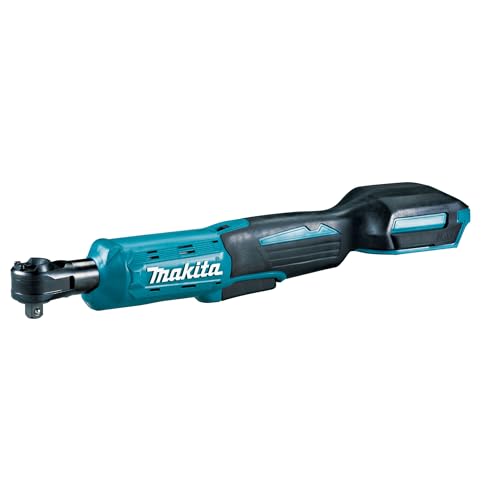
What We Like
- Slim body profile for tight spaces
- Can be tightened or loosened manually
- Includes forward/reverse lever and LED light
- Penetrating hole design for M8 nuts
Trade-offs
- Tool only: requires separate 18V Makita battery and charger
- At 2.6 lbs, it's heavier than some 12V competitors
The Makita WR180DZ can be tightened or loosened by hand, like a standard ratchet, which allows for manual control in tight spaces. Its maximum torque of 47.5 Nm and slim body are intended for vehicle and agricultural equipment maintenance or assembly jobs. A forward and reverse lever provides powered operation, and a penetrating hole allows access to M8 nuts from the opposite side.
You are buying into the 18V Makita platform here, so factor in the cost of a battery and charger if you don’t already own them. That commitment delivers solid power, but it also results in a tool that, at 2.6 pounds, has more heft than a compact 12V option. For a user with a stack of Makita 18V batteries, this ratchet integrates smoothly and offers a unique hybrid operation that pure power tools can’t match.
Product photos
How We Evaluated Cordless Ratchets
Our evaluation is research-based. We examined specifications and manufacturer data for torque, size, weight, and features. We also studied expert round-ups and aggregated common praises and complaints from owner feedback to understand real-world performance and durability patterns.
The key criteria were torque for breaking fasteners, physical size for access in tight spaces, and compatibility with existing battery platforms to avoid extra cost. We also prioritized features like sealed heads for automotive fluid resistance and onboard lights for low-visibility work.
A limitation of this research-led approach is that we cannot verify exact runtime or long-term durability through hands-on stress testing. Our recommendations are based on the consensus from technical data and aggregated user experiences, which reliably indicate a tool’s likely performance.
What To Look For In Cordless Ratchets
Choosing a cordless ratchet involves balancing power, access, and your existing tool collection. The goal is to find a tool that feels like an extension of your arm, not a compromise.
Focus on torque (measured in foot-pounds) for stubborn fasteners, overall length and head size for tight spaces, and your current battery ecosystem. A complete kit is great for new users, while a “tool-only” option saves money if you already own compatible batteries.
Torque and Drive Size
Torque, measured in foot-pounds (ft-lbs), determines the tool’s ability to break loose or tighten fasteners. Models in our list range from about 35 ft-lbs for light-duty work to 70 ft-lbs for more demanding applications. Most general-purpose work is well-served by tools in the 45-55 ft-lbs range. The drive size, most commonly 3/8-inch, determines the socket you can use; it’s the most versatile standard for automotive and mechanical tasks. For a deeper dive on this popular size, see our guide on best 3/8 ratchets.
Size, Weight, and Platform
A cordless ratchet’s value is in its ability to reach confined areas. Overall length and head compactness are critical specifications. Weight affects fatigue during overhead work, with models varying from very light to heavier builds. Your decision often starts with the voltage platform, as sticking with your existing brand’s batteries is the most cost-effective path. Understanding the advantages of cordless ratchets and their trade-offs helps frame this decision.
Key Features and Kits
Look for a variable-speed trigger for control, an LED work light, and a sealed or oil-resistant housing if you work around automotive fluids. Some models offer unique perks like interchangeable anvils or the ability to function as a manual ratchet. Decide if you need a complete kit with battery and charger, or a bare tool.
Kits are ideal for starting a new system, while tool-only options offer better value if you’re expanding a collection you already own, like Milwaukee’s M12 or 18V lines. For those specifically working on vehicles, our resource on ratchets for automotive repair offers further tailored advice.
- Check the tool’s total length against the spaces you commonly work in.
- Consider if a brushless motor (for efficiency and longevity) is worth a potential premium.
- Verify the direction switch placement to avoid accidental actuation.
- Look for a battery fuel gauge if runtime awareness is important.
- Assess the warranty and the brand’s reputation for durability in professional settings.
The best cordless ratchet is the one that fits your hand, fits your workspace, and fits into the battery ecosystem you already use.
Cordless Ratchets Compared
The table below compares our top picks across critical specifications to help you see the differences at a glance.
| Product | Drive Size | Max Torque | Weight | No-Load Speed |
|---|---|---|---|---|
| DEWALT ATOMIC 20V MAX Cordless Ratchet | 3/8 in. | 70 ft-lbs | 2.6 Pounds | N/A |
| Milwaukee M12 FUEL High Speed Ratchet Kit | 3/8 inch | N/A | 1.7 pounds | N/A |
| Makita 12V CXT Cordless Ratchet | 3/8" & 1/4" anvils | 35 ft.lbs | 2.4 pounds | 0-800 RPM |
| Ingersoll Rand R3130 Cordless Ratchet | 3/8 inch | 54 ft-lbs | 3.5 pounds | 225 rpm |
| Milwaukee M12 Sub-Compact Ratchet | 3/8 inch | 35 ft-lbs | 1.0 pounds | 250 RPM |
| DEWALT 20V MAX XR Sealed Head Ratchet | Interchangeable 3/8" & 1/2" | 75 ft-lbs | 3.1 pounds | 0-300 RPM |
| VESSEL 400ER3 Slim Electric Ratchet | N/A | N/A | 0.7 pounds | 400 rpm |
| ADOTOCAM Cordless Ratchet for Milwaukee | 3/8" | 75 Ft-lbs | N/A | 0-250 RPM |
| AOBEN Cordless Electric Ratchet Kit | 3/8 inch | 40 ft-lbs | 4.4 pounds | 280 rpm |
| Makita WR180DZ Rechargeable Ratchet | N/A | 47.5 Nm | N/A | 800 RPM |
Frequently Asked Questions
Who makes the best cordless ratchets?
Top brands like DEWALT, Milwaukee, Makita, and Ingersoll Rand consistently produce high-quality cordless ratchets favored by professionals. The “best” depends on your needs: DEWALT and Milwaukee often lead in power and compact design, while Makita offers innovative features like interchangeable drives. Our research into top cordless ratchet models highlights the strengths of various manufacturers.
Are battery-powered ratchets worth it?
Yes, for anyone regularly removing fasteners in tight spaces. They save significant time and reduce hand and wrist fatigue compared to manual ratcheting. They are not meant to replace high-torque impact wrenches for lug nuts or suspension bolts, but for engine bays, dashboards, and assemblies, they are invaluable efficiency tools. Exploring reviews of battery ratchet wrenches can clarify their ideal use cases.
Is a 72 tooth or 90 tooth ratchet better?
A higher tooth count allows for a smaller swing arc to engage the next tooth, which is beneficial in extremely tight quarters where you can only move the handle a few degrees. However, for a cordless ratchet, the motor’s drive mechanism is more relevant than the manual ratchet’s tooth count. Focus instead on the tool’s overall length, head size, and torque.
Which cordless ratchet has the most torque?
Among the models listed, the DEWALT ATOMIC 20V MAX and the DEWALT 20V MAX XR models offer some of the highest torque ratings, at 70 ft-lbs. The Ingersoll Rand R3130 also provides strong, air-tool-rivaling power at 54 ft-lbs. High torque is crucial for breaking loose seized or over-tightened fasteners without reaching for a breaker bar.
What’s the difference between a cordless ratchet and an impact wrench?
A cordless ratchet uses a rotating motor to turn the socket, similar to a drill but with a ratcheting head. It’s for speed in confined spaces. An impact wrench delivers sudden, concussive rotational blows (impacts) to generate very high torque for breaking loose extremely tight fasteners like lug nuts. They are larger, louder, and not as nimble. For a comparison of related tools, see our look at best electric ratchet wrenches.
The Bottom Line
The DEWALT ATOMIC 20V MAX Cordless Ratchet is our best overall pick, delivering a powerful 70 ft-lbs of torque in a durable, versatile package ideal for mechanics invested in the 20V platform. It balances strong performance with good access, making it a reliable primary tool.
For buyers seeking a complete, ready-to-use kit, the Milwaukee M12 FUEL High Speed Ratchet Kit is an excellent choice. If your priority is the absolute smallest tool for confined spaces, look to the Milwaukee M12 Sub-Compact or the ultra-lightweight VESSEL 400ER3.
Ultimately, the single most important factor is fit: the tool must physically fit in your workspace and logically fit into your existing battery system. Choosing a compatible tool you can use right away is smarter than buying a new ecosystem for one ratchet.
