
10 Best Dovetail Router Bits in 2026
This post contains affiliate links. As an Amazon Associate, we earn from qualifying purchases.
The Freud 22-104 Dovetail Router Bit earns the best overall spot for its 14-degree profile and broad jig compatibility. Other notable selections include the CMT ORANGE TOOLS 818.628.11, which is the best match for Incra jigs, and the Whiteside Router Bits D10-55 as the top 10-degree angle option. Using an incompatible or poorly suited bit risks joints that don’t fit, vibration during the cut, or potential damage to your tools. This guide is based on comparing specifications, manufacturer compatibility statements, and expert analysis to find the bits that provide the cleanest results for specific tasks.
Top 10 Dovetail Router Bits in the Market
Certain content that appears on this site comes from Amazon. This content is provided "as is" and is subject to change or removal at any time.
The Best Dovetail Router Bits, Reviewed
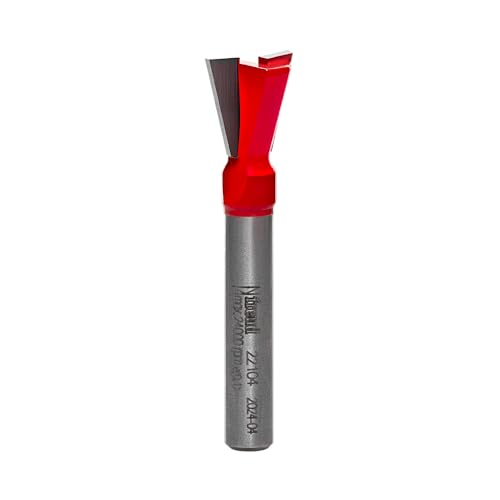
Freud 22-104 Dovetail Router Bit
What We Like
- Perma-SHIELD coating for reduced friction.
- Computer balanced for vibration-free operation.
- Compatible with many popular dovetail jigs.
- Anti-kickback design enhances safety.
Trade-offs
- 1/4-inch shank limits use in heavy-duty routers.
- Overall length of 1-7/8 inches offers less reach than some bits.
The 14-degree angle and 1/2-inch diameter strike a classic balance, creating a joint that’s both strong and visually pleasing for drawers and small boxes. Its computer-balanced construction and Perma-SHIELD coating mean it runs smoothly in handheld routers, reducing chatter and tear-out in fine hardwoods. This bit is a reliable workhorse for the woodworker who values predictable, clean results across a variety of jigs and projects, from shop furniture to keepsake boxes.
Freud’s dovetail bit uses a 1/4-inch shank, which fits many common handheld and table-mounted routers. Its 14-degree angle and 1/2-inch diameter are standard for creating strong drawer and box joints. The computer-balanced design aims to reduce vibration during high-speed operation over 22,000 RPM, which can contribute to a smoother finish.
Product photos
CMT ORANGE TOOLS 818.628.11 Dovetail Router Bit

What We Like
- Designed specifically to fit Incra jigs
- SinterHip carbide ensures long-lasting sharpness
- Non-stick coating reduces pitch and resin buildup
Trade-offs
- 1-2 inch cutting length limits joint depth
- Requires a 1/2-inch router collet
A 1/2-inch shank and specific 14-degree geometry mean this bit is engineered from the ground up for use with Incra’s precision jigs. That built-in compatibility translates to clean, repeatable cuts without slop or chatter in the guide bushing. For anyone committed to that system, it’s a purpose-built component, not an afterthought. The industrial carbide and non-stick coating are just sensible features that keep you making joints instead of cleaning bits.
Designed specifically for the Incra Jig, this CMT bit delivers great cutting performance within that system. Its 1/2-inch shank and diameter are matched to the jig’s requirements, so it removes a variable for dedicated users. Wood Magazine rated CMT bits the best overall in a comparison to other brands.
Product photos
Whiteside Router Bits D10-55 Dovetail Router Bit
What We Like
- 10° angle creates strong, decorative finger joints
- 1/2" shank provides stability in heavy cuts
- Carbide-tipped for clean cuts in various woods
- Designed for hand-held, table, and CNC routers
Trade-offs
- 5/8" cut depth limits stock thickness
The 10-degree cutting angle is the key feature here, producing a dovetail joint with a noticeably shallower slope than the common 14-degree bits. This creates a more delicate, traditional-looking finger pattern that adds a stylish touch to drawers and boxes, while still delivering a strong interlocking joint. It’s a solid choice for woodworkers who prioritize that classic aesthetic and are working with standard thickness stock, given its 5/8-inch cutting length.
With a 5/8-inch cutting length, this bit defines the maximum thickness of material you can machine in a single pass. For deeper joints needed in heavier furniture, other bits offer greater depth. In typical drawer and box construction, however, this Whiteside delivers precise, shallow-angle dovetails, and its compatibility with systems like Incra’s enhances its utility in an organized shop.
Product photos
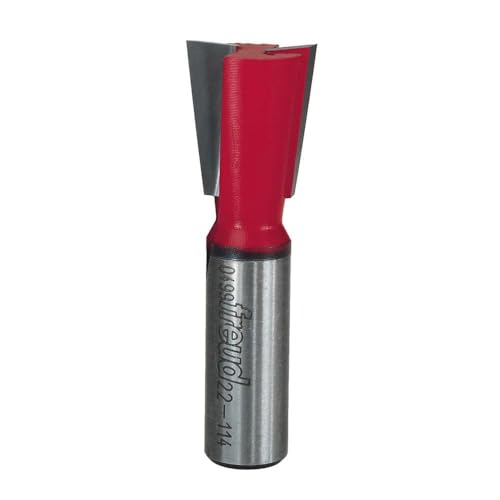
Freud 22-114 Dovetail Router Bit
What We Like
- Half-inch shank for stable cuts in routers.
- Perma-SHIELD coating for reduced friction.
- Compatible with many popular dovetail jigs.
- Large 3/4-inch diameter for substantial joints.
Trade-offs
- 7° angle is a specific, less common joint profile.
- Short 2-5/8" length limits depth in some jig setups.
A 7-degree cutting angle is the defining feature here, making this bit the precise tool for creating the shallow, elegant dovetail joints often preferred in fine furniture and small boxes. The Freud 22-114 is built for that specific task, with a full 1/2-inch shank to resist deflection and a durable carbide edge to stay sharp. It’s the clear choice for a woodworker whose project plans call for that exact, traditional angle, and the Perma-SHIELD coating helps it run smoothly through the cut.
This Freud bit has a 7-degree angle, which creates shallower, more easily separated joints than the typical 14-degree designs. That makes it a specialist tool for specific jigs and delicate work, not a general-purpose choice for building sturdy drawers or cabinets. For those stronger applications, a bit like the Bosch 84703M with its 14-degree angle would be a more versatile first purchase.
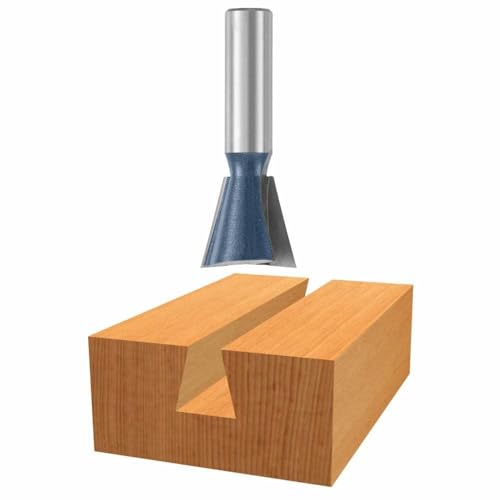
Bosch 84703M Dovetail Router Bit
What We Like
- Cuts half blind, through, and sliding dovetails
- Micrograin carbide tips for long wear life
- Control cut design helps minimize kickback
Trade-offs
- Requires a fixture or router table for proper operation
- Limited to 1/2-inch diameter dovetail joints
The Bosch 84703M’s ability to create half-blind, through, and sliding dovetails with a single bit makes it a remarkably versatile choice for drawer and box construction. This versatility is its core strength, allowing a woodworker to tackle multiple classic joint styles without needing a dedicated bit for each one. The 14-degree angle and 1/2-inch cutting diameter are common standards, ensuring compatibility with many jigs and plans. It’s a logical pick for the craftsperson who values a streamlined toolkit and wants to master several joint types.
For best results, the Bosch bit should be used with a fixture or router table, which provides the stable, guided context it’s designed for. Its control cut design helps minimize kickback during operation, a genuine benefit for safety and cut quality. While the Freud 22-114 has a larger 3/4-inch diameter, the Bosch 84703M’s half-inch size and design create half-blind, through, and sliding dovetails for drawer and box construction.
Amana Tool 45850 Dovetail Router Bit

What We Like
- 1/4-inch shank fits most compact routers
- Full 1/2-inch cutting height for deep joints
- Carbide-tipped edge for lasting sharpness
- 14-degree angle for traditional dovetail profile
Trade-offs
- 1/4-inch shank lacks rigidity for heavy cuts in hardwoods
The 1/4-inch shank is the defining feature here, making this Amana bit a direct fit for the vast majority of benchtop and compact router models. That half-inch cutting height is serious, allowing you to cut deep, strong joints in drawer sides and box parts up to the full thickness. If your workshop revolves around a router that only accepts quarter-inch collets, this bit delivers a professional-grade 14-degree dovetail profile without needing an adapter or a new tool.
The trade-off for that shank compatibility is inherent to its design. A 1/4-inch shank simply can’t handle the same torsional force as the larger half-inch size, so you’ll need to make controlled, incremental passes in dense hardwoods to avoid chatter. Compared directly to the Freud 22-104, the Amana has a slightly longer overall profile, which can be an advantage for chip clearance, but both share the same shank limitation. This bit excels in its specific niche but isn’t the choice for a high-horsepower cabinet router.
Product photos
CMT ORANGE TOOLS 818.142.11B Dovetail Router Bit

What We Like
- Guide bearing enables precise template routing
- Two cutting edges for extended bit life
- Compact 2-inch length fits in tight spaces
- 1/4-inch shank compatible with most routers
Trade-offs
- 3/8-inch cutting depth limits stock thickness
- 9/16-inch diameter yields a narrower joint profile
A 9/16-inch diameter bit with a guide bearing makes this CMT model a specialist for template-guided dovetails. The bearing rides directly against your jig’s template, ensuring the cut follows the pattern exactly. That’s a huge benefit for anyone using a commercial dovetail jig, as it translates template precision directly to the workpiece. The 1/4-inch shank and compact profile make it a straightforward fit for most routers, ideal for woodworkers who prioritize repeatability and clean template work over freehand flexibility.
The trade-off is in its focused design. That 3/8-inch cutting length dictates the maximum thickness of your stock, so it’s not the bit for deep cabinet sides. If your projects demand a larger, more sturdy joint, you’d look at something like the Freud 22-114 with its 3/4-inch diameter and greater cutting length for heavier work.
Product photos
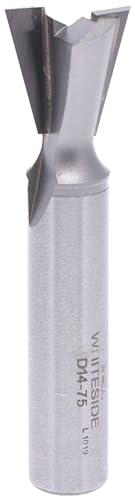
Whiteside Router Bits D14-75 Dovetail Router Bit
What We Like
- Large 3/4-inch diameter for strong, visible joints.
- Full 3/4-inch cutting depth for thicker stock.
- Carbide-tipped construction for clean cuts in wood.
- Compatible with router tables, handheld units, and CNC.
Trade-offs
- Requires a router with a 1/2-inch collet.
- The 3-inch overall length may limit use in some compact routers.
A 3/4-inch cutting diameter creates exceptionally strong and visually prominent dovetail joints, ideal for furniture and drawers where durability and classic craftsmanship are paramount. This bit is built for the woodworker tackling substantial projects in hardwoods, offering a full 3/4-inch of cutting depth to handle thicker stock with authority. Its carbide-tipped design and 1/2-inch shank provide the rigidity needed for clean, precise cuts across natural and composite woods.
With a 3/4-inch cutting diameter and matching depth, the Whiteside D14-75 is built for creating substantial, strong dovetail joints in drawers and furniture. This large diameter demands a router with a solid half-inch collet for stable operation. The bit’s 14-degree angle and carbide-tipped design are intended to provide clean, precise cuts in natural and composite woods.
Product photos
Amana Tool 45828 Dovetail Router Bit

What We Like
- Specialized 8-degree angle for fine joinery
- Substantial 0.825-inch cutting height
- Carbide-tipped construction for durability
- Compact 2-3/4-inch overall length
Trade-offs
- 1/4-inch shank limits use to lighter-duty routers
- Not compatible with routers requiring a 1/2-inch shank
With its 8-degree angle, this bit produces a shallower, more decorative dovetail joint compared to more common 14-degree profiles. The carbide-tipped construction is an industry standard for edge retention. A cutting height of 0.825 inches defines the maximum depth of the joint it can create.
The shank diameter is 1/4 inch, which fits many trim and mid-size routers. For applications requiring a half-inch shank, the Freud 22-114 is an example from the available selection. This bit provides a specific dovetail profile for joinery tasks.
Harfington 1-1/2" Dovetail Router Bit

What We Like
- Large 1-1/2" diameter for substantial joinery
- Full 1/2" shank provides excellent rigidity
- Tungsten carbide construction for wear resistance
- Two-flute design for efficient chip evacuation
Trade-offs
- Its 1-1/2" diameter demands a powerful router motor
- The 1-1/6" cutting depth limits use on thinner stock
With a 1-1/2″ cutting diameter, this bit creates large, visually prominent dovetail joints for cabinets or furniture where the connection is a design feature. That scale suits a woodworker needing extra strength and who has a router with enough power to spin it smoothly. The tungsten carbide material and two-flute design help manage the significant material removal a cutter this size requires.
You trade versatility for that capacity. The Harfington’s deep cut and large profile are too much for delicate box work or thin drawer sides. For tasks requiring a smaller profile, the Freud 22-114 has a 3/4″ diameter. Always make test cuts on scrap to dial in your router’s speed and feed rate for this substantial cutter, ensuring your workpiece is securely clamped to handle the forces involved.
Product photos
How We Evaluated Dovetail Router Bits
Our evaluation was research-based, examining manufacturer specifications for shank size, cutting angle, and cutting depth. We prioritized compatibility data with common dovetail jigs, as using the wrong geometry can ruin a joint. We also analyzed expert round-ups for performance insights and patterns in owner feedback regarding cut quality and bit longevity.
The most critical criteria were the dovetail angle, shank diameter, and cutting depth. The angle must match your jig’s requirements, while the shank size affects stability in your router. Cutting depth dictates the maximum stock thickness you can join. Because this is a research-led guide, we cannot report on long-term durability or personal experience with chatter in specific hardwoods.
What To Look For In Dovetail Router Bits
Dovetail bits are defined by a few key specifications that determine if they’ll work with your jig, router, and project. Getting these wrong means wasted wood and frustrating results.
Match the bit’s angle and diameter to your jig’s requirements first. Then, ensure your router’s collet fits the shank size. Finally, verify the cutting depth is adequate for your stock thickness.
Dovetail Angle
The bit’s cutting angle is its most defining feature. A 14-degree angle is the modern standard and is required by many common dovetail jigs. Bits with 7, 8, or 10-degree angles produce a shallower, more decorative profile suited to traditional furniture or fine box work, but they are not interchangeable with 14-degree jig templates. Our research shows that the best dovetail jigs are often designed for a specific angle, so always check your jig’s manual first.
Shank Size & Router Compatibility
Shank diameter is a primary factor in bit stability. A 1/2-inch shank offers maximum rigidity, reducing chatter and vibration, especially in powerful routers and when cutting hardwoods. A 1/4-inch shank fits most compact and benchtop routers but can deflect during aggressive cuts. Some high-end jigs even specify 8mm shanks. Always match the shank to your router’s collet capacity; using a reducer sleeve for a smaller shank can compromise stability.
Cutting Dimensions
Two measurements matter: the cutting diameter at the bit’s widest point and the cutting depth. The diameter determines the width of the tail in your joint. A larger diameter, like 3/4-inch or even 1 1/2-inches, creates a stronger, traditional-looking joint for casework.
Cutting depth, sometimes called cutting height, dictates the maximum thickness of material you can join. A bit with only a 5/8-inch cutting depth cannot create a through-dovetail in 3/4-inch stock. For a deeper dive into all the types of router bits and their uses, explore our dedicated guide.
Practical Checks Before You Buy
- Jig Compatibility: Confirm the bit’s angle and diameter are listed as compatible with your specific dovetail jig model.
- Router Power: Large-diameter bits (over 1-inch) demand a router with ample horsepower and a 1/2-inch collet.
- Project Scope: For one-off projects, a single, well-chosen bit suffices. For a shop that tackles varied joinery, a router bit set might offer better value.
-##- Bit Construction: Carbide-tipped bits stay sharper longer than high-speed steel. Solid carbide bits, often with spiral flutes, provide the smoothest shear cuts but command a premium price.
The right bit feels like an extension of your jig, not a compromise.
Dovetail Router Bits Compared
The following table compares our top picks across the key specifications to help you see the differences at a glance.
| Product | Shank Diameter | Overall/Bit Diameter | Cutting Angle | Overall Length |
|---|---|---|---|---|
| Freud 22-104 Dovetail Router Bit | 1/4" | 1/2" | 14° | 1-7/8" |
| CMT ORANGE TOOLS 818.628.11 Dovetail Router Bit | 1/2-Inch | 1/2-Inch | 14° | N/A |
| Whiteside Router Bits D10-55 Dovetail Router Bit | 1/2" | 1/2" | 10° | 2-5/8" |
| Freud 22-114 Dovetail Router Bit | 1/2" | 3/4" | 7° | 2-5/8" |
| Bosch 84703M Dovetail Router Bit | N/A | 1/2 inch | 14° | N/A |
| Amana Tool 45850 Dovetail Router Bit | 1/4 inch | 1/2 inch | 14 degrees | 2-1/4 inches |
| CMT ORANGE TOOLS 818.142.11B Dovetail Router Bit | 1/4 inch | 9/16 inch | 14 degrees | 2-Inch |
| Whiteside Router Bits D14-75 Dovetail Router Bit | 1/2 inch | 3/4 inch | 14° | 3 inches |
| Amana Tool 45828 Dovetail Router Bit | 1/4" | 1/2" | 8° | 2-3/4" |
| Harfington 1-1/2" Dovetail Router Bit | 1/2" | 1-1/2" | 14 degree | 2-5/9" |
Frequently Asked Questions
What router bit for dovetail joints?
You need a dedicated dovetail router bit, characterized by its tapered, flared cutting profile. The exact bit you need is determined by your dovetail jig’s requirements (most commonly a 14-degree angle) and your router’s collet size (1/4-inch or 1/2-inch shank).
Who makes the highest quality router bits?
Brands like Freud, Whiteside, and Amana Tool are consistently noted in expert research for their precision engineering, use of high-grade carbide, and balanced construction that reduces vibration, which is critical for clean dovetail cuts.
What is the best router bit for cutting mortise?
A mortise is best cut with a straight router bit or an up-cut spiral bit, not a dovetail bit. For mortise-and-tenon joinery, you would use a straight bit in conjunction with a router table or a dedicated mortising jig.
Is a 1/4-inch or 1/2-inch shank better for dovetail bits?
A 1/2-inch shank is generally better as it provides greater rigidity, minimizing deflection and chatter for smoother cuts. A 1/4-inch shank is suitable for lighter-duty routers and softer woods, but it may vibrate more in hard materials or during deep cuts.
Can I use any 14-degree dovetail bit with my jig?
Not necessarily. While the angle must match, the cutting diameter is also crucial. Many jigs are designed for a specific bit diameter to ensure the pins and tails mesh correctly. Always consult your jig’s manual for the recommended bit specifications.
The Bottom Line
Most woodworkers will find the Freud 22-104 to be the best overall dovetail bit, thanks to its balanced 14-degree cut and workmanship with many common jigs. The Amana Tool 45850 is a good alternative for budget-conscious users or those with routers that only accept a quarter-inch shank. Woodworkers who own Incra jigs should consider the CMT ORANGE TOOLS 818.628.11, as it is designed specifically for that system.
Ultimately, the single most important factor is compatibility. The finest bit is useless if its angle and diameter don’t match your jig’s template. Start there, and let your router’s power and your project’s scale guide the rest of your decision.
