
5 Best Handheld Wet Tile Saws in 2026
This post contains affiliate links. As an Amazon Associate, we earn from qualifying purchases.
Our best overall handheld wet tile saw is the POWERTEC HTS1045C, which combines a powerful motor with integrated water feed for clean, portable cutting. We also highlight the DEWALT DWC860W for deep cuts and the BIXIBIN machine for grooving work. This guide helps you match a portable saw’s specific strengths to your project’s demands.
Handheld wet saws solve the problem of cutting installed tile or making a few quick cuts without setting up a full table saw. The right choice balances cutting capacity against the tool’s weight and your ability to connect a water source for dust control.
We built this guide by comparing manufacturer specifications and analyzing patterns in professional feedback and expert round-ups. You’ll find a detailed breakdown of key features and a direct comparison of five top-performing models.
Top 5 Handheld Wet Tile Saws in the Market
Certain content that appears on this site comes from Amazon. This content is provided "as is" and is subject to change or removal at any time.
The Best Handheld Wet Tile Saws, Reviewed
POWERTEC HTS1045C Handheld Wet/Dry Tile Saw

What We Like
- Powerful 1400W motor handles hard materials
- Integrated water feed for clean, cool cutting
- GFCI plug for critical safety near water
- Lightweight design reduces user fatigue
Trade-offs
- Maximum cut depth limits very thick tile
- Requires a connected water source for wet cutting
- Blade size limited to 4.5 inches
Weighing only 9.5 pounds and powered by a 12-amp motor, this saw delivers heavy-duty cutting force in a format that reduces fatigue during overhead or vertical work. It reaches up to 12,000 RPM for fast cuts through ceramic, porcelain, granite, marble, and masonry. An integrated water feed system reduces dust and cools the blade, while the in-line GFCI plug is designed for safety on wet job sites.
The trade-off for that compact form is cutting capacity; you won’t be slicing through two-inch pavers with it. For deep cuts in very thick material, a larger, stationary saw is the better choice. Compared to a dedicated wall chaser like the BIXIBIN model, the Powertec is far more versatile for general tile shaping but lacks the dual-blade setup for creating precise channels. Its strength is in its balance, offering substantial power and useful features without becoming a burden to use.
Product photos
DEWALT DWC860W Handheld Wet/Dry Masonry Saw

What We Like
- 10.8-amp motor powers through granite and porcelain
- Cuts up to 3 cm deep for thick stone and tile
- Continuous rim blade provides chip-free results
- Can be used with a water feed to control dust
Trade-offs
- Dry cutting generates significant dust, requiring a mask
- Requires a garden hose hookup for wet cutting
A 3-centimeter maximum cut depth gives this handheld saw the ability to slice through most standard countertop materials and thick pavers in one go. That makes the DWC860W a strong choice for installers tackling deep porcelain or natural stone where a larger stationary saw isn’t practical. Its 10.8-amp motor provides the grunt for hard materials, and the water feed connection turns a messy job into a cleaner one. For pros or dedicated DIYers who need to make deep, straight cuts on-site, this DeWalt delivers the necessary capacity.
Dry cutting is possible with this saw, but reviewers note they generated a lot of dust and needed to wear masks, making a water hose connection the cleaner choice. It includes a depth adjustment plate for straight cuts, though it lacks a bevel function for angled work. Models like the POWERTEC HTS1045C offer that feature, so this DeWalt is built for straightforward, deep cuts in materials like granite and porcelain.
Pyroarle Electric Concrete Wet Cutting Saw

What We Like
- Exceptionally powerful 4800W motor for demanding cuts
- Deep 2.8-inch cutting capacity handles thick materials
- Integrated water pump and long hose for effective dust control
- Comprehensive electrical safety and debris protection features
Trade-offs
- Its 24.4-inch length demands significant storage space.
- The high-power motor results in a heavier, less nimble tool.
With a 4800W motor and a 2.8-inch maximum cutting depth, this saw is built for materials that demand substantial power. That capacity allows it to handle brick, concrete wall, granite, and marble as listed, where a shallower cut might not suffice. The included water pump and hose are designed to cool the blade and reduce dust during such heavy use, which can help extend the blade’s service life.
Its size and power focus it on demanding slotting tasks rather than finer detail work. For cutting standard wall tile, a more compact saw like the DEWALT DWC860W may be easier to maneuver. The Pyroarle’s adjustable baffle and cutting depth, however, make it adaptable to different work scenarios as described by the manufacturer.
Product photos
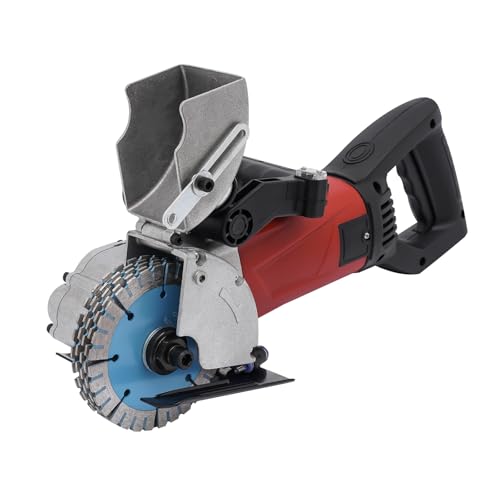
BIXIBIN Wall Groove Cutting Machine
What We Like
- High-power 2800W copper motor for demanding materials
- Adjustable depth and width for precise groove customization
- Integrated water pump system for dust-free operation
- Durable aluminum, copper, and steel construction
Trade-offs
- Primary design for wall slotting, not optimized for intricate tile cuts
- Weighs 14.3 pounds, requiring two-handed operation
With a 2800-watt motor spinning at 7000 RPM, this machine has the power for demanding groove cutting in concrete and brick, making it suitable for installing conduit or pipes in masonry. It is designed for controlled work, featuring a water pump to reduce dust and adjustable cutting depth up to 1.42 inches. The package includes five saw blades for different width requirements.
The trade-off is in specialization. This is a wall chaser first. Its lower speed and heft make it less agile for the quick, delicate cuts on ceramic tile where a tool like the POWERTEC HTS1045C excels. You buy this for its power and dust-control in masonry, accepting that it’s a dedicated solution rather than a general-purpose handheld saw for a kitchen backsplash.
Product photos
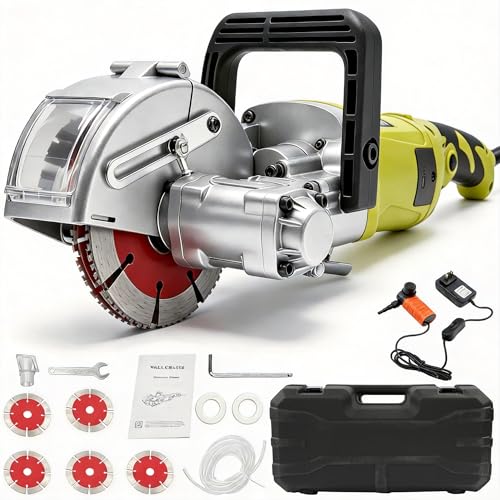
LOYALHEARTDY Wall Chaser Grooving Machine
What We Like
- Includes water pump and full dust control setup
- 360° movable headshell for corner access
- Power lock for continuous operation
- Comes in a durable, portable toolbox
Trade-offs
- At 21.6 inches long, it's a large, site-dedicated tool
- Requires simultaneous vacuum and water hookup for dust control
- 110V motor demands a substantial power source
With a 4000W all-copper motor, this wall chaser can cut up to 1.45 inches deep and 1.3 inches wide, handling tough materials like concrete and rebar. Its movable headshell allows 360-degree slotting to finish a chase in one continuous pass. The kit includes five diamond blades, a water pump, and a toolbox, so you have the core components to start a job and transport them together.
Its larger footprint and need for a vacuum and water connection make it a dedicated setup, unlike more compact handheld tile saws. The effective dust reduction design is intended for indoor renovation, but requires those accessories to function. For extensive channeling in masonry, it provides a single-pass solution with adjustable depth and width.
Product photos
How We Evaluated Handheld Wet Tile Saws
Our research focused on manufacturer documentation and expert assessments to understand each saw’s capabilities. We prioritized motor power, maximum cutting depth, and integrated water systems, as these factors determine a saw’s ability to handle tough materials while keeping dust under control.
The most important criteria were power for hard porcelain and stone, depth capacity for common tile and masonry thicknesses, and the effectiveness of dust and heat management via water feeds. We also considered ergonomics and safety features like GFCI plugs, which are critical when working with water and electricity.
A limitation of this research-led evaluation is that we cannot account for the individual user’s technique or feel. A saw’s true handling and balance are best judged in person, so we strongly suggest reviewing the physical specifications against your own strength and project setup needs.
What To Look For In Handheld Wet Tile Saws
Choosing the right saw means matching its technical limits to your most common tasks. A tool that’s perfect for trimming backsplash tile may struggle with thick natural stone, so focus on the specs that matter for your materials.
Key criteria include motor amperage for power, maximum cut depth for your tile thickness, and whether the saw has a built-in water pump or requires an external hose hookup for wet cutting.
Motor Power & Cutting Capacity
Motor power, measured in watts or amps, determines what materials can be cut. A saw with a 1400-watt motor handles ceramic and porcelain, while cutting dense granite or thick concrete requires a more powerful motor, such as a 4800-watt unit. The maximum cutting depth is also important; for standard tile, a depth of an inch or two is sufficient, but cutting thick pavers or stone requires a depth greater than two and a half inches.
Water Feed & Dust Control
A water feed isn’t just for cleanliness, it cools the diamond blade and suppresses hazardous silica dust. Some models have integrated water pumps with reservoirs, ideal for indoor work. Others require a direct garden hose connection, which is powerful but limits mobility. If you must cut dry, be prepared for significant dust and always use a high-quality respirator.
Portability & Application
True portability is a balance of weight, length, and intended use. A compact saw under ten pounds is easy to maneuver for overhead or tight-space cuts. However, specialized tools for grooving or chasing walls are heavier and longer, designed for two-handed operation on flat surfaces. Consider where you’ll use the saw most.
- Check the tool’s length against your storage space; some models are longer than twenty inches.
- Verify if the saw needs both a water source and a vacuum for effective dust control.
- Assess the grip design and weight distribution for comfort during extended use.
Match the tool’s primary design to your most frequent task, a saw optimized for wall chasing won’t excel at intricate tile mosaics.
Handheld Wet Tile Saws Compared
The comparison table below puts the key specifications of our five picks side-by-side for a quick visual reference.
| Product | Motor Power | Max RPM/Speed | Max Cut Depth |
|---|---|---|---|
| POWERTEC HTS1045C Handheld Wet/Dry Tile Saw | 12A / 1400W | 12,000 RPM | 1-7/16" |
| DEWALT DWC860W Handheld Wet/Dry Masonry Saw | 10.8 amp | N/A | 3 centimeters |
| Pyroarle Electric Concrete Wet Cutting Saw | 4800W pure copper | 5000 rpm | 2.8 inches |
| BIXIBIN Wall Groove Cutting Machine | 2800W | 7000 RPM | 1.42 inches |
| LOYALHEARTDY Wall Chaser Grooving Machine | 4000W all-copper | 6500 RPM | 0-1.45 inches |
Frequently Asked Questions
What is the best wet tile saw for the money?
For most tile professionals and advanced DIYers, the best value balances capable power with essential safety features. Our best overall pick, the POWERTEC HTS1045C, offers a strong motor, integrated water feed, and a GFCI plug at a mid-range price point, making it a reliable investment for frequent use.
What is the best handheld tile cutter?
The best handheld tile cutter depends on your primary material. For general tile work on countertops and backsplashes, the POWERTEC HTS1045C is an excellent all-around choice. For cutting thick stone or porcelain over an inch and a half deep, the DEWALT DWC860W is the superior tool.
Which wet tile cutter is the best?
The best wet tile cutter is the one whose cutting depth and power match your projects. For maximum depth and power in concrete and granite, the Pyroarle saw is unmatched. For a balance of portability and performance suitable for most tile installs, the POWERTEC HTS1045C is our top recommendation.
Are handheld tile cutters any good?
Yes, handheld tile cutters are excellent tools for specific jobs. They are indispensable for cutting tile that’s already installed, for making quick cuts without setting up a large table saw, or for working in tight spaces where a full-sized saw won’t fit. Their effectiveness hinges on using a model with adequate power and connecting a water source to control dust.
What should I know before using a wet tile saw?
Before using a wet tile saw, you must understand the critical need for water to cool the blade and suppress silica dust. Always use a GFCI-protected outlet, wear appropriate safety gear like eye protection and a respirator for dry cutting, and have a plan for managing the slurry or water runoff, especially when working indoors.
The Bottom Line
For tile installers and serious DIYers tackling a mix of countertop, backsplash, and trim work, the POWERTEC HTS1045C is the best overall handheld wet tile saw. Its powerful motor, integrated water system, and safety features make it a dependable, portable choice for most jobs.
If your budget is tight or you primarily need to cut deep channels in masonry walls, look instead at our award picks for deep cuts or grooving, like the DEWALT DWC860W or the BIXIBIN machine. These tools are specialized for their respective tasks.
Ultimately, the single most important factor is matching the saw’s maximum cutting depth and power to the thickness and hardness of the materials you cut most often. A tool that can’t handle your standard tile or stone will quickly become a source of frustration.
