
10 Best Lathes For Beginners in 2026
This post contains affiliate links. As an Amazon Associate, we earn from qualifying purchases.
The best lathe for beginners is the VEVOR 1 HP Benchtop Wood Lathe because it combines strong power with a full accessory kit for immediate start-up. Strong alternatives include the JET 10×15 for a premium build and the WEN 8×13 for its soft-start safety feature.
Choosing your first lathe can be daunting with so many specs and sizes. You need a machine that matches your project goals and shop space without overwhelming you. We researched specifications, manufacturer data, and patterns in owner feedback to identify the key features that matter most for new turners. This guide presents our findings to help you start turning confidently.
Top 10 Lathes For Beginners in the Market
Certain content that appears on this site comes from Amazon. This content is provided "as is" and is subject to change or removal at any time.
The Best Lathes For Beginners, Reviewed
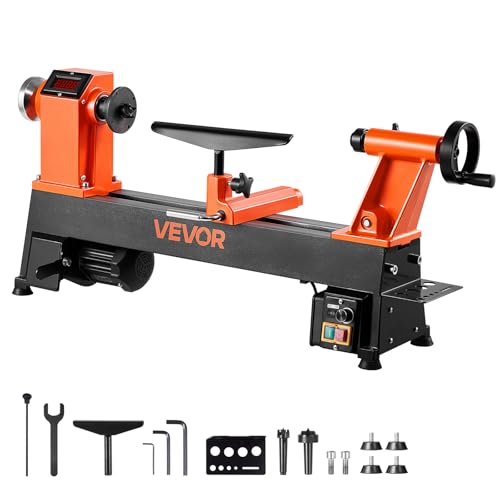
VEVOR 1 HP Benchtop Wood Lathe
What We Like
- Brushless motor eliminates carbon brush maintenance
- Wide 12×18-inch capacity for versatile projects
- Cast iron construction provides solid, low-vibration operation
- Comes with a complete accessory kit for immediate start
Trade-offs
- Its 36.6-inch length requires a substantial benchtop footprint
With a 1 HP brushless motor, this lathe provides enough power for serious cutting and shaping tasks while eliminating the maintenance of replacing carbon brushes. Its 12 by 18 inch work area accommodates projects like bowls, pens, and small carvings, giving beginners room to explore. Variable speed control from 150 to 3800 RPM handles everything from roughing out stock to fine finishing without manual gear changes. A cast iron construction minimizes vibration for stable operation, and the included accessory kit means you can start a project right away.
The trade-off is its fixed benchtop size. While the cast iron body dampens vibration, the machine’s 36.6-inch length demands a dedicated, sturdy workspace. For those with tighter shop space, the more compact JET 10×15 Variable Speed Wood Lathe is a logical comparison, though it offers less power and a smaller work envelope. This VEVOR strikes a balanced middle ground, providing more capacity and power than a mini lathe while remaining more accessible than a full-sized floor model.
Product photos
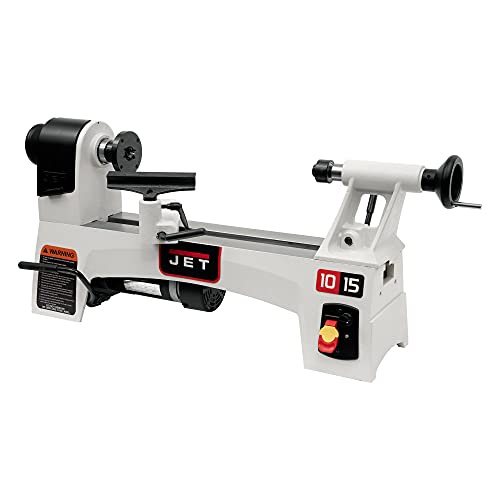
JET 10×15 Variable Speed Wood Lathe
What We Like
- Three-range variable speed for fine-tuning cuts
- Solid cast-iron construction damps vibration
- Includes centers, faceplate, and tool support
- 24-position indexing for fluting and drilling
Trade-offs
- 15-1/2" capacity limits stock length without an extension
- At 72.6 lb, it's a substantial lift for a benchtop model
Its three-range variable speed system, from 200 to 3600 RPM, handles tasks from roughing a bowl blank to finishing a slender spindle on one machine. This JET lathe suits a beginner planning to grow into the craft without outgrowing their first tool. All-cast-iron construction keeps the machine rigid and damps vibration for cleaner cuts as a gouge engages the wood. The included tooling and five-year warranty mean you can start turning the same day it arrives.
The trade-off for that premium feel and compact footprint is a 15-1/2-inch distance between centers. You’ll need the optional bed extension for anything longer, like table legs. If your primary goal is larger spindle work right away, the longer WEN 14×20 offers more capacity in a similar benchtop form. For the newcomer focused on smaller projects and exceptional build quality, however, this JET sets a high standard that rewards developing technique.
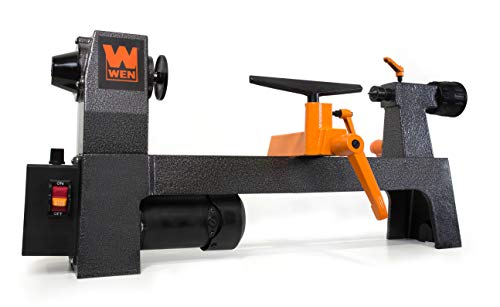
WEN 8×13 Variable Speed Benchtop Lathe
What We Like
- Soft-start motor for gradual, safer startups.
- Variable speed control across a wide range.
- Includes face plate and two tool rests.
- Compact size ideal for small workpiece projects.
Trade-offs
- MT1 taper is less common than MT2 for accessories.
- 13-inch between-centers capacity limits spindle length.
- 8-inch swing restricts diameter of bowls and cups.
This lathe’s soft-start motor begins its rotation gradually, which can help prevent sudden jolts when powering on. With a swing of eight inches and a distance of thirteen inches between centers, it accommodates small workpieces like pens and bowls. A variable speed dial adjusts from 750 to 3200 RPM, allowing the user to select an appropriate speed for different cuts and material sizes.
The eight-by-thirteen-inch capacity defines it as a mini lathe, best for pens, cups, and other small items. Users planning to work on longer spindles or larger bowls may find this size limiting. For a greater swing, the JET 10×15 Variable Speed Wood Lathe provides a larger working envelope and uses an MT2 taper, while this model includes an MT1 taper.
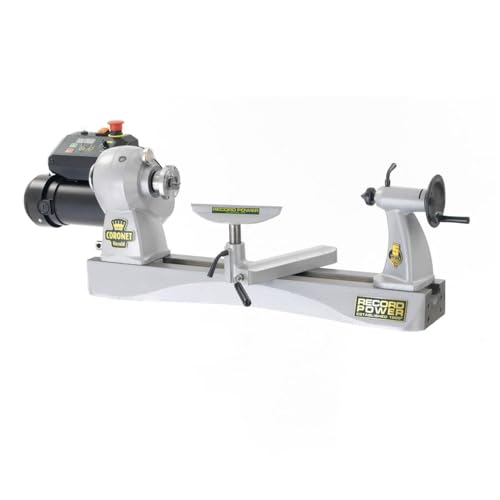
Record Power Coronet Herald Wood Lathe
What We Like
- Swivel headstock for large 21-inch bowl capacity.
- Powerful 1 HP motor handles unbalanced workpieces.
- Electronic variable speed and three pulley ratios.
- Convenient self-ejecting tailstock and built-in indexing.
Trade-offs
- Leg stand is a separate purchase.
A fully rotating headstock is the standout feature here, letting you swing a 21-inch bowl off the end of the bed with an optional outrigger. That’s a professional-level capacity in a benchtop footprint, making this lathe a serious contender for an ambitious beginner focused on bowl turning. The 1 HP motor provides the grunt to manage those large, out-of-round blanks smoothly. It’s built for the woodturner who wants to start with spindles but knows their ambition lies in hollow forms and substantial bowls, all without needing a massive floor-standing machine.
This professional benchtop lathe delivers full power and capacity in a compact design, so you get performance typically found in larger, higher-priced machines without needing their floor space. The trade-off is a tool-only package; the compatible tubular leg stand is a separate purchase, a practical consideration for your initial setup budget. Its versatility is hard to match in this class. The variable speed control and cam locks make it user-friendly, but the real draw is the swivel head, which fundamentally changes what you can tackle on a benchtop.
WEN 14×20 Variable Speed Benchtop Lathe

What We Like
- Wide 250-3550 RPM speed range
- Includes both MT2 spur and live centers
- Standard spindle thread for accessory compatibility
Trade-offs
- At 38 inches long, it requires a sizable benchtop
It suits the newcomer who has the physical bench space and wants to avoid outgrowing their machine’s size limits too quickly. The broad speed range and common MT2 tapers provide the flexibility to learn various techniques without an immediate accessory upgrade.
That large capacity requires a 38-inch long footprint, so you must measure your workbench first. Against a model like the 26-inch long JET, you gain project size but need a more dedicated station. Its 6A motor runs most beginner tasks, though working a full 14-inch diameter demands lighter cuts to keep the finish smooth.
Patikuin 14×40 Benchtop Wood Lathe

What We Like
- 40-inch spindle capacity for long stock.
- Digital spindle speed readout for precision.
- Includes two chisels and wrenches.
- Steel construction reduces vibration.
Trade-offs
- Four fixed speeds require belt changes.
- At 54 inches long, it needs a substantial bench.
A 40-inch distance between centers is the standout feature here, letting you tackle table legs, stair balusters, and other lengthy turnings that shorter benchtop lathes simply can’t handle. This makes the Patikuin a logical choice for a beginner focused on spindle work who wants room to grow without immediately outgrowing their machine. The digital speed readout is a thoughtful addition at this level, taking the guesswork out of setting the right RPM for cleaner cuts and safer operation.
The trade-off is the four-speed belt-drive system. You get solid torque, but changing speeds means stopping the lathe and moving the belt, which can interrupt your workflow compared to a variable-speed model like the VEVOR 1 HP. The 400-watt motor provides steady power for spindles and modest bowls, but it may bog down on more ambitious, out-of-balance turning blanks. For a beginner whose projects are defined by length rather than massive diameter, this lathe delivers a capable, straightforward platform.
Product photos
VEVOR 8×13 Mini Benchtop Wood Lathe
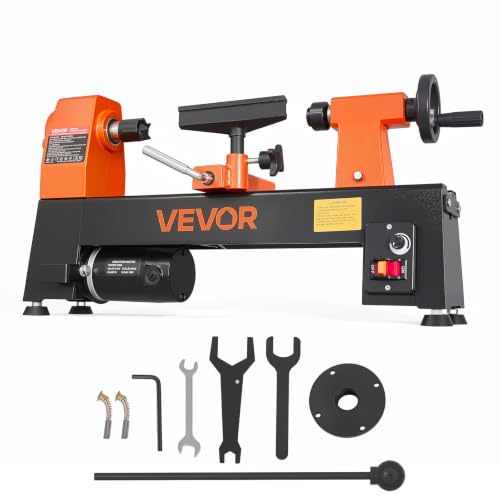
What We Like
- Lightweight 37-pound design is easy to move
- Comes as a complete ready-to-use kit
- Variable speed control for roughing and finishing
- Includes overcurrent protection for safety
Trade-offs
- 13-inch capacity limits workpiece length
- 1/3 HP motor is less powerful than many 1/2 HP models
- 8-inch swing restricts diameter of turnings
At 37 pounds, this lathe is genuinely easy to lift and position on a workbench, making it a practical choice for someone with limited shop space or who needs to store the tool between projects. The 8×13-inch capacity is perfect for pens, small bowls, and detailed spindles, which aligns with the typical first projects for a beginner. It includes all the basic tools and accessories to get started immediately, and the variable speed from 150 to 3200 RPM provides the control needed to learn proper technique on both soft and hard woods.
Its compact, lightweight footprint comes with a trade-off in scale. That 1/3 HP motor and 8-inch swing mean you’ll be working on smaller, less demanding projects. For turning longer spindles or larger bowls, you’ll quickly reach its limits. If your ambitions lean toward bigger items but you still want a compact benchtop unit, the more substantial JET 10×15 Variable Speed Wood Lathe offers greater capacity and power in a heavier, stationary package.
Product photos
ARTYMASTER WM101A-Plus Mini Wood Lathe
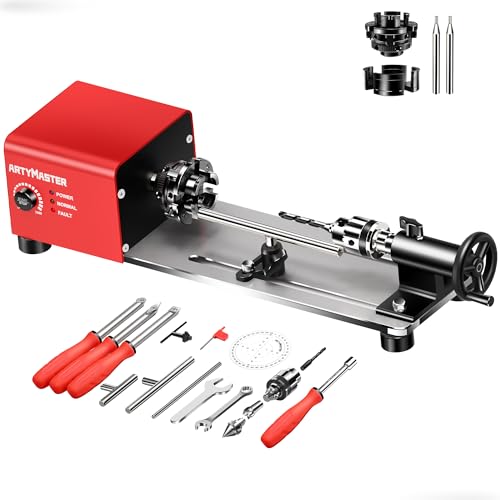
What We Like
- Complete accessory kit for immediate start
- Infinitely variable speed for material control
- UL-certified 96W power supply for safety
Trade-offs
- 8-inch length limits projects to small turnings
- MT1 spindle is less common than MT2 for accessories
A 96-watt motor and an 8-inch turning length define this machine’s purpose. It’s built for the absolute beginner who wants to learn the fundamentals of tool handling and basic spindle work without a large investment in space or complexity. The included tool set and chuck mean you can start turning pens, rings, or small handles right out of the box, and the compact, solid steel design keeps vibration low on a small workbench. This is the right first step if your ambition matches its capacity for small, detailed projects.
A machine like the VEVOR 1 HP Benchtop Wood Lathe shows where the ARTYMASTER’s beginner-friendly package has limits. Where the ARTYMASTER excels at pen blanks, the VEVOR’s 12-inch swing and more powerful motor let you tackle bowls and larger spindles. Your progression as a turner will eventually hit the limits of the smaller work envelope and the low-power motor, especially with hardwoods. Think of this as a dedicated training lathe; it teaches the craft efficiently within its defined lane.
Product photos
Laguna Revo 10|14 Benchtop Wood Lathe
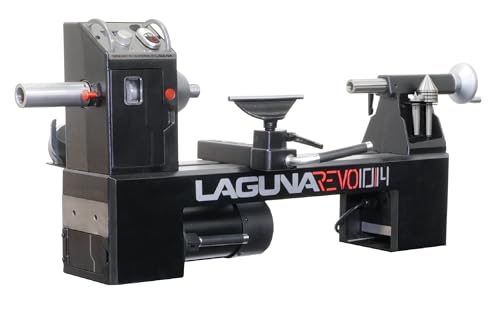
What We Like
- Digital RPM display for precise speed feedback
- Stable 95 lb cast iron construction dampens vibration
- Includes 24-position indexing and self-ejecting tailstock
- Auxiliary outlet for LED work light power
Trade-offs
- Freight delivery requires scheduling and a contact number
- 95 lb weight makes benchtop positioning a two-person job
A digital RPM display provides real-time spindle speed feedback, which removes guesswork for beginners learning speed control. The 1 HP motor delivers smooth torque for tasks like turning bowls up to 10 inches in diameter. Cast iron headstock and tailstock construction provides rigidity and vibration dampening, contributing to stability during operation. This lathe includes professional features like 24-position indexing within a 35.4-inch long frame designed for benchtop setups in small shops.
The main trade-off is the freight delivery, which adds complexity compared to a box on your doorstep. Its 95-pound heft also means you’ll want help setting it on a bench. That mass is what makes it so stable during a cut, though. Compared to the lighter JET 10×15, the Laguna gives up some spindle length but gains a more powerful motor and that crucial digital readout. This makes it a more confident choice for someone focused on mastering speed control from day one.
Product photos
POWERTEC 10×18 Benchtop Mini Wood Lathe
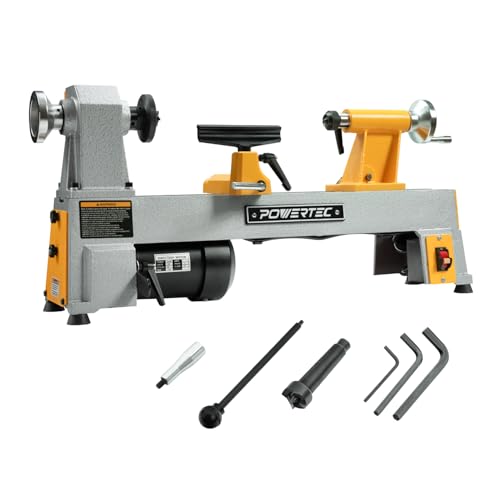
What We Like
- Solid cast iron build minimizes vibration
- Five preset speeds for material matching
- Includes MT2 centers and a faceplate
- 360-degree adjustable tool rest for control
Trade-offs
- Manual belt changes for speed adjustment
- Smaller 10-inch swing limits bowl diameter
A 10-inch swing and 18-inch between centers gives you the room to turn pens, spindles, and small bowls without overwhelming a beginner’s bench. The cast iron construction is the key here, it adds the mass to dampen vibration, making your first cuts noticeably smoother. This is a lathe for the methodical beginner who doesn’t mind stopping to change a belt by hand in exchange for a rock-solid, simple foundation. You get a genuine industrial-standard MT2 taper, which means your investment in accessories like chucks won’t be wasted if you upgrade later.
You get that simplicity and value by using a manual five-speed pulley system. You won’t dial in a perfect speed on the fly like you can with the variable-speed JET 10×15. It’s a deliberate process, better suited to planning your work stages than making quick adjustments mid-cut. For pure small-project versatility, the VEVOR 1 HP offers more speed range and power. If your priority is learning on a stable, no-frills machine that teaches you the fundamentals of tool control and project planning, this Powertec delivers core competence without fuss.
Product photos
How We Evaluated Lathes For Beginners
This evaluation is based on an analysis of manufacturer specifications, product documentation, and expert reviews to understand each machine’s capabilities and intended use. Patterns in owner feedback were also considered to gauge real-world reliability and common issues.
For beginners, we prioritized three key criteria: sufficient power to handle common woods without stalling, a stable build to minimize dangerous vibration, and a capacity that realistically matches a starter’s project scope. We also considered included accessories, as a complete kit removes a major initial hurdle.
A key limit of this research-led approach is that we cannot assess the nuanced “feel” of a lathe during operation. Subtle differences in control smoothness or balance under load are best experienced firsthand, which we encourage through local classes or club demonstrations.
What To Look For In Lathes For Beginners
As a beginner, you need a lathe that is safe, manageable, and capable of handling the projects that drew you to the craft. The goal is to find a machine that supports your learning curve without limiting your growth.
Look for a stable, vibration-resistant build, a motor with at least 1/2 HP for versatility, and a swing capacity that fits your project ambitions. A lathe that includes essential accessories like centers and a faceplate offers the best immediate value.
Motor Power and Control
A motor’s horsepower determines its ability to cut through denser woods and maintain speed under load. For most beginner wood lathes, look for at least 1/2 HP; 1 HP provides ample power for small bowls and spindles. How the motor starts and changes speed is equally important for safety.
A soft-start feature gradually ramps up to speed, preventing the workpiece from jerking violently. Variable speed control, either electronic or via a Reeves drive, lets you adjust the RPM with a dial or lever, which is crucial for matching speed to workpiece diameter and cut type.
Capacity: Swing and Distance Between Centers
Capacity defines your project limits. “Swing” is the maximum diameter of workpiece the lathe can handle, measured as twice the distance from the bed to the spindle center. A 12-inch swing allows you to turn a bowl just under 12 inches wide.
“Distance between centers” is the maximum length of a spindle you can mount. For beginners, common ranges for a wood lathe are 8-12 inches for swing and 13-20 inches for length, which suits projects like pens, small bowls, and tool handles. Consider your first-year goals: if pens are the aim, a mini lathe works. If small bowls intrigue you, prioritize a larger swing.
Stability and Build Quality
Vibration is the enemy of a clean cut and safe operation. A wobbly lathe makes precise tool control difficult and can loosen workpiece mounts. Mass and rigid construction dampen vibration. Look for a lathe bed and major components made of cast iron or heavy steel. A solid, non-flexing bed is the foundation. The total weight of the machine is a good proxy for stability; a heavier benchtop lathe will resist shaking more effectively. Ensure your workbench is equally sturdy to support it.
- Check the bed for thick, rigid construction without noticeable flex.
- Ensure the tailstock and tool rest lock down securely without slipping.
- Look for a headstock spindle that uses common tapers (like MT2) for broad accessory compatibility.
- Verify the included tool rest is sturdy enough to support your lathe chisels without deflection.
- Read owner reviews specifically mentioning vibration or “chatter.”
A lathe that feels solid and quiet at speed is safer and more enjoyable to learn on.
Lathes For Beginners Compared
The following table compares key specifications for all ten beginner lathes we researched.
| Product | Motor Power | Swing Capacity | Distance Between Centers | Speed Range | Motor Type/Control |
|---|---|---|---|---|---|
| VEVOR 1 HP Benchtop Wood Lathe | 1 HP / 750W | 12 inches | 18 inches | 150 to 3800 RPM | Brushless DC |
| JET 10×15 Variable Speed Wood Lathe | 1/2 HP | 10 inches | 15-1/2 inches | 200-3600 RPM | Variable Speed |
| WEN 8×13 Variable Speed Benchtop Lathe | 3.2-amp | 8 inches | 13 inches | 750 to 3200 RPM | Variable Speed |
| Record Power Coronet Herald Wood Lathe | 1 HP | N/A | N/A | 95-3890 RPM | Variable Speed |
| WEN 14×20 Variable Speed Benchtop Lathe | 6 Amp | 14 inches | 20 inches | 250-3550 RPM | Variable Speed |
| Patikuin 14×40 Benchtop Wood Lathe | 400W (3.5A) | 14 inches | 40 inches | 4-step belt drive | 4-step belt drive |
| VEVOR 8×13 Mini Benchtop Wood Lathe | 1/3 HP (250W) | 8 inches | 13 inches | 150-3200 RPM | Variable Speed |
| ARTYMASTER WM101A-Plus Mini Wood Lathe | 96W | 3in diameter | 8in length | Infinitely variable | Infinitely variable |
| Laguna Revo 10|14 Benchtop Wood Lathe | 1 HP | 10" diameter | 14" between centers | 250 to 3200 RPM | Electronic Variable Speed |
| POWERTEC 10×18 Benchtop Mini Wood Lathe | 1/2 HP | 10 inches | 18 inches | 5 preset (760-3200 RPM) | 5-speed pulley |
Frequently Asked Questions
What is the best brand of lathe for beginners?
There isn’t a single “best” brand, as several manufacturers offer excellent entry-point models. Brands like JET, WEN, and Record Power are consistently noted in expert round-ups for providing reliable, feature-packed beginner wood lathes at different price points. The best choice depends on the specific features you need, like variable speed or a particular swing capacity.
What is the best lathe for a beginner?
The best overall lathe for a beginner is the VEVOR 1 HP Benchtop Wood Lathe. It offers a powerful 1 HP brushless motor, a versatile 12-inch swing, and comes with a complete kit of accessories, providing good value and capability for someone starting out.
What are some good entry-level lathes?
Good entry-level lathes balance essential features with an affordable price. Our list includes several strong options: the WEN 8×13 for its soft-start safety, the VEVOR 8×13 Mini for its lightweight portability, and the POWERTEC 10×18 for its solid cast-iron construction and five preset speeds. These are all capable starter lathes for learning the fundamentals.
What is the best lathe machine for home use?
For home use, a benchtop lathe is often ideal due to its smaller footprint. The best model depends on your space and projects. The VEVOR 1 HP is excellent for general home use, while the Record Power Coronet Herald is superb if bowl turning is a primary goal. For very limited space, a mini wood lathe like the ARTYMASTER is a compact choice.
What accessories do I need to start woodturning?
At a minimum, you need a set of wood lathe tools (chisels and gouges), a sharpening system, and safety gear including a full-face shield. Most beginner lathes come with a spur center, live center, and faceplate. You’ll also need wood blanks. Before diving into a complex project like turning a bowl, practice spindle turning on scrap wood to master tool control.
The Bottom Line
For most beginners, the VEVOR 1 HP Benchtop Wood Lathe is the best overall choice. It provides the power, stability, and included accessories to tackle a wide range of introductory projects, from spindles to small bowls, offering strong long-term value as your skills grow.
If your budget is tight, consider the award-winning WEN 8×13 for its safety-focused soft start, or if you dream of turning bowls first, look to the Record Power Coronet Herald for its swivel-head capacity. For the absolute smallest projects and workspaces, the ARTYMASTER mini lathe provides a complete starter kit.
Ultimately, the most important factor is matching the lathe’s swing and length capacity to the projects you’re genuinely excited to make. A machine that fits your space and inspires you to practice is the best investment you can make in learning this rewarding craft.
