
10 Best Metal Cutting Band Saws in 2026
This post contains affiliate links. As an Amazon Associate, we earn from qualifying purchases.
Our best overall metal cutting band saw is the Jet MBS-1018-1 Dual-Mitering Horizontal Band Saw for its safety features and production-ready capacity. For shop versatility, the Jet HVBS-712 is a strong contender, while the WEN BA4664 is our top budget pick. Cutting metal demands the right tool to balance power, precision, and practicality.
A dedicated metal band saw delivers cleaner, faster cuts than improvised methods. This guide uses specifications, manufacturer data, expert round-ups, and patterns in owner feedback to help you understand the key features and trade-offs.
Top 10 Metal Cutting Band Saws in the Market
Certain content that appears on this site comes from Amazon. This content is provided "as is" and is subject to change or removal at any time.
The Best Metal Cutting Band Saws, Reviewed
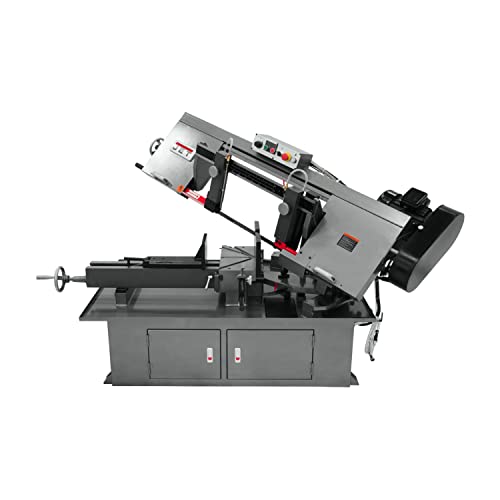
Jet MBS-1018-1 Dual-Mitering Horizontal Band Saw
What We Like
- Automatic blade breakage sensor for safety
- Self-propelled blade brush prevents chip buildup
- Integrated pressurized wash hose for cleanup
- Coolant distributed through blade guides extends life
Trade-offs
- At 1034 lb, it requires a permanent, heavy-duty shop floor.
- The 230V single-phase power needs a dedicated circuit.
- Its 79-inch length demands significant workshop space.
With a 10-inch by 18-inch cutting capacity and a 2HP motor, the Jet MBS-1018-1 is built for solid bar stock and large tubing. Its hydraulic downfeed control adjusts easily, enabling feed rates to evolve with variable types of materials for controlled cuts. The saw includes an automatic blade breakage sensor and a magnetic starter for low voltage and lost phase protection, features that address machine and electrical safety.
You pay for that capability with a substantial footprint and heft, this isn’t a tool you’ll move around. At over half a ton, it needs a dedicated, level spot on a concrete floor. For shops that need serious metal-cutting power but have tighter space or power constraints, the Jet HVBS-712 offers a more compact horizontal/vertical design. The MBS-1018-1 makes its case as a foundational piece of shop equipment for those ready to invest in a workhorse that can handle volume with minimal fuss.
Product photos
Jet HVBS-712 Metal Cutting Band Saw

What We Like
- Rigid cast-iron construction for accurate cuts
- Built-in hydraulic downfeed and flood coolant system
- Converts between horizontal and vertical operation
- Includes blade, table, and work stop, ready to use
Trade-offs
- At 286 lb, moving it requires serious planning
- Four-speed selector lacks infinite variable control
That flexibility, combined with its ability to switch between horizontal and vertical cutting, makes it a core machine for a home or small machine shop that needs one saw to do multiple jobs. The sealed oil-bath gear drive and built-in coolant system are engineered for longevity, letting you cut steel and aluminum without worrying about dusting the gears.
Its 286-pound weight is the trade-off for that cast-iron rigidity. This isn’t a tool you’ll roll around the garage on a whim; it needs a dedicated, stable spot. For users who require more capacity for large-diameter rounds, the larger Jet MBS-1018-1 in this guide is the logical step up, though it sacrifices the vertical mode. The HVBS-712 delivers a complete, warranty-backed package that gets you cutting right out of the crate.
Baileigh BS-712M Horizontal/Vertical Band Saw

What We Like
- Cast iron construction minimizes vibration for clean cuts
- Converts between horizontal and vertical operation
- Flood coolant system extends blade and machine life
- Heavy steel plate frame supports maximum capacity cuts
Trade-offs
- At 343 pounds, it requires a permanent, sturdy floor space
- Its 1 HP motor is less powerful than some larger 2HP saws
A 7-inch by 10-inch rectangular cutting capacity handles most common bar stock and tubing in a single pass. The Baileigh BS-712M is built for the shop owner who prioritizes cut accuracy and long-term durability over portability. Its cast iron saw head and bow are the foundation here, adding mass that damps vibration so the blade tracks truer, year after year.
That solid construction comes with a substantial physical footprint, both in weight and floor space. It’s a stationary tool for a dedicated workspace. For similar horizontal/vertical versatility in a lighter package, the JET HVBS-712 is worth a look, but you’ll trade some of that vibration-damping mass for a more mobile setup.
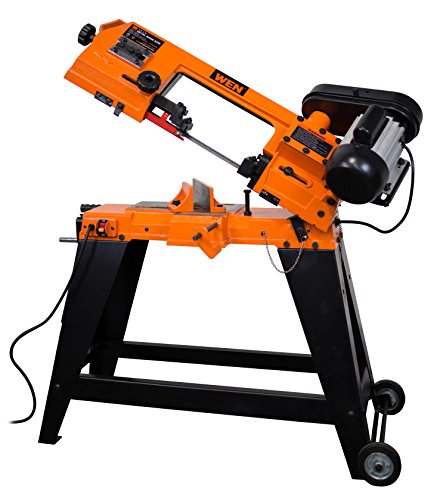
WEN BA4664 Metal Band Saw with Stand
What We Like
- Operates in vertical and horizontal positions
- Automatic shut-off after each cut
- Includes a mobile stand with wheels
- Three-speed blade for various metals
Trade-offs
- 118-pound weight limits portability despite wheels
- 4.6-amp motor is less powerful than 1HP+ models
Its ability to operate in both vertical and horizontal positions means you can set it up for a straight cut-off job or switch it to handle more intricate shapes without needing a separate machine. An included stand with wheels lets you move the 118-pound saw around a garage when needed, and a mitering vise adjusts for angled cuts. For someone setting up a home metalworking space, this dual-mode design covers a lot of fundamental tasks.
You trade some size and weight for that versatility, as the WEN is lighter and more compact than many stationary metal band saws. Its 4.6 amp motor is paired with three blade speeds, adjustable from 80 to 200 feet per minute, which provides flexibility for different metals. The automatic shut-off turns the saw off after a cut is completed, a feature that can help with repetitive operation.
DEWALT DWM120K Portable Band Saw

What We Like
- Powerful 10-amp motor for tough materials
- Industry-best 5-inch deep cut capacity
- LED sight light for dark workspaces
- Variable speed dial for material control
Trade-offs
- Portable design limits workpiece support for long cuts
- At 15 pounds, it's heavier than some handheld tools
With a 5-inch deep cut capacity, this portable band saw handles round or rectangular stock that smaller tools cannot, which is essential for plumbers or metalworkers tackling large conduit or structural pieces on site. Its 10-amp motor is designed with controlled power for jobsite applications, and a variable speed dial lets users match the 100 to 350 SPM blade speed to different materials. An LED sight light illuminates the cut line in dark environments, and a hang hook protects the front handle when the tool is not in use.
You trade the stability and hands-free operation of a horizontal benchtop saw like the JET MBS-1018-1 for this portability. That means you’re the one guiding every cut and supporting the workpiece, which can be tiring on long production runs. The ergonomic front handle and good balance help fight fatigue, but for repeated, identical cuts on long stock, a dedicated horizontal saw is far more efficient. The DeWalt excels at bringing deep-cut capability to the material, not the other way around.
Baileigh BS-128M Portable Mitering Bandsaw

What We Like
- Hydraulic descent reduces operator effort
- Cast iron head minimizes vibration for accuracy
- Stop rod enables repeatable cuts
- Fully-welded steel frame ensures long-term stability
Trade-offs
- At 230 lbs, it is not easily moved by one person
- Miter range is asymmetric (60° left, 45° right)
- Smaller 5×6 capacity limits stock size versus larger saws
With a 5″ x 6″ cutting capacity and a hydraulically-controlled descent, this bandsaw is designed for clean, controlled cuts on smaller metal stock. Its cast iron saw head and welded steel frame are built to reduce vibration, which helps maintain accuracy over time. The three blade speeds, selectable via a step pulley, provide options for different materials.
That solid construction means you’ll be wheeling it around a shop rather than tossing it in a van. Its mitering range is also more generous to the left, which is a specific workflow consideration.
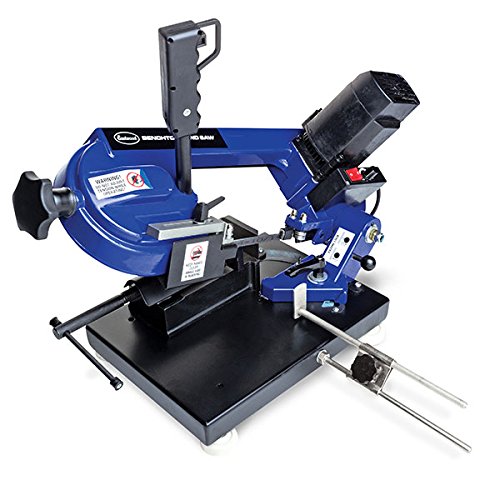
Eastwood Benchtop Metal Cutting Bandsaw
What We Like
- Variable speed trigger from 100 to 260 ft/min
- Miter cutting capability from 45 to 90 degrees
Trade-offs
- 3.25-inch throat limits width of large sheet cuts
At 47 pounds, this benchtop saw moves from shelf to workbench without a struggle, making it a natural fit for the fabricator with limited floor space who needs to cut tubing and small stock accurately. The variable speed trigger and 1000-watt motor let you match the blade speed to materials from aluminum to steel, while the miter table handles common angled cuts. It’s built for the workshop where the tool gets stored after each project, not left permanently on the floor.
You trade off some capacity for that portability. The 4.5-inch width capacity won’t handle large blocks, and the 3.25-inch throat is tight for wider sheet work. For heavier, continuous cutting of larger stock, a dedicated horizontal saw like the Baileigh BS-712M offers greater capacity and power. This Eastwood excels as a dedicated secondary saw for precise, smaller work right where you need it.
Product photos
Hoteche 12-Inch Benchtop Band Saw

What We Like
- Includes a stable, dedicated stand
- Large tilting table for bevel cuts
- Substantial 5-inch cutting depth
Trade-offs
- At 130 lbs, it's a heavy benchtop unit
- Large footprint for a benchtop tool
A 5-inch maximum cutting depth means this benchtop saw can handle thicker stock than many portable models, letting you process wider boards or blocks right on your workbench. Its adjustable blade speed provides flexibility for different materials, while the included stand creates a dedicated, stable workstation. This setup fits a home shop where floor space is limited but project needs vary, offering capacity for both straight and bevel cuts up to 45 degrees.
This capacity comes with a focus on specialization. Unlike a dedicated metal-cutting bandsaw like the heavier Jet HVBS-712, this model’s power and design are generalized for mixed materials. It works well as an all-rounder, but shops focused mostly on metal will likely find a purpose-built horizontal/vertical saw more efficient.
Product photos
VEVORĠ7×8.25inĠHorizontal/VerticalĠBandsaw

What We Like
- Converts between horizontal and vertical cutting
- Four-speed pulley for varied material cutting
- Automatic hydraulic shut-off after cut completion
Trade-offs
- At 407.9 lb, it requires a permanent, sturdy shop space
- Manual fine-tuning and belt changes needed for speed adjustment
- Less cutting capacity than the 10×18 Jet model
That flexibility, combined with its ability to switch between horizontal and vertical operation, makes it a serious contender for the home metalworker who needs one saw to handle both long stock and intricate shapes. The four speed settings, selected by moving the V-belt, let you dial in the right feed for everything from steel to wood. It’s built like a tank with a cast iron frame, which is exactly the kind of foundation you want for vibration-free cuts.
That cast iron construction results in a weight of 407.9 pounds. This demands a dedicated spot rather than casual movement around a garage. Manual fine-tuning and changing speed by repositioning the V-belt are hands-on processes, typical for this class but not as quick as using a dial. Compared to the 286-pound Jet HVBS-712, the VEVOR has more heft, trading some maneuverability for a rigid base.
Product photos
ProlinemaxĠ4×6ĠHorizontal/VerticalĠBandsaw

What We Like
- ['Engineered for low-noise operation']
- ['Dual horizontal and vertical design']
- ['Three-speed selection for multiple materials']
- ['Includes scale for mitering vise']
Trade-offs
- ['100-pound weight demands a sturdy, permanent bench']
- ['3/4 HP motor is modest for heavy-duty stock']
- ['Blade wheels are 7-3/8", smaller than some shop saws']
A 3/4 HP motor driving a saw built for low-noise operation makes this Prolinemax a considerate neighbor in a home workshop. Its dual horizontal and vertical functionality, combined with a three-speed gearbox, lets you tackle metal, plastic, and wood without switching tools. The included miter scale adds precision for angled cuts. This setup is a solid fit for a DIYer or small shop needing versatile, quiet cutting without overwhelming a shared space.
Its quiet, versatile operation comes at the expense of raw power and size. The motor and 4×6 capacity fit lighter gauge materials and smaller projects best. For slicing through thick bar stock all day, a heavier-duty machine like the JET MBS-1018-1 with its 2HP motor and larger frame is built for that job. The Prolinemax excels in adaptability over brute force.
Product photos
How We Evaluated Metal Cutting Band Saws
Our research focused on manufacturer specifications and documentation to compare core capabilities like cutting capacity, motor power, and construction. We studied expert round-ups and aggregated owner feedback. This helped identify which features proved most reliable in real-world use and where common frustrations arose. ForĠmetalĠcutting,ĠweĠprioritizedĠcuttingĠcapacityĠandĠmotorĠpowerĠforĠtacklingĠdifferentĠstock,ĠplusĠconstructionĠtypeĠforĠvibrationĠcontrolĠandĠdurability. We also looked at operational features like mitering, coolant systems, and portability that define a saw’s daily utility.
This research-led approach provides a detailed comparison of specs and reported performance, but it cannot replicate the hands-on feel of operating each saw in a specific workshop environment.
What To Look For In Metal Cutting Band Saws
ChoosingĠtheĠrightĠmetalĠcuttingĠbandsawĠdependsĠonĠyourĠtypicalĠprojects,Ġworkspace,ĠandĠbudget. The core decision is whether you need a stationary shop saw for precision and capacity or a portable model for on-site work.
Key factors are cutting capacity for your stock size, motor power for the materials you cut, and construction for stability. Also consider operational features like mitering, coolant systems, and whether you need horizontal, vertical, or convertible operation.
Cutting Capacity & Power
Cutting capacity, listed as a measurement like “7×12 inches” or “5-inch round,” dictates the maximum size of material the saw can handle. Match this to your most common stock. Motor power, measured in horsepower (HP) or amps, determines the saw’s ability to cut through harder metals and thicker sections without bogging down. A 1 HP motor is sufficient for light fabrication, while demanding shops will want 2 HP or more. For portable models, a deep cut capacity like 5 inches is crucial for large pipe.
Construction & Stability
The frame material is critical for clean cuts. Cast iron construction, found on many stationary models, absorbs vibration for smoother operation and greater accuracy. Heavy steel plate frames also provide solid support. For portable saws, a fully-welded steel frame ensures long-term durability. Stability also comes from weight; a heavier stationary saw is less likely to walk during a cut but requires a permanent, sturdy floor or bench.
Operational Features
Look for features that match your workflow. A mitering vise or head allows for angled cuts, essential for fabrication. A flood coolant system extends blade life and improves cut quality on harder metals. An automatic shut-off increases consistency and safety for repeat cuts. For shops with varied tasks, a saw that converts between horizontal and vertical operation offers tremendous versatility, functioning as both a cutoff saw and a contouring tool.
- Check the saw’s voltage requirements (115V/230V) to ensure your shop has the appropriate circuit.
- Verify the included blade’s teeth-per-inch (TPI) is suitable for your primary materials.
- Consider the footprint and weight to ensure it fits your intended space.
- Look for integrated blade brushes or cleaning systems to reduce maintenance.
- Assess portability needs: built-in wheels, carrying handles, or a lighter weight for job-site use.
Prioritize the feature that solves your biggest current frustration, whether that’s cutting speed, accuracy, or simply having a dedicated tool for metal.
Metal Cutting Band Saws Compared
The following table compares key specifications across our picks to help you see the differences at a glance.
| Product | Cutting Capacity | Motor | Weight | Blade Speeds |
|---|---|---|---|---|
| Jet MBS-1018-1 Dual-Mitering Horizontal Band Saw | 10" x 18" | 2HP, 230V 1Ph | 1034 lb | N/A |
| Jet HVBS-712 Metal Cutting Band Saw | 7" round, 12" wide rectangle | N/A | 286 pounds | 4 speeds (86-260 SFPM) |
| Baileigh BS-712M Horizontal/Vertical Band Saw | 7" round, 7" x 10.25" rectangle | 1 HP, 120V 1Ph | 343 pounds | N/A |
| WEN BA4664 Metal Band Saw with Stand | N/A | 4.6 amp | 118.0 Pounds | 80, 120, 200 FPM |
| DEWALT DWM120K Portable Band Saw | 5-inch deep | 10 Amp | 15.0 pounds | 100-350 SPM |
| Baileigh BS-128M Portable Mitering Bandsaw | 5" x 6" | 3/4 HP, 110V | 230 lbs | three blade speeds (78, 154, and 200 fpm) |
| Eastwood Benchtop Metal Cutting Bandsaw | Throat Capacity: 3.25 in.; Width Capacity: 4.5 in. | 1000 Watt | 47.0 pounds | 100-260 Ft/Min |
| Hoteche 12-Inch Benchtop Band Saw | 12" width, 5" depth | 1HP | 130 lbs | 7.6m/s to 15.8m/s |
| VEVORĠ7×8.25inĠHorizontal/VerticalĠBandsaw | 7 x 8.25 in | 1.1 kW | 407.9 lb | 86, 132, 178, 260 FPM |
| ProlinemaxĠ4×6ĠHorizontal/VerticalĠBandsaw | 4.5" round, 4" x 6" rectangular | 3/4 HP, 120V | 100 pounds | three speeds |
Frequently Asked Questions
What is the best band saw for cutting metal?
The best band saw depends entirely on your use. For a professional shop needing high-capacity, feature-rich daily production, a large horizontal model like the Jet MBS-1018-1 is ideal. For home shops needing versatility, a convertible model like the Jet HVBS-712 is excellent. For on-site work cutting large pipe, a portable deep-cut saw like the DEWALT DWM120K is the best tool.
What is the best saw for cutting through metal?
For precise, controlled cuts on metal stock, a band saw is generally superior. It uses a continuous toothed blade that applies even pressure, reducing heat and allowing for intricate shapes. WhileĠotherĠsawsĠcutĠmetal,ĠlikeĠabrasiveĠchopĠsawsĠorĠangleĠgrinders,ĠaĠbandsawĠisĠtypicallyĠmoreĠaccurate,ĠproducesĠlessĠwaste,ĠandĠcreatesĠnoĠsparks.
Who makes the best metal cutting bandsaw blades?
Blade quality is separate from the saw itself. Most saws come with a serviceable blade, but for best results, you should select a blade based on the material you’re cutting. Bi-metal blades with high-speed steel teeth are a popular upgrade for their durability and heat resistance, and they are available from specialty retailers and the saw manufacturers themselves.
Is 18 or 24 tpi better for metal?
It depends on the metal’s thickness and type. A higher Teeth Per Inch (TPI) count is better for cutting thin sheet metal and tubing, as it provides a smoother finish with less tearing. A lower TPI blade is a good general-purpose choice for thicker stock like solid bar or pipe. The rule is you want at least three teeth engaged in the material at all times.
Can a wood band saw cut metal?
We do not recommend it. While some heavy-duty wood band saws can be fitted with a metal-cutting blade, their construction and blade speed are not optimized for metal. They lack the rigidity and slow blade speeds required, which can lead to poor cuts, damaged blades, and potential safety issues. It’s best to use a saw specifically designed for cutting metal.
The Bottom Line
For professional fabricators and serious shops where daily production is key, the Jet MBS-1018-1 Dual-Mitering Horizontal Band Saw is the best overall choice, offering high capacity and advanced features like an automatic blade sensor. If your budget is tight, the WEN BA4664 provides remarkable versatility at an affordable price, while mobile tradespeople should look directly at the DEWALT DWM120K for its deep-cut capacity. Ultimately, the most important factor is matching the saw’s core capacity and power to the size and type of metal you actually cut.
