
10 Best Miter Saw Blades For Trim in 2026
This post contains affiliate links. As an Amazon Associate, we earn from qualifying purchases.
For the cleanest, most accurate cuts in trim and molding, the DEWALT DWA112100 stands out as our best overall miter saw blade due to its vibration-dampening design and ready-to-finish results. For a premium polished edge, consider the Diablo Ultimate Polished Finish blade, while the Freud LU79R010 excels at chip-free cuts in delicate materials.
Choosing the wrong blade can leave you sanding out tear-out and chip marks instead of installing flawless trim. This research-based guide examines 10 top blades, comparing tooth geometry, kerf width, and construction to help you match a blade to your specific trim work and saw.
Top 10 Miter Saw Blades For Trim in the Market
Certain content that appears on this site comes from Amazon. This content is provided "as is" and is subject to change or removal at any time.
The Best Miter Saw Blades For Trim, Reviewed
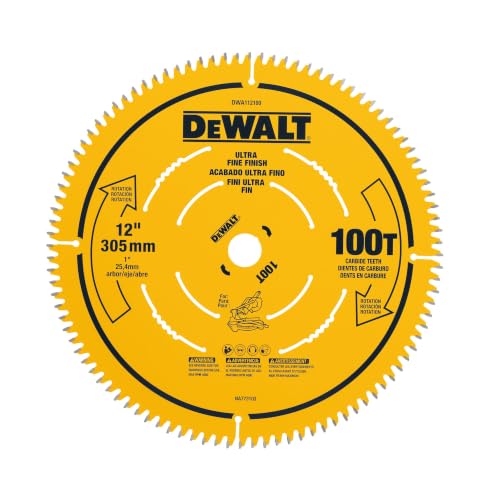
DEWALT DWA112100 Miter Saw Blade
What We Like
- Patented body slot design reduces vibration
- Optimized tooth geometry for increased accuracy
- Ultra sharp carbide delivers a fine finish
- Precision tensioning adds stiffness to the blade
Trade-offs
- At 2.7 lb, it is heavier than the Diablo Ultimate Polished Finish blade
- Designed for fine finish, not for heavy ripping or demolition
- 12-inch size requires a compatible miter saw
The 100-tooth ultra sharp carbide geometry is built for one thing: leaving a clean, ready-to-finish cut on trim. That focus, combined with a patented body slot design to dampen vibration, means you spend less time sanding and more time fitting perfect joints. It’s a blade engineered for the craftsman who values a flawless result straight off the saw, making it a reliable cornerstone for any trim project.
Designed for improved finish quality and up to three times the life of a standard blade, this DEWALT model prioritizes longevity and a clean cut. Its 2.7-pound weight contributes to a solid feel during operation, which can help dampen vibration when paired with the blade’s patented body slot design. For general trim and fine finish work, the combination of ultra-sharp carbide and optimized tooth geometry is engineered to deliver accurate cuts.
Product photos
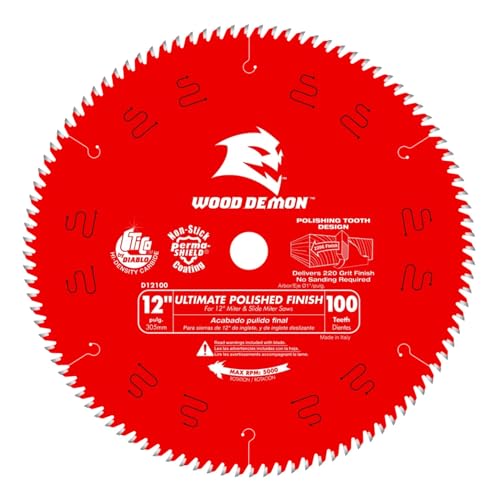
Diablo Ultimate Polished Finish Saw Blade
What We Like
- Ultra-thin kerf for fast, effortless cuts
- Double side grind delivers polished 220-grit finish
- Axial shear-face grind for clean shearing action
- TiCo carbide provides up to 5X longer cutting life
Trade-offs
- Polished finish geometry is specialized for fine materials
- Ultra-thin kerf may deflect in very hard or thick stock
A 220-grit equivalent polished finish straight from the saw is this blade’s raison d’être. That double side grind tooth geometry shears through moldings and hardwoods so cleanly it can eliminate a sanding step entirely. It’s built for the trim carpenter or serious hobbyist who values time and demands a flawless surface on visible work. The TiCo carbide and axial shear-face grind mean you’ll get that finish consistently, cut after cut, on veneers and delicate woods where tear-out is unacceptable.
That polished specialization comes with a trade-off. The ultra-thin kerf and fine-tooth geometry prioritize finish over brute-force crosscutting capacity, making it less suited for chopping thick, hard composite materials. For a more balanced blend of finish and durability in a general-purpose trim blade, the DEWALT DWA112100 offers a similar tooth count in a slightly heavier, sturdier package. The Diablo Ultimate is a scalpel, not a cleaver.
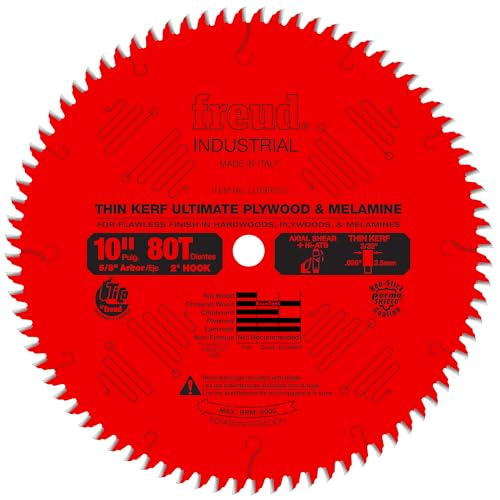
Freud LU79R010 Thin Kerf Saw Blade
What We Like
- Hi-ATB geometry for chip-free, polished edges
- Laser-cut slots reduce vibration for smoother cuts
- Perma-Shield coating reduces friction and pitch buildup
- Premium TiCo carbide blend for long edge life
Trade-offs
- 10-inch diameter limits cutting depth versus 12-inch blades
Designed for ultra-smooth, chip-free edges, the Freud LU79R010 blade uses a High Alternate Top Bevel tooth geometry for a superior shearing action. This Hi-ATB design reduces tear-out in delicate materials like veneered plywood and fine moldings, making cuts ready for glue-up right off the saw. Its Perma-Shield coating reduces friction and heat buildup during operation.
With a 10-inch diameter, this blade offers less cutting depth than larger 12-inch models such as the Diablo Ultimate Polished Finish. For tasks like cutting thick stock or crown molding nested against the fence, that smaller size can be a practical limit. Expert round-ups group Freud with brands like Forrest and Tenryu as representing a lasting investment for serious craftsmen.
Product photos
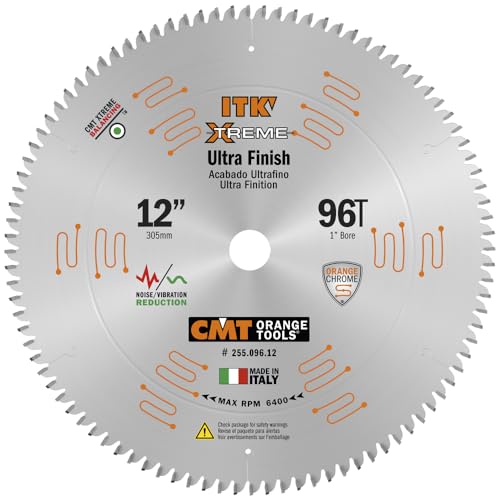
CMT Orange Tools Ultra Fine Finishing Saw Blade
What We Like
- Laser-cut plate for superior stability
- Mirror-sharpened industrial chrome carbide
- Polymer-filled slots reduce vibration and noise
Trade-offs
- Heavier 2.0 lb weight demands a stable saw
- Wider 0.102-inch kerf removes more material
A laser-cut steel plate provides the foundation for this blade, offering flatness and rigidity that contribute to cleaner cuts in materials like hardwoods and veneered plywood. Its Hi-ATB tooth geometry and mirror-polished industrial carbide are designed for a fine finish on crosscuts. This makes it a compatible choice for stationary table saws and miter saws where surface quality is a priority.
That focus on a pristine finish comes with a trade-off. Its solid 2.0-pound construction and laser-cut dampening slots ensure smooth operation, but that same heft requires a well-tuned, powerful saw to drive it effectively without bogging down.
Product photos
Diablo 12-Inch 80-Tooth ATB Saw Blade

What We Like
- Super thin kerf reduces material waste.
- 80-tooth Hi-ATB geometry for fine, clean crosscuts.
- Perma-SHIELD coating fights heat and corrosion.
- TiCo carbide designed for maximum durability.
Trade-offs
- The thin kerf can deflect on very dense hardwoods.
- Lacks the ultra-high tooth count of dedicated finish blades.
The laser-cut super thin kerf design reduces material waste and saw strain, a practical advantage for any project. With 80 alternate-top-bevel teeth, it provides the smooth, fine finishes and minimal tear-out needed for precise crosscuts in hardwoods and softwoods. This combination makes it a strong choice for detailed trim and molding work where a clean cut is essential.
That thin, fast-cutting profile does mean slightly less mass, so it can feel less stable on the hardest woods than a full-kerf blade. For the ultimate glass-smooth surfaces on showpiece trim, you’d want a blade with a higher tooth count, such as the Diablo D12100X. However, this Diablo blade finds a very practical sweet spot by balancing exceptional cut quality with efficiency across a wide range of jobs.
Forrest Duraline Hi-A/T Saw Blade

What We Like
- Double-hard carbide for up to 300% longer life
- Cuts melamine and plywood with no tears or chips
- 40° tooth points slice thin bottom layers cleanly
- Eliminates need for a separate scoring saw blade
Trade-offs
- At 3.5 lb, it's heavier than many 12-inch blades
- The 0.125-inch kerf is slightly wider than some ultra-thin competitors
- Requires a 1-inch arbor, not compatible with smaller saws
The Forrest Duraline Hi-A/T is built with double-hard C-4 Submicron carbide, which the manufacturer states can deliver up to 300% longer life than standard blades. This is a premium blade for the craftsman who runs their saw daily and wants to minimize downtime for blade changes. Its 100-tooth #7 Hi-A/T grind and 40° tooth points are engineered to slice through delicate veneers and melamine without chipping, making it a serious tool for flawless trim and finish work. You’re paying for longevity and a cut that often needs no sanding.
That durability adds weight, with the blade coming in at 3.5 pounds. Its 0.125-inch kerf is thinner than many standard blades, a design that eliminates the need for a separate scoring saw on table saw work. Compared to other options, the CMT Orange Tools model has a narrower 0.102-inch kerf, while the Diablo D12100X is a full pound lighter.
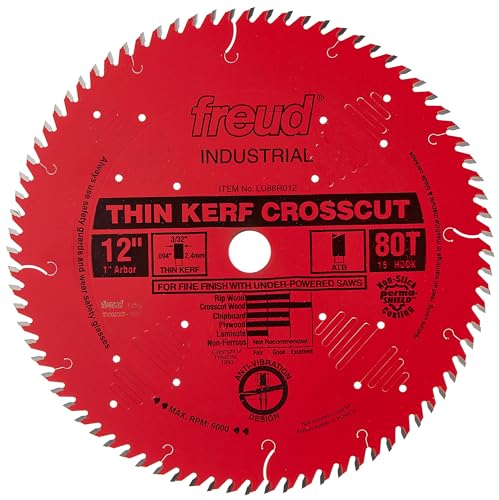
Freud LU88R012 Fine Finish Crosscut Blade
What We Like
- 80-tooth ATB grind with TiCo carbide delivers fine crosscuts.
- Positive 15° hook angle promotes a smooth, faster feed rate.
- Non-stick coating protects against corrosion and pitch buildup.
Trade-offs
- At 3.6 pounds, it's heavier than several other 12-inch trim blades.
- Heavier weight of 3.6 pounds.
With a kerf of just .094 inches, this blade removes less material and requires less motor effort from your saw. Its 80 teeth, made from a premium high-density carbide blend, are ground in an ATB pattern for clean crosscuts. That combination makes it a focused tool for fine finish work in moldings and similar stock.
The thin .071-inch plate and 15-degree positive hook angle are designed for a faster feed rate and smoother cut. Compared to a 100-tooth blade like the Diablo D12100X, this Freud prioritizes efficient cutting action. It is a specialist for high-quality crosscutting.
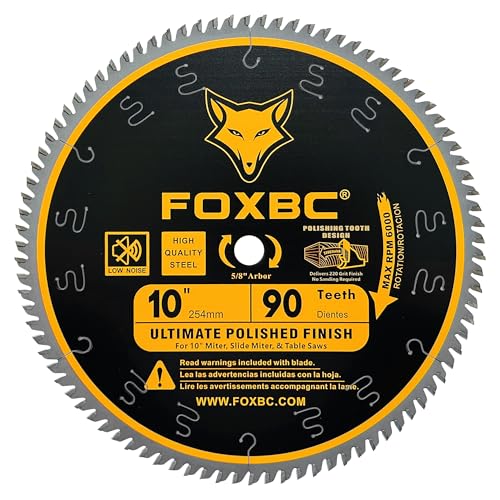
FOXBC 10-Inch Polished Finish Saw Blade
What We Like
- Polished finish equal to 220-grit sandpaper.
- Ultra thin kerf for reduced amp draw.
- Compatible with major 10-inch miter saw brands.
- ASFG design for clean, shearing cuts.
Trade-offs
- A 10-inch blade limits cutting depth versus 12-inch models.
- 90-tooth count is lower than premium fine-finish blades.
A 90-tooth, double side grind blade delivers a polished finish that rivals hand sanding, which is exactly what you need for fine trim work. This makes it a solid choice for woodworkers who prioritize a smooth cut on moldings and hardwoods without spending a fortune. The ultra-thin kerf helps your saw motor work easier, reducing strain during long sessions of detailed cuts.
The trade-off for the budget-friendly design is in its size and tooth density. It’s a 10-inch blade, so you won’t get the same depth of cut as with a 12-inch model such as the Diablo D12100X. For extensive crown molding or thicker stock, that limitation becomes real. However, for standard baseboards and window casings on a common 10-inch miter saw, this blade punches well above its weight.
Product photos
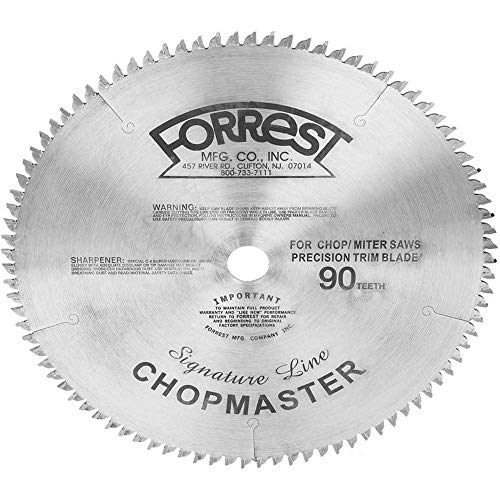
Forrest Chopmaster Signature Line Saw Blade
What We Like
- 90-tooth design for superior splinter control
- Proprietary tooth style cuts quieter
- Heavy steel plate for maximum stability
- Extended-life C-4 carbide teeth
Trade-offs
- 30mm arbor may require an adapter for common 1-inch saws
The 90-tooth count with its unique 2 PTS+1 Flat tooth design is what makes this blade excel. That specific geometry delivers exceptionally clean cuts with minimal tear-out, which is non-negotiable when you’re running expensive, pre-finished crown or picture frame molding. The heavier steel plate and double-hard carbide aren’t just specs on paper, they translate to a blade that stays rigid in the cut and keeps its edge through long projects, giving you repeatable, gallery-quality results.
The trade-off is compatibility. Its 260mm diameter and 30mm arbor are built for a specific class of saw, so you’ll need to check your miter saw’s specifications before ordering. If your primary saw is a common 12-inch model, you’re looking at an adapter or a different blade. For a more universal 12-inch option that also targets fine trim, the Forrest Duraline Hi-A/T offers a similar philosophy in a standard size.
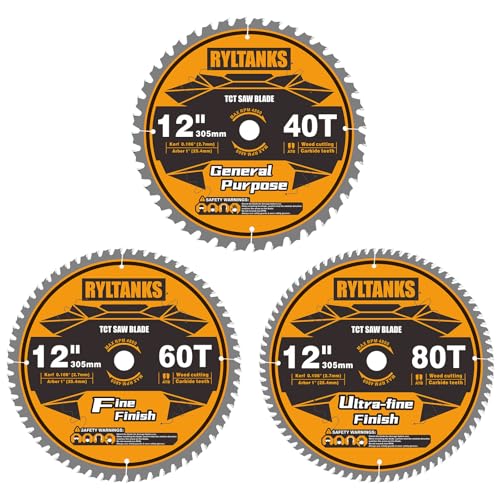
Ryltanks 12-Inch 3-Pack Saw Blades
What We Like
- Three-tooth-count blades cover general to ultra-fine cuts.
- Ultra-thin kerf design for less saw strain and cleaner cuts.
- Laser-cut stabilizer vents minimize vibration for precision.
- Compatible with major 12-inch miter saw brands.
Trade-offs
- Maximum RPM is 4,800.
- Arbor size is limited to 1 inch.
This pack includes three 12-inch blades with 40, 60, and 80 teeth for general purpose, fine, and ultra-fine wood cutting. Having three tooth counts in one set covers different material types like plywood, oak, and nail-embedded wood. C3 grade carbide and laser-cut stabilizer vents are designed for toughness and to reduce vibration during operation.
This 80-tooth blade is intended for ultra-fine finish work, while some other products in the category, like the Diablo D12100X, list 100 teeth. A three-blade set provides a range of options for various cutting tasks described in the feature list. For applications requiring the highest published tooth counts, a dedicated single blade from the other products list may be considered.
Product photos
How We Evaluated Miter Saw Blades For Trim
This guide is based on a review of manufacturer specifications, expert recommendations, and user reviews. The focus is on criteria important for fine woodworking: cut quality for a ready-to-finish surface, blade stability to prevent deflection during bevel cuts, and compatibility with common miter saw sizes. Specialized features like ultra-thin kerfs for reduced saw strain and advanced tooth coatings for longevity are also considered.
What To Look For In Miter Saw Blades For Trim
The right blade transforms your miter saw from a rough-cutting tool into a precision instrument for trim. Focus on tooth count and geometry for finish quality, blade stability for accuracy, and compatibility with your saw’s capacity and power.
Look for a high tooth count (80+) with an Alternate Top Bevel (ATB) geometry for clean crosscuts. A thin kerf reduces strain on the saw but can deflect; a heavier, laser-cut plate offers maximum stability. Always match the blade diameter and arbor size to your miter saw.
Tooth Count & Geometry
For trim work, a high tooth count is non-negotiable. Blades in this guide range from 80 to over 100 teeth. More teeth produce a finer cut but generate more friction, so they are best for thinner stock. The tooth geometry is equally important. An Alternate Top Bevel (ATB) design, common on fine-finish blades, shears the wood fibers cleanly for a polished edge. Some blades use a High Alternate Top Bevel (Hi-ATB) or specialized shear-face grind for even smoother results on veneers and delicate moldings.
Kerf Width & Plate Stability
The kerf is the width of material the blade removes. A thin kerf cuts faster, puts less strain on your saw’s motor, and wastes less material, a key consideration for expensive hardwoods. However, a very thin kerf can deflect, especially in dense hardwoods or during bevel cuts. A thicker, heavier blade plate, sometimes laser-cut for precision, resists this deflection for straight cuts. It’s a trade-off between ease of cutting and accuracy.
Compatibility & Special Features
First, ensure the blade diameter (10-inch or 12-inch) and arbor hole size (typically 1 inch) match your miter saw. A 12-inch blade offers greater cutting depth for thicker crown molding. Specialized coatings, like Perma-Shield or non-stick treatments, reduce friction, heat, and pitch buildup, extending the blade’s life between cleanings. For longevity, look for premium carbide teeth, such as TiCo blends, which hold an edge longer than standard carbide.
- Check your miter saw’s manual for the maximum blade diameter and arbor size.
- Consider a blade with vibration-dampening features, like polymer-filled or laser-cut slots, for smoother operation.
- For repetitive work with sheet goods like melamine, a blade with a dedicated anti-chip design prevents tear-out on the bottom layer.
A high-quality trim blade is an investment in less sanding and a more professional final product.
Miter Saw Blades For Trim Compared
The comparison table below summarizes the key specifications and strengths of all ten blades side-by-side.
| Product | Diameter | Tooth Count | Kerf Type/Width |
|---|---|---|---|
| DEWALT DWA112100 Miter Saw Blade | 12 inch | 100 Tooth | N/A |
| Diablo Ultimate Polished Finish Saw Blade | 12 inches | 100 teeth | Ultra-Thin Kerf |
| Freud LU79R010 Thin Kerf Saw Blade | 10 inches | 80 teeth | Thin Kerf |
| CMT Orange Tools Ultra Fine Finishing Saw Blade | 12 inches | N/A | 0.102 inches |
| Diablo 12-Inch 80-Tooth ATB Saw Blade | 12 inches | 80 Hi-ATB | Super Thin Kerf |
| Forrest Duraline Hi-A/T Saw Blade | 12 inches | 100 teeth | 0.125 inches |
| Freud LU88R012 Fine Finish Crosscut Blade | 12" | 80 ATB | .094" |
| FOXBC 10-Inch Polished Finish Saw Blade | 10 inches | 90 teeth | 0.087 inches |
| Forrest Chopmaster Signature Line Saw Blade | N/A | 90 teeth | 7/64" |
| Ryltanks 12-Inch 3-Pack Saw Blades | N/A | 40, 60, and 80 | 0.106 inch (2.7mm) |
Frequently Asked Questions
What is the best mitre saw blade for cutting trim?
The best blade depends on your specific needs. For most trim carpenters and serious DIYers, the DEWALT DWA112100 offers an excellent balance of vibration reduction and fine finish. For the ultimate polished edge on fine hardwoods, the Diablo Ultimate Polished Finish blade is a top choice.
What blade is best for trim work?
A blade dedicated to fine crosscutting is best. Look for a high tooth count (80 teeth or more) and an Alternate Top Bevel (ATB) tooth geometry. These features shear the wood fibers cleanly, minimizing tear-out and leaving a surface that often needs little to no sanding before finishing.
How many teeth blade for cutting trim?
For cutting trim, a blade with at least 80 teeth is recommended. Many specialized trim blades feature 90, 100, or even more teeth. Higher tooth counts produce a finer finish but are best suited for thinner stock, as they can generate more heat and require a slower feed rate in thicker material.
Which blade is better, CMT or Diablo?
Both brands offer excellent options for trim. Diablo blades are known for their ultra-thin kerf and aggressive cutting performance, often at a more budget-friendly price point. CMT blades frequently feature strong construction, like laser-cut steel plates, for superior stability and a very clean cut. The choice depends on whether you prioritize a faster, thinner cut (Diablo) or maximum plate stability (CMT).
Can I use a 10-inch blade on a 12-inch miter saw?
No, you cannot. Miter saws are designed for a specific maximum blade diameter. A 10-inch blade has a smaller arbor hole and will not physically mount or align correctly on a saw built for a 12-inch blade. Always use a blade that matches the diameter and arbor size specified in your saw’s manual.
The Bottom Line
For the trim carpenter or serious DIYer seeking reliable, vibration-free performance, the DEWALT DWA112100 is our best overall miter saw blade. It delivers a fine, ready-to-finish cut across a wide range of trim materials. If your priority is a flawless polished edge, choose the Diablo Ultimate Polished Finish blade, and for those on a tight budget with a 10-inch saw, the FOXBC 10-Inch blade offers solid value. Ultimately, matching the blade’s tooth geometry and kerf to your specific trim material is the single most important factor for a professional-looking result.
