
10 Best Miter Saw Blades in 2026
This post contains affiliate links. As an Amazon Associate, we earn from qualifying purchases.
For a versatile blade that delivers clean cuts across wood and sheet goods, our best overall is the Freud AvantiPro Fine Finish Saw Blade. For a flawless finish on visible work, consider the premium Diablo 12-Inch 80-Tooth blade, and for a budget-friendly fine finish option, the WEN Ultra-Fine Finish Saw Blade is a solid choice.
Choosing the right blade transforms your miter saw’s performance, directly impacting cut quality and project success. This guide is based on research into specifications, manufacturer data, and patterns in owner feedback to help you select a blade matched to your most common cuts.
Top 10 Miter Saw Blades in the Market
Certain content that appears on this site comes from Amazon. This content is provided "as is" and is subject to change or removal at any time.
The Best Miter Saw Blades, Reviewed
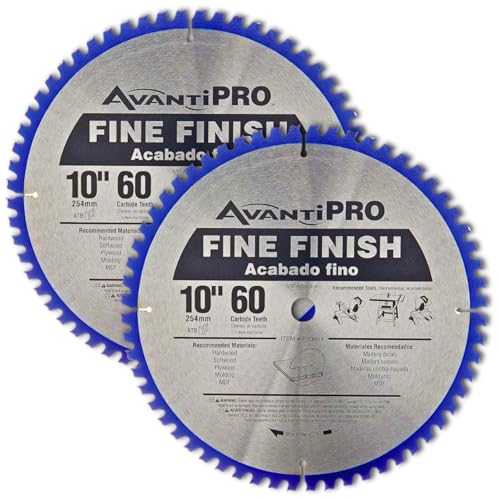
Freud AvantiPro Fine Finish Saw Blade
What We Like
- 60-tooth carbide design for smooth cuts
- Laser-cut stabilizer vents reduce vibration
- Works on both miter and table saws
- Two-blade pack offers immediate backup
Trade-offs
- 10-inch diameter limits use to compatible saws.
- Weighs 0.3 pounds per blade, lighter than many full-kerf options.
A 60-tooth carbide-tipped blade is the sweet spot for clean crosscuts in plywood and trim without sacrificing too much speed. The laser-cut stabilizer vents are a crucial feature, minimizing blade wobble so your miter saw stays accurate cut after cut. This makes the AvantiPro an excellent core blade for the workshop that needs to switch between a table saw and a miter saw for finish work. It’s built for the user who values a consistently smooth result and appreciates the practicality of having a second blade ready to go.
This Freud AvantiPro 2-pack includes a 10-inch blade with 60 teeth, a combination designed to produce ultra-smooth cuts in wood and plywood while reducing splintering. Its 6000 RPM rating supports fast, stable operation on standard 10-inch miter and table saws, making it a versatile choice for fine-finish projects. The value pack provides a convenient spare, ensuring you have a sharp blade ready when needed.
Product photos
Diablo 12-Inch 80-Tooth Fine Finish Blade

What We Like
- 80-tooth Hi-ATB geometry for clean, tear-out-free crosscuts.
- Perma-SHIELD coating reduces heat and gumming, extending blade life.
- Super thin laser-cut kerf for fast cuts with less material waste.
- TiCo Hi-Density carbide is engineered for maximum durability.
Trade-offs
- A 12-inch diameter limits compatibility to saws with that capacity, unlike more common 10-inch options.
- The fine finish focus means it's not the right blade for rough lumber or jobs requiring a fast, aggressive cut.
With 80 teeth in an alternate top bevel grind, this blade is designed for fine finish crosscuts in hardwoods and softwoods, offering precise and clean results that minimize tear-out. The Diablo D1280X pairs that high tooth count with a super thin kerf design for fast, durable cuts and reduced material waste. Its Perma-SHIELD non-stick coating protects the blade from heat, gumming, and corrosion to extend the blade’s life, a combination aimed at clean results where the final appearance matters, like on trim or furniture. One owner using this blade in a Bosch sliding miter saw reported being quite happy with it, noting a preference for spending a bit more to get a good product.
The trade-off for that fine finish is a blade built for finesse, not brute force. Its lighter 2.5-pound weight, compared to a dedicated shop blade like the heavier Forrest Chopmaster, means it may not feel as planted during the most demanding cuts on thick, dense material. For a dedicated miter saw station where you only make finish cuts, this is a non-issue. But if your miter saw is your only station and you frequently switch between rough and finish work, you might find the Freud Thin Kerf Sliding Miter Saw Blade offers a more versatile performance envelope. Its 72-tooth blend provides this without sacrificing too much finish quality.
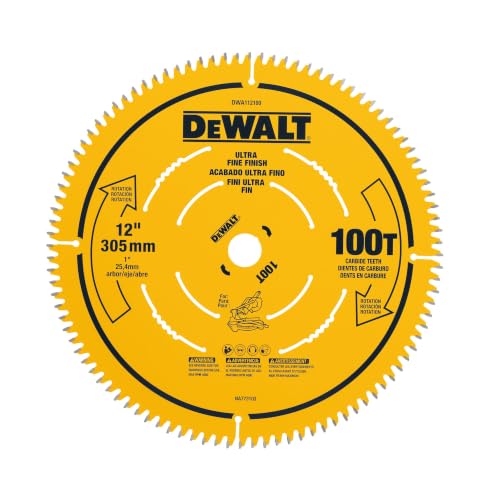
DEWALT 12-Inch 100-Tooth Miter Saw Blade
What We Like
- Patented body slot design minimizes vibration.
- 100 ultra-sharp carbide teeth for a fine finish.
- Precision tensioning adds stiffness for increased accuracy.
- Optimized tooth geometry enhances cut precision.
Trade-offs
- At 2.7 lb, it's heavier than some 12-inch blades.
- Ultra-fine finish focus less suited for rough framing.
The patented body slot design is the key feature here, delivering a noticeably smoother and quieter cut by reducing blade chatter. This makes it an excellent choice for finish carpentry and trim work where a flawless surface is critical. The 100 ultra-sharp carbide teeth are engineered for that purpose, leaving behind a clean edge that often needs little to no sanding. For a professional looking to upgrade their miter saw’s performance on moldings and furniture, this blade’s low-vibration operation directly translates to cleaner results and less fatigue over long sessions.
A 100-tooth design prioritizes a fine finish over raw speed, requiring a more deliberate feed on thick material. This blade is dedicated to precision work, not fast cutting. For a more versatile option that blends fine cuts with quicker crosscuts, the Diablo 12-Inch 80-Tooth Fine Finish Blade offers a faster cut with excellent results.
Product photos
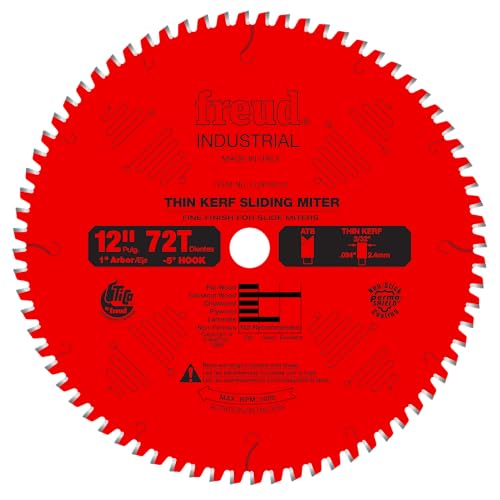
Freud Thin Kerf Sliding Miter Saw Blade
What We Like
- 5° negative hook angle for controlled cuts
- Thin kerf design reduces motor strain
- Premium TiCo carbide for edge retention
- Perma-Shield coating reduces friction and heat
Trade-offs
- Thin kerf is less rigid than a full-kerf blade
- Optimized specifically for sliding miter saws
A thin kerf and a 5° negative hook angle make this blade a specialist for sliding compound miter saws. The thin design requires less power from your saw’s motor, while the negative hook pulls the workpiece down against the fence, preventing it from climbing. This combination delivers clean, controlled crosscuts with minimal tear-out, exactly what you need for precise trim and finish work on a slider. It’s built for the craftsman who demands a smooth, predictable cut from their sliding miter saw.
The trade-off is rigidity. That thin kerf, while easier on your motor, can deflect more under heavy lateral pressure than a full-kerf blade like the Ridge Carbide Super Miter. This blade is optimized for crosscutting, not ripping. For a dedicated shop saw where maximum horsepower isn’t a concern and ultimate stability is key, a heavier full-kerf blade might be the choice. But for the sliding miter saw station, Freud’s design addresses the specific physics of that tool perfectly.
Product photos
Forrest Chopmaster Miter Saw Blade

What We Like
- Double-hard C-4 carbide for long life
- Heavy steel plate for maximum stability
- Produces tight miter joints with no bottom splinters
- Works with all makes of chop and miter saws
Trade-offs
- A 3.6 lb weight is substantial for a 12-inch blade
- The 1/8-inch kerf requires more saw power than a thin-kerf blade
Forrest Chopmaster blades produce tight, perfectly cut miter joints with no bottom splinters, which means cleaner cuts in trim and furniture projects. This result comes from its 4 PTS + 1 flat tooth style and a heavier than normal steel plate that maintains maximum stability for the best cut. The blade works with all makes of chop, miter and radial arm saws.
Weighing 3.6 pounds, the blade has a heavier steel plate for stability and uses double-hard C-4 Submicron Carbide for up to 300% longer life. One owner mentioned using an 80-tooth Diablo blade in a sliding miter saw and being quite happy with it. They noted they are not very price sensitive and prefer to spend a bit more for a good product.
Makita Micro Polished Miter Saw Blade

What We Like
- ATAF tooth design delivers ultra-precise cuts.
- Ultra-thin kerf reduces motor strain and drag.
- Micro-polished teeth produce a true mirror finish.
- Hand-tensioned steel plate ensures lasting accuracy.
Trade-offs
- The 10-inch diameter limits cutting capacity on larger stock.
- At 1.8 pounds, it's heavier than some 10-inch blades like the 1.6-pound WEN model.
- The 80-tooth design is specialized for fine crosscuts, not ripping.
The Makita A-93681’s defining feature is its micro-grain carbide teeth honed to a 600-grit finish, which translates directly to a glass-smooth, ready-to-finish edge on your trim and molding. This blade is built for the woodworker who prioritizes final surface quality over speed, where sanding is the enemy of detail. Its Japanese ultra-thin kerf design means your saw motor works less, preserving its life and maintaining a consistent feed rate through hardwoods. The fully hardened, hand-tensioned plate is the foundation for the repeatable accuracy that complex crown or picture-frame projects demand.
This blade’s 80-tooth, 10-inch configuration is a pure crosscut blade, so don’t expect it to rip lumber efficiently. For general shop work, a combination blade would be more versatile. But for achieving a flawless finish directly off the saw, particularly on expensive hardwoods or finished cabinetry, the Makita’s polished edge is its reason for being. Owner feedback consistently highlights the fantastic cut quality, noting it lives up to its precision billing.
DEWALT Miter Saw Blade Combo Pack

What We Like
- Two-blade pack covers rough cuts and fine finish work
- Patented body slot design reduces vibration for smoother operation
- Optimized tooth geometry is designed for increased cutting accuracy
- Carbide teeth are rated for up to 3x longer life
Trade-offs
- Pack contains only 40-tooth and 60-tooth blades
A pair of purpose-built 12-inch blades in one pack allows switching from fast framing cuts to clean trim work without separate purchases. This combo’s core appeal is that versatility. The 40-tooth blade handles dimensional lumber efficiently, while the 60-tooth blade steps up for finer moldings. Research mentions a general trust in Dewalt’s precision trim blades, and this pack offers two of them in a convenient set.
This two-blade set is designed for versatility rather than a single specialized task. You won’t find an 80-tooth or 100-tooth blade here for glass-smooth crosscuts on expensive hardwood. For that level of finish, you’d need to look at a dedicated fine-finish blade. But if your projects range from building a deck to installing baseboards, having these two solid options on hand covers a lot of ground without the premium price of a single high-tooth-count blade.
Product photos
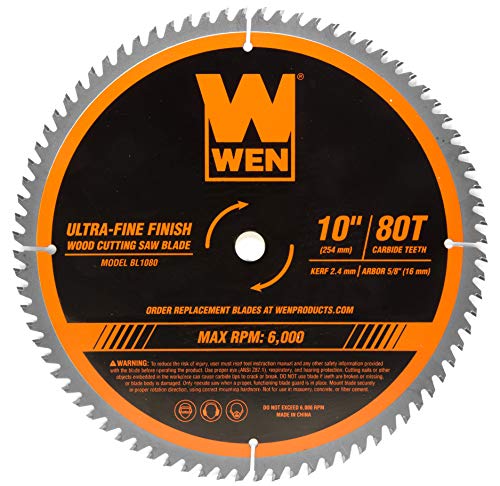
WEN Ultra-Fine Finish Saw Blade
What We Like
- 80-tooth design delivers ultra-fine finish cuts
- Ultra-thin kerf reduces waste and strain on motors
- Compatible with most 10-inch miter and table saws
- Carbide-tipped teeth handle hard and softwoods
Trade-offs
- 10-inch diameter limits maximum cut depth versus 12-inch blades
- The fine 80-tooth geometry is specialized for finish work, not rough cuts
An ultra-thin kerf paired with 80 carbide teeth delivers clean, efficient cuts in finish work, leaving minimal sanding. That combination makes this blade a standout for the cost-conscious woodworker who demands a smooth surface right off the saw. It’s built for the majority of common 10-inch shop saws, so it slots right into a typical miter or table saw setup without fuss. You get a blade focused on precision, not versatility, which is exactly what you want for trim, molding, or fine furniture components.
As a 10-inch blade, it simply cannot match the maximum cut depth of a larger 12-inch option. That’s the practical limit of its platform. This is a specialized tool for finish cuts, so don’t expect it to rip through construction lumber quickly. For a dedicated finish blade that maximizes the capability of a standard 10-inch saw without a premium price, however, the specifications are thoughtfully chosen for the task.
Product photos
Diablo 10-Inch Combination Saw Blade

What We Like
- TiCo carbide for sharp, durable edge
- Non-stick coating resists heat and gumming
- Thin kerf for fast, clean cuts
- Tri-metal shock resistant brazing
Trade-offs
- 50-tooth count is not ideal for ultra-fine finish cuts
- 5/8-inch arbor requires bushing for many 1-inch saws
- General-purpose grind, not specialized for delicate trim
This 10-inch blade’s 50-tooth design is specified for both rip cuts and crosscuts in wood, making it a versatile single-blade solution. That profile suits contractors or serious DIYers who need to switch between tasks like framing and basic trim without changing blades. Its Perma-SHIELD non-stick coating protects from heat and gumming, which helps extend the blade’s life during long sessions.
The 50-tooth count delivers clean cuts, but it won’t produce the ultra-fine finish of a dedicated fine-finish blade with a higher tooth count. Research mentions from owners of other Diablo blades indicate general satisfaction with the brand’s performance and durability. One owner noted they choose Diablo blades from their local home center for convenience and reliable quality.
Ridge Carbide Tool Co. RS11280-1 Miter Saw Blade
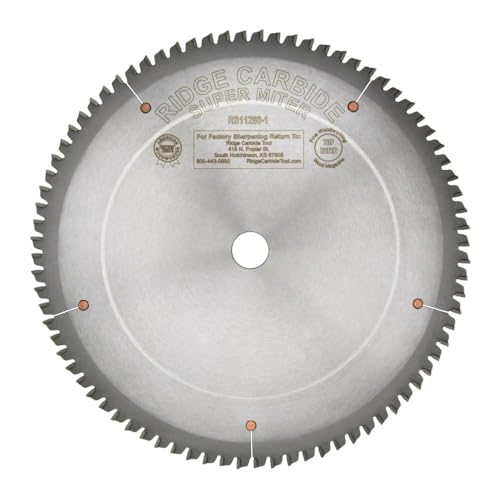
What We Like
- Negative hook angle for safe sheet good cutting.
- AR 4+1 grind for straight cuts in sheet goods.
- Explicitly rated for sheet goods and solid wood.
Trade-offs
- The full 0.125-inch kerf demands more saw power.
- 3.4-pound weight can strain smaller miter saws.
A -2-degree hook angle means the teeth lean backward, pulling the saw forward less aggressively. This reduces the chance of the blade grabbing when cutting large panels. Combined with an 80-tooth AR 4+1 grind, where every fifth tooth is a flat raker, the blade is engineered to track straight for clean edges on sheet goods. It is recommended for 3/8″ to 1″ thick solid wood and sheet goods, and its grind type is described as suitable for both ripping and crosscutting.
The full 0.125-inch kerf and heavier plate require a miter saw, compound miter saw, or radial arm saw with sufficient power to spin it without bogging down. A saw with a solid arbor is best suited to handle the blade’s 3.4-pound weight and 0.087-inch plate thickness. For users whose primary tasks differ, the other-products list includes thinner-kerf options like the Freud Thin Kerf Sliding Miter Saw Blade.
How We Evaluated Miter Saw Blades
Our evaluation started with the manufacturer’s specifications for tooth count, kerf, and hook angle, as these are the primary determinants of a blade’s performance. We then examined expert round-ups and synthesized patterns from extensive owner feedback to understand real-world durability and cut quality across different materials.
The most critical criteria were the blade’s intended application, such as finish work versus general construction. We also considered compatibility with your saw’s power and arbor size, along with the value offered by its features and longevity. This is a research-based guide, so we cannot account for the subjective feel of a cut or a specific blade’s longevity in high-production use. Instead, we focused on consistently reported strengths and trade-offs.
What To Look For In Miter Saw Blades
Selecting a miter saw blade means matching its design to your most frequent tasks. A blade optimized for crosscutting trim behaves very differently from one meant for ripping lumber, and using the wrong one leads to poor results and frustration. Our research into types of saw blades confirms that tooth geometry and count are the first things to consider.
Focus on tooth count for your primary task: 24-40 teeth for fast, rough cuts; 60-80 teeth for clean crosscuts in wood; and 80-100+ teeth for a mirror finish on moldings and veneers.
Tooth Count & Geometry
Tooth count dictates cut speed and smoothness. Lower counts (24-40 teeth) cut aggressively for framing but leave a rougher edge. For general finish work on wood, a 60-tooth blade like our best overall Freud AvantiPro offers a great balance. For pristine, tear-out-free crosscuts on visible trim, an 80 or 100-tooth blade like the Diablo or DEWALT models is essential. The tooth shape, or grind, also matters; Alternate Top Bevel (ATB) teeth are standard for clean crosscuts, while a Triple Chip Grind (TCG) is better for hard materials.
Blade Kerf & Compatibility
The kerf is the width of the cut the blade makes. A thin kerf blade removes less material, puts less strain on your saw’s motor, and is ideal for lower-powered or sliding miter saws, like the Freud model we highlight. A full kerf blade, like the Forrest Chopmaster, is more rigid for ultimate precision but demands a powerful saw. Always verify the blade diameter (10-inch or 12-inch) matches your saw’s capacity and that the arbor hole (typically 5/8″ or 1″) is compatible; some blades require a bushing to fit.
Specialized Features
Look for features that address specific challenges. A negative hook angle, found on blades like the Ridge Carbide for sheet goods or the Freud for sliding saws, provides more controlled, safer cuts on sheet materials and cross-grain work. Vibration-reduction technologies, such as the DEWALT blade’s body slots, contribute to smoother operation and increased accuracy. Coatings like Perma-SHIELD can reduce friction and heat buildup, helping to extend blade life between sharpenings.
- Check your saw’s manual for maximum blade diameter and arbor size specifications.
- Consider buying a dedicated blade for finish work to keep it sharp longer.
- For a single, do-everything blade, a 50-tooth combination blade like the Diablo is a practical compromise.
The best blade is the one designed for your most common cut on your specific saw.
Miter Saw Blades Compared
Use the table below to quickly compare the key specifications and best uses for each of our top picks.
| Product | Diameter | Tooth Count | Kerf |
|---|---|---|---|
| Freud AvantiPro Fine Finish Saw Blade | 10 inches | 60 teeth | N/A |
| Diablo 12-Inch 80-Tooth Fine Finish Blade | 12 inches | 80 teeth | Super Thin |
| DEWALT 12-Inch 100-Tooth Miter Saw Blade | 12 inch | 100 | N/A |
| Freud Thin Kerf Sliding Miter Saw Blade | 12 inches | 72 teeth | Thin Kerf |
| Forrest Chopmaster Miter Saw Blade | 12 inches | 80 teeth | 1/8 inch |
| Makita Micro Polished Miter Saw Blade | 10 inches | 80 teeth | Ultra-thin kerf |
| DEWALT Miter Saw Blade Combo Pack | 12 inches | 40-tooth and 60-tooth | N/A |
| WEN Ultra-Fine Finish Saw Blade | 10 inches | 80 carbide-tipped teeth | Ultra-thin 1/10 inch |
| Diablo 10-Inch Combination Saw Blade | 10 inches | 50 teeth | .098" Kerf |
| Ridge Carbide Tool Co. RS11280-1 Miter Saw Blade | 12 inches | 80 teeth | 0.125" |
Frequently Asked Questions
What is the best blade to use on a miter saw?
The best blade depends entirely on your project. For general-purpose crosscutting in wood and sheet goods, a 60-tooth blade like the Freud AvantiPro is an excellent all-around choice. For fine finish work on moldings, an 80-tooth or higher blade from Diablo or DEWALT delivers superior results. Always match the blade’s design to your material and desired cut quality.
What is the best tooth count for a miter saw blade?
There is no single best count; it’s a trade-off between speed and smoothness. For fast, rough cuts in construction lumber, use 24-40 teeth. For clean crosscuts in dimensional wood and plywood, 60 teeth is ideal. For a mirror-smooth finish on trim, hardwoods, or veneers, choose 80 teeth or more. Our guide to miter saw blades explores this in more detail.
Who makes the best quality saw blades?
Based on our research of expert opinions and owner feedback, brands like Freud (and its Diablo line), Forrest, DEWALT, and Makita consistently receive high marks for durability and cut quality. The “best” brand often comes down to the specific blade model and its intended use, as manufacturers excel in different specialties, from fine woodworking to job-site durability.
What is the best mitre saw blade for wood?
For cutting wood, you need to define the cut. For ripping lumber lengthwise, a lower-tooth-count blade is better, though most miter saw work involves crosscutting. For clean crosscuts in wood, a blade with 60-80 ATB-style teeth, like our best overall Freud or the premium Diablo, will perform excellently. For the absolute finest finish on hardwoods, a specialized blade like the Makita Micro Polished model is worth considering.
Can I use a table saw blade on my miter saw?
Yes, in many cases you can, as both often share a 10-inch diameter and a 5/8-inch arbor. Many blades, including the Freud AvantiPro, are marketed for both tools. The primary consideration is the blade’s hook angle. A low or negative hook angle is safer and provides more control on a miter saw, especially for crosscutting. A higher positive hook angle is more common on table saw blades designed for ripping.
The Bottom Line
The Freud AvantiPro Fine Finish Saw Blade is our best overall pick for its excellent balance of clean cuts, vibration reduction, and value. This makes it a reliable choice for DIYers and professionals using 10-inch saws. If your budget is tight but you need a dedicated finish blade, the WEN Ultra-Fine Finish Saw Blade delivers solid performance. Contractors needing one blade for everything should consider the Diablo 10-Inch Combination Saw Blade. Ultimately, the single most important factor is choosing a blade designed for your most frequent task. Trying to make a framing blade produce a finish-cut result only leads to frustration.
