
9 Best Miter Saws For Trim in 2026
This post contains affiliate links. As an Amazon Associate, we earn from qualifying purchases.
Our top choice for a miter saw dedicated to trim work is the DEWALT DWS780 12-inch Double Bevel Miter Saw, which wins with its precise XPS LED shadow line for perfect alignment. The Makita LS1019L is the best compact and precise saw for tight spaces, while the SKIL MS6305-00 offers excellent value with a dual-bevel design.
Choosing the right saw for trim is about balancing precision, capacity, and your workspace. A powerful motor is less critical than a dead-on cutline guide and a design that handles compound angles cleanly. This guide is based on research into specifications, expert round-ups, and patterns in owner feedback to help you find a saw that makes your trim work faster and more accurate.
Top 9 Miter Saws For Trim in the Market
Certain content that appears on this site comes from Amazon. This content is provided "as is" and is subject to change or removal at any time.
The Best Miter Saws For Trim, Reviewed
DEWALT DWS780 12-inch Double Bevel Miter Saw

What We Like
- XPS LED shadow line for precise alignment
- Powerful 15 amp motor for heavy-duty work
- Integrated cutline system needs no adjustment
- Double-bevel design for complex trim angles
Trade-offs
- At 54.7 lb, it's a substantial bench tool, not easily portable.
- No cordless flexibility for job sites without power.
Its 15-amp motor runs at 3,800 rpm, a combination designed for heavy-duty applications. The 12-inch blade provides a large cutting capacity, suited for substantial trim work. The integrated XPS LED shadow line projects an adjustment-free line onto the workpiece for better accuracy and visibility during cuts.
The saw weighs 54.7 pounds, so it requires a stable stand for secure operation. Its dust collection system captures over 75% of dust generated, a significant benefit for maintaining a cleaner workspace during extended use. Among 12-inch miter saws, its weight is similar to models like the Makita LS1219L.
Makita LS1019L 10-inch Sliding Compound Miter Saw

What We Like
- Compact, wall-flush design for tight spaces
- Smooth linear ball bearing slide for dead-on accuracy
- 12-inch saw capacity in a 10-inch footprint
Trade-offs
- Vertical cut capacity limits some thick stock
The Makita LS1019L packs the crown molding cutting capacity of a 12-inch miter saw into a tool that can slide flush against a wall. That unique 2-steel rail system and its 57.9-pound frame make it the most compact and portable design in its class. For trim carpenters and finish installers working in confined areas like built-in cabinets or tight corners, this saw delivers full capability without needing to be pulled out from the workspace. The linear ball bearing system ensures the smooth, precise operation that delicate moldings demand.
The trade-off for that compact slide is that it doesn’t tuck away like an articulated arm, so you’ll need clear space to the sides when making wide crosscuts. It’s a tool built for precision and space-saving, not for brute-force cutting of large dimensional lumber. Compared to a bulkier sliding 12-inch saw like the Makita LS1219L, you gain significant portability and a smaller footprint but give up some blade diameter and maximum cutting height. For detailed interior trim work where every inch of floor space counts, this Makita’s design is exceptionally smart.
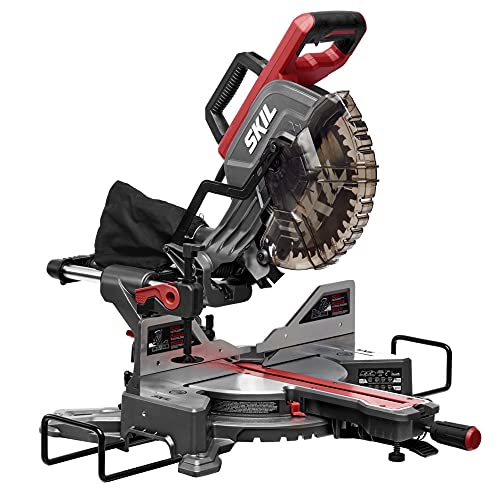
SKIL MS6305-00 10-inch Dual Bevel Sliding Miter Saw
What We Like
- LED shadow line for precise alignment
- Powerful 15-amp motor for quick cuts
- Cuts common angles with 11 positive stops
- Dual-bevel design for versatile trim work
Trade-offs
- At 39.4 lb, it's heavier than some 10-inch non-sliding saws
- 35.4-inch length requires a sizable workbench footprint
An LED shadow line instead of a laser provides a crisp, clear cut guide that won’t drift out of alignment, a genuine advantage for repetitive trim work. This saw pairs that with a solid 2×12 crosscut capacity and a dual-bevel function, giving you the core features needed for crown molding and baseboards without extra fuss. It’s a straightforward, capable machine for the DIYer or contractor who wants accuracy without navigating complex setups.
It’s a bench saw, not a portable one you’ll want to haul to a job site daily. For dedicated shop use where you need to slice through wide stock, the SKIL stands out. If your priority is a compact, lightweight saw for quick mobile jobs, the single-bevel Metabo HPT C10FCG2 at 24 pounds is worth a look.
DEWALT DCS785B 20V MAX 12-inch Cordless Miter Saw

What We Like
- Industry-leading cordless cut capacity for trim
- Regenerative braking for extended battery life
- Integrated wireless vacuum trigger control
- Adjustment-free Cutline blade positioning
Trade-offs
- Tool-only format requires separate battery purchase
- At 65.9 lb shipped, it's a substantial piece of kit
- Full size demands dedicated workspace or mobile stand
A 12-inch blade and sliding action delivering a 14-inch crosscut capacity means you can handle the widest crown molding and baseboards cordlessly, without ever compromising on stock size. This makes it the obvious choice for finish carpenters and serious remodelers who need pro-grade capacity away from an outlet. The claimed 97% dust capture and wireless vacuum trigger are built for the meticulous clean-up trim work demands, turning a messy job into a tidy one.
This is DEWALT’s largest cordless miter saw, so it handles big trim like 14-inch horizontal boards or 6-1/2-inch nested crown molding. That capacity means it’s a full-size stationary saw that happens to be cordless, requiring a solid stand rather than just a sawhorse. While cordless, its 65.9-pound weight and large footprint make it a dedicated workshop anchor for a truck-based crew, not a grab-and-go tool for quick site visits.
Product photos
Makita LS1219L 12-inch Dual-Bevel Sliding Miter Saw

What We Like
- Smooth dual-rail slide operation
- Direct drive motor for increased vertical capacity
- Flush-to-wall footprint with single slide-glide
- Dual dust ports for excellent extraction
Trade-offs
- At 81.6 lb, it's a heavy stationary tool
- Large 36-inch width demands dedicated shop space
- Unique motor angle differs from belt-drive designs
With a 15-inch crosscut capacity and the ability to handle 8-inch crown molding vertically nested, this saw cuts wide boards and complex trim that smaller models cannot. It suits serious trim carpenters or advanced DIYers regularly working with large casings and baseboards. The unique 2-steel rail sliding system offers smooth operation and a reduced footprint for use flush against a wall, a smart design for corners. Research mentions praise the soft-start feature on the 15-amp motor, which comes up to full power smoothly instead of jerking your trigger hand.
That massive capacity comes with significant size and heft. Weighing over 80 pounds, this is a saw you’ll likely mount on a dedicated stand in your shop, not one you’d carry to a job site every day. Its 36-inch width also requires a solid, spacious work surface. If your trim work is mostly smaller stock and you need more portability, the Bosch CM10GD with its articulated-arm glide is a compelling, more compact alternative that sacrifices some crosscut width.
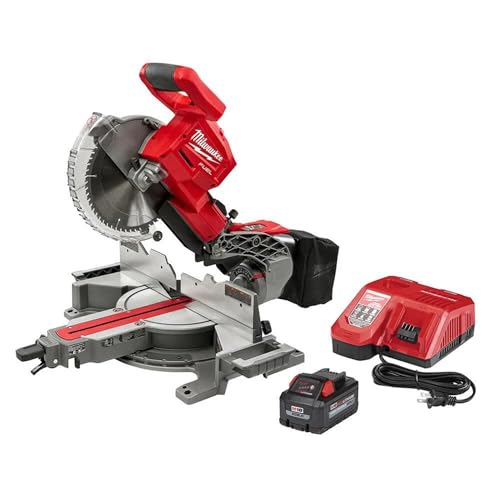
Milwaukee M18 Fuel 10-inch Sliding Compound Miter Saw
What We Like
- Cordless design for full jobsite mobility
- Durable construction noted in research
- Integrated side handles for easier transport
- Consistent power output per expert feedback
Trade-offs
- Weighs 45 pounds, less portable than lighter saws
- Large footprint at 34.5 inches long
The Milwaukee M18 Fuel’s cordless operation is its defining feature, freeing you from outlet hunting and extension cord tangles on a busy trim job. Research and owner feedback confirm it delivers power on par with corded models, making it a serious choice for finish carpenters and remodelers who value uncluttered workspaces and the flexibility to move from room to room without interruption. The durable build and side handles speak to a tool designed for daily use, not just occasional projects.
Compared to a compact corded model like the Metabo HPT C10FCG2, you’re gaining runtime but giving up a significant amount of weight and bulk. This saw excels when your battery ecosystem is already Milwaukee, letting you swap packs and keep cutting long after a corded saw would have you searching for an outlet.
Product photos
Metabo HPT C10FCG2 10-inch Miter Saw
What We Like
- Very portable at just over 24 pounds
- Powerful 15-amp motor for a compact saw
- Large table improves material support
- Includes a vice clamping system
Trade-offs
- Single-bevel design limits compound cuts from the right
- No sliding mechanism reduces maximum cut width
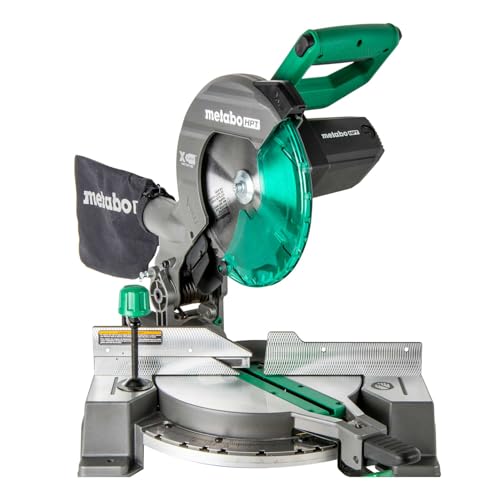
The Metabo HPT C10FCG2 weighs 24 pounds, so it’s easy to lift onto a bench or carry to a job site. Its 15-amp motor generates a no-load speed up to 5,000 RPM for the power to make effortless cuts, while an improved miter scale aids in accurate adjustments. A large table and vice clamping system provide material support and secure the workpiece.
Its light weight and simplicity are balanced by a single-bevel design. You’ll have to flip your workpiece for any compound cuts that require a bevel from the right side, which can slow down complex trim installations. Compared to a sliding model like the SKIL MS6305-00, it won’t handle wider boards as easily. However, for standard interior trim where portability and basic precision are the priorities, this saw hits a sweet spot.
Product photos
VEVOR 12-inch Sliding Miter Saw
What We Like
- LED guide system for precise alignment
- Dual-bevel design for complex trim joints
- Aluminum base for portability and stability
- Powerful 5000 RPM motor for hardwoods
Trade-offs
- At 46.4 lb, it's heavier than some 10-inch sliding saws
- Large 33.5-inch length demands significant bench space
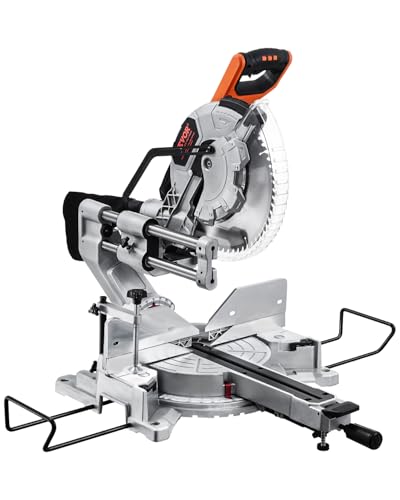
The VEVOR 12-inch Sliding Miter Saw provides dual-bevel cuts from 0° to 45° in both directions, which allows for complex angled work on projects like picture frames without having to flip the material. Its axial sliding system moves the saw head forward and backward, enabling wider crosscuts on longer boards. An LED guide system projects a cutting line onto the workpiece for alignment. This combination of features is also found on established models like the DEWALT DWS780.
You do make some concessions for that capability. The saw’s footprint is substantial, and its weight means it’s more of a semi-stationary shop tool than one you’d carry to a job site every day. Compared to a more compact 10-inch option like the SKIL MS6305-00, the VEVOR offers more blade and motor, but demands more real estate in your workspace. For trim work, the power and bevel range are excellent; just ensure your bench can handle its size.
Product photos
Bosch GCM18V-10SDN Cordless Miter Saw

What We Like
- Large 11-1/2-inch crosscut capacity for trim
- Dual-bevel design for compound cuts either side
- Lightweight 40.1-pound design with carry handle
- Tall fence supports taller material accurately
Trade-offs
- Tool only: requires separate battery and charger purchase.
- 40.1 pounds is heavier than some corded competitors like the 39.4-pound SKIL.
- 10-inch blade limits depth of cut compared to 12-inch models.
Its 11-1/2-inch crosscut width handles wide casing and its dual-bevel design tackles crown molding from both sides. The brushless motor is engineered for cordless power, making this a serious option for the trim carpenter who needs to work far from an outlet or is already invested in the Bosch 18V battery platform.
This is a bare tool, so a compatible high-power battery and charger must be purchased separately, increasing the upfront cost. For users who primarily work in one location, a lighter corded saw like the 24.2-pound Metabo HPT model exists. Where true mobility is essential, however, this Bosch provides a large cutting capacity without being tethered to an outlet.
Product photos
How We Evaluated Miter Saws For Trim
Our research focused on specifications from manufacturers, insights from professional woodworking publications, and consistent patterns in owner reviews. We prioritized the criteria that matter most for clean, professional-looking trim: a precise cutline system for accurate alignment, sufficient bevel and miter capacity for complex crown molding joints, and a stable, smooth sliding mechanism.
Because trim work often happens in finished spaces or small shops, we also considered footprint and whether a saw could sit flush against a wall. A research-based evaluation like this can identify well-engineered features and common user experiences, but it cannot replicate the personal feel of a saw’s handle or trigger in your own workshop.
What To Look For In Miter Saws For Trim
The perfect trim saw delivers accuracy first. It should make setting compound angles simple and provide a clear view of exactly where the blade will meet the wood.
Look for a precise cutline system (LED or laser), sufficient bevel and miter ranges for crown molding, and a compact or wall-flush footprint if shop space is limited. A smooth slide and solid detents are key for repeatable cuts.
Cutline Precision
For trim, seeing your cut before you make it is non-negotiable. An integrated LED shadow line, like the XPS system, projects the blade’s kerf onto the workpiece without needing adjustment. Laser guides are also common, but some can be difficult to calibrate. Research indicates that a clear, accurate guide is one of the most valued features for avoiding costly mistakes on finished moldings.
Capacity & Footprint
Capacity isn’t just about width; for trim, vertical cut height and nested crown molding capacity are critical. A 10-inch sliding saw can often match the crosscut capacity of a 12-inch non-slider in a smaller package. Designs with articulating arms or single glide rails can sit flush to a wall, saving valuable shop space. In contrast, models with rear-extending rails need a foot or more of clearance behind them.
Bevel & Miter Capability
Trim work requires compound cuts. A dual-bevel design allows you to tilt the blade left and right without flipping the workpiece, which is essential for efficiency on complex crown or casing. Look for a wide miter range (often up to 60 degrees left and right) and positive detents at common angles like 22.5, 31.6, and 45 degrees.
A smooth, solid locking mechanism for both miter and bevel adjustments ensures your angle stays true through the cut. For detailed projects like cutting crown molding with a miter saw, this precision is paramount.
- Check the saw’s specified “crown molding nested” capacity, which is different from its standard vertical cut height.
- Ensure the fence is tall enough to support your material vertically for cutting taller baseboards.
- Verify if the saw tilts for a bevel cut in both directions (dual-bevel) or only one (single-bevel).
- Test the smoothness of the slide and the solidity of the locks when the saw is powered off in the store.
- Consider the overall length; even compact saws can be over 30 inches long, demanding a dedicated bench space.
A saw that excels at trim and molding work will have accurate detents, a solid fence, and a clear cut guide.
Miter Saws For Trim Compared
The following table compares the key features of all nine saws side-by-side to help you weigh your options at a glance.
| Product | Blade Size | Weight | Bevel Type |
|---|---|---|---|
| DEWALT DWS780 12-inch Double Bevel Miter Saw | 12-inch | 54.7 pounds | Double Bevel |
| Makita LS1019L 10-inch Sliding Compound Miter Saw | 10 inches | 72.8 pounds | Dual-Bevel |
| SKIL MS6305-00 10-inch Dual Bevel Sliding Miter Saw | 10" | 39.4 pounds | Dual Bevel |
| DEWALT DCS785B 20V MAX 12-inch Cordless Miter Saw | 12 inch | 51.7 lb | Double Bevel |
| Makita LS1219L 12-inch Dual-Bevel Sliding Miter Saw | 12" | 81.6 pounds | Dual-Bevel |
| Milwaukee M18 Fuel 10-inch Sliding Compound Miter Saw | 10-inch | 45.0 Pounds | Dual Bevel |
| Metabo HPT C10FCG2 10-inch Miter Saw | 10-Inch | 24.2 pounds | Single Bevel |
| VEVOR 12-inch Sliding Miter Saw | 12-inch | 46.4 Pounds | dual |
| Bosch GCM18V-10SDN Cordless Miter Saw | 10 In. | 40.1 pounds | Dual-bevel |
Frequently Asked Questions
What is the best miter saw for cutting trim?
The best miter saw for trim prioritizes precision and versatility. Our top overall pick, the DEWALT DWS780, is excellent for its adjustment-free XPS LED cutline and powerful motor, making it ideal for a dedicated workshop. For those needing cordless freedom or working in tight spaces, other picks like the DEWALT DCS785B or Makita LS1019L are strong contenders.
What is the best miter saw for cutting baseboards?
For baseboards, look for a saw with a tall fence to support the material vertically and a good vertical cut capacity. A dual-bevel capability is also helpful for cutting inside and outside corners without flipping the board. Several saws on our list, including the Makita LS1219L and the SKIL MS6305-00, are well-suited for this common trim task.
What kind of miter saw do I need for trim?
You need a compound miter saw at a minimum, which allows for both miter (angled) and bevel (tilted) cuts. A sliding compound miter saw increases your crosscut capacity for wider boards. For professional results, a dual-bevel sliding model with a precise cutline indicator is the most versatile choice for complex trim work like crown molding.
Which mitre saw is considered the best quality?
Quality in a miter saw is defined by precise engineering, durable construction, and smooth, accurate operation. Brands like DEWALT, Makita, and Bosch are consistently noted in research for their build quality and innovative features, such as smooth gliding mechanisms and accurate detent systems. The best miter saws for trim often come from these established tool lines.
Can I use a cordless miter saw for trim work?
Yes, modern cordless miter saws are powerful and capable enough for trim work. They offer excellent mobility for job sites without easy power access. Models like the DEWALT DCS785B provide ample capacity, but remember they require a compatible battery investment and are often heavier than their corded counterparts.
The Bottom Line
For the trim carpenter or serious DIYer with a dedicated workshop, the DEWALT DWS780 12-inch Double Bevel Miter Saw is the best overall tool. It combines unparalleled cutline accuracy with the power and capacity for demanding jobs. If you’re on a budget, the SKIL MS6305-00 delivers crucial LED guidance and dual-bevel capability at a mid-range price. The Makita LS1019L is the perfect solution for anyone wrestling with a cramped workspace. Ultimately, the single most important factor for a trim saw is a precise, reliable system for aligning your cuts, because in finish work, there’s no hiding a bad miter.
