
9 Best Mitre Saws For Picture Framing in 2026
This post contains affiliate links. As an Amazon Associate, we earn from qualifying purchases.
For picture framing, a miter saw must deliver wobble-free precision to create flawless joints. Our best overall is the Festool KAPEX KSC 60 for its cordless convenience and twin-column stability. Other top picks include the Bosch CM10GD for flush-wall cutting and the Makita LS1019L for compact spaces.
Picture framers need a saw that balances capacity with precision, especially when working with delicate moldings in a home workshop. The right tool minimizes tear-out and ensures repeatable, accurate 45-degree cuts without requiring constant recalibration.
This guide is based on a review of specifications, manufacturer data, and patterns in professional feedback. We’ll help you understand the key features that matter for framing so you can invest in a saw that fits your space and project scale.
Top 9 Mitre Saws For Picture Framing in the Market
Certain content that appears on this site comes from Amazon. This content is provided "as is" and is subject to change or removal at any time.
The Best Mitre Saws For Picture Framing, Reviewed
Festool KAPEX KSC 60 Cordless Sliding Miter Saw

What We Like
- Twin-column guide for wobble-free cuts
- Brushless motor for strong, efficient power
- Fast-charging batteries with active cooling
- Complete cordless system in organized case
Trade-offs
- At 29.5" L x 21.3" W, it requires a sizable workshop footprint
- Cordless design adds battery management versus plug-in rivals
This cordless sliding miter saw delivers miter angles up to 60° on both sides and bevel angles up to 47°, a wide range suitable for trim and finish carpentry. Its advanced twin-column guide with dual bearings keeps the blade aligned for clean, precise cuts without deflection. The included dual 18V battery system with an 8.0Ah capacity and rapid charger supports a full day of typical jobsite work, eliminating the need for a nearby power outlet.
The design is substantial, measuring 29.5 inches long, so it requires significant bench or stand space. You manage batteries instead of a power cord, a trade-off for cordless operation. Batteries and the charger are stored in an organized Systainer for transport, aiding jobsite readiness.
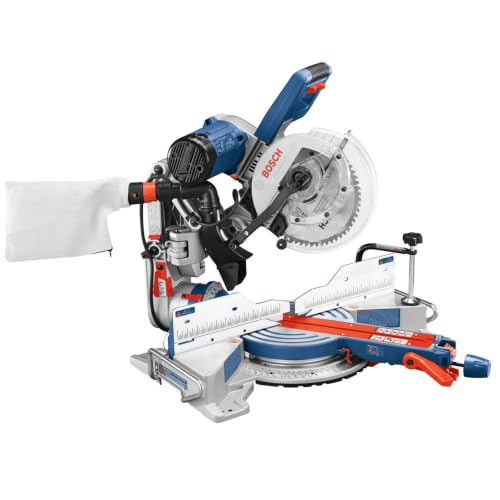
Bosch CM10GD Dual-Bevel Glide Miter Saw
What We Like
- Front bevel lock for easy angle changes
- Tall sliding fences support wide moldings
- Wide, precise detents for common framing angles
Trade-offs
- At 64 pounds, it's a substantial bench tool
- Weighs 64 pounds
Its articulated glide system reduces the front-to-back footprint by up to ten inches compared to slide saws with similar capacity, which can conserve valuable floor space. A 12-inch horizontal cut capacity and tall sliding fences support work with wider moldings and baseboards. The upfront bevel lock and range selector, plus detents at common angles like 31.6 and 45 degrees, allow for quick setting changes without reaching behind the saw.
At 64 pounds, this is a substantial tool designed for a stable work area. Compared to the 30.9-pound Makita LS0816F, the Bosch CM10GD provides greater horizontal cutting capacity and a dual-bevel function. The design prioritizes durable precision and space efficiency over being a lightweight, highly portable unit.
Makita LS1019L Dual-Bevel Sliding Miter Saw

What We Like
- Most compact design in its class for portability
- Linear ball bearing system for dead-on accurate cuts
- Unique sliding system reduces footprint significantly
- Delivers crown molding capacity of a larger 12-inch saw
Trade-offs
- Vertical cut capacity is limited to 5-1/4 inches
- The specialized rail system may require familiarization
A 10-inch saw that handles crown molding like a 12-inch model is a serious space-saver for a framer’s workshop. The Makita LS1019L achieves this with its unique two-steel rail sliding system, which pulls the blade forward in a single, compact motion instead of needing rear clearance. That lets you tuck it permanently against a wall, a huge advantage in a cramped shop. Combined with its linear ball bearing system engineered for dead-on accuracy, this design makes it the definitive choice for the framer who needs big-saw performance in a small-saw footprint.
The Makita LS1019L is the most compact and least heavy saw in its class, which makes it easier to move around a jobsite and allows it to operate flush against a wall. Its innovative direct drive system provides a vertical cutting capacity of 5-1/4 inches. The saw’s 2-steel rail sliding system delivers single slide-glide operation for accurate cuts, and its linear ball bearing system is engineered for ‘dead-on’ accuracy.
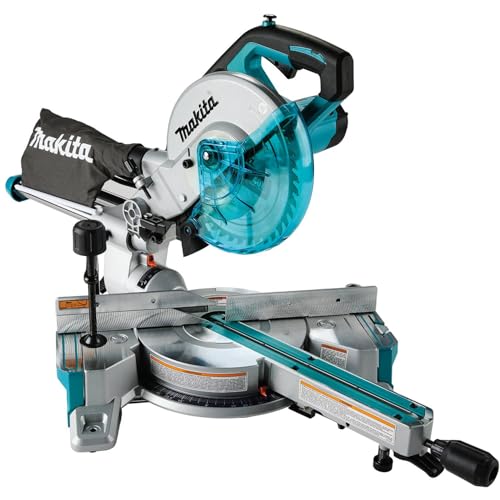
Makita LS0816F Slide Compound Miter Saw
What We Like
- Exceptionally portable at just 30.9 pounds.
- LED light illuminates the cutline for precision.
- Linear ball bearing system promises dead-on accuracy.
- Soft start feature ensures smooth, controlled operation.
Trade-offs
- 8-1/2-inch blade limits stock thickness compared to 10-inch or 12-inch saws.
- Smaller blade reduces cutting depth on wide crown moulding.
At 30.9 pounds, the Makita LS0816F is lighter than most sliding miter saws, so it’s easier to carry to a jobsite. Its 10.5 AMP motor delivers 5,000 RPM for cutting, and a soft start feature helps prevent the tool from jerking on startup. An LED light illuminates the cut line, and a linear ball bearing system is engineered for accurate cuts.
The primary trade-off is the 8-1/2-inch blade, which limits the maximum width of material you can cut in a single pass. For standard picture frame moulding, it’s more than sufficient, but it will struggle with deeper, more ornate profiles that a larger saw like the Makita LS1019L would handle easily. This saw excels in situations where its light weight and solid cut quality are the top priorities, even if it means making a two-step cut on the widest stock.
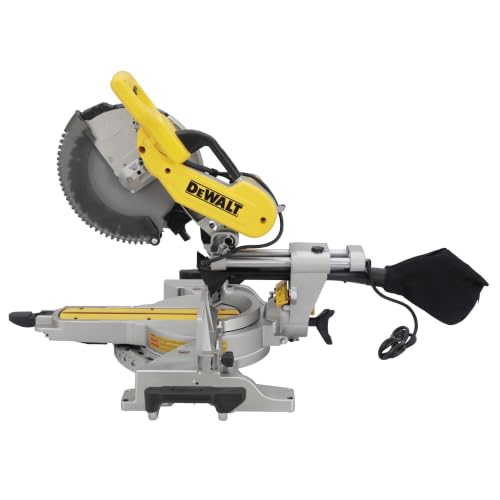
DEWALT DWS779 Sliding Compound Miter Saw
What We Like
- Tall sliding fence supports large moldings for picture frames
- Powerful 15-amp motor maintains speed in dense hardwoods
- Wide 60° right miter capacity for complex compound cuts
- Cam lock miter handle with detent override ensures precise angles
Trade-offs
- Its large footprint requires a dedicated, sturdy work surface.
A tall sliding fence that supports crown molding up to 7-1/2 inches nested means you can build substantial, ornate picture frames with deep profiles in a single pass. This capacity, combined with a dual-bevel design and a 15-amp motor, makes the DWS779 a workhorse for framers working with wide stock or creating shadow box designs. It’s built for the shop where you need to handle bulky materials with precision and repeatability.
The trade-off for that capacity and power is a substantial 67.7-pound weight and a large footprint, making it a permanent bench tool, not something you’ll want to move around often. For framers who prioritize extreme portability for on-site work, the much lighter Makita LS0816F presents a clear alternative, though with a smaller blade and reduced cutting capacity. The DEWALT’s design is all about delivering stationary shop power for demanding frame projects.
Product photos
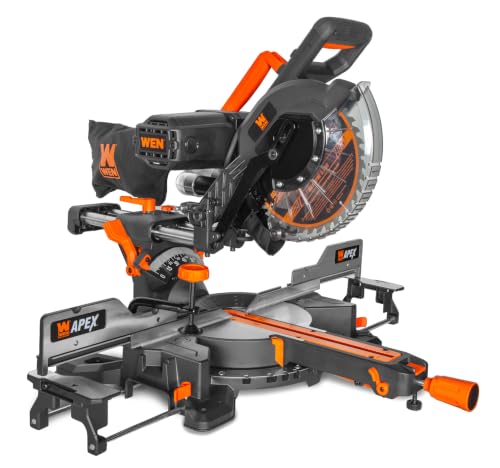
WEN MM1510 Dual-Bevel Sliding Miter Saw
What We Like
- LED cutline illuminates the cutting path
- Fan-assisted dust port captures up to 90% of sawdust
- Dual-bevel design with stops for complex angles
- Includes blade, extensions, and quick-clamp assembly
Trade-offs
- Large footprint at 37.8 inches wide
- Tool-only package lacks a stand
Its 15-amp motor and sliding system can crosscut boards up to 12.2 inches wide, allowing users to handle wider materials without needing multiple passes. The dual-bevel design permits miter cuts up to 50 degrees and bevel cuts up to 45 degrees in either direction, aided by positive stops for repeatable angle settings. An onboard LED cutline illuminates the line of cut, and the saw includes a carbide-tipped blade, extensions, and a two-year warranty as part of the WEN Apex series.
The trade-off for that capacity and feature set is a substantial 37.8-inch width, so you’ll need a permanent or very sturdy mobile stand in your workspace. It’s a capable, stationary centerpiece, not a tool you’d easily haul to a job site. For pure precision on smaller stock, a dedicated tool like the Festool KAPEX is in another league, but the WEN MM1510 brings a compelling mix of utility and value to the bench.
Product photos
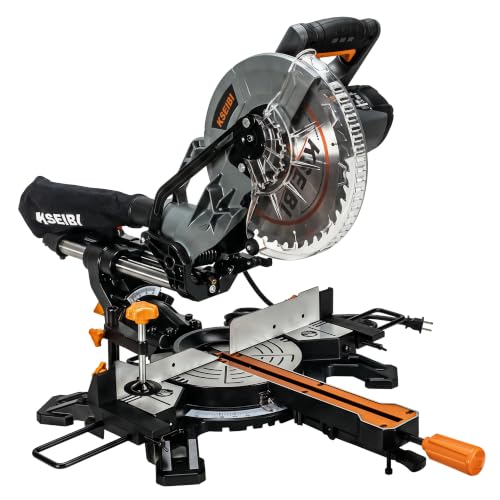
KSEIBI 10-Inch Sliding Compound Miter Saw
What We Like
- Sliding rails crosscut wide boards in one pass.
- Powerful 15-amp motor handles dense framing lumber.
- Cast aluminum base provides excellent stability.
- Comes complete with fence, clamp, and dust bag.
Trade-offs
- Single-bevel design requires flipping boards for complex cuts.
- No laser or LED cutline guide for alignment.
Its dual-rail sliding design lets the blade glide forward to crosscut wider boards than a fixed chop saw, which is essential for handling planks and framing lumber. A 15-amp motor delivers consistent corded power to cut cleanly through wood without bogging down, and the cast aluminum base keeps cuts stable. The saw comes with a sliding fence, clamp, and dust bag, making it complete and ready to work.
The single-bevel head tilts to 45 degrees, while the miter table swings 45 degrees left and right for accurate crown molding and trim cuts. It is a tall tool, measuring 30.0 inches in height, so space planning is required. For crosscutting wider materials, the sliding capacity and straightforward design provide the necessary function.
Product photos
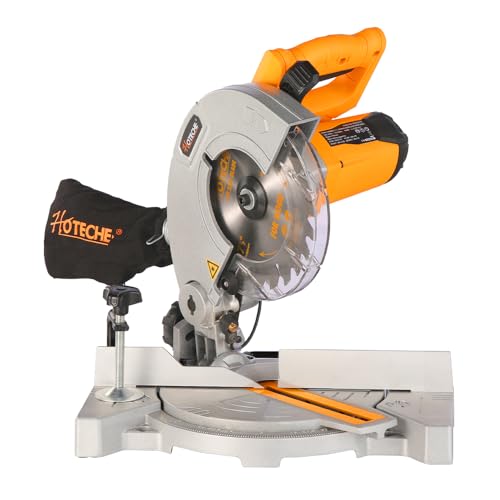
Hoteche 7-1/4-Inch Compound Miter Saw
What We Like
- Built-in laser guide for precise alignment
- Lightweight, compact aluminum base with rubber feet
- Includes extension bars for wider workpieces
- Complete kit with wrenches, dust bag, and brushes
Trade-offs
- Maximum crosscut of 120mm limits stock width for larger frames.
- Single-bevel design restricts complex compound angle cuts.
Its 7-1/4-inch blade and laser guide make this a purpose-built tool for the fine, accurate cuts picture framing demands, especially on delicate moldings. The lightweight, compact design and included extension bars mean you can set up a dedicated cutting station in a small shop or even on a benchtop without it dominating the space. For a hobbyist or a DIYer building a few frames at a time, this saw delivers the essential precision in a manageable package.
Its maximum crosscut capacity of 120mm at 90 degrees means it can handle standard 2×4 lumber but is limited for wider boards. This makes the saw suitable for baseboards, trim, and smaller frames, while larger projects would require a tool with a greater crosscut width. The 7-1/4-inch blade size is a common factor in this capacity limitation.
Product photos
Genesis GMSDR1015LC Sliding Miter Saw

What We Like
- Integrated laser guide for cut alignment
- Electric brake stops blade quickly
- Includes extension wings for workpiece support
- Sliding rails enable wide crosscuts
Trade-offs
- Bevel cuts only to the left, not dual-bevel
Its 12-inch crosscut capacity allows you to slice through wide boards like picture frame stock in one motion, which is crucial for handling larger trim pieces. An integrated laser guide provides a visible line to follow, aiding alignment for the precise miter cuts needed in clean frame joints. The Genesis GMSDR1015LC is designed for the home woodworker making standard moldings. It includes sliding compound functionality for basic angled projects.
The trade-off is in the bevel range. With bevel cuts limited to the left side only, creating complex compound cuts for certain molding profiles becomes a more manual, flip-the-workpiece process. Compared to a dual-bevel model like the Bosch CM10GD, this adds a step. For straightforward picture framing, however, where most cuts are simple miters, the Genesis provides the essential sliding capacity and laser guidance at a notably accessible point.
Product photos
How We Evaluated Mitre Saws For Picture Framing
Our evaluation compared specifications like blade size, miter and bevel ranges, and cutting capacities. We prioritized manufacturer data on fence design and slide mechanisms, as these directly impact cut accuracy for moldings. We also analyzed professional round-ups and owner feedback patterns regarding precision, dust collection, and long-term reliability in a framing context.
The most critical criteria were cut capacity for wide crown molding, the saw’s footprint in a workshop, and the precision aids like lasers or tall fences. For framing, a saw must handle stock vertically and crosscut wide boards cleanly. We also considered portability for mobile framers and the value of cordless operation versus plug-in power.
An evaluation based on product research and user reports focuses on key performance aspects such as blade deflection, detent accuracy, and dust management. The aim is to highlight models that are frequently noted for delivering the clean, repeatable cuts necessary for detailed work like picture frames.
What To Look For In Mitre Saws For Picture Framing
Choosing a miter saw for framing means matching its physical limits and precision features to your most common moldings and workspace. The ideal saw disappears into the process, letting you focus on the cut.
Look for a tall, sliding fence to support deep moldings, a compact footprint for small shops, and precision aids like lasers or shadow lines. Capacity and stability matter more than raw power for framing work.
Cutting Capacity & Fence Design
The vertical cut capacity determines the tallest molding you can lay flat against the fence, which is crucial for ornate frames. A tall, sliding fence provides crucial support and prevents the workpiece from tipping during a cut. For crosscutting wide boards used in larger frames, a saw with sliding rails is essential; a basic compound miter saw may require multiple passes. Many workshops rely on specialized saws for miter joints to achieve perfect corners consistently.
Workspace Footprint & Portability
Framing shops are often space-constrained. A saw’s footprint, especially its depth from the wall, dictates workshop layout. Rail-forward designs or axial glide systems can save precious inches behind the saw. Weight is a key factor for mobile framers or those who need to store the tool between projects. While a full-size 12-inch sliding saw offers maximum capacity, many framers find a compact miter saw perfectly meets their needs without dominating the bench.
Precision Features & Stability
Precise angle detents, especially at 45 degrees, are non-negotiable for repeatable frame cuts. A solid locking mechanism and a rigid slide or glide system minimize blade wobble and deflection, which can ruin a miter. Integrated cutline guides, whether laser or shadow, help align the blade with your mark, reducing guesswork. For the cleanest finish on fine moldings, pairing your saw with the right blade for cutting molding is as important as the tool itself. Learning to calibrate a miter saw ensures these features deliver accuracy over time.
- Check the saw’s detent override for fine-tuning angles beyond the common stops.
- Ensure the base and fence are machined flat to provide a reliable reference surface.
- Consider a saw with a soft-start motor to reduce jerking at the beginning of a cut.
The most important rule: stability and accurate angle settings will save more molding and yield better frames than a saw with higher horsepower alone.
Mitre Saws For Picture Framing Compared
The table below compares key specifications across all nine saws to help you see the differences in capacity, power, and design at a glance.
| Product | Motor | Bevel Range | Crosscut Capacity (90°) |
|---|---|---|---|
| Festool KAPEX KSC 60 Cordless Sliding Miter Saw | Dual 18V, 8.0Ah included | Up to 47° | N/A |
| Bosch CM10GD Dual-Bevel Glide Miter Saw | 15 Amp, 4,800 RPM | 47° left/right | 12 In. |
| Makita LS1019L Dual-Bevel Sliding Miter Saw | N/A | Dual-Bevel | N/A |
| Makita LS0816F Slide Compound Miter Saw | 10.5 AMP, 5000 RPM | 0°- 47° (left) and 0°- 2° (right) | 12 inches |
| DEWALT DWS779 Sliding Compound Miter Saw | 15 Amp, 3800 rpm | 49° right and left | 2 x 14 dimensional lumber |
| WEN MM1510 Dual-Bevel Sliding Miter Saw | 15-amp | 45 degrees either direction | 12.2 inches wide |
| KSEIBI 10-Inch Sliding Compound Miter Saw | 15-amp 120V corded | Single, 45 degrees | N/A |
| Hoteche 7-1/4-Inch Compound Miter Saw | 7.5A, 5000 RPM | N/A | 120mm x 45mm |
| Genesis GMSDR1015LC Sliding Miter Saw | 15-amp, 4800 RPM | 45° left only | 12 inches at 90° |
Frequently Asked Questions
What is the best mitre saw for picture framing?
For most professional framers needing cordless freedom and top-tier precision, the Festool KAPEX KSC 60 is the best overall. Its twin-column guide system provides exceptional stability for wobble-free cuts on delicate moldings.
What is the best saw to use for making picture frames?
A dual-bevel sliding miter saw is ideal, as it allows you to cut both left and right miters without flipping the workpiece. The Makita LS1019L is an excellent choice for its compact sliding design that saves space while still offering the crosscut capacity needed for wider frame boards.
What is the best way to cut miters in a picture frame?
Use a miter saw with a sharp, fine-tooth blade designed for finish work. Secure the molding firmly against a tall fence, and make sure the saw’s 45-degree detent is properly calibrated. Always practice safe cutting techniques on short pieces of stock.
What brand makes the best mitre saw?
Several brands excel in different areas. Festool leads in precision engineering, Bosch is renowned for innovative space-saving designs like its axial glide system, and Makita offers outstanding portability and reliability, especially in their compact models.
Do I need a sliding miter saw for picture frames?
Not always, but it is highly recommended. A sliding saw can crosscut much wider boards in a single pass, which is necessary for cutting the long sides of larger frames. For standard small to medium frames, a high-quality compound miter saw may suffice.
The Bottom Line
The Festool KAPEX KSC 60 is our best overall miter saw for picture framing, combining cordless convenience with the rock-solid stability professionals need for flawless joints. Its premium design and efficient brushless motor make it a long-term investment for a busy shop.
If your budget is tighter, the WEN MM1510 offers excellent dual-bevel capability and a helpful LED guide. For framers wrestling with limited workshop space, the Makita LS1019L delivers full sliding capacity in a remarkably compact footprint.
Ultimately, the single most important factor is the saw’s ability to make repeatable, perfectly square 45-degree cuts. A precise saw with a solid fence will yield cleaner frames and save you far more material than any minor price difference.
