
10 Best Right Angle Drills in 2026
This post contains affiliate links. As an Amazon Associate, we earn from qualifying purchases.
The Makita XAD05Z LXT Brushless Right Angle Drill is our best overall for its powerful brushless motor and slim barrel that reduces fatigue. For maximum maneuverability in finished spaces, the DeWalt DCD740B is our best compact professional, while the Milwaukee M12 offers a top lightweight option.
These tools are essential for working where a standard drill simply can’t fit. If you’re tired of struggling in tight corners, a right-angle drill provides the access you need. We built this guide by researching specifications and evaluating expert and owner feedback on key performance criteria for confined-space work.
You’ll find a detailed breakdown of what to look for and a comparison of ten top-rated models.
Top 10 Right Angle Drills in the Market
Certain content that appears on this site comes from Amazon. This content is provided "as is" and is subject to change or removal at any time.
The Best Right Angle Drills, Reviewed
Makita XAD05Z LXT Brushless Right Angle Drill

What We Like
- Slim barrel design for reduced operator fatigue
- Brushless motor for maximum efficiency
- Built-in LED light with pre and afterglow
- Drills up to 200 holes per battery charge
Trade-offs
- Tool only: requires separate Makita LXT battery and charger
- At 7.6 lbs, it's substantial for prolonged overhead work
- 16.5-inch width demands clearance in very tight cavities
A 1/2-inch chuck paired with a brushless motor that drills 5-inch holes with a saw means you can tackle serious framing and plumbing jobs without hunting for a cord. The slim barrel and 7.6-pound weight balance power and maneuverability. This makes it a logical choice for contractors and advanced DIYers who need one tool for both heavy drilling and fitting into joist bays or between studs. Owner feedback highlights its durability and the practical advantage of the two-speed selector for everything from slow, high-torque auger bits to faster spade bits.
The tool’s size may be less suited for confined cabinet or electrical box work in finished spaces. For lighter-duty tasks in tighter areas, a more compact model like the Milwaukee M12 could be considered. However, for projects requiring boring through thick lumber or using large-diameter hole saws, the Makita’s capacity and its LXT battery platform provide a dedicated solution.
DeWalt DCD740B 20V MAX Right Angle Drill

What We Like
- Extremely compact 4-inch front-to-back profile
- Dual-speed ranges for application flexibility
- Multi-grip trigger for access in tight spaces
- Deep hex pocket for 2-inch bit insertion
Trade-offs
- Tool only: battery and charger sold separately
- 3/8" chuck limits bit shank size versus 1/2" models
A front-to-back length of just four inches is the defining feature here, letting this drill slip into joist bays, between studs, and other cramped spots where a standard drill simply won’t fit. That compactness, combined with the multi-grip trigger, makes it the right choice for electricians, plumbers, or any pro who regularly works in finished cavities. The dual-speed ranges and deep bit pocket add genuine utility for driving fasteners or drilling pilot holes in those confined areas.
The trade-off for that slim profile is raw power; this isn’t the tool for boring large-diameter holes through dense lumber. That job belongs to a brute like the Milwaukee M18 FUEL Hole Hawg. The DCD740B excels at precision work in tight quarters, not demolition. Remember, it’s a bare tool, so you’ll need a DeWalt 20V battery on hand to get it running.
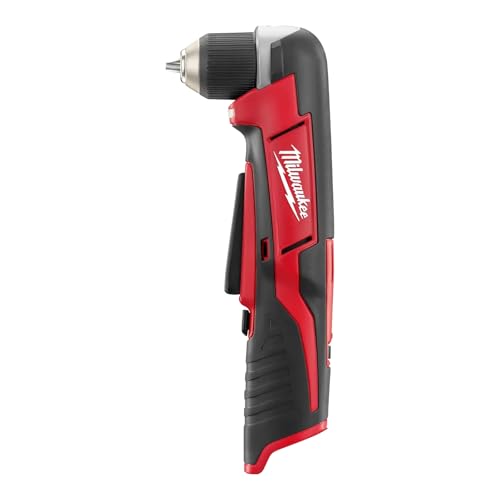
Milwaukee M12 Cordless Right Angle Drill
What We Like
- Compact 2.2-pound weight for tight spaces
- Extended paddle switch for multiple grip positions
- Electronic clutch provides precise fastener control
- On-board fuel gauge shows battery run-time
Trade-offs
- Tool only: requires separate purchase of M12 battery and charger
- 3/8-inch chuck limits accessory size versus 1/2-inch models
Weighing 2.2 pounds, this drill fits into tight spaces where larger tools cannot. Research categorizes it as a best light-duty right-angle drill. Its extended paddle switch allows for controlled use in multiple positions, while an electronic clutch with 11 settings plus drill mode offers precision for various materials.
Operating on the 12-volt M12 platform, it is less powerful than larger cordless systems. Compared to the 18-volt Milwaukee M18 FUEL Hole Hawg, it is not designed for high-torque applications like heavy framing. The tool is sold without a battery or charger, which must be purchased separately for operation.
Milwaukee M18 FUEL Hole Hawg Right Angle Drill

What We Like
- 1/2-inch chuck handles large-diameter bits.
- M18 FUEL brushless motor provides high power.
- Built for heavy-duty drilling tasks.
- Cordless design offers full jobsite mobility.
Trade-offs
- 7.7-pound weight demands significant user strength.
- 15.6-inch length limits use in very tight spaces.
- Battery and charger are a separate purchase.
The Milwaukee M18 FUEL Hole Hawg is a cordless right-angle drill with a 1/2-inch chuck, a size that accommodates large-diameter bits common in heavy framing and plumbing. Its brushless motor is part of the M18 FUEL line, designed for demanding applications. Operating without a cord allows it to be used anywhere on a job site.
The tool-only drill weighs 7.7 pounds and measures 15.6 inches in length, giving it substantial physical presence during use. For general-purpose right-angle tasks, a more compact model like the DeWalt DCD740B would be easier to manage.
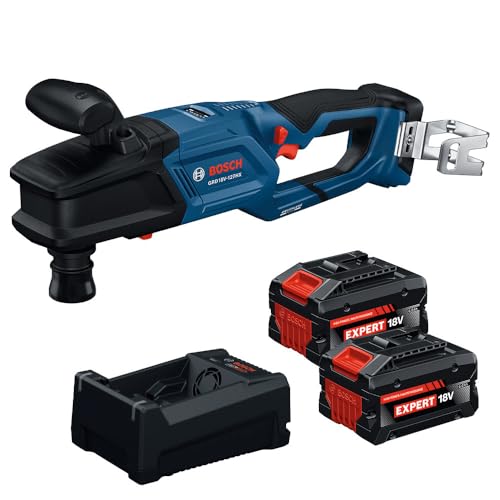
Bosch EXPERT GRD18V High Torque Right Angle Drill Kit
What We Like
- Dual KickBack Control for enhanced user safety.
- Compact, ergonomic design for tight space access.
- Integrated LED work light for dimly lit areas.
- High-torque brushless motor with two-speed transmission.
Trade-offs
- 16.6-inch length limits access in extreme crevices
- Kit configuration requires AMPShare-compatible battery purchase
The Dual KickBack Control is the standout feature here, actively reducing the risk of injury from sudden torque reaction during bind-up. That makes this Bosch a top-tier choice for professionals like electricians and plumbers who regularly drive large holes in dense material, where safety is non-negotiable. Its brushless motor and two-speed gearing deliver the power needed for 5-inch hole saws and 2-9/16-inch self-feed bits, while the in-line design provides better leverage and control in confined spaces than a bulky pistol-grip tool.
This power and safety come from a tool that isn’t the most compact on the market. For the heaviest-duty stud and joist drilling where raw power is the only priority, the dedicated DeWalt 60V MAX model is a more specialized beast. But for a balanced tool that brings serious muscle and crucial protection to demanding remodeling and trade work, the Bosch GRD18V hits a very practical sweet spot.
DeWalt 60V MAX Stud and Joist Right Angle Drill

What We Like
- Powerful 60V brushless motor for demanding tasks
- Two-speed gearbox shifts without feathering the trigger
- Anti-rotation E-Clutch System enhances safety
- Tool Connect Tag ready for tracking via app
Trade-offs
- Tool-only listing: requires separate battery and charger purchase
- At 17.6 pounds, it's heavy for overhead or prolonged use
- Large 23.8-inch length limits maneuverability in tight spaces
The DeWalt DCD470B is built around a 60V MAX brushless motor, which provides the cordless power and runtime needed for demanding tasks like drilling through studs and joists. Its magnesium gear case reduces weight while maintaining durability for jobsite use. For safety, the E-Clutch System detects drill motion and shuts it down if necessary, with a red LED indicating when it’s engaged.
That raw power comes with real heft. At nearly 18 pounds, it’s a workout for any task above your shoulders. Its substantial size also means it won’t fit where a compact right-angle drill, like the Milwaukee M12, will. This is a primary tool for major structural work, not a detail driver for finish carpentry. You buy it for its muscle, accepting the trade-off in weight and bulk for jobs where nothing else will do.
Product photos
Ryobi ONE+ HP Brushless Compact Right Angle Drill

What We Like
- Brushless motor for longer runtime and motor life
- Delivers twice the torque of the previous model
Trade-offs
- Tool only: requires separate purchase of battery and charger
Ryobi’s compact right-angle drill delivers up to 350 in./lbs. of torque from a brushless motor, a combination that provides extended runtime and power for tasks in tight spaces. At 11.5 inches long and 2.8 pounds, its profile allows it to fit into cabinets or between obstructions where a standard drill driver cannot reach. This tool-only model is part of the ONE+ HP line, requiring separate purchase of a compatible battery and charger.
This compact, budget-friendly design does mean you give up some raw power. For framing or running large-diameter auger bits all day, you’d need a dedicated high-torque tool such as the Milwaukee M18 FUEL Hole Hawg. But for the vast majority of weekend tasks, the Ryobi provides capable performance without the bulk or expense of a pro-grade tool, assuming you’re already invested in the ONE+ ecosystem.
Product photos
Makita DA3010F Right Angle Drill

What We Like
- Powerful 4.0 AMP motor for demanding tasks
- Compact head fits between studs and in tight spaces
- Built-in clutch prevents gear damage from binding
- Variable speed with limiting dial for fastener control
Trade-offs
- Corded design limits mobility compared to battery models
- Weighs 4.2 lb, heavier than some compact cordless options
- Tool only, requires a separate corded power source
A 4.0 AMP motor delivers the consistent grunt you need for boring through dense lumber or driving large lag bolts, without the runtime anxiety of a battery. That reliable corded power, combined with a head just over two and a half inches wide, makes the DA3010F a workhorse for the electrician or carpenter running conduit or plumbing in finished walls. It’s the straightforward, no-frills tool you grab when the job calls for sustained power in confined spaces, not a quick battery swap.
Its 4.0 AMP motor delivers power for drilling in a variety of materials, but it requires a corded power source. This cord can limit mobility in open spaces or on roofs, making the tool best suited for work near an outlet or on a stationary bench. For cordless operation, other models like the Makita XAD05Z are available.
Product photos
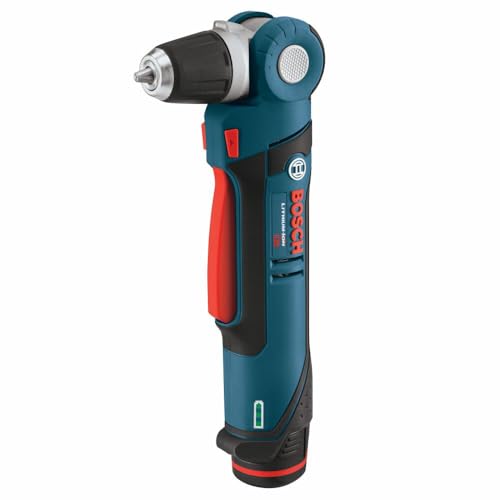
Bosch PS11-102 12V Right Angle Drill/Driver Kit
What We Like
- Pivoting head articulates 90 to 180 degrees
- Lightweight at just 2.75 pounds
- Variable-speed trigger for precise control
- Motor brake for exact screw driving
Trade-offs
- 12V system offers less torque than 18V/20V models
- 3/8-inch chuck limits maximum bit shank size
A 5-position pivoting head that swings from a standard right angle to fully inline defines this tool’s purpose. That range of motion allows access into cabinet corners, between studs, or under a sink where a standard drill won’t fit. Weighing 2.75 pounds, it is easy to hold in awkward positions, and its 115 in-lbs of torque is specified for tasks like driving three-inch screws or using a spade bit.
Its compact versatility does come at the expense of raw power. Compared to a dedicated high-torque drill, the Bosch’s 12V motor isn’t built for continuous heavy-duty hole saw work in dense lumber. It’s a precision driver and hole-maker for confined areas, not a production framer. For pros or serious DIYers tackling a mix of finish work and light rough-in, this tool excels as a specialized problem-solver that complements a larger primary drill.
Product photos
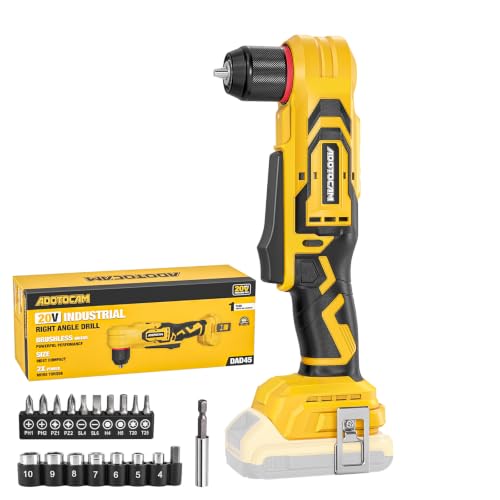
ADOTOCAM Brushless Right Angle Drill
What We Like
- Compact 3.8-inch length for tight spaces
- Brushless motor for efficiency and longevity
- High 400 in-lb torque for demanding tasks
- Dual-speed control for fine and fast work
Trade-offs
- 3/8" chuck limits bit shank size versus 1/2" models
- Torque is lower than dedicated high-torque models
Compatibility with DeWalt 20V MAX batteries is the core proposition here. It delivers a capable, compact right-angle drill that slots directly into an existing DeWalt ecosystem without buying into a new battery platform. The brushless motor and up to 400 in-lb of torque mean it can handle serious drilling and fastening in joist bays or between studs. Its dual-speed range and LED light also make it practical for detailed work in dim corners.
The focus here is on accessibility, not maximum power. Its 3/8″ chuck and torque output put it solidly in the compact class, well below dedicated high-torque drills for boring large holes through dense lumber. The front-to-back length of 3.8 inches and a multi-grip trigger are designed for control in confined spaces.
Product photos
How We Evaluated Right Angle Drills
This guide is based on a review of manufacturer specifications, technical documents, and patterns from professional reviews and user reports. It focuses on the key criteria for working in confined spaces. These are the tool’s size and weight for maneuverability, its motor power and chuck size for task suitability, and the grip and trigger design for control in tight positions.
This research-led approach allows us to compare features and reported performance consistently. However, it cannot replicate the subjective feel of a tool in your hand or predict its long-term durability, which depends heavily on individual use and maintenance.
What To Look For In Right Angle Drills
A right-angle drill is a specialized tool for a specific problem: lack of access. The right choice balances power with the ability to fit into your workspace.
Prioritize chuck size for hole diameter, overall length for clearance, and motor voltage or amperage for power. Cordless models offer mobility, while corded ones provide consistent, budget-friendly torque.
Size, Weight, and Maneuverability
The primary reason to buy a right-angle drill is to reach confined areas. Pay close attention to the tool’s front-to-back length or width, as this determines the minimum clearance needed to operate it. Models like our best compact professional pick measure as little as 4 inches. Weight is equally important for overhead work or prolonged use in tight quarters; our lightweight pick is only 2.2 pounds, while heavy-duty models can approach 8 pounds or more.
Power and Chuck Capacity
Your projects dictate the needed power. For driving screws or drilling pilot holes in finish work, a compact 12V system may suffice. For boring large holes through studs for plumbing or electrical lines, you’ll need an 18V/20V brushless motor or a dedicated high-torque corded model. The chuck size dictates the maximum bit shank you can use. A 3/8-inch chuck is common for compact models, but a 1/2-inch chuck is necessary for large-diameter spade bits and hole saws.
Grip, Trigger, and Control Features
Since you’re often working blind or at odd angles, control is paramount. Look for features that aid precision and reduce fatigue. A multi-position paddle switch or extended trigger offers more grip options. A variable-speed trigger allows gentle starting. Some models include an electronic clutch for precise fastener driving or advanced safety systems like kickback control, which can be vital when a bit binds in dense material.
- Check the grip design and presence of a secondary handle for high-torque models.
- Ensure the LED work light, if included, adequately illuminates the work surface.
- Verify if the tool is sold as a bare tool (requiring a separate battery and charger purchase) or as a kit.
The right tool minimizes frustration by fitting your space and having enough power for your most common tasks without being overly cumbersome.
Right Angle Drills Compared
The following table summarizes the key specifications of our top picks to help you compare them at a glance.
| Product | Chuck Size | Weight | Speed Ranges |
|---|---|---|---|
| Makita XAD05Z LXT Brushless Right Angle Drill | 1/2 inch | 7.6 pounds | 0-450 RPM and 0-1,400 RPM |
| DeWalt DCD740B 20V MAX Right Angle Drill | 3/8" ratcheting | 3.2 pounds | 0-650/0-2000 rpm |
| Milwaukee M12 Cordless Right Angle Drill | 3/8-inch ratcheting | 2.2 pounds | N/A |
| Milwaukee M18 FUEL Hole Hawg Right Angle Drill | 1/2 inch | 7.7 pounds | N/A |
| Bosch EXPERT GRD18V High Torque Right Angle Drill | 7/16 inch | N/A | 0-550/0-1,800 RPM |
| DeWalt 60V MAX Stud and Joist Right Angle Drill | N/A | 17.6 pounds | 0-400/ 0-1320 rpm |
| Ryobi ONE+ HP Brushless Compact Right Angle Drill | 3/8 in. | 2.8 Pounds | 0-450 / 0-1,700 RPM |
| Makita DA3010F Right Angle Drill | 3/8 inch | 4.2 Pounds | 0 – 2,400 RPM |
| Bosch PS11-102 12V Right Angle Drill/Driver Kit | 3/8-inch auto lock | 2.4 pounds | N/A |
| ADOTOCAM Brushless Right Angle Drill | 3/8" ratchet | N/A | 0-500 & 0-1900 rpm |
Frequently Asked Questions
What is the best right angle drill?
The best model depends on your specific needs. For a balance of high torque, good hole capacity, and a design that reduces operator fatigue, we selected the Makita XAD05Z LXT Brushless Right Angle Drill as the best overall. It’s built for demanding tasks in structural spaces.
Is a right angle drill worth it?
For professionals or serious DIYers who frequently work in tight spaces, like between studs, inside cabinets, or in ceiling joists, a dedicated right-angle drill is absolutely worth it. It provides significantly better access and control than a standard drill with a right-angle attachment, which can be bulky and reduce torque. For a deeper look at the trade-offs, our article on the pros and cons of these tools can help.
Is there a 90 degree drill?
Yes, a right-angle drill is essentially a 90-degree drill. The terms are used interchangeably to describe drills where the chuck is positioned at a right angle (90 degrees) to the main body of the tool. This design is what allows it to fit into narrow gaps where a standard inline drill would not.
What is the best angle drill tool?
The “best” tool depends on whether you need a dedicated drill or an attachment. For permanent, heavy-duty use, a dedicated right-angle drill like our top picks offers the most power and reliability. For occasional use, a right-angle drill attachment that connects to your existing drill can be a cost-effective solution, though it may sacrifice some torque and clearance.
What should electricians look for in a right-angle drill?
Electricians often need to drill through multiple studs in tight bays to run wiring. They should prioritize a compact length to fit between studs, sufficient torque for the task, and a 1/2-inch chuck capacity if using large-diameter bits. Our guide to drills for electricians explores these specialized needs in more detail.
The Bottom Line
For framers, remodelers, and serious DIYers tackling tough jobs in tight structural spaces, the Makita XAD05Z LXT is the best overall right-angle drill, offering a powerful brushless motor in a slim, fatigue-reducing design. If your budget is tight or your tasks are lighter, consider the Ryobi ONE+ HP for a capable budget DIY option, or the corded Makita DA3010F for excellent corded value.
Ultimately, choosing the right tool comes down to honestly assessing your most common jobs. Consider the tightest spaces you work in and the most demanding material you’ll drill through. Then pick the most compact and powerful drill that meets those needs.
