
10 Best Sanders For Deck Sanding in 2026
This post contains affiliate links. As an Amazon Associate, we earn from qualifying purchases.
For a powerful tool that excels at both aggressive stock removal and fine finishing on a deck, a top choice is the Bosch GET75-6N Electric Orbital Sander. For a multi-mode sander, consider the Festool ROTEX RO 150, while the DEWALT DWE6423 offers great value for corded DIYers.
Deck sanding requires a tool that can strip old finishes from large, flat areas without bogging down or leaving swirl marks. You need power, a pad that covers ground quickly, and a design that manages dust and vibration for longer sessions.
Top 10 Sanders For Deck Sanding in the Market
Certain content that appears on this site comes from Amazon. This content is provided "as is" and is subject to change or removal at any time.
The Best Sanders For Deck Sanding, Reviewed
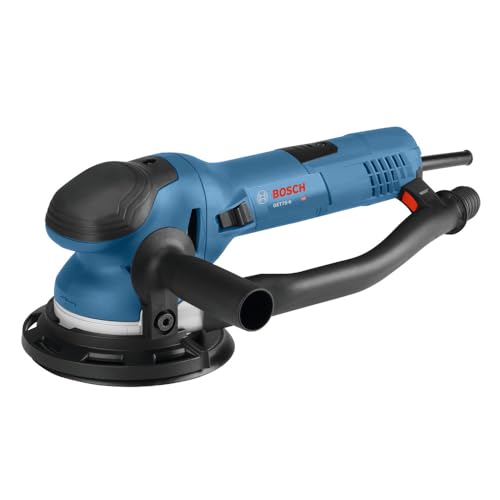
Bosch GET75-6N Electric Orbital Sander
What We Like
- Turbo mode for aggressive stock removal
- Powerful 7.5 amp variable-speed motor
- Multi-hole pad system for disc flexibility
- Includes vacuum hose adapters
Trade-offs
- Weighs 5.7 pounds, heavier than many 5-inch sanders.
- Dust collection requires a separate vacuum purchase.
- Large 15-inch length demands more arm clearance.
A 7.5 amp motor and a dedicated turbo mode give this sander the muscle for aggressive stock removal, with Bosch stating the turbo mode offers an alternative to a belt sander. That dual-mode versatility provides a single-tool solution for tasks requiring both heavy material removal and a fine finish. It suits users who prioritize power and mode flexibility over a lighter tool.
The trade-off for that power is a tool that’s notably heavier and longer than compact palm sanders like the Bosch ROS20VSC, which can fatigue your arm over a large deck surface. Its passive dust collection is also an incomplete solution, mandating a shop vacuum for clean operation. For a dedicated finish sander without the turbo function, the Festool ETS EC150/5 would be a more specialized, albeit premium, choice.
Festool ROTEX RO 150 Multi-Mode Sander

What We Like
- FastFix allows tool-less pad changes.
- Dual-mode design handles aggressive removal and fine finishing.
- Festool Protector enables sanding up to edges.
- Ergonomic grip positions reduce fatigue.
Trade-offs
- At 11.5 lb, it is significantly heavier than palm sanders like the Bosch ROS20VSC.
- Its large 15.6-inch length requires more space to maneuver.
The Festool ROTEX RO 150’s multi-mode design combines a rotary motion for efficient material removal with an eccentric motion for high-quality, scratch-free surfaces. This allows the user to handle different stages of a project, from stripping material to final smoothing, with a single sander.
That capability comes with a physical trade-off. At over eleven pounds, this is a substantial tool to hold overhead on deck railings or for extended periods. For comparison, the DEWALT DWE6423 is less than a third of the weight for basic finish work. Choose the RO 150 when your project demands its raw material removal power and finishing finesse, but be ready for its heft.
DEWALT DWE6423 Random Orbit Sander

What We Like
- Separate counterweight reduces vibration
- Rubber overmold improves grip
- Dust-sealed switch for longer life
- One-handed locking dust bag
Trade-offs
- Corded power limits mobility on large decks
- 3-Amp motor less powerful than 7.5A Bosch
Weighing 3.4 pounds with a shorter height, this sander is easier to maneuver in tight spaces like corners and less taxing to use overhead. Its separate counterweight design reduces vibration, which can help extend comfortable sanding sessions. A dust-sealed switch and rubber overmold on critical areas aim to improve durability and grip during operation.
This sander’s light weight and comfort mean it doesn’t have the raw power of a tool like the Bosch GET75-6N, whose 7.5-amp motor will strip old finish faster on heavily weathered wood. You also need DEWALT’s universal connector if your shop vac isn’t part of their dust collection system. For the cost-conscious deck restorer who wants a reliable, ergonomic corded sander from a trusted brand, the DWE6423 delivers solid performance without the premium price tag of a Festool.
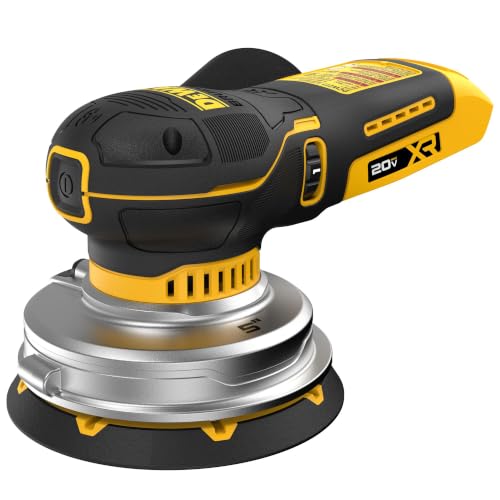
DEWALT DCW211B Cordless Orbital Sander
What We Like
- Up to 50 sq-ft. of sanding per battery charge
- Lowest profile design for tight spaces
- Five variable speed settings for different applications
- Industry-leading material removal rate and control
Trade-offs
- Requires separate purchase of compatible battery and charger
- Integrated vacuum control requires a separate dust extractor
- At 3.8 lb, it's heavier than some corded 5-inch competitors like the Makita BO5041
With a claimed sanding area of up to 50 square feet per charge, the DEWALT DCW211B cordless sander allows for extended work sessions away from an outlet. Its low-profile design is noted for working in tight spaces, while the manufacturer states it has up to 40% less vibration to reduce user fatigue during long tasks.
Choosing this cordless sander means committing to a battery platform. You’ll need to factor in the cost of a battery and charger if you don’t already own DEWALT’s 20V XR tools. In a dedicated workshop where a cord is never an issue, a corded model like the DEWALT DWE6423 offers a direct, unlimited power connection and saves you from managing battery cycles. For anyone who values unplugged maneuverability above all, this sander delivers professional-grade performance without the tether.
Product photos
Makita BO5041 Random Orbit Sander

What We Like
- Variable speed dial for application matching
- Ergonomic rubberized grip for comfort
- Lock-on button for continuous operation
- Lightweight design reduces arm fatigue
Trade-offs
- 5-inch pad is smaller than 6-inch models for large decks
- Corded design requires extension cord and outlet access
At just 3.1 pounds, the Makita BO5041 is a sander you can wield overhead on deck railings all afternoon without your shoulder begging for mercy. That lightweight design, combined with its rubberized palm grip and an adjustable front handle, makes it the clear choice for anyone prioritizing comfort and control during a long, dusty deck refinishing project. The variable speed dial lets you dial down for a final finish pass or crank it up to strip old stain, while the lock-on button saves your finger during large, flat areas.
Its featherlight design makes it comfortable for long sessions, but it uses a 5-inch sanding pad. You’ll cover a deck surface more slowly than with a 6-inch sander like the Bosch GET75-6N. This tool is built for finesse and operator endurance, not raw speed. The smaller pad means more passes on a sprawling deck floor. For detailed work on railings, stairs, and tight corners, however, its compact size and adjustable handle become significant advantages larger models can’t match.
Festool ETS EC150/5 Orbital Sander

What We Like
- Extremely low weight for reduced arm fatigue
- Vibration Control System for smoother operation
- Constant speed under load for consistent results
- Compact design improves handling in tight spaces
Trade-offs
- Requires a 6-inch paper size, less common than 5-inch
Weighing only 2.5 pounds, the Festool ETS EC150/5 is built for comfort over long sessions. Its Vibration Control System is designed for smoother operation to help reduce fatigue, which can be a critical factor for extended sanding work. Stepless speed pre-selection and constant speed even under load ensure consistent results, pass after pass.
The trade-off is in its sanding stroke. The 5 mm orbit is optimized for fine finishing, not for rapidly stripping old stain or leveling cupped boards. For that kind of heavy lifting on a deck, you’d want a more aggressive tool like the Festool ROTEX RO 150 in its gear-driven mode. Think of the ETS EC as the final-finish specialist. It excels at preparing the wood for a flawless coat of sealer after the initial rough work is done, making it a premium choice for detail-oriented refurbishments.
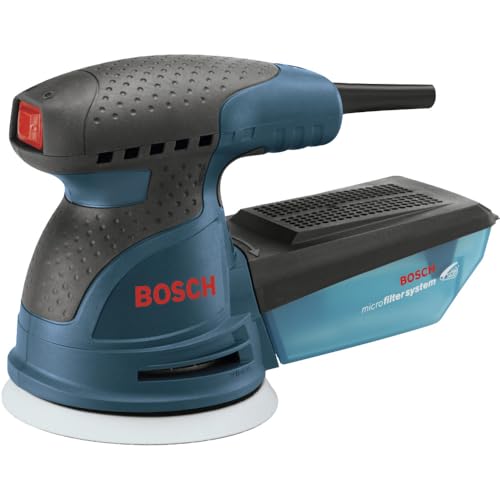
Bosch ROS20VSC Palm Sander
What We Like
- Excellent microfilter system for fine dust.
- Compact and lightweight at 3.5 pounds.
- Twist-off dust canister shows fill level.
- Variable speed control from 7,500-12,000 OPM.
Trade-offs
- 3.5-pound weight for a corded palm sander
- No-load OPM range tops out at 12,000
A microfilter system traps particles as small as half a micron, which helps minimize fine dust during extended sanding sessions. Its 3.5-pound weight and variable speed motor allow for detailed control on contoured surfaces. The dust canister shows the level and detaches easily for mess-free cleanup.
Clean operation comes with a compromise: the sanding pad is smaller. Reviewers report it covers less area per pass than a 6-inch model, which can slow progress on large, flat surfaces. For bulk work, pairing it with a larger sander like the Bosch GET75-6N is common. You would then use this palm sander for corners and final smoothing, where its dust control and maneuverability shine.
Product photos
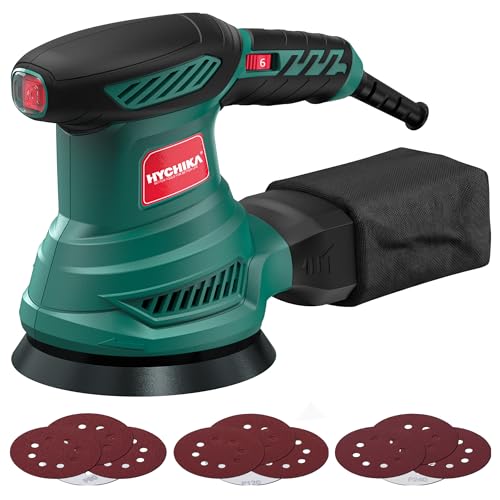
HYCHIKA BETTER TOOLS FOR BETTER LIFE FL117 Sander
What We Like
- Ergonomic rubber grip reduces hand fatigue.
- Quick-change hook and loop sandpaper system.
- Large dust bag collects about 90% of debris.
- Complete kit with multiple sanding grits included.
Trade-offs
- At 5.2 inches tall, it has a bulkier profile than some palm sanders.
- Dust bag requires manual emptying, lacks direct vacuum port.
A 300W motor paired with a 13,000 RPM top speed delivers enough oomph for refinishing deck boards without intimidating a first-timer. The six speed settings let you dial in the aggression, and the included sandpaper assortment covers everything from stripping old finish to final smoothing. This package is a solid fit for the DIYer tackling a single deck or a homeowner who needs a capable sander for occasional projects without a hefty investment. It gets the fundamentals right.
Its 9.2-inch length and 6.6-inch width give it a larger footprint than some compact palm sanders like the Bosch ROS20VSC, which may affect access in very tight spaces. The ergonomic, textured rubber grip is designed to enhance hand grip and reduce fatigue during use, aiding in precise one-handed control. An upgraded dust bag is claimed to collect about 90% of debris and needs emptying only after hours of continuous work.
Product photos
VEVOR 5 & 6-Inch Brushless Orbital Sander

What We Like
- Includes two interchangeable sanding pad sizes
- Brushless motor for longevity and low noise
- Six-speed control from 4,000 to 10,000 RPM
- Instant-stop safety function and dust connector
Trade-offs
- At 4.4 lb, it's heavier than most 5-inch palm sanders
- 350W motor is less powerful than some dedicated 6-inch models
- 10-inch length requires more clearance than compact palm sanders
The ability to switch between a 5-inch and a 6-inch sanding pad is this tool’s defining feature, letting you tackle detailed edges with the smaller pad before moving to the larger one for deck boards. It’s a smart fit for the DIYer who wants a single sander to handle multiple stages of a deck refinishing project. The brushless motor should hold up over time, and having six speed settings gives you the control to adjust for different woods or finishes without swapping tools.
You do trade some heft and bulk for that versatility. At 4.4 pounds, it’s noticeably heavier than a dedicated 5-inch sander like the DEWALT DWE6423, which can lead to fatigue on big, overhead jobs. The 350-watt motor is competent, but it won’t remove material as aggressively as a heavier-duty 6-inch tool. For a large, flat deck where speed is the priority, a more powerful single-pad sander might be a better match.
Product photos
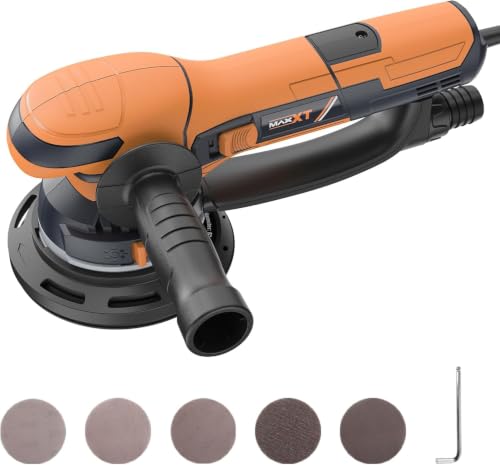
MAXXT 800W 6-Inch Random Orbital Sander
What We Like
- High-power 800W motor for aggressive stock removal
- Dual-mode operation handles rough sanding to fine finishing
- Efficient 27mm dust port for cleaner workspaces
- Includes five sanding discs from P120 to P400
Trade-offs
- At 6.1 lb, it's heavier than many 5-inch palm sanders
- Weighs 6.1 pounds, more than some 5-inch sanders.
An 800-watt motor paired with a forced-rotation mode makes this sander a beast for tearing through old deck finishes and leveling uneven boards. The dual-mode design means you can strip paint aggressively, then switch to a random orbit for a swirl-free final pass without changing tools. It’s built for the demanding, large-scale work of deck restoration where speed and power trump a lightweight design. The 5mm orbit and six speed settings give you the control to match the grit to the task, from coarse removal to fine smoothing.
That power comes at the cost of a tool that’s noticeably heavier and larger than a standard orbital sander. This can lead to fatigue on overhead surfaces or detailed railings. Compared to a compact model like the DEWALT DWE6423, it demands more arm strength over a full day’s work. However, if your deck is a major refinishing project with heavy material removal, this sander’s brute force and dual functionality justify its heft by saving you significant time and effort.
Product photos
How We Evaluated Sanders For Deck Sanding
Our evaluation began with manufacturer specifications for motor power, pad size, weight, and dust collection systems. We then analyzed expert round-ups and patterns in owner feedback to understand real-world performance for tasks like stripping old stain and smoothing rough deck boards. Key criteria were power and material removal rate for efficiency, pad size and tool ergonomics for handling large surfaces, and dust management for a cleaner workspace.
This evaluation is based on product specifications and cannot account for the subjective feel of a tool’s balance during extended use.
What To Look For In Sanders For Deck Sanding
Selecting the right sander turns a laborious chore into a manageable project. You need a tool matched to the scale of your deck and the condition of the wood.
Prioritize a powerful motor and a large sanding pad (5-inch minimum, 6-inch ideal) for covering area quickly. Variable speed control helps adapt from rough stripping to fine finishing. Effective dust collection is crucial for visibility and cleanup.
Power And Pad Size
A deck’s large surface area demands a sander that can work quickly. Motor power, measured in amps for corded tools, directly impacts how aggressively the tool can remove old finish or level uneven boards. The sanding pad size determines how much surface area contacts the wood per pass. A 6-inch pad covers more area than a standard 5-inch pad, which can speed up the job on flat deck boards.
Ergonomics And Control
You’ll be guiding this tool across every square foot of your deck, so comfort is paramount. Weight is a primary factor; while a heavier tool like a 6-inch sander offers more power, a lighter 5-inch model reduces arm fatigue over long sessions. Features like a variable speed dial, a soft-grip handle, and a low-vibration design improve control and make extended use more comfortable, which is essential when following a deck sanding guide.
Dust Management And Versatility
Sanding a deck creates a tremendous amount of fine dust. A sander with a dust collection port that connects to a shop vacuum or a large, integrated bag keeps your workspace cleaner and improves visibility for a more even finish. Some models offer a multi-hole pad system or dual-mode operation, providing the flexibility to switch from a fast, aggressive orbit for stripping to a fine, swirl-free orbit for final smoothing, making them versatile for deck sanding.
- Check that the dust port matches your shop vacuum hose diameter or that the included bag is sizable.
- Consider if the tool offers a “turbo” or aggressive mode for initial deck prep.
- Look for a tool with a lock-on button for continuous operation during large, flat areas.
- Ensure the sander’s power source (corded or cordless battery) suits your deck’s location and size.
- Verify the available sandpaper grits and disc types (hook-and-loop or adhesive) for the model.
For most deck projects, a 6-inch random orbital sander with variable speed offers the best balance of speed, finish quality, and control.
Sanders For Deck Sanding Compared
To see how these top picks stack up on key specifications, the comparison table below details motor power, pad size, weight, and special features.
| Product | Motor Power / Amp | Orbit Speed / RPM | Pad Size | Weight |
|---|---|---|---|---|
| Bosch GET75-6N Electric Orbital Sander | 7.5 amp | 3300 to 7300 OPM | 6-inch disc | 5.7 Pounds |
| Festool ROTEX RO 150 Multi-Mode Sander | N/A | N/A | 6-Inch | 11.5 pounds |
| DEWALT DWE6423 Random Orbit Sander | 3-Amp | 8,000 – 12,000 OPM | 5-Inch | 3.4 pounds |
| DEWALT DCW211B Cordless Orbital Sander | 20V MAX XR | 8,000 – 12,000 OPM | 5 inches | 3.8 pounds |
| Makita BO5041 Random Orbit Sander | 3.0 AMP | 4,000-12,000 OPM | 5" | 3.1 Pounds |
| Festool ETS EC150/5 Orbital Sander | N/A | N/A | 6 inches | 2.5 lbs |
| Bosch ROS20VSC Palm Sander | 2.5 Amp | 7,500-12,000 OPM | 5 inches | 3.5 Pounds |
| HYCHIKA BETTER TOOLS FOR BETTER LIFE FL117 Sander | 300W | 13000 RPM | 5-Inch | N/A |
| VEVOR 5 & 6-Inch Brushless Orbital Sander | 350W brushless | 10,000 RPM | 5-inch & 6-inch | 4.4 pounds |
| MAXXT 800W 6-Inch Random Orbital Sander | 800W pure copper | 3300-7400 RPM | 6-Inch | 6.1 pounds |
Frequently Asked Questions
What is the best sander for sanding a deck?
For most deck refinishing projects, a 6-inch random orbital sander is the best choice. It provides an optimal balance of a large sanding area for speed and a random orbit pattern that prevents swirl marks. Our top pick, the Bosch GET75-6N, exemplifies this with its powerful 7.5-amp motor and multi-hole pad system for effective stock removal and fine finishing.
What sander do you use for decking?
Professionals often use powerful, large-pad orbital sanders or dedicated belt sanders for maximum speed on big deck jobs. For DIYers, a variable-speed random orbital sander is the most practical and forgiving tool. It efficiently handles both stripping old finishes and preparing the wood for a new coat of stain or sealant on deck boards.
What is the best way to sand an exterior deck?
The best method is to work systematically in sections, starting with a coarse grit to remove old finish and level the wood, then progressing through medium and fine grits. Always sand with the grain of the wood where possible, use a consistent, overlapping motion, and connect your sander to a vacuum for dust control to ensure a clean, smooth surface for finishing.
What grit is best for sanding a deck?
Begin with a coarse grit to aggressively strip old stain and smooth out splinters or rough spots. Move to a medium grit to remove scratches from the coarse paper, and finish with a fine grit to create a smooth surface ready for stain or sealant. Understanding the sandpaper grit for wood sequence is key to a professional result.
Is a belt sander or orbital sander better for a deck?
A belt sander removes material faster but requires more skill to avoid gouging the wood and is less ideal for final finishing. An orbital sander is generally the best tool for most deck work. Its random orbit action is easier to control, won’t leave linear scratches, and can handle everything from rough stripping to fine sanding, making it a more versatile and safer choice for the average project.
The Bottom Line
The Bosch GET75-6N Electric Orbital Sander is our best overall choice for deck sanding, offering professional-grade power and versatility for the serious DIYer or pro tackling a full refinishing job. If your priority is budget-friendly performance, the DEWALT DWE6423 is an excellent corded value, while the DEWALT DCW211B provides unmatched cordless freedom for decks far from an outlet.
Ultimately, matching the sander’s power and pad size to the scale of your deck is the most important decision. A tool that feels like a compromise during research will become a burden during the project, so choose one built for the job.
